

B.Sc Nursing at Haridwar University: 4-Year Programme, Career Paths & Salary Guide (2026)
Jiya Sajeev
HOD, Nursing Department, Haridwar University
Talk to any hospital administrator in India today, and staffing shortages come up almost immediately. Nurses, specifically. And it isn't a temporary blip — the Gulf and parts of Europe keep pulling qualified Indian nurses out of the domestic workforce faster than colleges can train replacements. For a science student weighing options after Class 12, that shortage works in your favour. It means picking a degree where the demand isn't hypothetical.
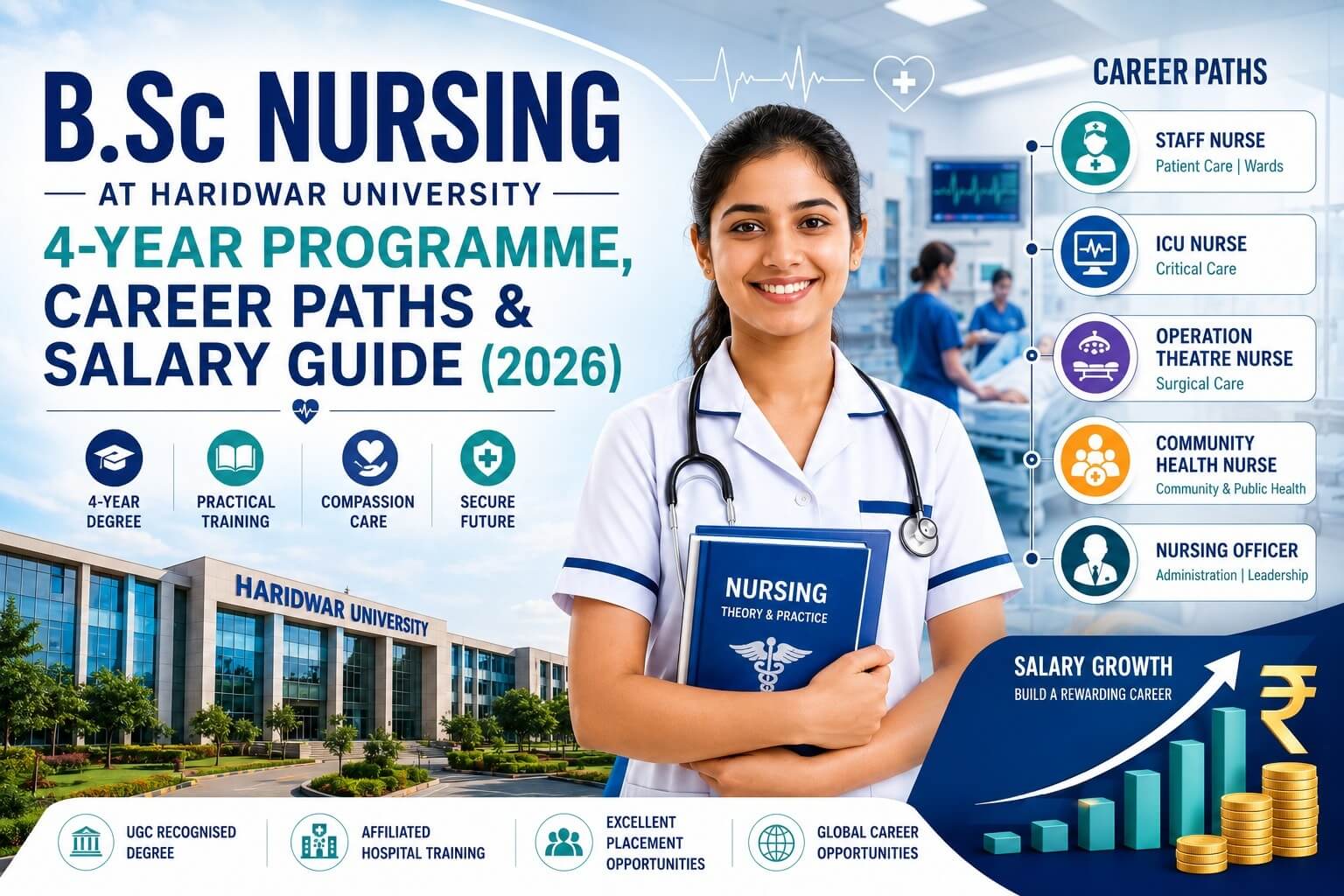
If you're researching B.Sc Nursing at Haridwar University specifically, here's the real detail: how the four years break down, what clinical training actually looks like on a ward, who accredits the degree, who's eligible, realistic salary numbers for 2026, and whether HU's Roorkee College of Allied Health Sciences is worth your time.
Table of Contents
- What Exactly Is B.Sc Nursing?
- How the Curriculum Plays Out, Year by Year
- Clinical Training and Hospital Tie-Ups
- Accreditation: INC and the State Nursing Council
- Eligibility: Who Can Actually Apply
- Where the Degree Actually Takes You
- Salary Ranges to Expect in 2026
- Why Consider HU for Nursing
- Fees for 2026–27
- Frequently Asked Questions
What Exactly Is B.Sc Nursing?
Set aside the brochure language for a second. B.Sc Nursing is a four-year degree that turns a Class 12 science student into a professionally registered nurse — someone who can handle an ICU shift, a delivery ward, or community health outreach without needing someone standing over their shoulder. It sits above the three-year GNM diploma in nearly every practical sense: a full bachelor's degree, eight semesters, clinical hospital exposure built in from fairly early rather than tacked on at the end.
Because it's a degree rather than a diploma, more doors stay open later — M.Sc Nursing, most government recruitment exams, and nearly every serious international licensing route either prefers or outright requires a B.Sc.
How the Curriculum Plays Out, Year by Year
HU runs theory and clinical practice together from close to day one rather than sequencing them.
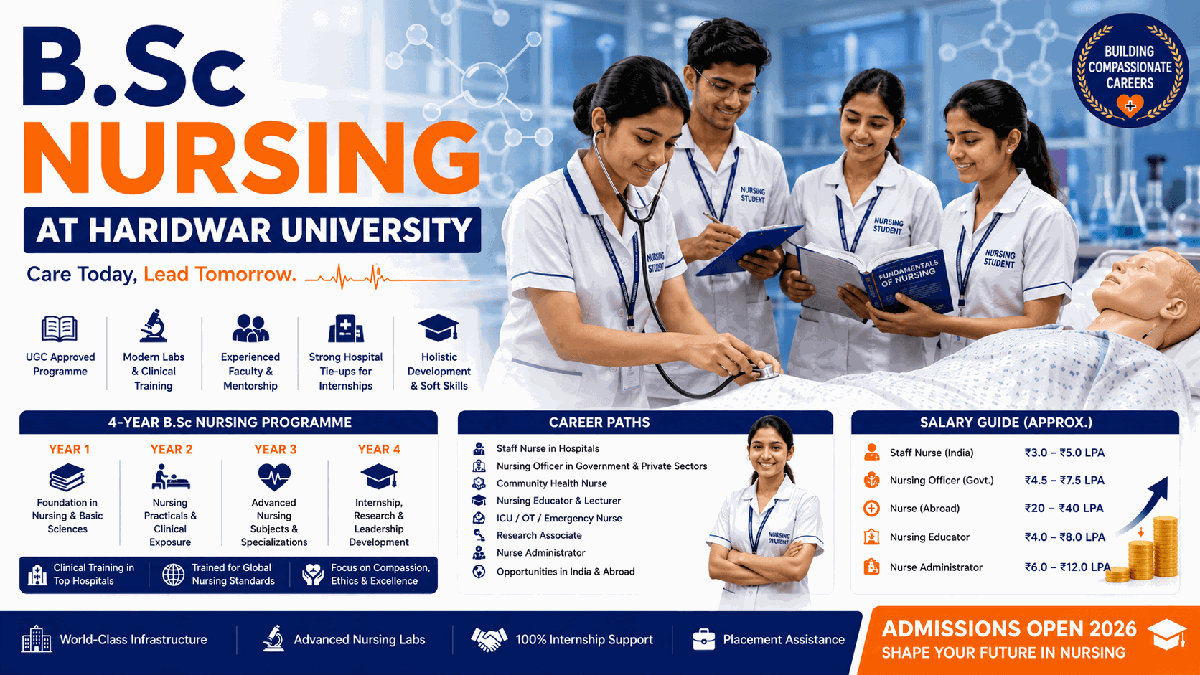
- Year 1 covers what every nurse needs before touching a patient — Anatomy & Physiology, Nutrition & Biochemistry, Nursing Foundations, Psychology, English, and the harder skill of talking to someone who's frightened and in pain.
- Year 2 goes deeper — Medical-Surgical Nursing I, Pharmacology, Pathology, Microbiology — and this is also when the first real hospital postings begin.
- Year 3 branches into specialisation — Child Health Nursing, Mental Health Nursing, Midwifery & Obstetrics, Community Health Nursing — with rotations across departments so nobody leaves having only seen one kind of ward.
- Year 4 pulls everything together — Medical-Surgical Nursing II, Management of Nursing Services, Research & Statistics — plus an internship stretch demanding enough that students are essentially doing the job by the end, just with a supervisor nearby.
The logic is simple: nobody should graduate having only read about an ICU. By the time an HU nursing student finishes, they've already worked in one.
Clinical Training and Hospital Tie-Ups
Worth saying plainly — a lot of nursing colleges in India treat clinical training as a box to tick. Students pass through hospitals briefly, watch more than they do, and end up unprepared for how fast a real ward moves.
HU's affiliated teaching hospitals cover general medicine, surgery, paediatrics, obstetrics and gynaecology, psychiatry, and critical care — ICU, CCU, OT included. Students document cases, assist directly, and gradually take on more independent responsibility under supervision, which matters enormously once they're working alone.
It also matters in a way students don't always anticipate. Recruiters notice, informally at least, when a candidate trained somewhere with genuine clinical infrastructure. Practical skill tends to show up in interviews and competency tests even when nobody's directly asking about it.
Accreditation: INC and the State Nursing Council
Direct point here: pick a college without proper accreditation, and four years of study can end with a graduate unable to legally register as a nurse. Teaching quality won't rescue that situation — the paperwork will sink it.
Nursing programmes need approval from the Indian Nursing Council, the national body that sets and regulates nursing education standards, along with separate registration through the State Nursing Registration Council in whichever state the graduate intends to practise. Miss either one, and registration as a professional nurse isn't possible — which also closes off exams like AIIMS NORCET or state-level Nursing Officer recruitment.
Whichever college is on your shortlist — HU or otherwise — confirm this first. Nothing else on the list matters much if this piece is missing.
Eligibility: Who Can Actually Apply
For B.Sc Nursing at HU, candidates need Class 12 with Physics, Chemistry, Biology, and English — the PCB combination is fixed, since first-year anatomy and physiology lean on that science base almost right away. Most applicants sit around 45–50% aggregate in PCB, with the exact cutoff moving slightly by category. Age generally falls between 17 and 35 as of the admission year's cutoff, and medical fitness gets checked before enrolment, given how physically demanding clinical postings are.
Some institutions, including a few central government ones, now weigh NEET-UG scores in nursing admissions. Not universally, though — plenty of state and private universities still admit on Class 12 merit alone. These rules shift periodically, so it's worth confirming against the current year's actual notification rather than assuming last year's criteria still hold — check the current details on HU's Fees & Scholarships and admissions pages.
Where the Degree Actually Takes You
Probably the strongest argument for choosing B.Sc over GNM is simply how many directions it opens up.
Comparing career paths across disciplines? Check Where the Degree Actually Takes You at Haridwar University for engineering options.
- Staff Nurse is the standard entry point — general wards, private hospitals, nursing homes — with a fairly clear path toward senior or charge nurse roles as experience builds.
- ICU/CCU/OT specialisation pays noticeably more than general ward work, and reasonably so — critical care demands faster, sharper decisions under real pressure, and hospitals compensate accordingly.
- Nursing Officer (Government) is the track most ambitious graduates aim for early on. Exams through AIIMS (NORCET), ESIC, state health departments, and railway boards (RRB) lead to postings with job security and pension benefits that private hospitals rarely match.
Government exam preparation takes up real time for many graduates — six months to a year isn't unusual — since a central government nursing post is still viewed as the safest long-term bet in this field.

Foreign nursing opportunities are where things get genuinely lucrative:
- Gulf countries (UAE, Saudi Arabia, Qatar) — clear licensing exams like DHA, HAAD/DOH, MOH, or QCHP, complete DataFlow verification, and the reward is tax-free pay with accommodation often included.
- UK — the NMC route (CBT plus OSCE) typically places Indian nurses into the NHS at Band 5, with structured progression to Band 6 and beyond.
- Germany — B2-level German is mandatory and the process runs slower, but it offers one of the few genuine paths to permanent residency, along with pension and social security benefits that Gulf postings don't provide.
Salary Ranges to Expect in 2026
The honest answer is that it depends heavily on sector, specialisation, and location — sometimes more than years of experience.
Within India, a fresher starting in a private hospital general ward typically earns ₹18,000 to ₹30,000 a month, while government hospital freshers start a bit higher, around ₹25,000 to ₹35,000. A few years in, private-sector pay climbs to roughly ₹35,000–₹60,000, and an experienced state government nurse can expect ₹55,000–₹85,000. Central government roles — AIIMS, ESIC, or through NORCET at Pay Level 7 — bring the in-hand figure to somewhere between ₹80,000 and ₹92,000. ICU, OT, or general critical-care specialisation adds another 30–40% over standard ward pay, regardless of sector.
Abroad, the numbers shift considerably (converted to INR, approximate). UAE general staff nurses see ₹98,000 to ₹1.6 lakh a month, tax-free; ICU or critical care roles push that to ₹1.7–₹2.9 lakh, still tax-free. The UK, through an NHS Band 5 entry role, works out to roughly ₹2.5–₹4 lakh a month (₹30–50 LPA annually). Germany's gross figures land around ₹2.5–₹3.6 lakh, though take-home ends up 35–40% lower once tax is factored in.
Figures above are indicative, compiled from AmbitionBox salary data, published Gulf/UK/Germany nursing recruitment sources, and central government pay scale notifications (2026). Individual pay varies by employer, city, and years of experience.
There's no single "best" option here. Government work wins on stability and pension. The Gulf wins on immediate tax-free income. Europe wins for anyone prioritising long-term permanent residency. It depends entirely on what a given graduate is optimising for.
Why Consider HU for Nursing
A few things set HU apart from a generic nursing college. The programme is INC-recognised, with clinical exposure beginning in year one rather than crammed into the final semester. Hospital tie-ups span general wards through to ICU and OT-level critical care, giving students a wider range of settings before graduation. Eligible students can get up to 25% off first-year tuition, covering categories like merit, girls' education, armed forces or freedom fighter families, and alumni siblings. Campus life is handled too — hostels include mess, laundry, and security. And the degree keeps every serious next step genuinely open: government exam eligibility, M.Sc Nursing, international licensing — workable in practice, not just on paper.
Fees for 2026–27
As per Haridwar University's current fee structure for the Roorkee College of Allied Health Sciences, here's the complete year-wise breakdown for B.Sc Nursing:
| Component | Amount |
|---|---|
| Tuition Fee | ₹98,000 |
| Year 1 – Semester 1 | ₹1,41,000 |
| Year 1 – Semester 2 | ₹49,000 |
| Year 1 Total | ₹1,90,000 |
| Year 2 | ₹1,90,000 |
| Year 3 | ₹1,90,000 |
| Year 4 | ₹1,90,000 |
| Approximate 4-Year Total | ₹7,60,000 |
This covers tuition, enrollment, admission, examination, and uniform charges. Hostel fees sit outside it — ₹85,000 for a normal room, ₹95,000 for semi-deluxe, ₹1,05,000 for a deluxe AC room, per year — and transport is billed separately by route. Up to 25% off first-year tuition is available for students who qualify; check the current year's eligibility list before assuming anything, since it's revised annually.
Frequently Asked Questions
Is NEET compulsory for B.Sc Nursing admission at HU?
It varies by year. Some seats go by NEET-UG merit, others by Class 12 PCB scores directly — check the current admission notification for exact criteria.
Can male students apply for B.Sc Nursing?
Yes. Private universities like HU admit both male and female applicants, unlike many government nursing colleges that admit women only.
What's the minimum Class 12 percentage needed?
Roughly 45–50% aggregate in PCB as a general rule, with some flexibility by category.
Is B.Sc Nursing actually better than GNM?
For long-term prospects, yes. It opens up postgraduate study, most government Nursing Officer exams, and international licensing — none of which sit as comfortably within reach of a three-year GNM diploma.
Can graduates head abroad right after finishing the degree?
Not immediately. There's a licensing exam first, specific to the destination — DHA, HAAD, or MOH for the Gulf, NMC's CBT and OSCE for the UK, or language plus qualification recognition for Germany — along with verification steps like DataFlow before work can actually begin.
What's the typical starting salary after B.Sc Nursing in India?
Most freshers start somewhere in the ₹18,000–₹35,000 range monthly, moving up fairly quickly once specialisation or a central government posting enters the picture.
Ready to Start Your Nursing Career at Haridwar University?
Apply today for the 2026 session and secure your seat in our INC-recognised B.Sc Nursing programme.
Apply for B.Sc Nursing at HU →