

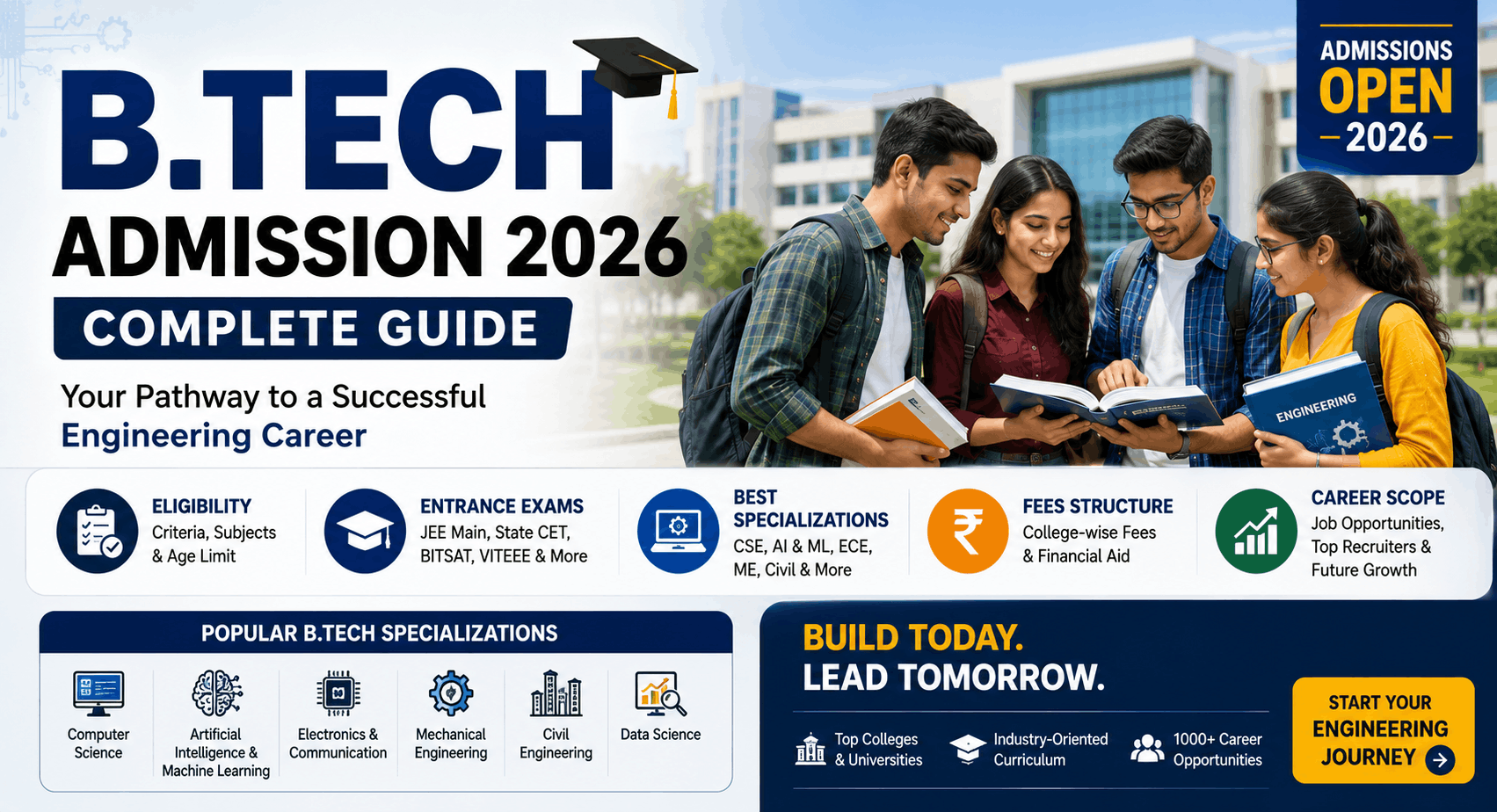
B.Tech Admission 2026: Complete Guide to Eligibility, Entrance Exams, Best Specializations, Fees & Career Scope
Haridwar University Editorial Team
Choosing a career after 12th is one of the biggest decisions students have to make. Bachelor of Technology (B.Tech) has been one of the most popular choices for students who studied Physics, Chemistry, and Mathematics (PCM) in Class 12 because it combines technical knowledge with practical skills and opens doors to careers across various industries. However, getting admission into a B.Tech programme is no longer just about qualifying for an entrance exam.
Students also need to understand the eligibility, compare engineering branches and specializations, evaluate colleges, and think about long-term career opportunities before making decisions.
If you are planning for B.Tech admissions in 2026, this guide is designed to answer most of the questions students usually have. This guide covers the eligibility criteria, entrance exams, admissions routes, engineering branches, career opportunities, placement prospects, fees, and factors you should consider before choosing the college that's right for you. After going through this guide, you’ll have a clear roadmap to make an informed decision about your engineering career journey.
Whether you're preparing for JEE Main, looking for direct admission options, or comparing different engineering branches, this article will help you understand the complete admission process in a simple and practical way.
Why B.Tech Continues to Be a Popular Career Choice in 2026
Technology continues to transform almost every industry, creating huge opportunities for skilled engineers in software development, manufacturing, healthcare, infrastructure, renewable energy, artificial intelligence, robotics, cybersecurity, and several other fields. As industries grow, engineering graduates are expected to solve real-world problems using innovation, analytical thinking, and practical skills.
A B.Tech degree offers much more than classroom learning. Students work on laboratory experiments, industry projects, internships, hackathons, and research activities which prepare them for professional careers. With emerging technologies becoming part of engineering education, graduates are also developing skills that are in high demand and highly valued by employers.
Many students begin their admission journey by asking, "Is B.Tech still worth pursuing in 2026?" The answer depends on your interests and career goals. If you enjoy mathematics, science, problem-solving, designing solutions, or working with technology, engineering can provide diverse career paths across both private and public sectors.
If you're still deciding which specialization matches your interests, this guide on AI vs CSE: Which Engineering Branch Should You Choose After 12th? compares two of today's most sought-after engineering fields.
What Is a B.Tech Degree?
Bachelor of Technology (B.Tech) is a four-year undergraduate engineering programme that combines theoretical knowledge with practical application. Throughout the course, students study engineering fundamentals while gaining hands-on experience through laboratories, workshops, projects, industrial training, and internships.
Most universities offer a range of engineering specializations, including:
- Computer Science Engineering (CSE)
- Artificial Intelligence & Machine Learning (AI & ML)
- Data Science
- Mechanical Engineering
- Civil Engineering
- Electrical Engineering
- Electronics & Communication Engineering (ECE)
Each specialization prepares students for different industries and career opportunities. Instead of choosing a branch based only on popularity, students should consider their interests, strengths, and long-term career goals.
Students interested in emerging technologies can also explore the B.Tech in Artificial Intelligence & Machine Learning to understand its curriculum, career opportunities, and future scope.
Who Is Eligible for B.Tech Admission in 2026?
One of the first questions students ask is whether they meet the eligibility criteria for engineering admission. While exact requirements may vary between universities, the basic eligibility remains similar across most institutions.
In general, students should:
- Pass Class 12 or an equivalent examination from a recognised board.
- Study Physics and Mathematics as compulsory subjects.
- Have Chemistry, Computer Science, Biotechnology, or another approved subject as the third subject, depending on the university's admission policy.
- Meet the minimum qualifying marks specified by the institution or entrance examination.
Some universities admit students through national or state-level entrance examinations, while others also offer merit-based admissions according to their admission guidelines.
Before applying, always review the latest eligibility requirements published by your preferred university.
You can also check the complete B.Tech Admission Process at Haridwar University for programme-specific admission details.
Can You Get B.Tech Admission Without JEE?
Yes. Many students believe that JEE Main is the only way to pursue a B.Tech degree, but that isn't always the case.
Although JEE Main is one of India's most recognised engineering entrance examinations, several universities and institutions also offer admissions through other approved routes.
Depending on the university, students may be admitted through:
- JEE Main scores
- State-level engineering entrance examinations
- University-specific admission processes
- Merit-based admissions, where applicable
The admission route may differ from one institution to another, so it's important to understand the admission policy before applying.
Step-by-Step B.Tech Admission Process
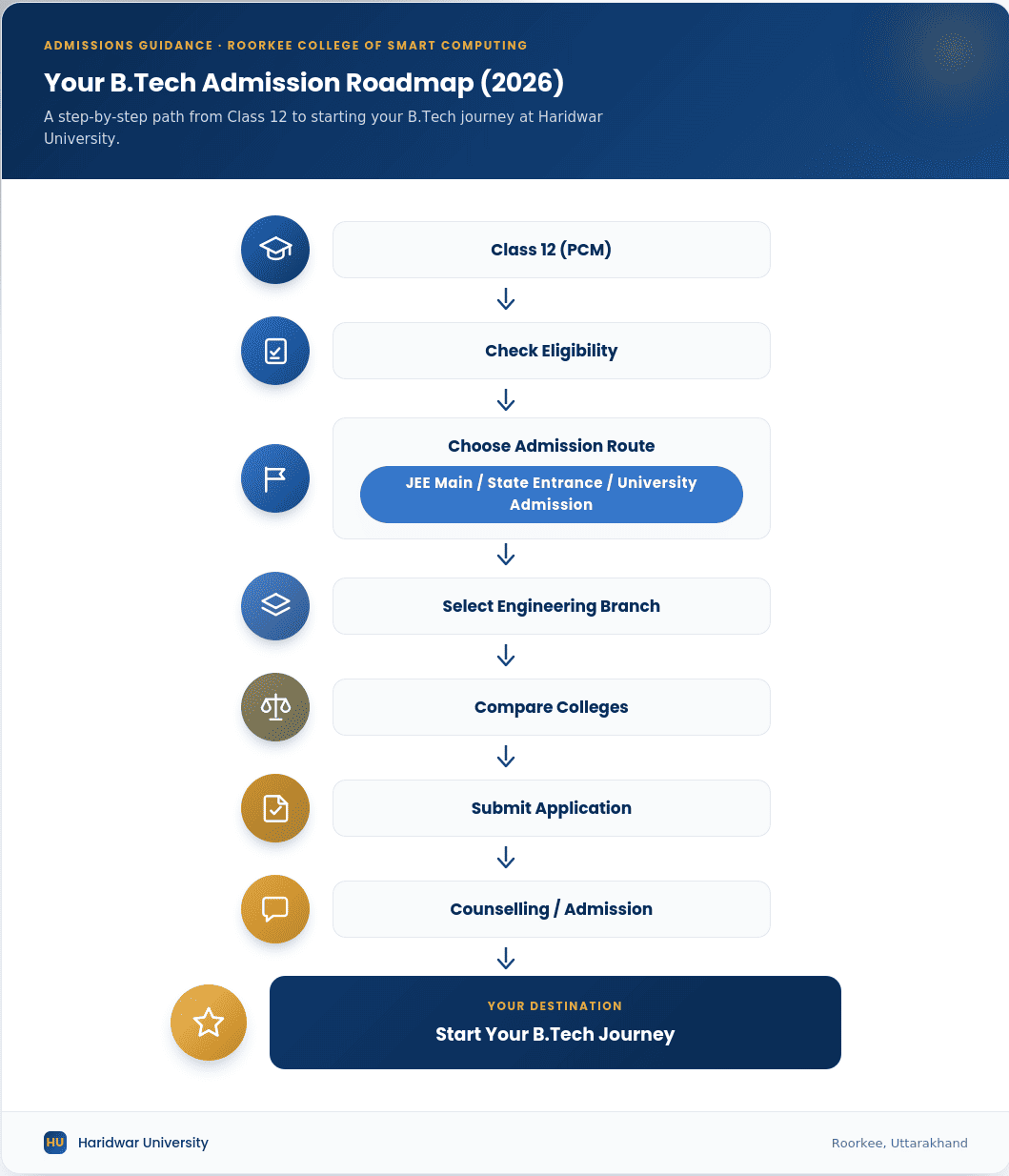
While admission procedures may vary across universities, the overall process usually follows these steps:
- Check your eligibility: Ensure you meet the educational and age requirements for admission.
- Choose the engineering specialization: Pick a branch that matches your interests and career goals.
- Appear for entrance examinations: Register and sit for national, state, or university entrance exams, if applicable.
- Compare engineering colleges: Evaluate colleges based on accreditation, faculty, placements, laboratories, industry exposure, and campus facilities.
- Complete the application: Fill out online application forms and upload the required documents.
- Counselling & Admission: Participate in counselling or complete the university's specific admission process.
One common observation is that many students spend weeks comparing entrance exams but spend very little time comparing engineering branches or colleges. In reality, selecting the right specialization and learning environment often has a greater impact on your future career than the admission route itself.
Which Engineering Branch Is Best for Placement in 2026?
One of the most searched questions among engineering aspirants is, "Which engineering branch is best for placement?" While there's no single answer that applies to everyone, some branches consistently offer strong placement opportunities because of growing industry demand, technological advancements, and the skills graduates develop during their studies.
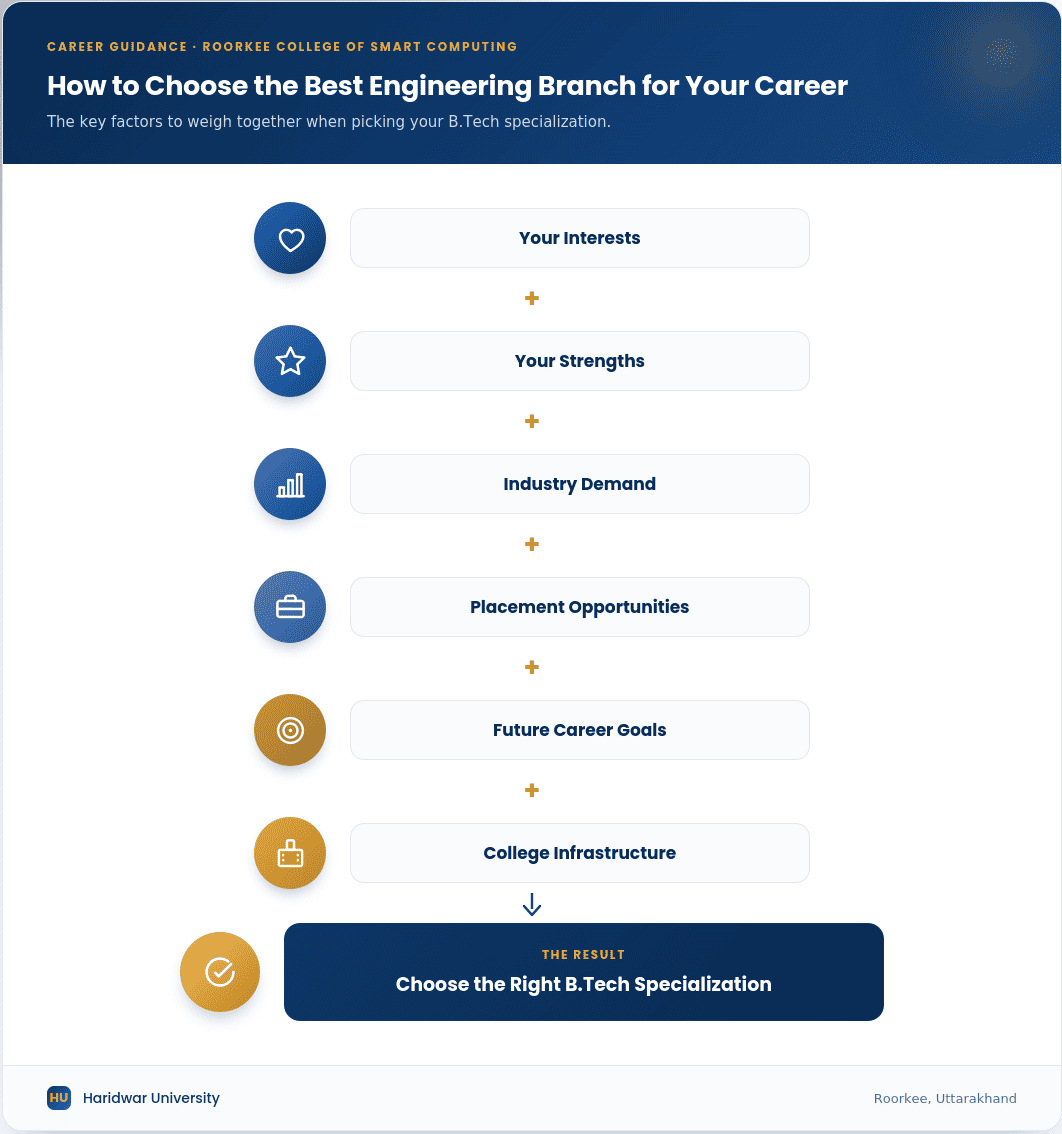
Instead of choosing a branch based only on trends or advice from others, students should evaluate three important factors:
- Their interest in the subject.
- Industry demand and future growth.
- Placement opportunities and career flexibility.
Choosing a branch that matches both your interests and market demand can help you build a rewarding career after graduation.
Popular B.Tech Specializations Compared
| Engineering Branch | Career Opportunities | Placement Potential | Future Demand |
|---|---|---|---|
| Computer Science Engineering (CSE) | Software Development, Cloud Computing, Cybersecurity | Very High | Very High |
| Artificial Intelligence & Machine Learning | AI Engineer, ML Engineer, Data Scientist | Very High | Very High |
| Data Science | Data Analyst, Data Engineer, Business Intelligence | Very High | Very High |
| Electronics & Communication Engineering | Embedded Systems, Telecom, IoT | High | High |
| Electrical Engineering | Power Systems, EV Industry, Automation | High | High |
| Mechanical Engineering | Manufacturing, Automotive, Robotics | High | High |
| Civil Engineering | Infrastructure, Construction, Smart Cities | Moderate–High | Moderate–High |
Although Computer Science Engineering and AI & Machine Learning continue to attract significant attention, every branch has opportunities for students who develop practical skills, complete internships, and work on industry-relevant projects.
If you're confused between two of today's most popular specializations, explore the detailed comparison AI vs CSE: Which Engineering Branch Should You Choose After 12th?.
Choosing the Right Engineering Branch
Engineering is no longer limited to traditional disciplines. New technologies have created specialised programmes that prepare students for rapidly evolving industries. Here are some of the most popular choices for students planning B.Tech admission in 2026.
Computer Science Engineering (CSE)
Computer Science Engineering remains one of the most sought-after branches because of its broad career opportunities in software development, cloud computing, cybersecurity, web development, and mobile application development. Graduates often work with technology companies, startups, financial institutions, healthcare organisations, and government departments.
Explore: B.Tech in Computer Science Engineering.
Artificial Intelligence & Machine Learning (AI & ML)
As businesses increasingly adopt AI-driven solutions, demand for professionals with AI and machine learning skills continues to grow. Students learn programming, data science, machine learning algorithms, deep learning, and intelligent systems while working on practical projects. If you're curious about future salaries in this field, read AI Engineers Salary in India: Skills, Experience & Career Growth (2026).
Data Science
Data Science focuses on extracting meaningful insights from data to support business decisions. Students develop skills in statistics, programming, data visualisation, machine learning, and analytics. Graduates may work in sectors such as finance, healthcare, e-commerce, consulting, and technology.
Electronics & Communication Engineering (ECE)
ECE combines electronics, communication systems, embedded technologies, IoT, and semiconductor applications. As industries invest in automation and smart devices, skilled electronics engineers continue to find opportunities across multiple sectors.
Electrical Engineering (EE)
Electrical Engineering focuses on the generation, transmission, and efficient use of electrical power. Students learn about power systems, electrical machines, renewable energy, automation, and control systems through both theoretical and practical training. Graduates can pursue careers in power generation, renewable energy, electric vehicles (EVs), manufacturing, automation, public sector organisations, and infrastructure projects, making Electrical Engineering a promising choice for the future.
Mechanical Engineering
Mechanical Engineering remains an excellent choice for students interested in design, manufacturing, robotics, automotive engineering, and industrial automation. With Industry 4.0 transforming manufacturing, mechanical engineers increasingly work alongside digital technologies and intelligent systems.
Civil Engineering
Civil Engineering plays an important role in infrastructure development, transportation, urban planning, and sustainable construction. Government projects, smart city initiatives, and infrastructure investments continue to create opportunities for skilled civil engineers.
How Should You Choose the Right Engineering Branch?
Instead of asking which branch is the "best," ask which branch is the best for you. Before selecting a specialization, consider these questions:
- Which subjects do you genuinely enjoy studying?
- Do you prefer software, design, electronics, construction, or manufacturing?
- Are you interested in emerging technologies like AI, robotics, or cybersecurity?
- Which industries would you like to work in after graduation?
- What kind of projects would you enjoy building during your degree?
Students who choose a branch based only on popularity often lose interest during the course. On the other hand, students who align their interests with industry demand generally perform better academically and professionally.
What Do Recruiters Look for Beyond Your Branch?
Industry hiring trends show that recruiters don't evaluate students based only on their engineering specialization. Today's employers also look for:
- Practical project experience.
- Internship exposure.
- Technical problem-solving ability.
- Communication and teamwork skills.
- Familiarity with industry tools and technologies.
For example, a Computer Science student with no projects may be at a disadvantage compared to an AI & ML student who has built practical applications and completed internships. Similarly, a Mechanical Engineering student with hands-on automation projects may stand out during campus placements.
If you're planning to strengthen your technical profile during college, our guide The Complete AI Toolkit for Engineering Students: Best AI Tools for Coding, Projects, Research & Placements (2026) explains the tools that engineering students can start learning from the first year. Students can also explore 25 AI Projects Every Engineering Student Should Build in 2026 to understand how practical projects help build stronger portfolios and improve placement readiness.
B.Tech Entrance Exams in 2026
The admission route for a B.Tech programme depends on the university you choose. While many institutions accept national-level entrance examination scores, others conduct their own admission process or offer merit-based admissions according to their guidelines.
Some of the commonly accepted engineering entrance examinations include:
- JEE Main: Accepted by NITs, IIITs, several private universities, and many engineering institutions across India.
- JEE Advanced: Required for admission to the Indian Institutes of Technology (IITs).
- State-Level Engineering Entrance Exams: Conducted by different states for admission to engineering colleges within their respective regions.
- Haridwar University Admission Test (HUAET): Haridwar University conducts the Haridwar University Admission Entrance Test (HUAET) as an admission route for eligible programmes. Students who qualify through HUAET can apply for admission to various undergraduate programmes offered by the university, subject to the applicable eligibility criteria and admission guidelines. Candidates should refer to the university's admissions page for the latest HUAET schedule, eligibility requirements, and application details.
- University-Specific Admission Process: Some universities conduct their own admission process or admit students based on qualifying examination performance.
The admission criteria may differ from one institution to another, so students should always verify the latest admission requirements on the university's official website before applying. Students can also refer to the official All India Council for Technical Education (AICTE) for information on technical education policies, approvals, and engineering education in India.
What Is the Fee Structure for B.Tech?
The cost of pursuing a B.Tech degree varies depending on factors such as the type of institution, facilities offered, location, and available scholarships.
Instead of choosing a college based only on fees, students should also evaluate the overall value they receive during their four years of study.
When comparing engineering colleges, consider:
- Quality of faculty
- Laboratory and research facilities
- Industry collaborations
- Internship opportunities
- Placement support
- Campus infrastructure
- Student clubs and technical activities
- Scholarship opportunities
A college that provides strong practical learning, industry exposure, and placement assistance may offer better long-term value than simply having the lowest tuition fees.
How to Choose the Right Engineering College
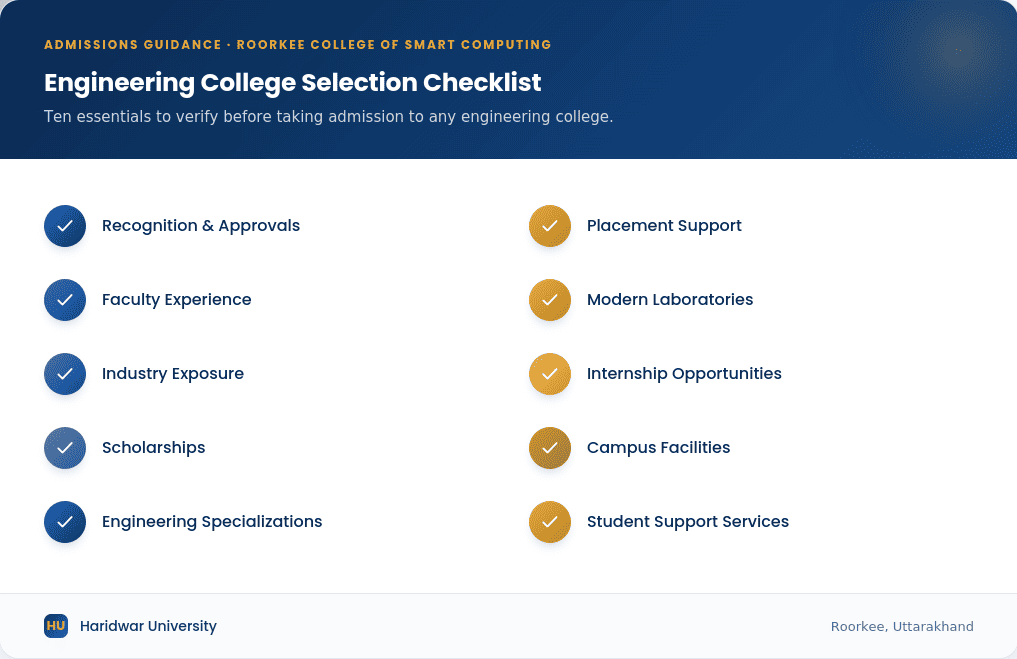
One of the biggest mistakes students make during the admission process is selecting a college based only on advertisements, rankings shared on social media, or advice from friends. Instead, compare colleges using objective factors that directly influence your learning experience and career opportunities.
1. Check Recognition and Approvals
Choose a university that is recognised by the appropriate regulatory authorities and follows approved academic standards. Accreditation and institutional approvals help ensure the quality and credibility of your degree.
2. Review Placement Support
A good engineering college should actively support students through internships, industry interactions, skill development programmes, and campus recruitment opportunities.
Instead of focusing only on the highest salary package advertised, try to understand:
- Companies visiting the campus.
- Internship opportunities.
- Placement training programmes.
- Average placement performance.
- Alumni success stories.
While comparing engineering colleges, students may also review the National Institutional Ranking Framework (NIRF) to understand the ranking methodology and compare institutions using publicly available parameters such as teaching, research, graduation outcomes, and outreach.
You can also explore Training & Placement at Haridwar University to understand how industry exposure, internships, and placement preparation support engineering students.
3. Evaluate Laboratories and Practical Learning
Engineering is a practical discipline. Modern laboratories, workshops, project-based learning, innovation centres, and technical clubs help students apply classroom concepts to real-world problems. Practical exposure becomes especially valuable during internships and campus placements.
4. Industry Exposure
Look for opportunities such as industrial visits, expert sessions, live projects, technical workshops, hackathons, and industry certifications. These experiences help students develop practical skills before graduation.
5. Compare Available Specializations
Not every university offers the same engineering programmes. Before applying, review the curriculum, faculty expertise, laboratories, and career opportunities for the branch you're interested in.
Students considering emerging technologies can compare programmes such as:
Why Choose B.Tech at Haridwar University?
Selecting the right engineering college involves more than comparing admission requirements. Students should also evaluate the quality of academics, practical learning, placement opportunities, industry exposure, laboratories, fee structure, and scholarship support before making a decision.
Industry-Focused B.Tech Programmes
Haridwar University offers future-ready B.Tech programmes through the Roorkee College of Engineering and Roorkee College of Smart Computing, including:
- Computer Science Engineering (CSE)
- Artificial Intelligence & Machine Learning (AI & ML)
- Data Science
- Cyber Security
- Electronics & Communication Engineering (ECE)
- Electrical & Electronics Engineering (EEE)
- Mechanical Engineering
- Civil Engineering
The curriculum combines classroom learning with practical projects, internships, innovation activities, and industry-oriented skill development.
Affordable Fee Structure
B.Tech tuition fees vary by programme. For the 2026–27 session, annual tuition ranges approximately from ₹1.27 lakh to ₹1.62 lakh, depending on the specialisation. Hostel accommodation is available with multiple room options for students who require on-campus residence.
Modern Laboratories & Research Facilities
Students receive practical exposure through modern laboratories and innovation facilities, including:
- Artificial Intelligence & Machine Learning Labs
- Computer Programming & Software Development Labs
- IoT and Embedded Systems Labs
- Electronics & Communication Laboratories
- Mechanical, Civil and Electrical Engineering Workshops
- Research and Innovation Centres supporting project-based learning
These facilities help students develop practical skills through experiments, mini-projects, internships, and final-year research work.
Industry Collaboration & Placement Support
Haridwar University strengthens industry readiness through 200+ academic and industry MoUs, giving students opportunities for internships, expert sessions, live projects, skill development programmes, and collaborative learning. The university has collaborated with organisations such as IBM, L&T EduTech, NASSCOM Foundation, and academic institutions including IIT Roorkee to enhance industry exposure and bridge the gap between classroom learning and workplace expectations.
Highlights include:
- 10,000+ placement offers
- 1,300+ companies participating in recruitment
- 200+ academic and industry MoUs
- Highest national package: ₹60 LPA
- Multiple recruiters offering packages of ₹22 LPA, ₹15 LPA, ₹10 LPA, ₹7 LPA, and ₹5 LPA across different hiring bands
- Dedicated Training & Placement Cell for internships, aptitude training, mock interviews, industrial visits, guest lectures, and campus recruitment support.
Scholarships & Financial Support
Haridwar University offers several scholarships to support deserving students, including:
- Up to 80% tuition fee scholarship based on JEE rank, CUET percentile, or Class 12 marks
- 25% scholarship for Uttarakhand domicile students
- 25% scholarship for girl students
- Sports scholarships for eligible candidates
- Academic Excellence Award for students achieving outstanding semester performance
Students should review the latest eligibility criteria before applying, as scholarship benefits may vary by programme and admission category.
Choose a College That Supports Your Long-Term Goals
While comparing engineering colleges, don't focus only on admission eligibility or fees. Look at the overall learning environment, practical training, placement support, industry collaborations, research opportunities, scholarships, and campus facilities. These factors play an important role in shaping both your college experience and future career.
Common Mistakes Students Make During B.Tech Admission
Many students focus on admission formalities while overlooking decisions that have a greater impact on their long-term academic and career growth. Here are some common mistakes to avoid:
- Choosing a Branch Only Because It's Popular: Every engineering specialization has career opportunities. Selecting a branch only because your friends are choosing it may not align with your interests or strengths.
- Ignoring Placement and Skill Development: Placements depend on more than your degree. Students who build technical skills, complete internships, and work on practical projects are often better prepared for recruitment.
- Applying Without Researching Colleges: Take time to compare faculty, infrastructure, industry collaborations, placement support, and student opportunities before submitting your application.
- Missing Important Deadlines: Keep track of application dates, counselling schedules, document verification, and admission deadlines to avoid unnecessary stress.
- Overlooking Scholarships: Many universities offer scholarships based on academic performance or other eligibility criteria. Exploring these opportunities early can help reduce the overall cost of education.
Career Scope After B.Tech
One of the biggest reasons students pursue a B.Tech degree is the wide range of career opportunities it offers. Engineering graduates work across technology companies, manufacturing industries, infrastructure projects, consulting firms, startups, research organisations, and government departments.
Your career path depends on several factors, including your engineering specialization, technical skills, internship experience, projects, and willingness to continue learning.
Some popular career options after B.Tech include:
- Software Engineer
- AI & Machine Learning Engineer
- Data Analyst
- Data Scientist
- Cybersecurity Analyst
- Cloud Engineer
- Mechanical Design Engineer
- Civil Site Engineer
- Electrical Engineer
- Embedded Systems Engineer
- Robotics Engineer
- Project Engineer
- Government Engineer (through competitive examinations)
- Research Associate
- Entrepreneur or Startup Founder
Students can also pursue higher education such as M.Tech, MBA, MS, or specialised certifications to further expand their career opportunities.
To understand how AI-related careers are evolving, read AI Engineers Salary in India: Skills, Experience & Career Growth (2026).
Skills You Should Start Learning Before Joining B.Tech
Getting admission is only the beginning. Students who begin developing technical and professional skills early often adapt more quickly during engineering and become stronger candidates for internships and placements.
Some valuable skills include:
- Basic programming (Python or C++)
- Logical and analytical thinking
- Problem-solving
- Communication skills
- Teamwork and collaboration
- Presentation skills
- Time management
- Microsoft Excel and productivity tools
- Basic Git and GitHub
- Familiarity with AI tools for learning and research
You don't need to master everything before your first semester. Even learning the basics can give you greater confidence during your engineering journey.
If you're looking for practical resources, explore The Complete AI Toolkit for Engineering Students: Best AI Tools for Coding, Projects, Research & Placements (2026). Students interested in building practical experience can also explore 25 AI Projects Every Engineering Student Should Build in 2026.
B.Tech Admission Timeline 2026
Although exact schedules vary across institutions, students can follow this general admission timeline to stay organised.
| Timeline | Recommended Action |
|---|---|
| January – March | Research engineering branches and colleges |
| February – April | Register for entrance examinations (where applicable) |
| April – June | Complete applications and prepare required documents |
| May – July | Entrance exam results, counselling, and college selection |
| June – August | Admission confirmation, document verification, and fee submission |
| July – September | Begin your first semester and orientation |
Preparing early helps students compare colleges carefully instead of making rushed decisions at the last moment.
Ready to Start Your B.Tech Journey?
Choosing the right B.Tech programme is one of the most important decisions after Class 12. Beyond admission eligibility, take time to compare engineering branches, entrance exams, fee structure, scholarships, placement support, and practical learning opportunities before making your final choice.
If you're planning to pursue B.Tech Admission 2026, explore the available specialisations, review the admission process, and shortlist colleges that align with your career goals and interests. A well-informed decision today can help build a stronger engineering career tomorrow.
Take the Next Step
- Explore B.Tech Programmes
- Check Eligibility & Admission Process
- View Fees & Scholarship Details
- Apply Online for B.Tech Admission 2026
Frequently Asked Questions (FAQs)
1. Is B.Tech still a good career choice in 2026?
Yes. Engineering continues to offer strong career opportunities across technology, manufacturing, infrastructure, electronics, renewable energy, automation, and emerging fields such as artificial intelligence and data science. Success depends on your skills, practical experience, and continuous learning.
2. Can I get B.Tech admission without JEE?
Yes. Many universities accept admissions through state-level entrance examinations, university-specific admission processes, or merit-based criteria, depending on their admission policies.
3. Which engineering branch is best for placement?
There is no single best branch for every student. Computer Science Engineering, Artificial Intelligence & Machine Learning, Data Science, Electronics & Communication Engineering, and several other branches offer excellent placement opportunities. The right choice depends on your interests, strengths, and career goals.
4. What is the eligibility for B.Tech admission?
Generally, students should have completed Class 12 with Physics and Mathematics as compulsory subjects, along with another approved subject, while meeting the minimum eligibility criteria specified by the university.
5. What should I consider before choosing an engineering college?
Look beyond advertisements. Compare approvals, faculty, laboratories, placements, internships, industry exposure, campus facilities, scholarships, and student support before making your decision.