

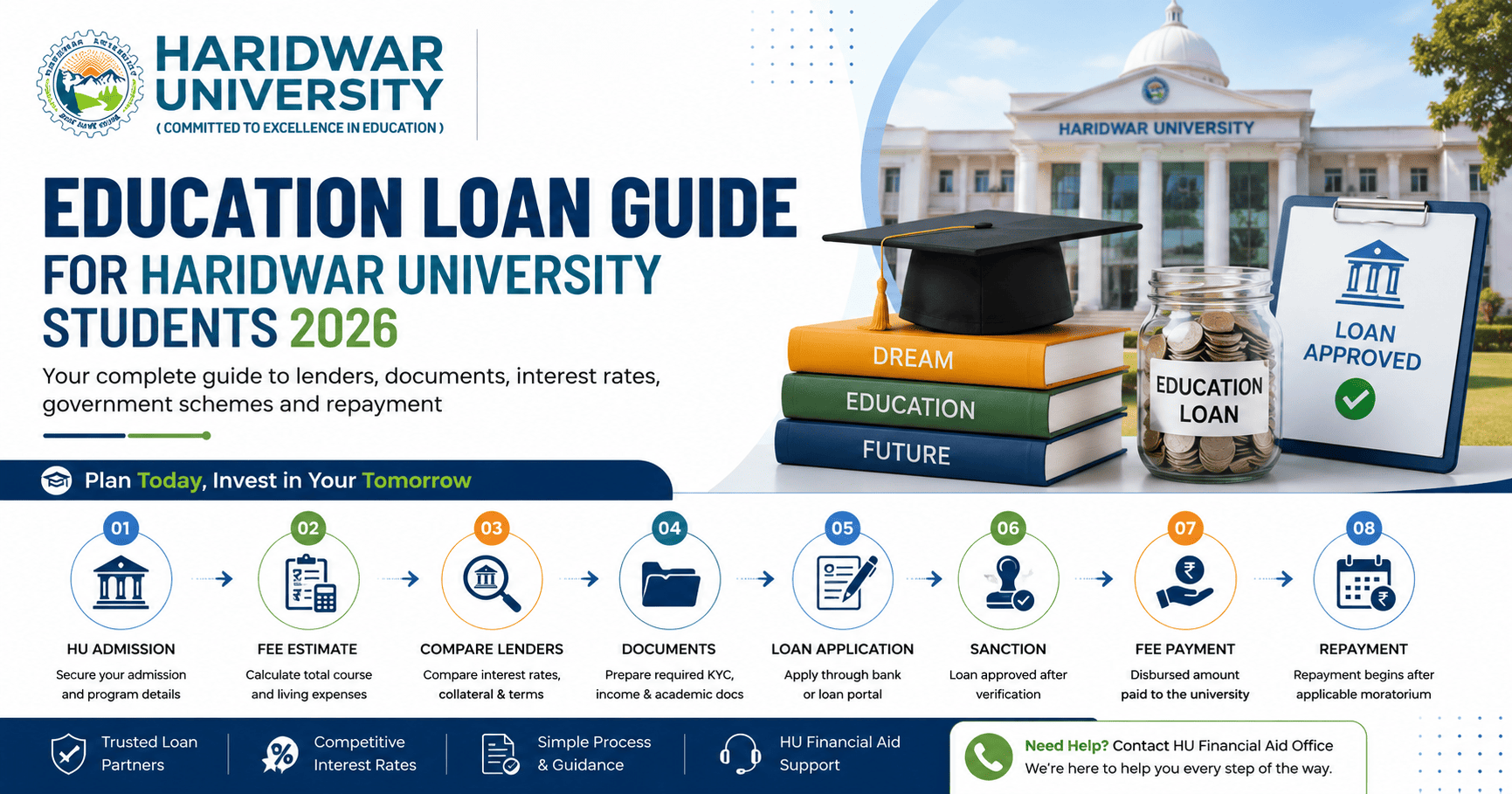
Paying for higher education is often a family decision as much as an academic one. At Haridwar University, I regularly meet students who have clear plans for their course but need guidance on how to manage the cost.
An education loan can bridge that gap. But the useful question is not simply, "Which bank gives an education loan?" It is: How much do I need, which lender or government route may apply, what documents will I need, and what will repayment look like?
Haridwar University's 2026-27 fee page provides the starting point. The university also maintains a dedicated Payment & Loans section listing education-finance providers and a financial-aid contact route.
Table of Contents
- 1. Which banks and lenders can finance HU courses?
- 2. How much education loan might an HU student need?
- 3. Collateral or non-collateral: what should students expect?
- 4. What are education-loan interest rates in 2026?
- 5. Moratorium: when does repayment begin?
- 6. What documents should you keep ready?
- 7. A practical application process
- 8. Can government schemes reduce the interest burden?
- 9. What does repayment look like?
- 10. FAQs
- 11. The next step is to make the numbers work
1. Which banks and lenders can finance HU courses?
Haridwar University's Payment & Loans resources list the following providers and loan platforms:
| Lender / Platform | Listed by HU |
|---|---|
| GQ EMI / GrayQuest | Yes |
| Vidya Lakshmi Portal / PM-Vidyalaxmi | Yes |
| HDFC Bank | Yes |
| State Bank of India (SBI) | Yes |
| Propelld | Yes |
| Punjab National Bank (PNB) | Yes |
| ICICI Bank | Yes |
| Axis Bank | Yes |
| Union Bank of India | Yes |
| IDBI Bank | Yes |
HU's listing should be treated as a starting point, not a guarantee of sanction. The final loan amount, interest rate, collateral requirement and approval depend on the lender's current scheme and the applicant's eligibility.
Students can also use the Vidya Lakshmi portal to explore education-loan options. The government-backed PM-Vidyalaxmi system advises students to check the latest interest rate directly with the concerned bank because rates differ between lenders.
2. How much education loan might an HU student need?
The answer begins with the programme fee rather than a predetermined loan limit.
For example, HU's 2026-27 fee structure lists:
| Programme | Duration | 1st-year fee | Subsequent annual fee* |
|---|---|---|---|
| B.Tech Hons. CSE | 4 years | ₹1.32 lakh | ₹1.15 lakh |
| B.Tech Hons. AI & ML | 4 years | ₹1.62 lakh | ₹1.45 lakh |
| B.Tech Hons. Cyber Security | 4 years | ₹1.42 lakh | ₹1.25 lakh |
| B.Tech Hons. Data Science | 4 years | ₹1.42 lakh | ₹1.25 lakh |
| BBA with AI | 3 years | ₹82,000 | ₹65,000 |
| B.Com with AI | 3 years | ₹67,000 | ₹50,000 |
| B.Pharm with AI | 4 years | ₹1.27 lakh | ₹1.10 lakh |
| B.Sc. Nursing with AI | 4 years | ₹1.90 lakh | ₹1.90 lakh |
*Subject to the programme's published duration and applicable fee structure.
These figures include tuition, enrolment, admission, examination and uniform fees. Hostel and transportation are charged separately.
That distinction matters when calculating the amount to request. A student should first prepare the full course-cost estimate, including applicable academic and accommodation expenses, and then discuss the eligible amount with the lender.
3. Collateral or non-collateral: what should students expect?
There is no single collateral threshold that applies to every education loan.
For example, SBI's Student Loan Scheme currently publishes separate rates for loans up to ₹7.50 lakh without collateral and loans above ₹7.50 lakh with collateral. SBI's published education-loan rates are floating and linked to its external benchmark.
This is why I advise students not to assume that a loan below or above a particular amount will automatically be approved without security. The scheme, institution category, loan amount and applicant profile all matter.
A lender may also have separate products for students studying at selected institutions.
4. What are education-loan interest rates in 2026?
Interest rates change, so students should always verify the rate immediately before applying.
For reference, official lender pages currently show different structures. SBI lists its Student Loan Scheme at 10.15% for loans up to ₹7.50 lakh without collateral and 9.15% for loans above ₹7.50 lakh with collateral on the rate page published for its education-loan schemes. It also lists a 0.50 percentage-point concession for girl students.
IDBI Bank's published education-loan table, meanwhile, shows 10.35% for non-vocational courses up to ₹7.5 lakh, with different rates for higher amounts and PM-Vidyalaxmi loans.
PNB's published education-loan material also shows scheme-specific rates, including different treatment for loans covered by credit-guarantee arrangements and loans supported by collateral.
The lesson is simple: compare the actual scheme offered to you, not just the bank's headline rate.
5. Moratorium: when does repayment begin?
An education loan normally separates the study period from the repayment period through a moratorium. The exact terms depend on the lender and scheme.
Students should ask the bank four questions before signing:
- When does the moratorium end?
- Is interest charged during the study period?
- Is that interest capitalised into the outstanding loan?
- When does the first EMI become payable?
These questions can materially change the eventual repayment burden.
6. What documents should you keep ready?
The exact checklist varies by lender, but students should prepare a basic file before applying.
| Document | Why it may be required |
|---|---|
| Admission / offer letter | Confirms admission to the programme |
| HU fee structure | Establishes the academic cost |
| Academic certificates and marksheets | Verifies educational background |
| Aadhaar / PAN and other KYC | Identity and address verification |
| Passport-size photographs | Applicant records |
| Parent / co-applicant KYC | Required where a parent or guardian is a co-borrower |
| Income proof | Helps lender assess repayment capacity |
| Bank statements / financial documents | May be requested for assessment |
| Collateral documents | Required where the particular loan scheme demands security |
The PM-Vidyalaxmi portal also allows students to upload documents electronically and advises applicants to check lender-specific requirements.
7. A practical application process
I recommend treating the application as a sequence rather than waiting until the fee deadline.
- Step 1: Secure your HU admission and fee details.
- Step 2: Compare the education-loan options listed by HU and the available government portal routes.
- Step 3: Check the lender's current interest rate, collateral conditions, margin, processing charges and repayment terms.
- Step 4: Prepare your admission letter, fee structure, academic records and KYC documents.
- Step 5: Submit the application through the lender or relevant portal.
- Step 6: Respond promptly if the bank requests additional documents or verification.
- Step 7: Before accepting the sanction, read the repayment schedule and total cost carefully.
Haridwar University's own application process also allows students to register online, select a programme and complete the subsequent application process after registration.
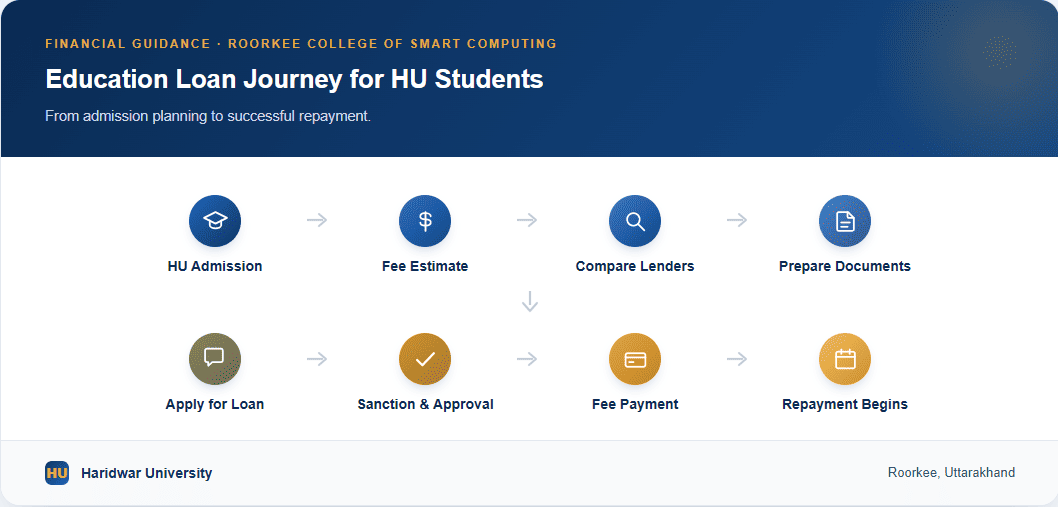
Education loan journey for Haridwar University students, covering admission, fee estimation, lender comparison, documentation, loan application, sanction, fee payment, and repayment.
8. Can government schemes reduce the interest burden?
This is an area students should investigate before choosing a loan.
The Government of India's PM-Vidyalaxmi Scheme provides a framework for education-loan support, including interest subvention for eligible students. Under the published guidelines, students from families with annual income up to ₹4.5 lakh pursuing eligible technical/professional courses can receive full interest subvention during the moratorium period for education loans up to ₹10 lakh under the PM-USP Central Sector Interest Subsidy Scheme, subject to the scheme's eligibility conditions. Students with family income between ₹4.5 lakh and ₹8 lakh may qualify for a 3% interest subvention under PM-Vidyalaxmi for eligible courses/institutions.
The government has also provided for collateral- and guarantor-free education loans under PM-Vidyalaxmi for students in eligible Quality Higher Education Institutions, subject to scheme conditions.
However, students should verify whether their specific programme and institution are eligible under the applicable scheme at the time of application. Eligibility should never be assumed from the scheme name alone.
9. What does repayment look like?
Consider an illustrative loan of ₹5 lakh at an assumed annual interest rate of 9% over five years after the applicable repayment period.
The EMI would be approximately ₹10,379 per month, with total repayment of roughly ₹6.23 lakh over 60 monthly instalments.
This is only a mathematical illustration, not a bank quotation. Actual repayment will depend on the sanctioned amount, interest rate, moratorium, capitalisation of interest, repayment tenure and lender terms.
That is why I tell students: do not compare loans only by the EMI. Compare the total repayment obligation.
10. FAQs
1. Can HU students apply for education loans?
Yes. Haridwar University provides information on multiple education-loan providers and directs students towards financial-aid assistance. Final sanction remains subject to the lender's eligibility and approval process.
2. Is collateral always required?
No single rule applies to every education loan. Requirements depend on the lender, scheme, amount and applicant profile.
3. Can scholarships reduce the loan requirement?
Yes. HU's 2026-27 fee page lists several first-year tuition-fee scholarships, including merit-, sports-, domicile- and other category-based scholarships. A student should establish the applicable scholarship before calculating the amount that needs to be financed.
4. Where can I compare education-loan options?
Students can start with HU's Payment & Loans page and the Vidya Lakshmi/PM-Vidyalaxmi ecosystem, then compare the actual terms offered by individual lenders.
5. Can I apply for an education loan before paying my full HU admission fee?
Yes. Students can begin exploring education-loan options after receiving the relevant admission and fee details. The lender may ask for documents such as the admission letter, fee structure, KYC documents and co-applicant income details before assessing the application.
6. Does Haridwar University decide whether my education loan will be approved?
No. Loan approval is determined by the respective bank or lending institution based on its eligibility criteria, documentation, credit assessment and other applicable conditions. HU provides information and guidance on available loan options, but the final lending decision rests with the lender.
7. Can an education loan cover hostel and other study-related expenses?
Depending on the lender and the sanctioned loan structure, education loans may cover eligible education-related expenses in addition to tuition fees. Students should check the specific terms of the lender before assuming that hostel, transport or other charges will be financed.
8. Should I compare different lenders before choosing an education loan?
Yes. Students and co-applicants should compare the interest rate, processing charges, collateral requirements, repayment period, moratorium terms and other applicable conditions before selecting a loan. HU lists several loan providers and banks for prospective students, but the terms offered can vary by lender and applicant.
11. The next step is to make the numbers work
An education loan should not be approached as a last-minute financial emergency. It works better as part of the admission plan.
First establish the actual HU fee. Then account for scholarships, hostel or other applicable costs. Compare lenders on interest rate, collateral, moratorium, processing charges and total repayment. Finally, keep the required documents ready.
At Haridwar University, students can also seek guidance through the university's financial-aid and admissions channels while working through their financing options.
If you are planning to join HU in 2026, secure your admission details first. Once you have the programme and fee structure in hand, the education-loan conversation becomes much clearer.