

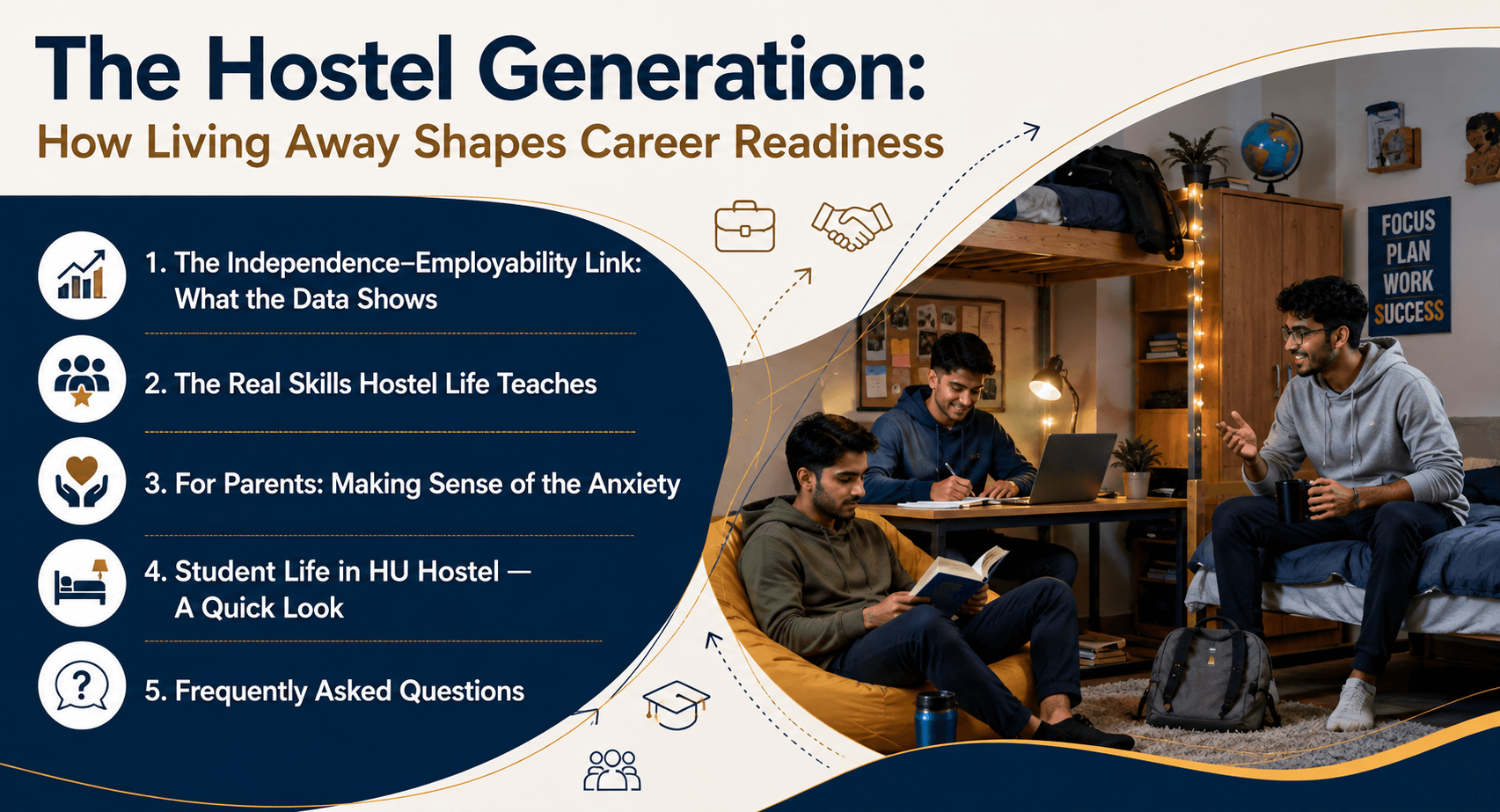
The Hostel Generation: How Living Away Shapes Career Readiness
Mr. Jitendra Chaudhary
Head of Admissions, Haridwar University
Table of Contents
For an eighteen-year-old, moving into a hostel is usually framed as a housing decision. It rarely is. Student life in HU Hostel — like hostel life anywhere — quietly hands students a second, unofficial curriculum: budgeting, conflict resolution, and self-accountability. Employers don't interview for “did well in a hostel,” but those habits are exactly what recruiters mean by “workplace-ready.” This piece looks at what the data says about that link, the skills hostel life builds, and how parents can think about the anxiety of letting go.
1. The Independence-Employability Link: What the Data Shows
No single study isolates hostel living as a standalone cause of employability — that would be a hard claim to prove, and this piece won't pretend otherwise. What the data does show is the shape of the readiness gap that independence-building experiences are meant to close.
According to the India Skills Report 2026 — the 13th edition, released by ETS in partnership with CII, AICTE, AIU and Taggd — national graduate employability rose to 56.35% this year, up from 54.81% in 2025, while employability among engineering (B.Tech) graduates specifically stood at 70.15%, a slight dip from 71.5% the previous year (primary report, published 11 November 2025, checked 26 August 2026).
That gap between “degree completed” and “genuinely employable” is where soft skills live. In an op-ed for Careers360, Deloitte India directors Preeti Khemka and Yagesh Singhania make a similar point from the employer side: recruiters are increasingly prioritising candidates who can collaborate under pressure, solve problems without hand-holding, and show emotional intelligence — not just technical scores (published 26 September 2025, checked 26 August 2026). Independent living doesn't manufacture these traits out of nowhere, but it forces daily, low-stakes practice of exactly this kind — which is arguably why career counsellors keep returning to hostel life as a talking point in admissions conversations, including the ones our own placement cell has with recruiting companies each year.
2. The Real Skills Hostel Life Teaches
Strip away the nostalgia, and hostel life teaches three specific, transferable skills.
2.1 Budgeting: Running Your Own Small Economy
A hostel resident manages a monthly allowance the way a junior employee manages a project budget: fixed inflow, variable outflow, and consequences for miscalculating. Mess bills, laundry, and the odd emergency compete for the same limited amount, with no parent to top it up mid-month. That's the same discipline a first job expects — tracking spend and living within a budget someone else has set.
2.2 Conflict Resolution: Your First Real Workplace Simulation
Sharing a room with someone you didn't choose is, in some ways, better preparation for office life than a soft-skills workshop. Disagreements over noise, cleanliness, or shared space have to be resolved through conversation, compromise, or escalation through the institution's own channels — the same “resolve it yourself, then involve a manager” ladder most workplaces run on. Students who've been through a few of these cycles tend to arrive at their first job less rattled by an irritated colleague or an unclear brief.
2.3 Self-Management: The Skill Behind Every Deadline
Without a parent enforcing a routine, hostel residents build their own: waking up for a 9 a.m. class, submitting assignments on time, and balancing coursework against a more distracting social environment. That's self-management in its rawest form — the same muscle a first job exercises daily. For students who want to see what this looks like professionally before they graduate, the Government of India's National Career Service portal is a useful starting point on workplace expectations.
3. For Parents: Making Sense of the Anxiety
It is entirely reasonable for a parent to feel uneasy about sending a child away from home for the first time — this isn't a phase to be talked out of, it's a rational response to genuine unknowns. What helps is turning the anxiety into concrete, checkable questions rather than a general sense of worry:
What's the institution's day-to-day supervision like? What happens if my child faces harassment or ragging? Is there a way to see the place before committing?
On the supervision question, HU's own homepage lists 24/7 security among its standard hostel features, and the full day-to-day staffing structure — Faculty Warden, Assistant Warden, and Chief Warden, each with a listed contact number — is set out in detail on HU's Hostel Rules page. On the safety question, India's National Anti-Ragging Helpline — 1800-180-5522, run under UGC's monitoring mechanism — operates 24/7, independently of any single university, alongside the on-campus warden contacts listed on that same page. On the “see it first” question — this is genuinely the most reassuring step available, and worth taking before signing off on any decision. Parents and prospective students can arrange this directly:
4. Student Life in HU Hostel — A Quick Look
At Haridwar University, hostel accommodation for the 2026-27 session is priced as follows:
| Room Type | Includes | Annual Fee (2026-27) |
|---|---|---|
| Normal Room | Lodging, mess, laundry | ₹85,000 |
| Semi-Deluxe Room | Lodging, mess, laundry | ₹95,000 |
| Deluxe Room (AC) | Lodging, mess, laundry | ₹1,05,000 |
| Non-veg meal add-on | Optional, all room types | + ₹20,000 / year |
For students on a 4-year programme (most B.Tech courses), the approximate 4-year hostel total — assuming fees stay flat, which they may not — works out to roughly ₹3.4 lakh (Normal), ₹3.8 lakh (Semi-Deluxe), or ₹4.2 lakh (Deluxe AC), before any non-veg add-on. Treat this as an illustrative estimate, not a locked-in figure — confirm the actual year-on-year rate with the admissions office.
On the financial-aid side, HU's rank-based scholarship (tied to JEE, CUET, or Class 12 aggregate performance) discounts first-year tuition by 10% to 80% depending on score band. A separate 25% first-year tuition scholarship applies to girl students, with no additional eligibility condition. The same 25% scholarship also extends to an “Other” category — children of University employees, alumni siblings, orphan children, and defence or freedom-fighter families — who scored above 60% in Class 12. Sports-quota certificate holders are assessed on their own scale, from 10% at school level up to 50% for national achievers.
Beyond the numbers, student life in HU Hostel runs on the same independence-building rhythm described above, on a 20-acre riverside campus first established in 2010 as Roorkee College of Engineering; the campus gained university status under the Haridwar University Act, 2022 (Act No. 16 of 2023). HU's homepage separately lists University Grants Commission, the Pharmacy Council of India, the Indian Nursing Council and the Association of Indian Universities among its approvals and accreditations. Room-sharing arrangements and day-to-day hostel supervision follow the warden structure — Faculty Warden, Assistant Warden, and Chief Warden — set out in full on HU's Hostel Rules page.
On outcomes, HU's own homepage lists a 95% placement rate, an average package of ₹6 LPA, a highest package of ₹60 LPA, and 200+ companies visiting campus, alongside recruiter names like TCS, Wipro, Accenture, Cognizant, IBM, Infosys, HCL and Capgemini pictured on its own placement overview page (all figures as listed on HU's homepage and placement page as of 26 August 2026; these are university-wide figures across all programmes and years, not specific to any single hostel or branch). Placement partners visiting campus each year are, in a sense, the other half of this story: the readiness hostel life builds is what a placement cell tries to showcase to recruiters. Students weighing HU can browse the course list on the Our Programs page or read alumni accounts on the Alumni page before deciding.
Frequently Asked Questions
Q1. Does living in a hostel actually improve employability, or is it mostly about grades?
Grades matter, but recruiters increasingly weigh collaboration and composure under pressure too. Hostel life gives daily practice at exactly these traits, though no single study claims it's the sole cause of employability.
Q2. What specific skills do employers say hostel-experienced graduates tend to have?
Budgeting discipline, comfort with conflict resolution, and self-managed routines are the three most consistently cited — the same traits recruiters flag as increasingly valuable in the sources above.
Q3. Is hostel life necessary for career readiness, or can day scholars build these skills too?
Day scholars can build the same skills through part-time work or other independent responsibilities. Hostel life simply concentrates the practice into daily, unavoidable situations.
Q4. How does HU make sure independence doesn't turn into a student feeling isolated?
HU's placement and student-support teams stay engaged with residents through the year, not just at admission. The full hostel-level supervision structure — Faculty Warden, Assistant Warden, and Chief Warden, each with a listed contact number — is set out on HU's Hostel Rules page, linked above.
Q5. What does HU hostel accommodation actually cost for the 2026-27 session?
Rooms are priced at ₹85,000/year (Normal), ₹95,000/year (Semi-Deluxe) and ₹1,05,000/year (Deluxe AC), with mess and laundry included; a non-veg meal add-on costs ₹20,000/year. See the fees & scholarships page for the complete, current breakdown.
Q6. How can parents cope with the anxiety of sending a child away for the first time?
It helps to turn general worry into specific, checkable questions — who supervises daily life, what's the safety mechanism, and can we visit first — rather than trying to reason the anxiety away in the abstract.
Q7. When's the right time to book a campus or hostel visit before deciding?
Before finalising any admission decision — seeing the hostel, mess and campus in person is consistently the most reassuring step for both students and parents, and it's simple to arrange directly with the university.