

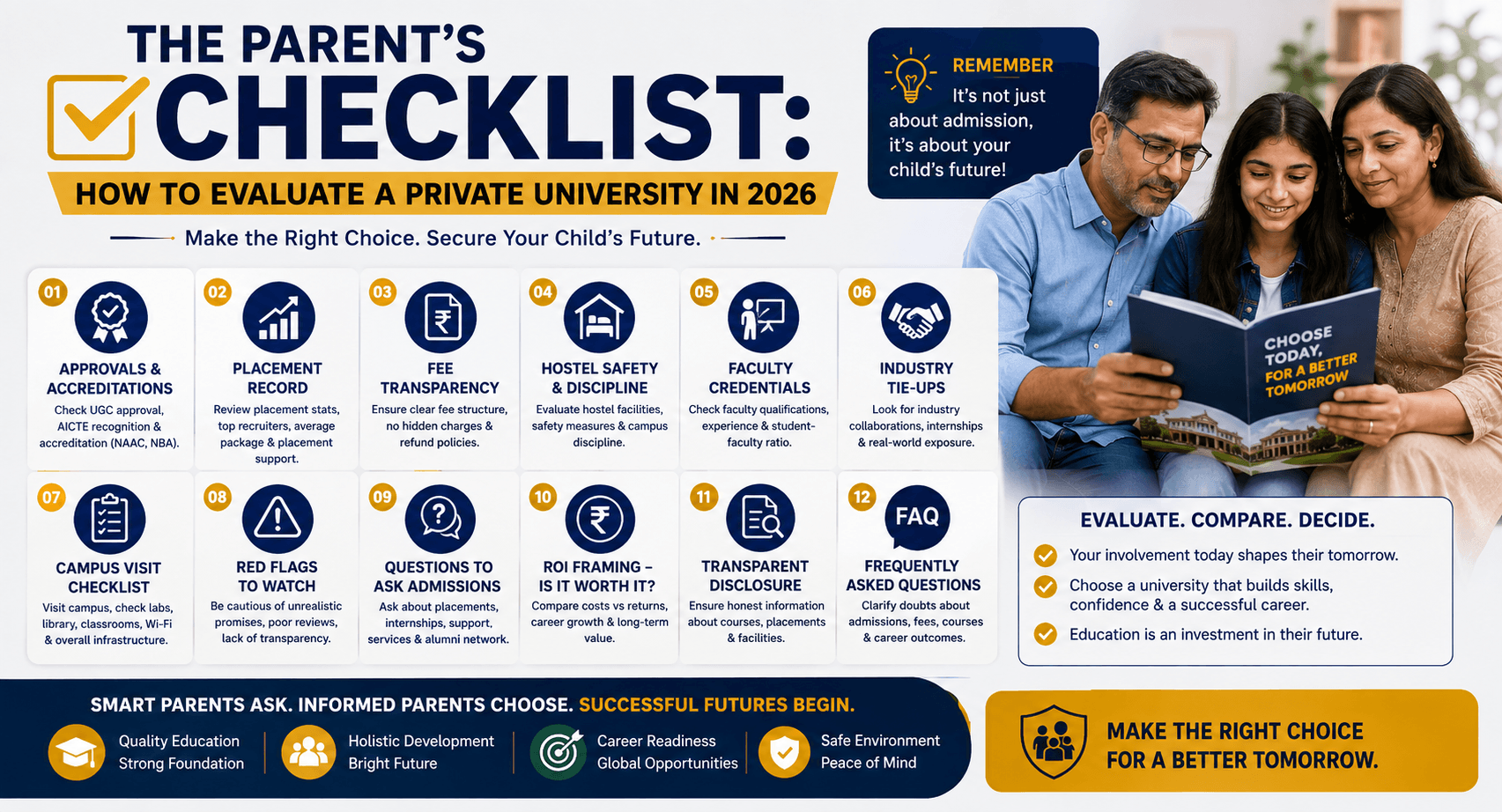
The Parent's Checklist: How to Evaluate a Private University in 2026
Lt Sumit Chauhan
Registrar, Haridwar University
Table of Contents
- Why This Is Written for Parents, Not Students
- 1. Approvals & Accreditations — UGC, AICTE, PCI, NAAC
- 2. Reading Placement Numbers the Way a Recruiter Would
- 3. Fee Transparency & the Costs Nobody Mentions First
- 4. Hostel Safety & Discipline
- 5. Faculty Credentials
- 6. Industry Tie-Ups — Real or Decorative?
- 7. Campus Visit Checklist
- 8. Red Flags to Watch
- 9. Questions to Ask Admissions
- 10. ROI Framing — Is the Degree Worth the Investment?
- A Real-World Example of Transparent Disclosure
- Frequently Asked Questions
A Parent's Job, Not a Marketing Exercise
Every admission season, I meet parents who've already made up their minds — not from homework, but because a counsellor quoted a placement figure too good to double-check. If fifteen years around admissions desks have taught me anything, it's this: how to evaluate a private university isn't a specialist skill reserved for paid consultants. It's a checklist any parent can run through in a single evening. This piece walks through ten such checkpoints — the questions I wish more families asked before the first instalment, not after.
Why This Is Written for Parents, Not Students
An eighteen-year-old choosing between two campuses is usually weighing hostel photographs or which brochure looked more exciting — a normal, age-appropriate way to choose, but not the lens the decision actually needs. The fee receipt, the loan it draws from, and the legal admission form are almost always signed by a parent, not the student. That single fact turns "evaluating a university" from a matter of taste into a financial and legal commitment one adult is accountable for, often for four years running.
That's what makes this a decision piece rather than an information piece: it tells you, step by step, what to check and what to do if an answer doesn't add up — so that by the time you're asked to sign anything, you're doing it with documents in hand, not reassurance in your ears. Every checkpoint below asks not "is this campus impressive," but "can I defend this choice with evidence, a year from now."
The 10-Point Evaluation Checklist
None of these ten checks require special access or insider knowledge. Most take less than fifteen minutes on a government website. Work through them in whatever order suits you, but don't skip the first one.
1. Approvals & Accreditations — UGC, AICTE, PCI, NAAC
A campus can look immaculate in photographs and still run a course no regulator has approved this year — that gap is where most admission regret begins. Before you fall for a hostel block or a wall of recruiter logos, find out precisely what the institution is licensed to teach.
How to Verify Each Approval Online
- UGC recognition confirms whether the institution can legally award a degree in the first place. The official UGC website lets you search recognised universities by name — do this first, since a lapsed or provisional status changes everything that follows.
- AICTE approval for engineering, management, and technical diplomas is renewed every academic year, not granted once. Pull up the AICTE portal and check this year's list specifically — a programme approved two years ago is not automatically approved today.
- Pharmacy Council of India (PCI): Pharmacy is its own category: B.Pharm, D.Pharm, and Pharm.D seats must appear on the Pharmacy Council of India approved-institution list for the current session. A university-wide approval counts for nothing here.
- NAAC accreditation is a quality grade, not a licence to operate — a report card, not a gatekeeper. Look up both the grade and its expiry date on the NAAC portal; a five-year-old 'A' tells you far less than the marketing team would like.
Here's what a genuine, checkable answer looks like: Haridwar University's own Recognitions & Approvals page states its UGC recognition under Section 2(f) of the UGC Act, 1956, plus PCI, Indian Nursing Council, and state-university approval — with a downloadable certificate behind each, not just a logo. That's the standard worth holding every shortlisted university to.
2. Reading Placement Numbers the Way a Recruiter Would
Nearly every prospectus leans on the same trick: one spectacular placement number, floated without context. A '98% placement' figure means little if it's calculated against a shrunk 'eligible pool.' Push past the headline — ask for the percentage against the full class size, and how the median package compares to the single highest one on the banner.
Take Haridwar University's own placement page as an example of why that follow-up matters. It names real recruiters — TCS, ITC, Tech Mahindra, and IBM among them — and states a placement rate in the 86-95% range across passing-out students, depending on the year and programme. That's checkable, since you can verify recruiter names on LinkedIn. But it doesn't volunteer the branch-wise split — ask what share of your child's own branch was placed, since a strong university-wide number can sit alongside a lower number in any one department.
3. Fee Transparency & the Costs Nobody Mentions First
The number quoted during a campus tour is almost never the number a family ends up paying over four years. Development fees, hostel charges, examination re-appearance fees, and a quiet annual increase buried in the fine print add up faster than most parents expect.
Ask for the entire four-year fee sheet in writing at your first meeting, not after a token deposit has changed hands. A transparent university will have this laid out on its fees and scholarships page, caution deposits included, so you can compare true four-year cost across your shortlist. Haridwar University's 2026-27 fee sheet shows the detail worth asking for: a B.Tech (Hons.) CSE seat lists ₹1,32,000 in year one and ₹1,15,000 in years two through four, broken into admission, examination, and uniform charges. The same page spells out merit scholarships in tiers — up to 80% off first-year tuition for a JEE rank inside the top 1,00,000 with above-90% marks, tapering to 50%, 20%, and 10% — plus 25% category scholarships for defence families, alumni siblings, and girl students. Ask for this slab structure in writing.
4. Hostel Safety & Discipline
If your child is going to live on campus, safety isn't a line item buried in a brochure. Ask how many CCTV cameras cover common areas, the real warden-to-student ratio, and whether the anti-ragging committee is functioning or just a name on a noticeboard. Every institution must register its anti-ragging affidavit and display grievance contacts on the National Anti-Ragging Portal; if a college can't produce that on request, treat it as disqualifying rather than merely concerning.
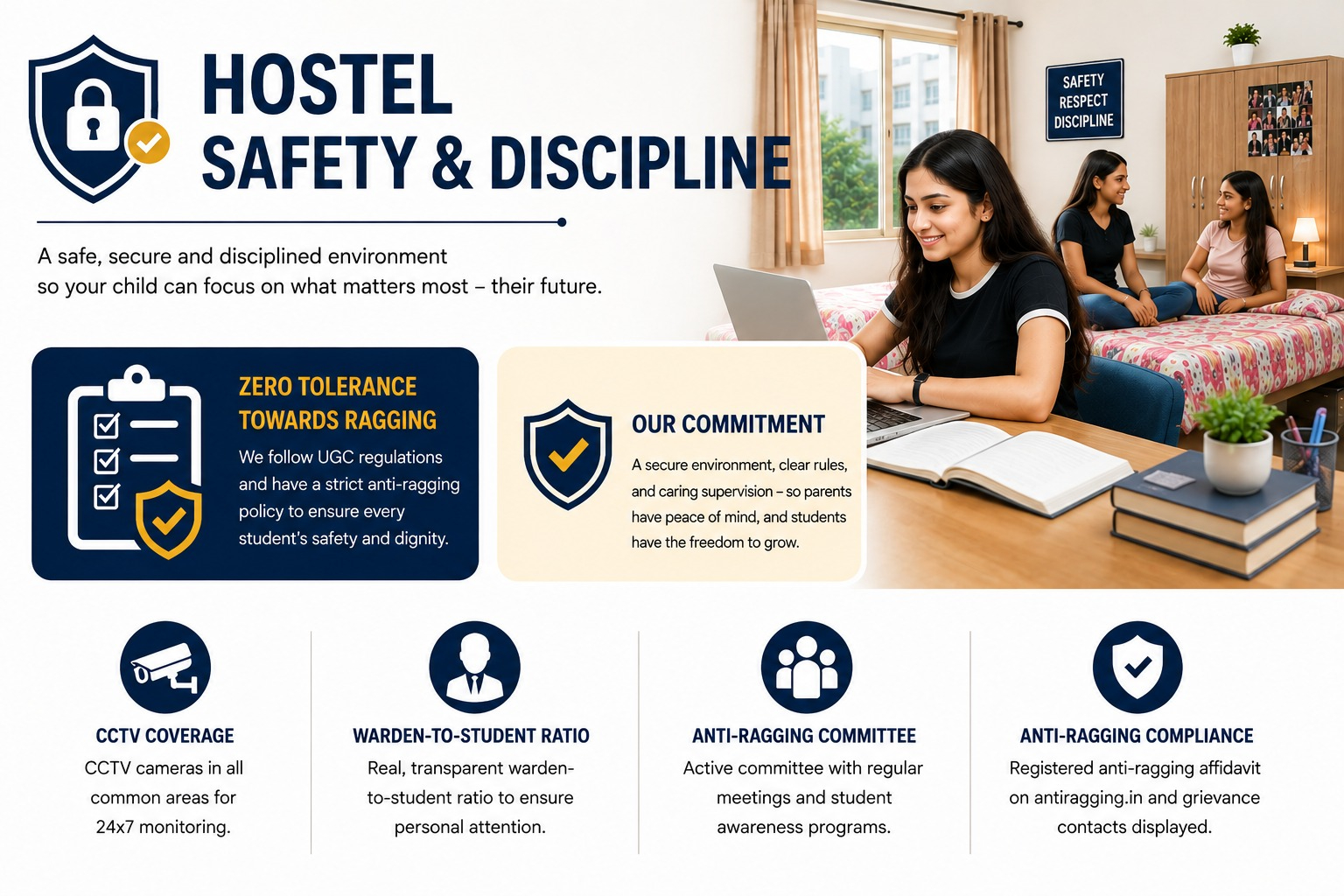
Hostel costs deserve the same scrutiny as tuition. Haridwar University's tariff runs from ₹85,000 a year for a normal room to ₹1,05,000 for an AC deluxe room, mess and laundry bundled in, plus a separate ₹20,000-a-year charge for non-vegetarian meals. Ask for it broken out this way, not as one round figure.
5. Faculty Credentials
Faculty described as 'expert' on a website almost never comes with a name, qualification, or publication attached. Ask instead for a department-wise list — degrees, share of PhD holders, years of experience — for the exact programme your child is applying to.
Cross-check a few of those names against the listings under Academic Programmes or the equivalent page on any shortlisted university's site. Genuine faculty profiles mention research output or industry experience; inflated ones recycle the same three adjectives across every name.
6. Industry Tie-Ups — Real or Decorative?
A wall of partner-company logos proves very little on its own. MoUs get signed once and often never renewed, yet the logo stays on the website for years. Ask when a tie-up was last active, whether it has produced an internship or guest lecture in the past twelve months, and who on campus maintains that relationship.
Look for tie-ups you can date and name, not just a logo strip. Haridwar University, for instance, names its NASSCOM Foundation partnership for applied IT training directly on its placement page, rather than leaving it as an unnamed logo. Ask any shortlisted university for that same specificity.
7. Campus Visit Checklist
No drone footage or virtual walkthrough replaces standing inside a lab and checking whether the equipment switches on. When you visit, sit in on whichever class happens to be running, not one staged for visitors. Taste the mess food without an escort trailing you. Check the library's real seating capacity against enrolment, not the number of shelves on display.
Most institutions will arrange a guided walk-through if you write in through their official contact page ahead of time — but insist on a working academic day, not an open house staged for prospective families.
8. Red Flags to Watch
- An admission offer with no entrance test, no interview, and effectively no eligibility bar.
- Pressure to clear the full fee, or a large non-refundable deposit, within 24 to 48 hours of a campus visit.
- Reluctance — or a flat refusal — to hand over the current-year AICTE, UGC, or PCI approval letter in writing.
- Placement claims that can't be broken down by company, package, or branch when you ask directly.
- No accreditation history visible on the NAAC website, despite confident claims of an active grade on campus banners.
9. Questions to Ask Admissions
- What is this year's AICTE, UGC, or PCI approval reference number, and can I get it emailed to me?
- What was last year's actual placement percentage for this specific programme — not the university as a whole?
- What is the complete four-year cost, hostel, exams, and every compulsory charge included?
- Can I speak with a current second- or third-year student without an admissions staff member in the room?
If a counsellor can't answer these on the spot, ask them to confirm the current programme's approval on the Pharmacy Council of India site for pharmacy courses, or the corresponding AICTE or UGC listing otherwise — and follow up over email so the answer exists in writing, not just memory.
10. ROI Framing — Is the Degree Worth the Investment?
At bottom, how to evaluate a private university is a question of ROI: total cost weighed against realistic, checkable earning outcomes — not the single best-case package quoted during counselling. Ask for placement data across the last three years, not just the most recent, set against the total four-year spend.
Named outcomes beat averages. Haridwar University's alumni page carries a testimonial from Shivani Bhati, who names her employer directly — Tech Mahindra — instead of speaking vaguely about 'great opportunities.' A recent recruitment drive on the university's news page separately notes a placement at ₹48 LPA. Figures like these matter because they're specific enough to check; ask any shortlisted university for names and companies, not just an average with no way to trace it.
A Real-World Example of Transparent Disclosure
As one example of this kind of disclosure in practice, Haridwar University, on the Roorkee–Haridwar Canal Road in Uttarakhand, lists its UGC, PCI, and Indian Nursing Council recognitions with downloadable certificates on its Recognitions & Approvals page, publishes its full 2026-27 fee and scholarship structure by programme, and names its placement recruiters rather than routing every detail through a phone call. This isn't a claim that any one university suits every family — it's a benchmark for the kind of checkable detail parents should expect. If an institution can't match this level of open disclosure, that's worth asking about directly.
Frequently Asked Questions
1. Where should a parent actually begin — the fees, the campus, or the approvals?
Start with approvals, always. Fee negotiations and campus visits are worth your time only once you've confirmed the exact programme is currently recognised by UGC, AICTE, or PCI. Everything else follows from that first, non-negotiable check.
2. Isn't UGC approval the same thing as AICTE approval?
No — they cover different ground. UGC recognises a university's overall standing to award degrees; AICTE separately approves specific programmes yearly. A university can hold valid UGC status while one AICTE course has quietly lapsed, so check both independently.
3. How exactly do I confirm a pharmacy programme's PCI approval?
Visit the Pharmacy Council of India's approved-institutions list for the current session and search the exact institution and course name. PCI approval is renewed programme by programme, year by year — a general 'PCI approved' claim isn't sufficient on its own.
4. Does a NAAC grade guarantee strong placements?
It doesn't, and treating it that way is a common mistake. NAAC assesses governance, infrastructure, and academic process, not employment outcomes. Use it as one data point, and verify placements separately.
5. What hidden costs catch parents off guard most often?
Development fees, hostel charges for day scholars, exam re-appearance fees, small annual increases, and caution deposits with unclear refund terms. Ask for one written four-year fee schedule before you commit.
6. If the website already looks impressive, is a physical campus visit still worth the trip?
Yes, and it isn't close. Photos and virtual tours can be staged or outdated. A visit lets you check lab equipment, whether the hostel matches the brochure, and whether students speak candidly with no staff nearby.
7. What should a parent actually do during that visit?
Sit in on whichever class happens to be running rather than a staged one, ask for current-year approval letters on the spot, request placement data by branch and year, and try to speak with second- or third-year students privately.
8. What's a sensible way to work out ROI before committing?
Add the full four-year cost, hostel and incidentals included, against realistic starting salaries from the last three placement cycles, not the highest banner figure. A chat with a recent alumnus about actual career progression often says more than any prospectus.
9. What's the one red flag parents most often talk themselves out of noticing?
Time pressure. A demand to pay a large, non-refundable amount within a day or two, before approval documents or a verifiable placement breakdown are shared, is the clearest signal to slow down. An institution confident in its disclosure will give you time to check its claims.
Evaluating Private Universities for 2026?
Explore programmes, recognitions, and fee structure at Haridwar University.