

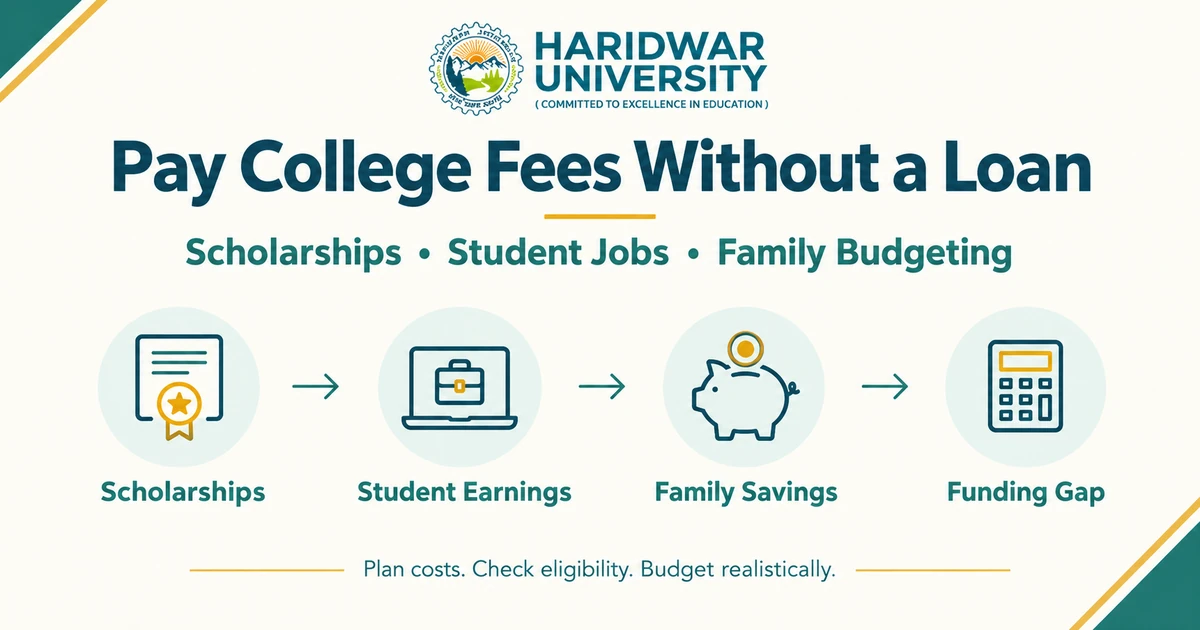
Paying for a college degree without borrowing requires more than simply finding a scholarship. Families need to understand the complete cost of attendance, identify financial support they are genuinely eligible for, plan household contributions steadily across the academic year, and decide how much a student can realistically earn without compromising coursework. If you are exploring how to pay college fees without a loan in India, starting with verified numbers rather than relying on a single funding source is essential.
The most dependable approach integrates four pillars: verified institutional and government scholarships, disciplined family savings, manageable student side-work, and a clear budget for tuition and living costs. While no single formula fits every household, a written financial roadmap reveals exactly how much funding is already available, what shortfall remains, and which practical steps to prioritize first.
Table of Contents
- 1. How to Pay College Fees Without a Loan in India
- 2. Scholarships That Can Reduce Your College Fees
- 3. How to Earn Money While Studying
- 4. How Families Can Plan and Save for College Fees
- 5. How to Calculate Your Degree Funding Gap
- 6. Which College Funding Options Are Truly Debt-Free
- 7. How Haridwar University Students Can Explore Scholarships and Fees
- 8. Frequently Asked Questions (FAQs)
- 9. Building a Realistic Plan to Fund Your Degree
1. How to Pay College Fees Without a Loan in India
Begin by separating the overall cost of higher education into four distinct categories: university academic fees, accommodation and mess food, daily or term travel, and academic/personal expenses (including books, software, laptop equipment, and internet access). A tuition fee that appears manageable on a promotional brochure can strain family finances when living expenses and incidental charges are overlooked.
Next, calculate what your household can comfortably contribute from existing savings and monthly disposable income. Then subtract confirmed scholarships and any realistic part-time earnings the student can set aside. This establishes a grounded funding plan built on real cash flow rather than wishful estimates.
Five-Step Sequential Funding Strategy
- Compare the comprehensive four-year cost of your shortlisted degree programmes.
- Verify institutional, state, and central government scholarship eligibility.
- Set a sustainable family contribution that can be maintained across all semesters.
- Identify genuine part-time work or paid summer internships that fit class schedules.
- Evaluate the remaining shortfall before paying admission or hostel enrollment deposits.
Remember the fundamental distinction: a scholarship permanently reduces the gross amount you owe, whereas a fee instalment arrangement merely splits payment dates. Instalments assist monthly cash flow, but they do not diminish the cumulative institutional fee.
2. Scholarships That Can Reduce Your College Fees
Scholarships provide the strongest foundation for debt-free college education because grants do not require repayment. However, the term scholarship does not automatically signify a 100% free ride. Many schemes cover specific portions of tuition, apply exclusively to the initial academic year, or depend on strict board examination percentages, entrance test ranks, domicile, or sports achievements.
Students should systematically explore three scholarship streams:
- University Merit & Category Scholarships: Review the published fee regulations of each prospective institution. Check exact award percentages, qualifying rank cutoffs, duration (single-year vs renewable), and CGPA maintenance criteria.
- Central Government Schemes: Access the official National Scholarship Portal (NSP). For the 2026–27 academic session, NSP requires One-Time Registration (OTR) to submit applications across Central Sector schemes, AICTE Pragati/Saksham grants, and ministry stipends.
- State Domicile and Social Welfare Support: Check state higher education portals for post-matric scholarships linked to state domicile, parental income thresholds, or affirmative categories.
Keep essential documentation organized: verified Class 10 and 12 marksheets, valid Aadhaar card, income certificate issued by a competent revenue authority, domicile certificate, active bank passbook (Aadhaar-seeded), and university admission letter. Always apply through official government or university portals, avoiding unauthorized third-party processing agents.
3. How to Earn Money While Studying
Student work can help cover books, transit, data packs, or semester examination fees, but it should be treated as supplementary income rather than a full replacement for tuition funding. Earnings depend heavily on marketable skills, local campus opportunities, and time management.
| Opportunity Type | Key Considerations |
|---|---|
| Academic Tutoring | Teaching secondary school students math, science, or English locally or via online platforms offers steady hourly compensation. |
| Digital Freelancing | Graphic design, content drafting, video editing, social media management, or coding for clients allows flexible weekend work. |
| Paid Summer / Winter Internships | Stipend-based industry internships provide professional workplace exposure while yielding lumpsum contributions toward semester fees. |
| Campus / Departmental Assistance | Assisting in campus computer laboratories, libraries, or administrative centers aligns conveniently with class schedules. |
Beware of Online Work Scams: Disregard advertisements promising guaranteed daily earnings of ₹1,000–₹2,000 with zero skills. Never pay upfront registration fees, security deposits, or accept roles asking you to transfer funds between accounts. Set a realistic target (such as earning ₹2,000–₹4,000 monthly) and safeguard academic study hours.
4. How Families Can Plan and Save for College Fees
Household budgeting succeeds when planned well in advance of the admission notification. Review the fee structure, calculate living costs, and divide the required family funding across the available savings timeline.
For instance, if a household must accumulate ₹1,20,000 over 12 months, setting aside exactly ₹10,000 every month is necessary. If that monthly figure exceeds the family surplus, the student and parents should evaluate course options, local commuting versus on-campus hostels, or fee concessions early.
Four Components of a Resilient Savings Strategy
- Dedicated Higher Education Account: Keep academic funds segregated from daily household checking accounts to prevent incidental spending.
- Term-Wise Payment Schedule: Record exact due dates for admission confirmation, semester exam charges, hostel fees, and uniform dues.
- Contingency Reserve: Budget a 10% buffer for urgent medical needs, project travel, or replacement of computing hardware.
- Annual Re-Assessment: Re-examine the budget before each academic year, as hostel utility charges or transport routes may be revised.
5. How to Calculate Your Degree Funding Gap
A funding-gap calculation converts vague worries into a clear, actionable target. Use this practical formula:
Funding Gap = Total Education Costs − Confirmed Scholarships − Family Contribution − Allocated Savings − Realistic Student Earnings
| Budget Item / Funding Source | Annual Amount (₹) |
|---|---|
| Tuition and Academic Charges | ₹1,50,000 |
| Living, Hostel and Personal Expenses | ₹60,000 |
| Total Estimated Annual Outlay | ₹2,10,000 |
| Less: Confirmed Merit Scholarship | −₹30,000 |
| Less: Family Contribution from Income & Savings | −₹1,00,000 |
| Less: Student Earnings Allocated to College Costs | −₹20,000 |
| Net Remaining Funding Gap to Bridge | ₹60,000 |
In this illustrative scenario, the family's actionable target is ₹60,000, not the daunting original gross figure of ₹2,10,000. That targeted sum can be tackled through supplementary grant applications, minor expenditure adjustments, or structured payment dates negotiated with the admissions office.
6. Which College Funding Options Are Truly Debt-Free
Not every financing option promoted as an alternative to a bank loan is genuine debt-free support. Before adopting any mechanism, confirm whether future repayment liabilities, interest charges, or penalty clauses apply:
| Funding Option | Truly Debt-Free? | Key Verification Check |
|---|---|---|
| Scholarship / Fee Waiver | Yes | Eligibility slabs, renewal requirements, and tenure. |
| Family Accumulated Savings | Yes | Ensure emergency liquidity remains untouched. |
| Family Monthly Income | Yes | Sustainable across all multi-year semester cycles. |
| Paid Internship / Student Job | Yes | Timely stipends that do not compromise academic attendance. |
| Fee Instalment Plan | Cash-flow tool only | Does not reduce the fee total; check late payment terms. |
| Credit Cards / Fintech EMI Plans | No (High Debt) | High interest rates, hidden processing fees, and penalties. |
| Bank Education Loan | No (Formal Debt) | Requires full repayment plus interest upon graduation. |
If a legitimate funding gap persists despite savings and grants, read our comparative guide on Scholarship vs Education Loan: How to Fund Your HU Degree to evaluate formal student credit versus debt-free funding transparently.
7. How Haridwar University Students Can Explore Scholarships and Fees
Prospective students exploring admission at Haridwar University can review verified schedules directly on our official Fees & Scholarships Portal for the 2026–27 academic session. All published figures comprehensively cover tuition, enrollment, admission, examination, and uniform fees.
Haridwar University provides substantial institutional fee waivers, including merit scholarships up to 80% on tuition fees based on JEE Main ranks, CUET percentiles, and Class 12 board marks, sports achievements, and dedicated 25% tuition waivers for girl students, Uttarakhand domicile holders, and children of Armed Forces personnel. Consult our detailed Haridwar University Scholarship Eligibility & Application Guide and the HU Fee Structure Guide 2026–27 for itemized course breakdowns.
Families can explore our multidisciplinary degree offerings across engineering, computer applications, management, pharmacy, commerce, and agricultural sciences on the Haridwar University Academic Programmes directory.
8. Frequently Asked Questions (FAQs)
Can I complete a college degree in India without taking an education loan?
Yes. Many students fund their degree debt-free by combining institutional merit scholarships, government welfare grants, disciplined family contributions, and earnings from internships or part-time work.
Where can I find scholarships for undergraduate students in India?
Check your university's official scholarship portal, the central National Scholarship Portal (NSP), and state higher education department websites for domicile and merit schemes.
Can a scholarship cover the entire college fee?
Certain highly competitive full-ride scholarships cover 100% of tuition, but most institutional awards waive between 10% and 80% of tuition fees. Incidental charges like hostel, mess, and books usually require separate budgeting.
How can I earn money as a student while attending college?
Students frequently earn through subject tutoring, remote digital freelancing (content writing, design, web development), paid semester break internships, and campus student assistant roles.
How much should a family save each month for college fees?
Divide the net annual fee after scholarships by the available saving months. For example, budgeting ₹1,20,000 across a 12-month period requires saving ₹10,000 per month.
Are college fee instalments the same as a debt-free funding option?
No. Fee instalment facilities ease cash flow by dividing semester bills into smaller chunks, but they do not reduce the cumulative fee owed to the university.
What should I do if scholarships, savings and family contributions do not cover the full cost?
Re-evaluate optional expenses, look into additional government or philanthropic grants, discuss institutional payment timelines with admissions counselors, and compare formal education loan options carefully before signing any agreement.
9. Building a Realistic Plan to Fund Your Degree
Higher education becomes far less stressful to manage when families plan early with verified figures. The most effective way to complete college without debt is to construct a balanced funding roadmap before orientation, secure every institutional scholarship for which you qualify, and re-assess your budget at the start of each academic year.
This proactive methodology empowers students and parents to choose a degree programme that is not only academically enriching, but financially sustainable throughout all four years.
Plan Your Degree Funding at Haridwar University
Discover our transparent fee structures, check your eligibility for merit and category scholarships, and speak directly with our admissions and student welfare counselors today.