

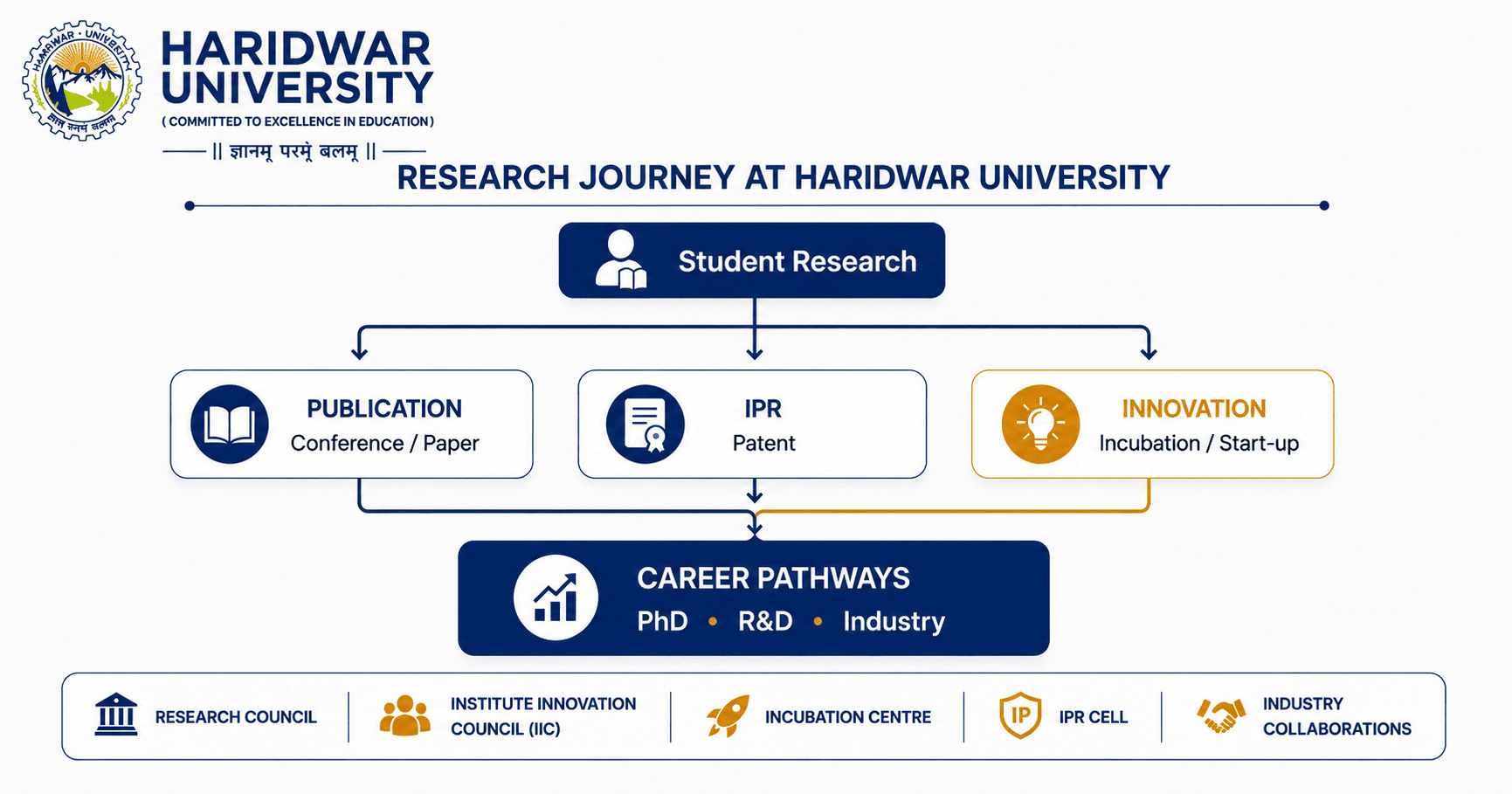
Research at Haridwar University connects academic learning with research, innovation, industry collaboration and entrepreneurship. The University's Research Council works to strengthen academic-industry collaboration while supporting incubation, innovation and entrepreneurial development. Its research framework also aims to develop research skills among students and encourage original publications and patents.
For students, this creates opportunities to move beyond classroom learning. A research idea can develop through laboratory work, faculty guidance and project-based learning and potentially progress towards a publication, intellectual property, start-up or higher research degree.
Table of Contents
- 1. Research Labs and Infrastructure at HU
- 2. What Areas Does HU Research Cover?
- 3. How Can Students Get Involved in Research?
- 4. Research Publications, Conferences and Patents
- 5. From Research to Innovation and Start-ups
- 6. Research-to-Career Pathways
- 7. How to Approach a Faculty Mentor for Research
- 8. FAQs
- 9. Explore Research at HU
1. Research Labs and Infrastructure at HU
Haridwar University's laboratory infrastructure covers engineering, computing, sciences, agriculture and pharmacy. The University's page lists Virtual, AI, Civil, Mechanical, Electrical, Electronics & Communication, Chemistry, Physics, Research, Agriculture and Pharmaceutics laboratories.
| Research area | HU laboratory | Focus |
|---|---|---|
| Artificial Intelligence | AI Lab | AI, Deep Learning, Machine Learning and Big Data Analytics |
| Engineering | Civil, Mechanical, Electrical & Electronics Labs | Practical experimentation and engineering applications |
| Science | Chemistry and Physics Labs | Experimental and foundational sciences |
| Materials & applied research | Research Laboratory | Materials creation, characterisation and computational research |
| Agriculture | Agriculture Lab | Soil testing, medicinal plants and plant-related research |
| Pharmacy | Pharmaceutics Lab | Dosage forms, formulation and pharmaceutical production |
| Multidisciplinary learning | Virtual Lab | Simulation-based experiments across scientific and engineering fields |
The AI Lab identifies research directions in Artificial Intelligence, Deep Learning, Machine Learning and Big Data Analytics. Its objectives also include encouraging students to submit research articles, develop patents and explore start-ups.
The Research Laboratory provides facilities for creating crystalline, polycrystalline, amorphous and nano-scale materials, along with characterisation facilities for conductivity, band-gap and acoustical testing and computational research.
2. What Areas Does HU Research Cover?
HU's Research Publications record demonstrates research activity across engineering, science, agriculture, computer science and humanities. The published work includes research on heat exchangers, PMMA-based denture materials, IoT, gold-price variations, civil engineering materials, soil stabilisation, agriculture, computer-assisted education and piezoelectric materials.
Selected Research Areas Documented by HU
| Discipline | Examples of research themes |
|---|---|
| Computer Science | Computer vision, AI, IoT and data-driven applications |
| Mechanical Engineering | Heat transfer and material properties |
| Civil Engineering | Structural materials, slabs and soil stabilisation |
| Agriculture | Ecology, sericulture, soil and rural development |
| Electrical & Electronics | Electronics, communication and technology applications |
| Science | Materials, environmental and physical science |
| Humanities | Human values and workplace-related research |
This multidisciplinary spread gives students opportunities to explore research questions within their own academic discipline or, where appropriate, at the intersection of multiple fields.
3. How Can Students Get Involved in Research?
Students can begin developing research skills during undergraduate and postgraduate study. HU's Research Promotion Policy explicitly identifies the development of research skills among students as an objective and encourages original research publications and patents. The policy also recognises UG and PG students under its research-publication framework.
The AI Lab similarly encourages students to work towards research articles, patents and start-ups.
A practical student research pathway can look like:
Choose an area → identify a research question → approach a faculty mentor → conduct experiments or analysis → document findings → develop a paper, prototype or invention → explore publication, IPR or incubation.
This is a practical framework rather than a prescribed University procedure. Students should confirm project requirements and available opportunities with their department or faculty mentor.
4. Research Publications, Conferences and Patents
HU maintains a publication record containing research contributions across multiple disciplines. The online database includes publications from 2024 and earlier years, with research spanning engineering, science, agriculture, computer science and humanities.
HU's Research Promotion Policy also recognises knowledge sharing through seminars, symposiums, workshops and conferences and provides a formal framework for research dissemination.
From Research to Intellectual Property
Research can also move beyond publication. HU's Intellectual Property Rights Cell supports students and researchers in protecting and commercialising ideas and technologies. Its scope includes patents, trademarks, copyrights, confidential information and technology transfer.
HU's published patent records include AI Based Currency Verifier, listed as a granted patent under CSE, and Deep Learning-Based Weather Prediction in Global Position, also listed as granted.
For students developing potentially patentable work, understanding IPR before public disclosure is important. The University's IPR framework sets out provisions covering inventions and discoveries developed within the University and explains responsibilities relating to patenting and technology transfer.
5. From Research to Innovation and Start-ups
Research at HU connects with a wider innovation ecosystem through the Institute Innovation Council and the Incubation Centre.
The IIC focuses on developing a local innovation ecosystem, scouting ideas, pre-incubation and entrepreneurship support. Its listed activities include workshops, seminars, interactions with entrepreneurs and professionals, mentorship for student innovators, concept competitions, mini-challenges and hackathons involving industry engagement.
The Incubation Centre provides a structured process for ventures:
| Stage | Incubation process |
|---|---|
| 1 | Application |
| 2 | Pre-screening |
| 3 | Expert committee review |
| 4 | Interview |
| 5 | Approval |
| 6 | Financial support |
| 7 | Execution |
| 8 | Delivery |
| 9 | Commercialisation support |
The centre's stated objectives include developing a start-up culture, addressing real-life challenges through mentorship and translating innovative ideas into products with commercial potential.
For students, this creates a potential progression from research question → prototype → intellectual property → incubation → commercialisation.
6. Research-to-Career Pathways
Research experience can support several career directions after graduation.
| Pathway | Possible progression |
|---|---|
| Academic research | UG/PG research → advanced research → PhD → academic career |
| Industry R&D | Project/lab experience → technical role → specialist R&D |
| Innovation | Research idea → prototype → IPR → incubation/start-up |
| Industry projects | Research project → practical exposure → internship → employment |
Students interested in advanced research can explore HU's Doctoral Programme, which covers research areas including Engineering & Technology, Arts & Humanities, Management & Commerce, and Science & Mathematics. The programme highlights expert supervision, research facilities and collaborative opportunities.
Research experience can therefore be relevant not only to students planning a PhD, but also to those targeting technical R&D, specialist roles, innovation or entrepreneurship.
7. How to Approach a Faculty Mentor for Research
Students interested in research can begin with a focused conversation rather than a broad request.
- Choose a specific area: Identify a subject that interests you, such as AI, materials, agriculture, civil engineering, electronics or pharmaceutical research.
- Read before approaching: Look at the faculty member's research interests, publications or current project areas.
- Prepare a short idea: Explain the problem you want to investigate, your proposed approach and why the topic matters.
- Ask for academic guidance: Request a short discussion about whether the idea could develop into a project, paper, prototype or further research topic.
A clear research question gives a faculty mentor something specific to evaluate and improve.
8. FAQs
1. What research facilities are available at Haridwar University?
HU has AI, Civil, Mechanical, Electrical, Electronics & Communication, Chemistry, Physics, Research, Agriculture and Pharmaceutics Labs, along with Virtual Lab facilities.
2. Can undergraduate students participate in research at Haridwar University?
Yes. HU encourages student involvement in research projects, publications, patents and innovation activities.
3. Does Haridwar University support student research publications?
Yes. HU's research framework supports student research and publications, with the AI Lab also encouraging research article submissions.
4. Does Haridwar University support innovation and start-ups?
Yes. The Research Council, IIC and Incubation Centre support innovation, entrepreneurship, mentorship, IPR and start-up development.
5. What research areas are covered at Haridwar University?
Research spans AI and Machine Learning, engineering, materials, agriculture, pharmacy, sciences, computer science and other interdisciplinary areas.
6. What does the Research Council do at Haridwar University?
It promotes research, academic-industry collaboration, innovation, incubation, intellectual property development and entrepreneurship.
7. Can research experience help students pursue R&D careers or a PhD?
Yes. Research experience can support pathways towards doctoral studies, industry R&D, specialist technical roles and entrepreneurship.
8. How can students start research at Haridwar University?
Students can identify an area of interest, explore relevant labs and approach a faculty member for guidance on projects, experiments or publications.
9. Explore Research at HU
Research at Haridwar University brings together laboratories, faculty research, student research development, publications, intellectual property, industry collaboration and innovation activities.
For students, the important opportunity is the ability to connect what they learn with what they can investigate, build, publish or develop. A well-defined research question, supported by laboratory facilities and faculty guidance, can become a foundation for a publication, patent, start-up, PhD or research-oriented career.