

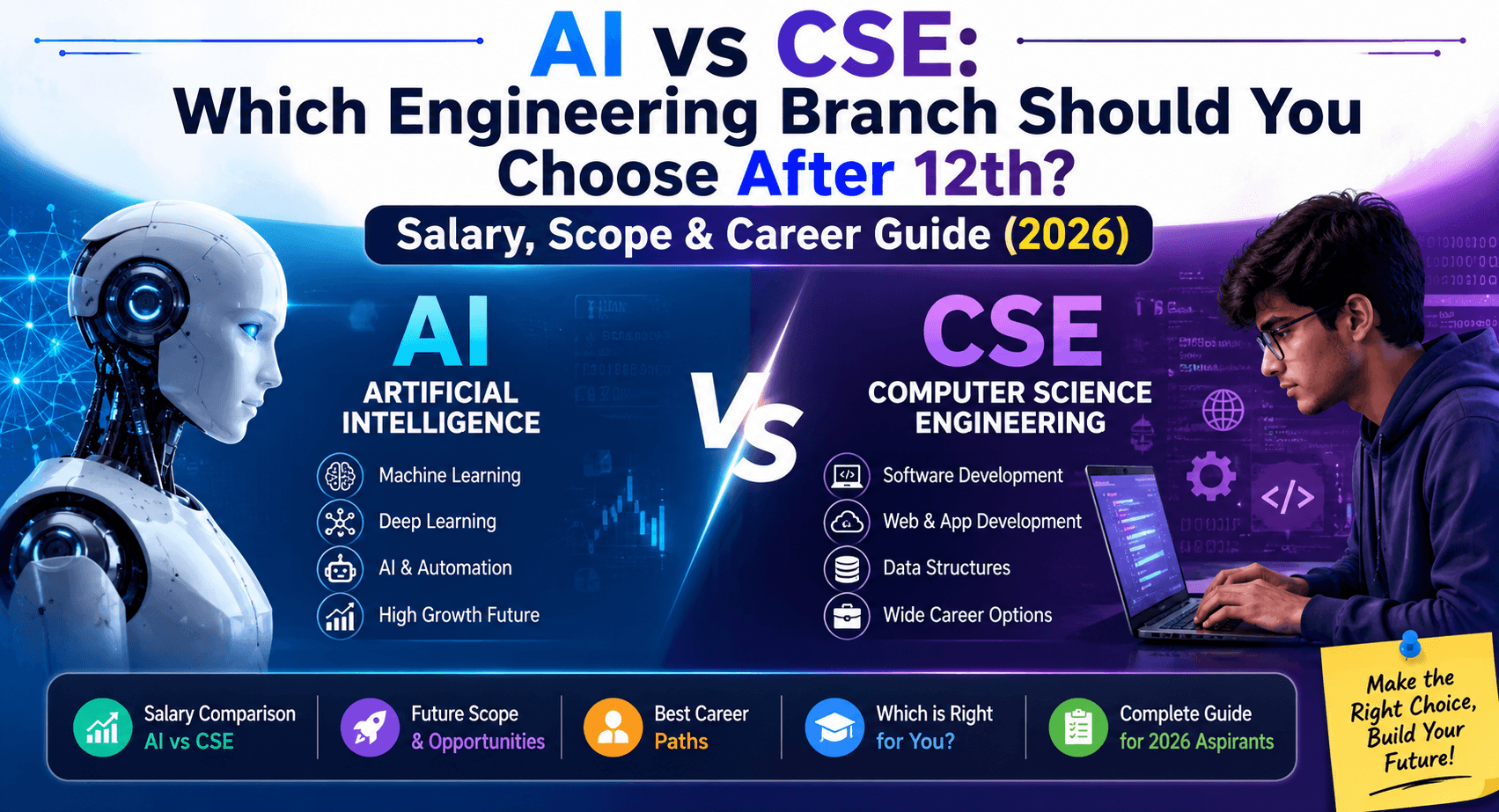
AI vs CSE: Which Engineering Branch Should You Choose After 12th? Salary, Scope & Career Guide (2026)
Haridwar University
Quick Answer
If you are confused between AI vs CSE, the right choice depends on your interests, career goals, and the type of engineer you want to become.
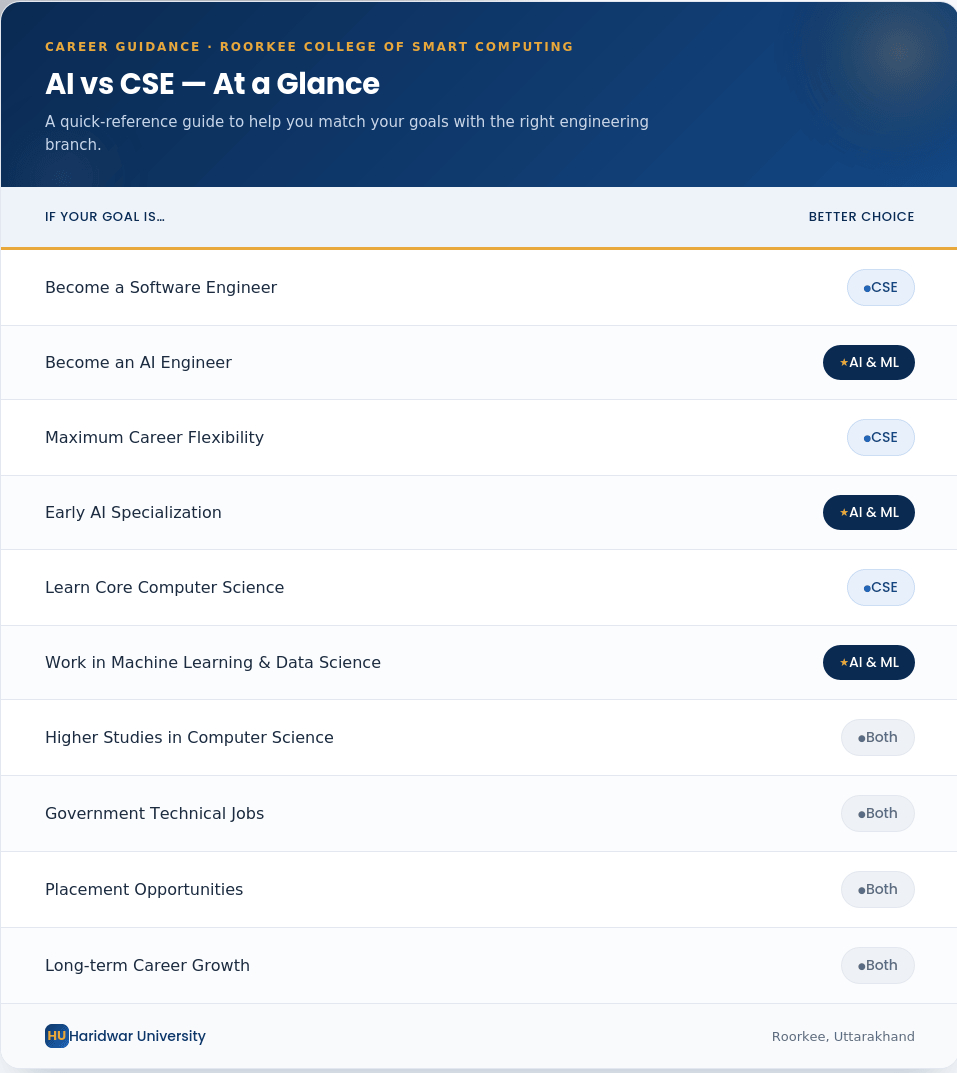
Choose Computer Science Engineering (CSE) if you want a broad foundation in software development, programming, cloud computing, cybersecurity, and multiple technology domains.
Choose Artificial Intelligence & Machine Learning (AI & ML) if you are passionate about intelligent systems, data science, automation, robotics, and building AI-powered applications.
The good news is that both branches offer excellent career opportunities, competitive salaries, and strong placement potential. Your long-term success will depend more on your skills, projects, internships, and continuous learning than the branch name alone.
Introduction
Choosing an engineering branch after Class 12 is one of the most important academic decisions a student will make. As Artificial Intelligence transforms industries across healthcare, finance, manufacturing, education, and cybersecurity, many students wonder whether to pursue a specialised AI degree or a broader foundation through Computer Science Engineering.
The confusion is understandable — AI attracts attention through innovations such as generative AI and intelligent automation, while CSE remains a trusted, versatile branch producing software engineers, cybersecurity professionals, and cloud engineers for decades. Students often ask questions such as:
-
Is AI better than CSE?
-
Does AI offer better salaries than Computer Science Engineering?
-
Which branch has better placement opportunities?
-
Can a CSE student become an AI Engineer?
-
Will AI replace traditional software engineering jobs?
-
Which course has a better future in India and abroad?
-
Which engineering branch should I choose after Class 12?
This guide answers these questions by comparing both branches across curriculum, career opportunities, salaries, placement potential, higher education options, industry demand, and future scope, so you can decide based on your interests rather than online trends.
Why This Decision Matters More Than Ever
The technology industry is evolving faster than ever. Companies are investing heavily in AI, cloud computing, cybersecurity, and automation, while still hiring large numbers of software engineers who design, secure, and maintain digital systems. Students are no longer choosing between an “old” and a “new” branch, they are choosing between two highly relevant career pathways.
According to the World Economic Forum’s Future of Jobs Report (Outbound Link → World Economic Forum Future of Jobs Report), AI and Big Data are among the fastest-growing skill areas globally, but the report also highlights continued demand for software development and cybersecurity, core strengths of CSE. Reports from NASSCOM (Outbound Link → NASSCOM AI & Technology Reports) and Deloitte India (Outbound Link → Deloitte AI Insights) similarly point to strong demand for both traditional computer science and specialised AI skills in India.
The takeaway is simple: Artificial Intelligence is growing rapidly, but it is building on the foundation of computer science, not replacing it.
Key Takeaway
If you are looking for maximum flexibility across the technology industry, CSE remains one of the strongest engineering choices. If you are already passionate about Artificial Intelligence, data science, and intelligent systems, AI & ML offers an exciting opportunity to specialise early. Neither branch is universally better. The best choice depends on your interests, strengths, and long-term career goals.
- Computer Science Engineering (B.Tech CSE)
- Artificial Intelligence & Machine Learning (B.Tech AI & ML)
- Roorkee College of Smart Computing
- Engineering Programmes at Haridwar University
- Admissions 2026

Understanding CSE and AI & ML: What Will You Actually Study?
Many students assume Artificial Intelligence is completely different from Computer Science Engineering. In reality, both programmes share a strong technical foundation but gradually move in different directions as the course progresses.
Think of Computer Science Engineering as learning the entire ecosystem of computing, while Artificial Intelligence & Machine Learning is one of the fastest-growing specializations built on that ecosystem.
Who Should Read This Guide?
📌 This guide is especially helpful if you are:
✔ A Class 12 (PCM) student exploring engineering options.
✔ A parent helping your child choose the right B.Tech programme.
✔ Preparing for JEE, CUET, or university admissions.
✔ Interested in Artificial Intelligence, Software Development, Data Science, or emerging technologies.
✔ Confused after reading different opinions online about AI vs CSE.
What is Computer Science Engineering (CSE)?
Computer Science Engineering (CSE) is one of the most established and versatile engineering disciplines, focusing on computing systems, software development, programming, algorithms, and digital technologies. Students learn how software is designed, developed, tested, secured, and deployed, and how systems communicate, process data, and solve complex problems. This broad curriculum lets CSE graduates work across almost every technology-driven industry — software companies, startups, banks, healthcare, manufacturing, e-commerce, and government organizations.
Students interested in exploring the complete curriculum can learn more through B.Tech Computer Science Engineering (Internal Link → B.Tech CSE Course Page).
Core Subjects in Computer Science Engineering
Although subjects may vary slightly between universities, most CSE programmes include:
-
Programming with C, C++, Java, and Python
-
Data Structures and Algorithms
-
Database Management Systems (DBMS)
-
Operating Systems
-
Computer Networks
-
Object-Oriented Programming
-
Software Engineering
-
Web Development
-
Cloud Computing
-
Cyber Security
-
Compiler Design
-
Computer Architecture
-
Artificial Intelligence Fundamentals
-
Mobile Application Development
-
DevOps Basics
Notice that Artificial Intelligence itself is usually introduced as one of the subjects inside Computer Science Engineering, because AI is built upon core computer science concepts rather than existing independently.
Key Takeaway
CSE prepares students to become adaptable technology professionals. Instead of limiting you to one specialization, it provides a broad foundation that can later lead to careers in software engineering, AI, cybersecurity, cloud computing, DevOps, product development, or entrepreneurship.
What is Artificial Intelligence & Machine Learning (AI & ML)?
Artificial Intelligence & Machine Learning (AI & ML) is a specialized branch that combines Computer Science fundamentals with advanced topics in intelligent systems and data-driven technologies. Instead of only building software, AI & ML focuses on designing systems that learn from data, recognize patterns, make predictions, understand language, and support intelligent decision-making, powering recommendation engines, virtual assistants, fraud detection, self-driving vehicles, and medical diagnosis tools. Demand for AI-skilled professionals continues to grow.
Students who want to explore programme details can visit B.Tech Artificial Intelligence & Machine Learning (Internal Link → B.Tech AI & ML Course Page).
Core Subjects in AI & ML
Along with the fundamental computer science subjects, students usually study:
-
Python Programming
-
Data Structures
-
Machine Learning
-
Deep Learning
-
Artificial Intelligence
-
Data Science
-
Statistics for AI
-
Probability
-
Natural Language Processing (NLP)
-
Computer Vision
-
Neural Networks
-
Big Data Analytics
-
Reinforcement Learning
-
Generative AI Concepts
-
AI Ethics and Responsible AI
-
MLOps Fundamentals
Although this curriculum appears highly specialized, it still relies heavily on programming, algorithms, databases, and operating systems also taught in Computer Science Engineering, one of the biggest reasons why many software engineers later transition into AI careers.
Key Takeaway
AI & ML is not a replacement for Computer Science Engineering. It is a specialization that builds upon core computer science concepts while focusing more deeply on intelligent systems, machine learning models, and data-driven technologies.
CSE vs AI & ML: What Do They Have in Common?
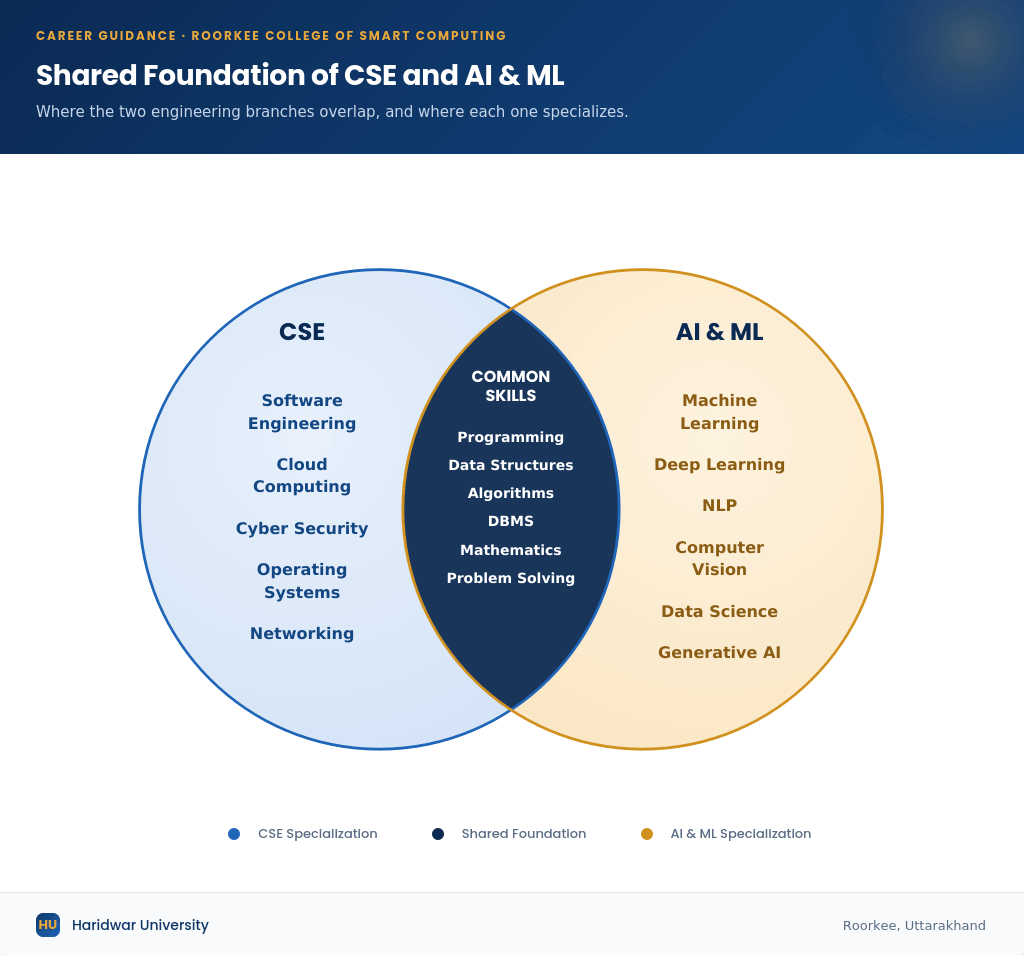
A common misconception is that CSE and AI & ML are completely different courses. In fact, during the initial semesters, students from both branches study many common subjects, including programming, mathematics, algorithms, databases, and software engineering fundamentals. Specialization begins gradually as AI & ML introduces advanced topics such as deep learning, computer vision, and natural language processing. Regardless of which branch you choose, you will develop strong programming and problem-solving skills.
Similarities Between CSE and AI & ML
|
Common Learning Areas |
CSE |
AI & ML |
|
Programming |
✅ |
✅ |
|
Data Structures & Algorithms |
✅ |
✅ |
|
Database Management |
✅ |
✅ |
|
Operating Systems |
✅ |
✅ |
|
Computer Networks |
✅ |
✅ |
|
Software Engineering |
✅ |
✅ |
|
Mathematics |
✅ |
✅ |
|
Problem Solving |
✅ |
✅ |
Shared Foundation of CSE and AI & ML
So, What is the Real Difference?
- Computer Science Engineering teaches you how to build software systems across a wide range of technologies.
- Artificial Intelligence & Machine Learning teaches you how to build software systems that can learn, predict, and make intelligent decisions using data.
Neither approach is better; they simply prepare students for different kinds of technology careers.
| Comparison Parameter | B.Tech Computer Science Engineering (CSE) | B.Tech AI & ML |
|---|---|---|
| Programming Focus | Broad focus (C, C++, Java, Python, Web Dev, Mobile apps) | Specialized focus (Python, R, Machine Learning & Deep Learning libraries) |
| Mathematical Depth | Moderate (Discrete Mathematics, Probability, Calculus) | High (Linear Algebra, Statistics, Probability, Optimization) |
| Career Flexibility | Very High (Software, Cloud, Cybersecurity, DevOps, AI, etc.) | High (AI/ML Engineering, Data Science, Data Analytics) |
| AI/ML Specialization | Basic (Usually 1-2 introductory subjects or electives) | In-depth (Deep Learning, NLP, Computer Vision, Neural Networks) |
| Entry-Level Salaries | ₹4–8 LPA (Can scale higher in top product companies) | ₹6–14 LPA (Commanding premiums for niche AI skills) |
| Ease of Switching Fields | Easy (Can switch to any software or technology domain) | Moderate (Easy for software, but requires effort for domains like Cyber Security) |
| Future Relevance | Highly Stable (Forms the infrastructure of all technology) | Exponential Growth (Driving automation and smart systems) |
Key Takeaway
Students often think they must choose between Computer Science and Artificial Intelligence. In reality, AI is one of the most exciting specializations built on Computer Science. If you want maximum career flexibility, CSE is an excellent choice. If you already know that Artificial Intelligence is your passion, AI & ML gives you an opportunity to specialize earlier while still learning the core foundations of computing.
Skills Required to Succeed in CSE vs AI & ML
Choosing an engineering branch should not depend only on placement statistics or salary; it should also match your interests and learning style. Both branches require dedication and continuous learning, but the type of work you enjoy can help you decide.
The Most Important Skill That Both Branches Have in Common
If there is one skill that determines your success in both CSE and AI & ML, it is problem-solving. Languages and frameworks keep changing, but the ability to analyze a problem logically and design an efficient solution stays valuable throughout your career. This is why companies hire graduates who can solve real-world problems, not just those who know a language.
Key Takeaway
Your career growth depends more on your ability to solve problems than on the programming language you learn in college.
Skills Required for Computer Science Engineering (CSE)
CSE is ideal for students who enjoy understanding how software systems work from the ground up. A CSE graduate may work on web applications, mobile apps, cloud platforms, operating systems, cybersecurity, or scalable backend systems.
Technical Skills
- Programming (C, C++, Java, Python)
- Data Structures & Algorithms
- Database Management
- Operating Systems
- Computer Networks
- Object-Oriented Programming
- Software Engineering
- Cloud Computing Fundamentals
- Version Control (Git & GitHub)
Soft Skills
- Logical Thinking
- Communication
- Team Collaboration
- Time Management
- Debugging Mindset
- Continuous Learning
Who Usually Enjoys CSE?
CSE is often a good choice for students who:
- Enjoy building software and applications.
- Like exploring different areas of technology instead of specializing immediately.
- Want the flexibility to switch between domains such as cloud, cybersecurity, DevOps, AI, or blockchain.
- Prefer learning broad computer science concepts before specializing.
Skills Required for AI & Machine Learning
AI & ML suits students fascinated by intelligent systems and how computers learn from data. AI projects often involve large datasets, mathematical models, predictive algorithms, and continuous experimentation, so students should be comfortable with both programming and analytical thinking.
Technical Skills
- Python Programming
- Machine Learning Algorithms
- Statistics
- Probability
- Linear Algebra
- Data Science
- Deep Learning
- Neural Networks
- Natural Language Processing (NLP)
- Computer Vision
- Model Evaluation
- MLOps Basics
Soft Skills
- Analytical Thinking
- Curiosity
- Research Mindset
- Patience
- Experimentation
- Communication
- Creativity
Who Usually Enjoys AI & ML?
AI & ML may be right for you if you:
- Love mathematics and logical reasoning.
- Enjoy analyzing patterns and data.
- Are curious about how ChatGPT, recommendation systems, and autonomous vehicles work.
- Want to build intelligent applications rather than only traditional software.
- Enjoy research and experimentation.
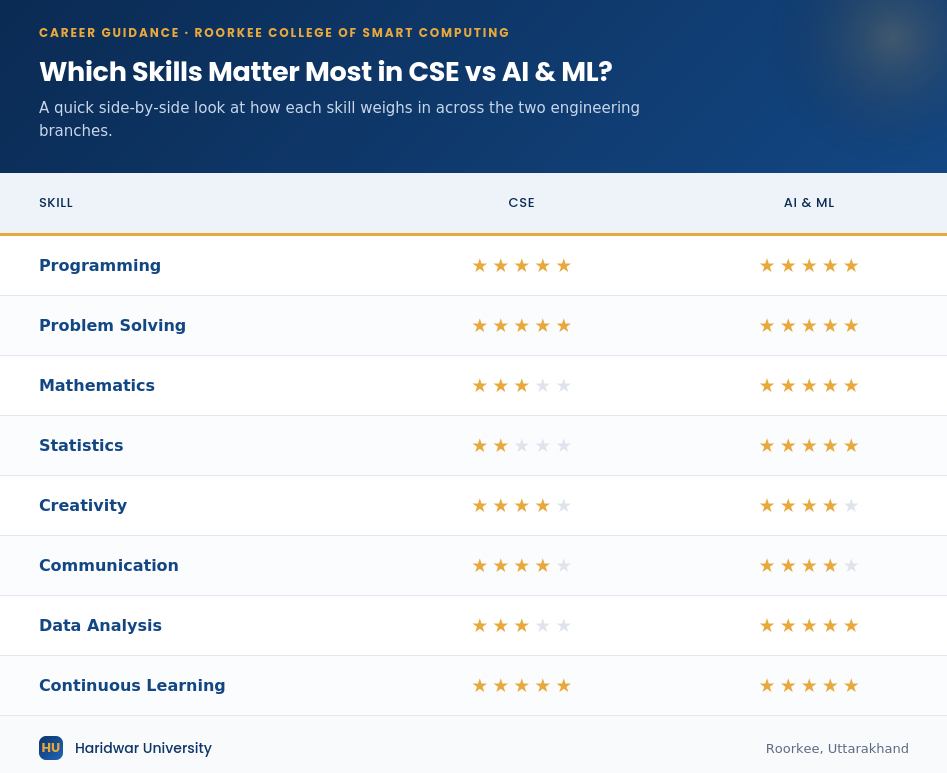
Do You Need to Be Good at Mathematics?
Yes, but the level differs. In CSE, mathematics mainly strengthens logical thinking and problem-solving through subjects like discrete mathematics, engineering mathematics, and probability. In AI & ML, mathematics matters even more, since many AI models rely on linear algebra, calculus, probability, optimization, and statistics. However, you do not need to be a mathematics genius before joining — consistent effort throughout the degree is what counts.
Myth vs Reality
Myth: “AI is only for students who are brilliant at mathematics.”
Reality: Mathematics is important, but consistent practice, curiosity, and strong programming skills are equally essential for succeeding in AI & ML.
Which Branch is More Difficult?
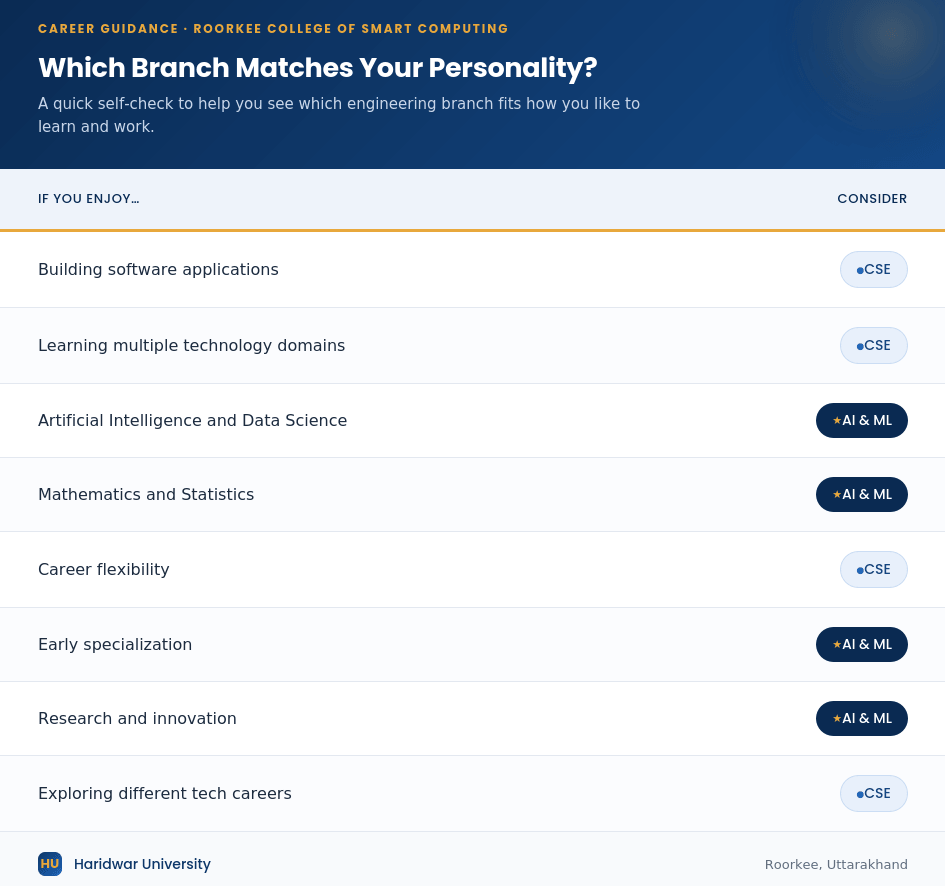
There is no universal answer; it depends on your interests. If you enjoy software development and system design, CSE may feel more natural; if you enjoy mathematics, data analysis, and experimentation, AI & ML may feel more engaging. AI is often perceived as harder due to its mathematical depth, but CSE also has demanding subjects like operating systems, compiler design, and computer architecture. A better question than “which is harder” is: which branch will keep me motivated to learn for the next four years? That is usually the branch in which students perform best.
Skills That Companies Actually Value
Many students believe companies hire based solely on branch. In reality, recruiters evaluate a broader set of factors: strong programming ability, practical projects, internship experience, problem-solving skills, communication, teamwork, a GitHub portfolio, hackathon participation, familiarity with modern tools, and the ability to learn quickly. This is why many CSE graduates become AI Engineers and many AI & ML graduates work as Software Engineers. Your branch creates the foundation, but your skills and portfolio shape your career.
According to the World Economic Forum (Outbound Link → Future of Jobs Report 2025), analytical thinking, AI literacy, technology skills, creativity, resilience, and lifelong learning are among the capabilities employers will value most in coming years.
Key Takeaway
Choosing between CSE and AI & ML is not about the highest salary or the latest trend — it is about choosing the learning journey that matches your interests. If you want the freedom to explore multiple technology domains, Computer Science Engineering offers an excellent foundation. If you are passionate about intelligent systems and data-driven innovation, Artificial Intelligence & Machine Learning lets you specialize early while still building strong computer science fundamentals.
- B.Tech Computer Science Engineering
- B.Tech Artificial Intelligence & Machine Learning
- Roorkee College of Smart Computing
- World Economic Forum – Future of Jobs Report 2025
- NASSCOM Technology & AI Reports
Career Opportunities, Placements & Salary: AI vs CSE
The next big question is: which branch offers better career opportunities? Both CSE and AI & ML offer excellent prospects. The difference lies not in whether you get a job, but in the roles you pursue and how your career evolves. A branch alone does not guarantee placement or salary — recruiters evaluate skills, projects, internships, and communication, which is why two students from the same branch can have very different outcomes.
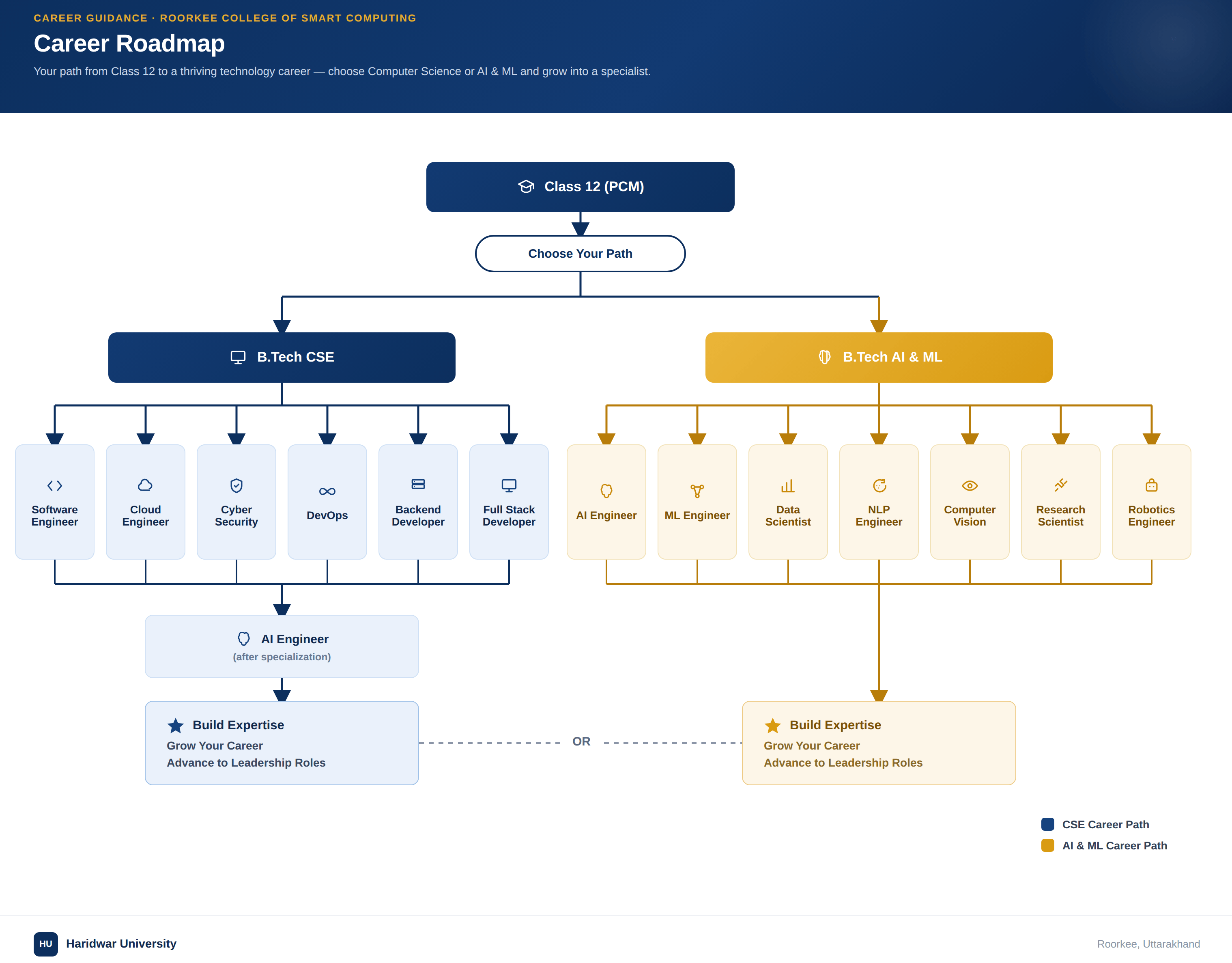
Quick Career Comparison
| Career Goal | Recommended Branch |
|---|---|
| Software Engineer | CSE |
| Full Stack Developer | CSE |
| Backend Developer | CSE |
| Mobile App Developer | CSE |
| Cloud Engineer | CSE |
| Cyber Security Analyst | CSE |
| DevOps Engineer | CSE |
| AI Engineer | AI & ML |
| Machine Learning Engineer | AI & ML |
| Data Scientist | AI & ML |
| NLP Engineer | AI & ML |
| Computer Vision Engineer | AI & ML |
| Robotics Engineer | AI & ML |
| AI Research Engineer | AI & ML |
Salary Comparison: AI vs CSE in India
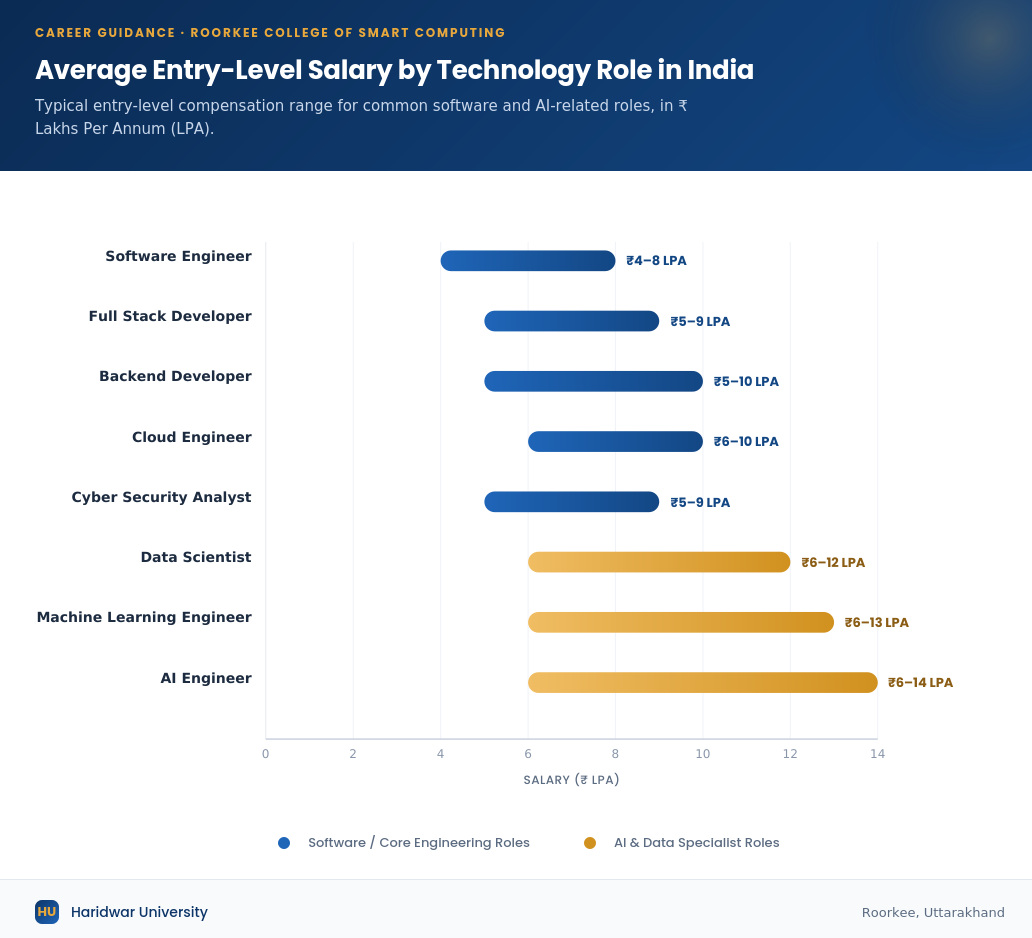
A common question is: “Does AI & ML offer a higher salary than CSE?” The answer is: not always. Companies hire for job roles and skills, not just the branch on your degree. That is why comparing Software Engineer vs AI Engineer is more meaningful than comparing CSE vs AI & ML.
| Job Role | Typical Entry-Level Salary* | Typical Degree Background |
|---|---|---|
| Software Engineer | ₹4–8 LPA | CSE / AI & ML / IT |
| Full Stack Developer | ₹5–9 LPA | CSE / IT |
| Backend Developer | ₹5–10 LPA | CSE |
| Cloud Engineer | ₹6–10 LPA | CSE / IT |
| Cyber Security Analyst | ₹5–9 LPA | CSE / Cyber Security |
| Data Scientist | ₹6–12 LPA | AI & ML / Data Science / CSE |
| Machine Learning Engineer | ₹6–13 LPA | AI & ML / CSE |
| AI Engineer | ₹6–14 LPA | AI & ML / CSE |
*Salary ranges are approximate entry-level packages compiled from publicly available salary data and industry reports. Actual compensation varies based on employer, location, skills, internships, and interview performance.
Technology Trends & Placements Insight
| Trend | What It Means for Students |
|---|---|
| AI adoption is increasing across industries | Growing demand for AI, ML, and Data Science skills. |
| Software engineering remains the backbone of digital transformation | Strong demand for CSE graduates continues. |
| Cloud, Cybersecurity, and AI are among the fastest-growing technology domains | Students with practical skills in these domains have better placement opportunities. |
Important Insight
Students often assume AI & ML automatically means a higher salary, but the job role matters much more than the degree title. A Software Engineer at Google or Amazon may earn more than an AI Engineer at a smaller company, and a highly skilled AI Engineer may earn more than many Software Engineers. The deciding factors are skills, projects, internships, company, role, and experience.
Industry Perspective
According to salary insights from AmbitionBox and Glassdoor, AI-related roles like Machine Learning Engineer and Data Scientist generally command competitive salaries due to specialized skills, but experienced Software Engineers and Cloud Engineers at leading product companies can earn equally well. Choosing the right branch is only the first step — building strong skills determines your earning potential.
Sources:
- AmbitionBox Salary Insights
- Glassdoor Salaries
- NASSCOM (Industry trends and technology workforce)
- World Economic Forum – Future of Jobs Report 2025
- LinkedIn Jobs (Demand trends for AI and software roles)
Career Opportunities After Computer Science Engineering (CSE)
CSE is one of the broadest engineering disciplines in technology. Rather than preparing students for one profession, it equips them with fundamentals that open doors across industries, including:
- Software Development
- Web Development
- Mobile Application Development
- Cloud Computing
- Cyber Security
- Data Engineering
- DevOps
- System Administration
- Product Engineering
- Game Development
- Artificial Intelligence
- Startups
- Government Technical Services
One of CSE’s biggest strengths is its flexibility; many current AI Engineers and Cloud Architects began their careers with a CSE degree before specializing later.
Popular Job Roles After CSE
| Job Role | Typical Career Path |
|---|---|
| Software Engineer | Design and build software applications. |
| Full Stack Developer | Manage both frontend and backend development. |
| Backend Engineer | Build APIs, databases, and cloud services. |
| Mobile Developer | Develop Android and iOS applications. |
| Cloud Engineer | Deploy and manage systems on AWS, Azure, or Google Cloud. |
| DevOps Engineer | Handle CI/CD pipelines and infrastructure automation. |
| Cyber Security Analyst | Protect organizational systems and information security. |
| Data Engineer | Build data pipelines and manage Big Data systems. |
| Product Engineer | Design SaaS and technology products. |
Key Takeaway
CSE provides one of the widest ranges of career opportunities in engineering because its curriculum forms the foundation for almost every modern technology domain.
Career Opportunities After AI & Machine Learning
AI & ML graduates begin with a similar programming foundation but move towards intelligent systems and data-driven technologies. As AI adoption grows, organizations increasingly hire professionals who can build predictive models and AI-powered applications across sectors such as Healthcare AI, FinTech, Robotics, Autonomous Vehicles, E-commerce, Manufacturing, and EdTech.
Popular Job Roles After AI & ML
| Job Role | Typical Career Path |
|---|---|
| AI Engineer | Build and deploy intelligent, AI-powered applications. |
| Machine Learning Engineer | Design and train predictive models and neural networks. |
| Data Scientist | Analyze large datasets to extract actionable business intelligence. |
| NLP Engineer | Build chatbots, translation systems, and large language models. |
| Computer Vision Engineer | Develop image and video recognition systems. |
| Robotics Engineer | Design intelligent and autonomous automation systems. |
| AI Research Engineer | Conduct research and drive innovation in advanced AI models. |
| MLOps Engineer | Manage the deployment, scaling, and monitoring of AI models. |
Key Takeaway
AI & ML offers a focused career path for students who want to work on cutting-edge technologies involving intelligent systems, automation, and advanced analytics.
Can a CSE Graduate Become an AI Engineer?
Yes. This is one of the biggest misconceptions among aspirants. Many AI Engineers at leading tech companies started with a CSE degree since AI relies on programming, algorithms, and mathematics core to CSE. By learning Machine Learning, Deep Learning, and Generative AI through projects, certifications, or higher studies, CSE graduates can successfully transition into AI roles.
Can an AI & ML Graduate Become a Software Engineer?
Absolutely. AI & ML students also study programming, software engineering, databases, and algorithms, so many go on to work as Software Engineers, Backend Developers, Full Stack Developers, or Python Developers before moving into specialized AI roles. Choosing AI & ML does not restrict you to AI-only jobs.
Top Recruiters
Both CSE and AI & ML graduates find opportunities at leading technology companies, including Google, Microsoft, Amazon, Infosys, TCS, Wipro, Accenture, Capgemini, IBM, Cognizant, Deloitte, NVIDIA, and Oracle. Recruitment depends on business requirements, technical skills, internships, and interview performance rather than the branch name alone.
Future Scope: Which Branch Has Better Long-Term Growth?
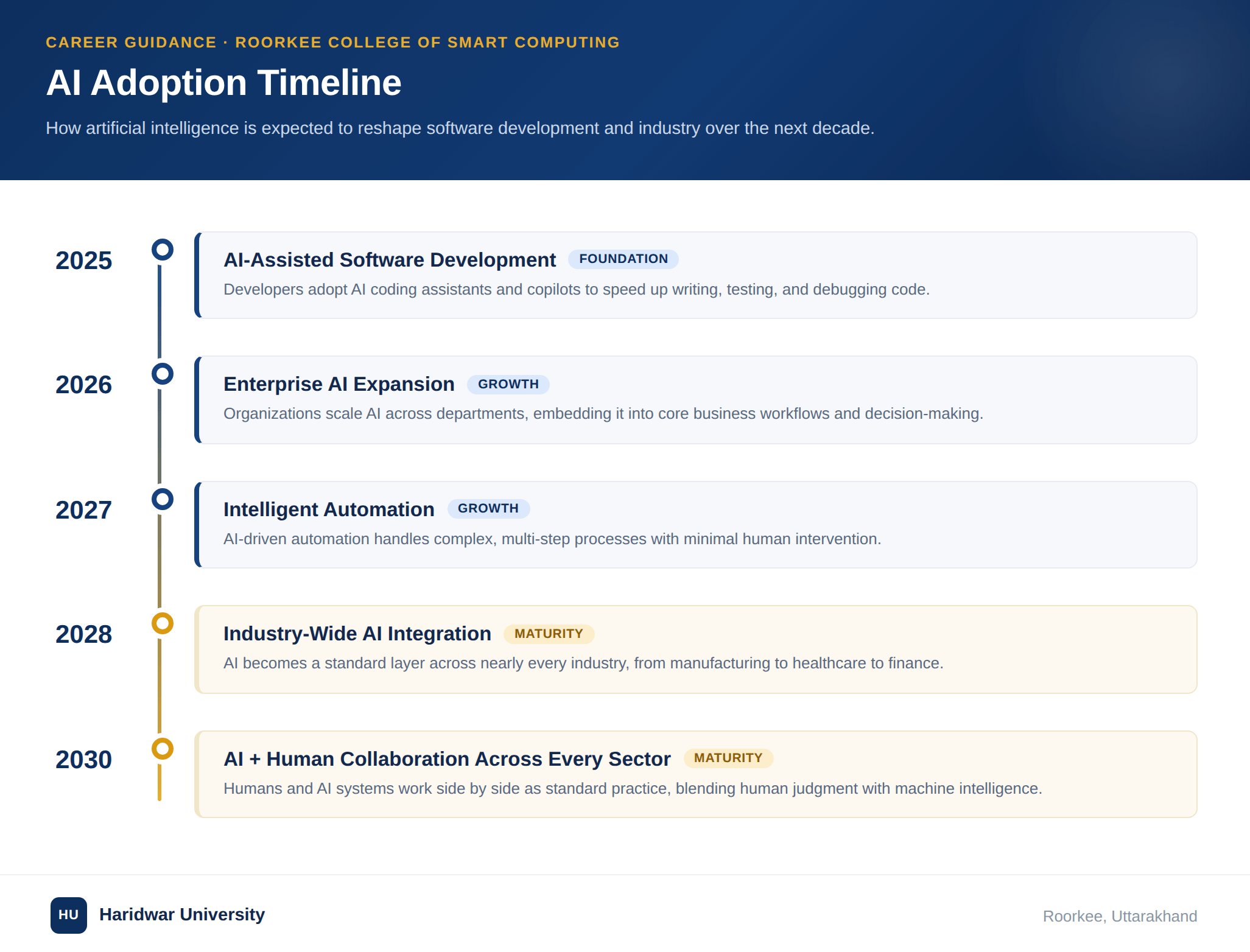
The future of technology is not about choosing between AI and Computer Science — it is about how these fields complement each other. AI continues to expand across healthcare, finance, education, and manufacturing, but these systems still need software engineers, cloud platforms, and cybersecurity professionals to function.
The World Economic Forum’s Future of Jobs Report 2025 (Outbound Link → World Economic Forum) lists AI and Big Data among the fastest-growing skill areas globally, but software development and cybersecurity remain highly valued too. NASSCOM (Outbound Link → NASSCOM Technology Reports) similarly highlights India’s growing demand for professionals skilled in both AI and traditional software engineering.
The conclusion is clear: AI is creating new opportunities, not replacing Computer Science Engineering. Both branches are expected to remain highly relevant over the coming decade.
Final Takeaway of This Section
There is no universal winner in the AI vs CSE debate. If your goal is flexibility, broad software engineering knowledge, and freedom to explore multiple technology domains, Computer Science Engineering is an excellent choice. If you are passionate about intelligent systems, machine learning, and emerging AI technologies, Artificial Intelligence & Machine Learning offers an exciting opportunity to specialize early. In both cases, your long-term success depends on the projects you build, the internships you complete, and your willingness to keep learning.
Frequently Asked Questions (FAQs)
1. Which is better: AI or CSE after 12th?
It depends on your interests and goals. CSE suits a broad understanding of software development, cloud computing, and cybersecurity. AI & ML suits a passion for intelligent systems, data science, and automation. Both offer excellent opportunities with strong technical skills.
2. Is AI & ML better than Computer Science Engineering?
Not necessarily — AI & ML is a specialization built on computer science fundamentals. CSE offers greater flexibility, while AI & ML lets you specialize earlier.
3. Can a CSE student become an AI Engineer?
Yes. By learning Python, machine learning, deep learning, and data science, and working on AI projects, CSE graduates can successfully transition into AI roles.
4. Can an AI & ML student become a Software Engineer?
Absolutely. AI & ML students study programming, algorithms, and databases, enabling them to work as Software Engineers, Backend Developers, or Full Stack Developers alongside AI-related roles.
5. Which branch has better placement opportunities: AI or CSE?
Both have strong placement opportunities. CSE offers a broader range of software and IT roles, while AI & ML graduates are increasingly recruited for specialized AI and data science positions. Placements depend more on skills, internships, and interview preparation than the branch itself.
6. Does AI & ML have a higher salary than CSE?
Specialized AI roles may pay more at some companies, but experienced CSE graduates in software engineering or cloud can earn equally well. Experience and skills matter more than the degree title.
7. Is AI replacing Computer Science Engineering?
No. AI is creating new opportunities that build on computer science foundations, and still needs software engineering, cloud infrastructure, and cybersecurity — keeping CSE skills highly relevant.
8. Which branch has a better future in India?
Both have promising futures. India’s growing digital economy will continue to create demand for software engineers, AI specialists, cloud professionals, and data scientists. Students who continuously upgrade their skills will find excellent opportunities regardless of branch.
9. Is mathematics compulsory for AI & ML?
Yes, mathematics (including linear algebra, probability, calculus, and statistics) is widely used in machine learning models. However, you do not need to be exceptionally strong in mathematics before joining; consistent learning during the degree is usually sufficient.
10. Which engineering branch is easier: CSE or AI & ML?
Neither is inherently easier. CSE focuses more on software systems and networking, while AI & ML includes additional mathematics and machine learning. The easier branch is usually the one that matches your interests.
11. Which companies hire CSE and AI & ML graduates?
Both are recruited by companies such as Google, Microsoft, Amazon, Infosys, TCS, Wipro, Accenture, IBM, Capgemini, Cognizant, Deloitte, Oracle, NVIDIA, and many startups, based on skills, projects, and interview performance.
12. Can I pursue higher studies after CSE or AI & ML?
Yes. Graduates from both branches can pursue M.Tech, MS, MBA, or research programmes in India and abroad, in AI, cybersecurity, cloud computing, data science, or robotics.
13. Which branch is better for studying abroad?
Both offer excellent opportunities for higher education abroad. A strong academic record and project experience matter more than the branch itself.
14. How should I choose between AI and CSE?
Ask yourself: Do I enjoy building software across different domains? Am I interested in mathematics and data-driven technologies? Do I prefer flexibility or early specialization? What career excites me most? Broad software interests point to CSE; passion for intelligent systems points to AI & ML.
15. Does Haridwar University offer both CSE and AI & ML programmes?
Yes. Haridwar University offers undergraduate programmes in Computer Science Engineering and Artificial Intelligence & Machine Learning. Students can explore the curriculum, eligibility, and admission process through the official programme pages before deciding.
Still Confused Between AI and CSE? Here’s My Advice
If you are still confused after reading this guide, don’t worry — thousands of students face the same dilemma every year. There is no “wrong” choice between CSE and AI & ML; both are future-ready branches. The key is to choose the one that matches your interests, stay consistent in learning, build projects, complete internships, and keep upgrading your skills. Technology evolves quickly, but curious learners continue to succeed regardless of the branch they choose.