

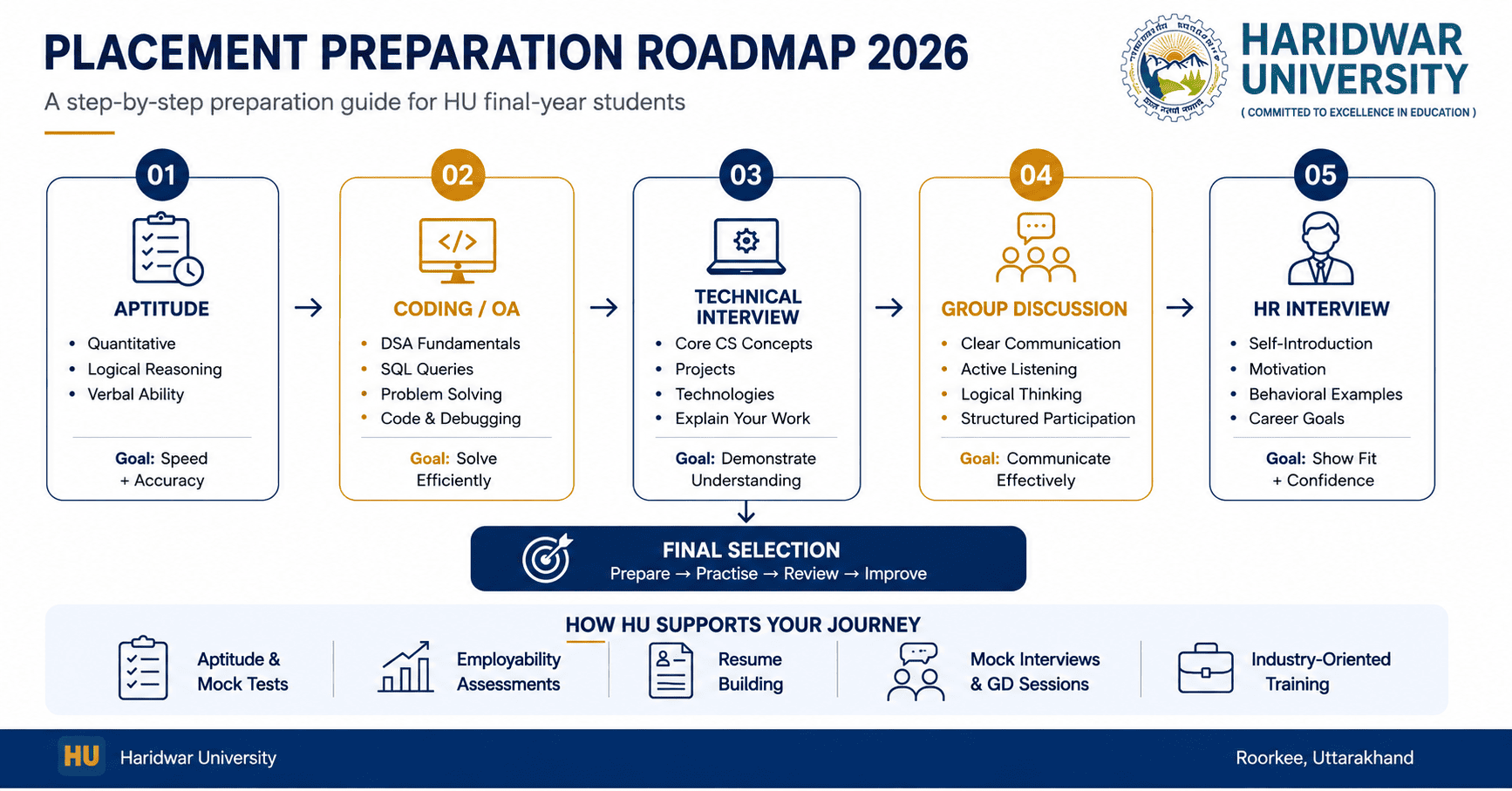
Placement season has a predictable rhythm. The first shortlist arrives, the online assessment follows, and suddenly a student who has spent three years preparing for a degree has to prove what they can do in 60 or 90 minutes.
I have seen this stage repeatedly. The students who handle it best are rarely those who simply study the most. They are the ones who know which filter comes next and prepare specifically for it.
At Haridwar University, pre-placement preparation includes aptitude and mock tests, interview and assessment preparation, resume building, internships, live projects and career guidance. This guide is designed around that reality.
Table of Contents
- 1. What Placement Tests Actually Measure
- 2. Aptitude Preparation: Quantitative, Logical and Verbal
- 3. Five Practice Questions
- 4. Coding Round: What Should You Practise?
- 5. Your 60-Day Coding and Aptitude Plan
- 6. Online Assessments: Prepare for the Platform, Not Just the Question
- 7. GD, Technical Interview and HR Preparation
- 8. Common Reasons Students Lose a Placement Opportunity
- 9. A Week-by-Week Placement Preparation Plan
- 10. How HU Supports Placement Preparation
- 11. Placement Preparation Roadmap 2026
- 12. Frequently Asked Questions (FAQs)
- 13. Final Word: Prepare for the Filter in Front of You
1. What Placement Tests Actually Measure
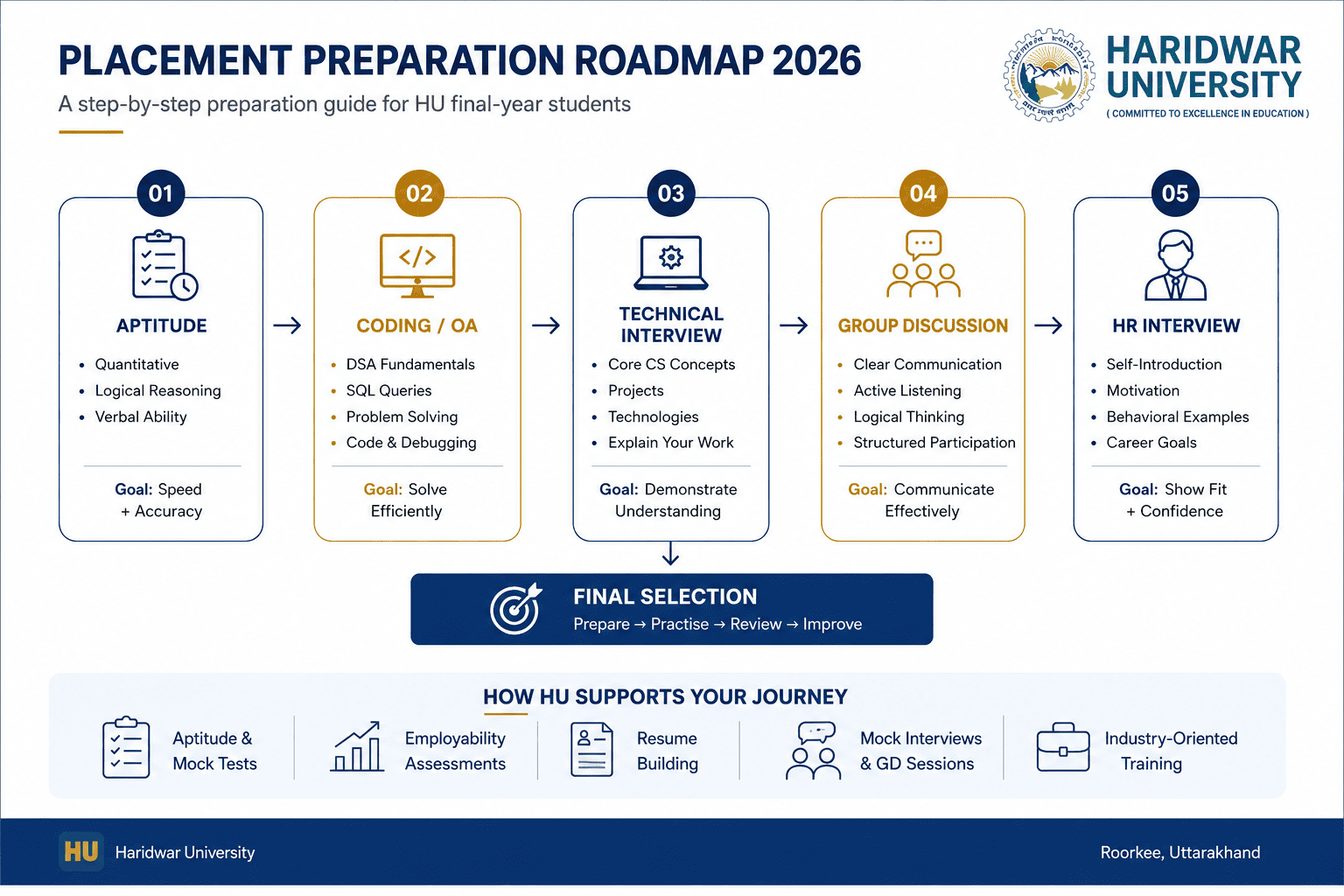
A campus hiring process may vary by employer, but students should prepare for five recurring filters:
| Stage | What is usually tested | What to practise |
|---|---|---|
| Aptitude | Speed, accuracy, reasoning | Timed questions |
| Coding/OA | Problem solving, programming | DSA + coding |
| Technical interview | CS fundamentals + projects | Core subjects |
| GD/communication | Clarity, listening, reasoning | Structured speaking |
| HR interview | Behaviour, motivation, fit | Specific examples |
The mistake is treating all five as one subject. They are not.
An aptitude test rewards speed. A coding round rewards structured problem solving. An interview rewards explanation. Your preparation should reflect that difference.
2. Aptitude Preparation: Quantitative, Logical and Verbal
Start with three buckets.
| Section | High-value areas | Practice target |
|---|---|---|
| Quantitative | Percentages, ratios, averages, profit & loss, time-work, speed-distance | 20–30 timed questions |
| Logical | Series, coding-decoding, arrangements, syllogisms, patterns | 15–20 questions |
| Verbal | Grammar, vocabulary, sentence correction, comprehension | 15–20 questions |
HU already conducts employability assessment tests to identify students' strengths, weaknesses and areas requiring additional training. Use those assessments as a starting point: do not spend equal time on every topic when your own scores show a clear weakness.
3. Five Practice Questions
1. Quantitative: A product priced at ₹800 is discounted by 15%. What is the selling price?
Answer: ₹680.
Solution: 15% of ₹800 = ₹120; ₹800 − ₹120 = ₹680.
2. Ratio: The ratio of two numbers is 3:5 and their sum is 64. Find the numbers.
Answer: 24 and 40.
Solution: The ratio is 3:5, so the total number of parts is: 3 + 5 = 8 parts.
Given that the sum of the two numbers is 64:
8 parts = 64 ⇒ 1 part = 64 ÷ 8 = 8.
First number = 3 × 8 = 24.
Second number = 5 × 8 = 40.
Therefore, the two numbers are 24 and 40.
3. Logical: Find the next number: 3, 6, 12, 24, __.
Answer: 48.
Solution: Each term is multiplied by 2.
4. Verbal: Choose the correct sentence:
A. “Neither of the candidates were selected.”
B. “Neither of the candidates was selected.”
Answer: B.
5. Logical: If all programmers are problem-solvers and some students are programmers, what follows?
Answer: Some students are problem-solvers.
The lesson is simple: accuracy first, then speed. A fast wrong answer is still wrong.
4. Coding Round: What Should You Practise?
For computing students, coding preparation should not become an endless attempt to memorise hundreds of problems.
HackerRank's 2025 Developer Skills Report analysed data from more than 3 million assessments and surveyed 13,732 developers, recruiters, managers, executives and students across 102 countries. Its analysis found SQL, REST API, Java, Python and JavaScript among the highest-volume skills on its platform.
For final-year preparation, I would prioritise:
| Priority | Topic | What to be able to do |
|---|---|---|
| 1 | Arrays & strings | Traversal, searching, manipulation |
| 2 | Hashing | Frequency/counting problems |
| 3 | Sorting & searching | Binary search, sorting logic |
| 4 | Linked lists | Insert, delete, reverse |
| 5 | Stack & queue | Basic implementation + applications |
| 6 | Trees | Traversal and basic problems |
| 7 | Recursion | Base cases and problem decomposition |
| 8 | SQL | Queries, joins, grouping |
HackerRank's skills analysis also identifies backend development, data science/ML and frontend development as major learning priorities, with Spring Boot, Node.js, .NET, React, ML development, LLM/AI APIs and data engineering appearing among its highlighted areas.
For a fresher, fundamentals remain the better investment than chasing every new framework.
5. Your 60-Day Coding and Aptitude Plan
A two-month plan works best when the workload changes as the assessment date approaches.
| Period | Main focus | Weekly outcome |
|---|---|---|
| Days 1–15 | Aptitude fundamentals + arrays, strings, SQL | Build accuracy |
| Days 16–30 | DSA basics + logical reasoning | Increase speed |
| Days 31–45 | Mixed coding + timed aptitude | Simulate assessments |
| Days 46–55 | Mock tests + weak areas | Fix recurring errors |
| Days 56–60 | Full-length mocks + interview revision | Assessment readiness |
I recommend keeping a mistake log. Record the question, your error, the correct method and the time taken. Repeating the same mistake for 60 days is not practice. It is rehearsal.
6. Online Assessments: Prepare for the Platform, Not Just the Question
Online assessments may combine aptitude, coding, technical questions, language evaluation or personality assessment. Platforms such as Mercer | Mettl provide employers with coding, technical, aptitude, language and personality evaluation tools for campus hiring.
HackerRank is another widely used technical assessment platform, with coding assessments designed for both freshers and experienced candidates.
Do not assume every company uses the same format. Before an assessment:
- Check the instructions carefully.
- Confirm whether negative marking applies.
- Test your browser and internet connection.
- Practise with a timer.
- Read whether external tools or AI assistance are permitted.
- Attempt sample questions without distractions.
That last point matters more now. HackerRank reports that 66% of developers prefer practical coding challenges, while 78% say assessments do not align with real-world tasks. The assessment may not perfectly reproduce the job. You still have to clear it.
7. GD, Technical Interview and HR Preparation
The interview stage is where preparation becomes visible.
HU's placement preparation includes mock interviews, group discussions, skills and communication assessments, expert talks and industry-oriented training.
For GDs, practise three habits:
- Make one clear opening point.
- Support it with an example or fact.
- Listen before adding another argument.
For technical interviews, prepare your own projects first. You should be able to explain the problem, technology, your contribution, one difficulty and what you would improve.
For HR interviews, avoid memorised speeches. Prepare concise examples for:
- Tell me about yourself.
- Why should we hire you?
- Tell me about a difficult problem you solved.
- Why this role?
- What did you learn from a failure?
- Where do you want to develop professionally?
A confident answer is not necessarily a long answer.
8. Common Reasons Students Lose a Placement Opportunity
There is rarely one universal rejection reason, but the same preparation gaps appear repeatedly:
| Problem | Better approach |
|---|---|
| Running out of time | Practise under a timer |
| Weak programming basics | Revisit fundamentals |
| Memorised interview answers | Use real examples |
| Cannot explain projects | Prepare project walkthroughs |
| Ignoring communication | Practise speaking regularly |
| Applying without reading requirements | Study the job description |
| Repeating mistakes | Maintain a mistake log |
| Depending completely on AI | Learn to explain and debug your own work |
The last point deserves emphasis. AI can accelerate learning, but it cannot replace understanding. HackerRank reports that 97% of developers use at least one AI assistant, while developers also continue to raise concerns about assessment integrity and AI-assisted performance. Use AI to learn, practise and review. Do not let it become a substitute for thinking.
9. A Week-by-Week Placement Preparation Plan
If placement preparation begins in September, I suggest this rhythm:
| Week | Priority |
|---|---|
| Week 1 | Baseline aptitude + coding assessment |
| Week 2 | Quantitative fundamentals |
| Week 3 | Logical reasoning + arrays |
| Week 4 | Verbal + strings + SQL |
| Week 5 | DSA basics |
| Week 6 | Mixed timed tests |
| Week 7 | Mock assessment |
| Week 8 | Technical interview + project revision |
| Week 9 | GD + communication |
| Week 10 | HR preparation |
| Week 11 | Full mock cycle |
| Week 12 | Company-specific revision |
HU's placement ecosystem already includes aptitude and mock tests, employability assessments, resume development, mock interviews, GDs, industry-oriented training, live projects and internships.
10. How HU Supports Placement Preparation
Placement preparation should not begin on the day a recruiter arrives.
HU's Training and Placement Cell describes its role as connecting students with industry through training, placement activities, orientation programmes, guest lectures, industrial visits, expert talks, alumni interaction and career counselling.
Its industry collaboration programme also provides opportunities for internships, training and joint projects through institutional and industry partnerships.
That is the bigger picture I want final-year students to remember: a placement test is one checkpoint, not the entire preparation process.
11. Placement Preparation Roadmap 2026
12. Frequently Asked Questions (FAQs)
Q1. How should final-year students start placement aptitude preparation in 2026?
Start with quantitative aptitude, logical reasoning and verbal ability. Take a baseline mock test first, then practise weak areas regularly.
Q2. Which aptitude topics should I prioritise for campus placements?
Focus on percentages, ratios, averages, profit and loss, time and work, number systems, data interpretation, logical sequences, coding-decoding and verbal comprehension.
Q3. How important is coding for placement tests?
Coding can be a key part of online assessments for technical roles. Students should prioritise DSA fundamentals, problem-solving, basic SQL and debugging practice.
Q4. What should I practise for a coding or online assessment round?
Practise arrays, strings, sorting, searching, linked lists, stacks, queues, basic recursion and SQL queries. Timed practice is important because online assessments test both accuracy and speed.
Q5. How can I prepare for technical interviews after clearing the online test?
Revise core computer science concepts, understand your projects thoroughly and practise explaining your technical decisions clearly. Be prepared to discuss the technologies you have listed on your CV.
Q6. How should I prepare for a group discussion round?
Work on clear communication, active listening and structured participation. Avoid dominating the discussion and focus on contributing relevant points with logical reasoning.
Q7. What are common reasons students get rejected during placements?
Common problems include weak aptitude fundamentals, poor coding practice, inability to explain projects, unclear communication, inadequate interview preparation and difficulty performing under time pressure.
Q8. How does Haridwar University support students during placement preparation?
HU's Training and Placement Cell provides support through aptitude and mock tests, employability assessments, resume building, mock interviews, group discussions, industry-oriented training and career guidance.
13. Final Word: Prepare for the Filter in Front of You
There is no shortcut around preparation. But there is a shortcut around wasted preparation: measure where you are weak, practise under realistic conditions and review every mistake.
Start with aptitude. Build coding fundamentals. Know your projects. Practise speaking. Take mock assessments. Then repeat.
HU students can connect with the Training & Placement Office for information about placement drives, career opportunities, industry collaborations and on-campus recruitment activities.
"A placement test is one checkpoint, not the entire preparation process. Master each stage, understand your strengths, and execute your strategy with consistency."