

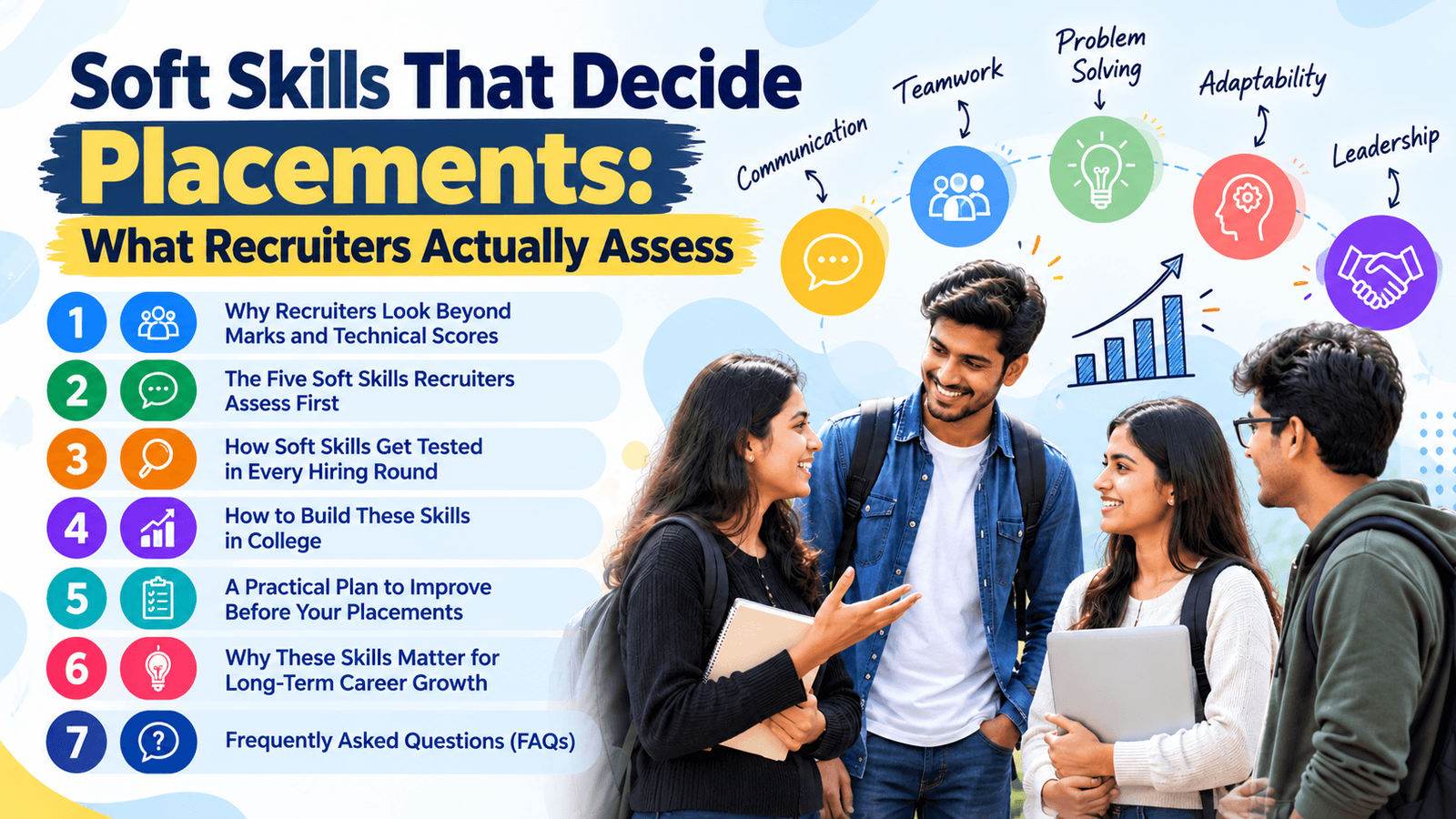
Soft Skills That Decide Placements: What Recruiters Actually Assess
Mr. Prajwal Chaudhary
Training & Placement Manager, Haridwar University
Picture two students walking into the same campus drive. Similar CGPA, same branch, near-identical final-year projects. One leaves with an offer letter. The other hears, “We’ll get back to you.” So what separated them? Often it isn’t the syllabus. It’s how they spoke, how they listened, and what they did with a question they hadn’t prepared for.
Soft Skills That Decide Placements never show up on a marksheet, yet recruiters start reading them from the first hello. This guide breaks down what hiring panels actually assess, how those skills get tested round by round, and how you can build them at Haridwar University well before drive season begins.
Table of Contents
- 1. Why Recruiters Look Beyond Marks and Technical Scores
- 2. The Five Soft Skills Recruiters Assess First
- 3. How Soft Skills Get Tested in Every Hiring Round
- 4. How Haridwar University Builds Soft Skills on Campus
- 5. A Practical Plan to Build Soft Skills Before Your Drive
- 6. Costs, Scholarships and Your Next Step at HU
- 7. Frequently Asked Questions (FAQs)
1. Why Recruiters Look Beyond Marks and Technical Scores
Marks get you shortlisted. That’s about all they do. By the time a company reaches the interview table, it has already accepted that everyone left meets the technical bar, so the question changes: Who will be easy to work with? Who explains a problem calmly, takes feedback without sulking, and doesn’t go quiet when a deadline slips?
None of this is corporate folklore. India’s National Education Policy 2020 lists teamwork, leadership and communication among the social and emotional skills, also called soft skills, that education should develop. The policy states that principle in its school-education summary, but the logic carries straight into campus hiring.
Haridwar University points the same way on its About Us page, describing a holistic approach that aims to shape students with moral and ethical values and a sense of social responsibility, not just a degree.
2. The Five Soft Skills Recruiters Assess First
There’s no single scorecard that every company uses, but frameworks help. The US-based National Association of Colleges and Employers (NACE) defines eight career-readiness competencies, and several of them match what Indian campus panels look for. Here are the five worth building first:
Communication
Can you explain an idea to someone who doesn’t share your background? NACE describes communication as exchanging information and ideas clearly and effectively. In an interview, that means answering the question you were asked, not the one you rehearsed in the mirror.
Teamwork
Panels watch how you disagree. NACE frames teamwork as building collaborative relationships to work toward shared goals. In a group discussion, that looks like picking up someone’s point and extending it, rather than talking over them.
Critical Thinking
Recruiters throw curveballs on purpose. NACE ties critical thinking to logical analysis of the information in front of you. If you’re unsure, think aloud. Your reasoning shows more than a lucky guess does.
Professionalism
Punctuality, accountability, a polite email, a clean resume. NACE links professionalism to personal accountability and effective work habits. A late reply to a drive invitation can say more about you than a polished slide.
Career and Self-Development
Are you still learning? NACE counts continual learning and awareness of your own strengths and weaknesses as a competency. An honest answer about a gap you’re actively closing usually lands better than a rehearsed “my weakness is perfectionism.”
3. How Soft Skills Get Tested in Every Hiring Round
The soft skills that decide placements rarely get a paper of their own. They hide inside the rounds you already know, which is why many students don’t realise they’re being assessed at all.
Group Discussion
Panels score clarity, listening and how you respond to a louder voice. Our group discussion topics and framework guide shows how to structure your points so you contribute meaningfully without hijacking the room.
HR and Behavioural Interview
Questions about a failure, a conflict with a teammate or a decision you’d reverse test self-awareness and honesty. Practising them before the real thing helps, and HU’s guide to mock interviews and placement training explains how that preparation fits together.
Group Tasks and Case Rounds
Some companies add a case study or a team exercise. There, the quiet skills show: who assigns roles, who checks the numbers, who keeps time. You don’t need to dominate to lead. You need to be visibly useful.
The Moments In Between
Waiting-room conversation, the follow-up email, how you thank the student coordinator. These can feel unofficial, but seasoned recruitment panels treat them as an authentic part of the assessment.
4. How Haridwar University Builds Soft Skills on Campus
HU’s Placement Overview page outlines how its Training and Placement Cell facilitates campus recruitment and builds corporate partnerships with leading MNCs. It lists orientation programmes, guest lectures, industrial visits, industry expert talks and alumni interaction among the cell’s regular touchpoints with the corporate world. Haridwar University also partners with NASSCOM Foundation and L&T EduTech on industry-aligned student training.
The pre-placement activities page goes further. It features dedicated modules for soft skills and communication skills, with workshops, seminars and conferences held at regular intervals. It also details a Careers and Employability Service covering resume building, industrial internships, live-project support, aptitude tests, mock assessments and structured interview preparation. Students who wish to explore external opportunities can also browse listings on the official AICTE internship portal.
Then there’s feedback, which is where students improve fastest. HU conducts a series of employability assessment tests, giving each candidate a personalized report highlighting strengths and specific areas to refine. The university’s corporate review records reflect this focus: a representative from Panasonic noted that a humane attitude and collaborative mindset are just as vital as technical acumen in making graduates genuinely employable.
5. A Practical Plan to Build Soft Skills Before Your Drive
Soft skills improve the way fitness does: a little, often, with someone watching. Here’s a plan that doesn’t need a costly coaching package:
1. Practise Out Loud
Answer common questions aloud and record yourself on video or audio. It feels awkward for the first sixty seconds, and then it becomes transformative. Ask a batchmate to interrupt you mid-answer, because real interview panels frequently do.
2. Join Something That Needs Teamwork
HU’s Student Welfare Service page lists vibrant student clubs, including Saaz Music Club, Madhuram Dance Club, Yuva Sports Club, Kalki Drama Club, Soch Cultural Club and Creative Lens. Organising a single university event teaches crisis handling, delegation and negotiation faster than most textbooks ever will.
3. Use Free National Resources
The Government of India’s National Career Service portal offers registered job seekers a free, self-paced Career Skills course in partnership with TCS iON, focused directly on workplace soft skills. Additionally, the Ministry of Skill Development and Entrepreneurship’s Skill India Digital platform brings verified skilling courses and national certifications onto a single platform.
4. Keep a Feedback Log
After every mock interview, GD session or assessment test report, log exactly one concrete thing to rectify. Review this log before walking into every campus drive—behavioral patterns and progress show up fast.
6. Costs, Scholarships and Your Next Step at HU
Soft skills training at Haridwar University is embedded directly inside the academic curriculum and campus life, so there are no hidden coaching fees—the primary investment is academic tuition.
Based on the Fee Structure 2026-27 on HU’s fees and scholarships page:
Note: These institutional charges cover tuition, enrollment, admission, examination and uniform fees; hostel and mess fees are structured separately.
On scholarships, HU offers merit-based tuition fee waivers linked to JEE ranks, Class 12 board marks, or CUET percentiles, alongside sports quotas and a dedicated 25% scholarship for girls’ education (a student can avail one scholarship at a time). An Academic Excellence Award of ₹5,000 is also awarded to students scoring 85% or above in any semester examination cleared in the first attempt.
When you are ready to secure your admission, the admission overview provides a straightforward step-by-step process, with provisional seats confirmed upon a deposit of ₹25,000.
The soft skills that decide placements aren’t a gift some people are born with. They are daily habits: speak clearly, listen properly, think out loud, show up on time, and keep learning. Start building them today, and by drive season, you will have months of hard evidence backing up your confidence.
7. Frequently Asked Questions (FAQs)
1. What are the most important soft skills for campus placements?
Communication, teamwork, problem-solving, professionalism and a habit of learning from feedback cover most of what panels look for. None needs a special talent; each improves with deliberate practice.
2. Do recruiters care about soft skills if my technical scores are strong?
Strong scores usually get you shortlisted, but group discussions and interviews still test how you communicate and collaborate. A capable candidate who can’t explain their own work often loses ground there.
3. How do recruiters assess soft skills during a campus drive?
Mostly through group discussions, HR and behavioural interviews, and sometimes group tasks. Panels also notice punctuality, replies and how you carry yourself between rounds.
4. Can an introvert do well in a group discussion?
Yes. Panels reward clarity and good listening, not volume. Prepare two or three solid points, wait for a natural opening, and build on what others said instead of competing to speak the most.
5. How can I improve my communication skills before placements?
Practise answers aloud, record yourself and ask a friend for blunt feedback. Mock interviews and group discussion practice speed this up because they add realistic pressure.
6. Does Haridwar University offer soft skills training?
HU’s pre-placement page lists soft skills and communication skills among its training areas, along with workshops, seminars and employability assessment tests.
7. Are soft skills tested for technical roles too?
Yes. Technical interviews still ask you to explain projects, justify choices and handle follow-up questions. Explaining clearly is itself a soft skill.
8. How long does it take to build soft skills?
There’s no fixed timeline. Communication and teamwork improve with steady practice over semesters, so starting in your first or second year beats cramming in the final weeks.
9. Are scholarships available at HU for new students?
HU’s fee page lists first-year tuition scholarships based on JEE rank, class 12 percentage or CUET percentile, a Sports Quota and a 25% scholarship for girls’ education. A student can claim only one scholarship.
Accelerate Your Career & Placement Success at Haridwar University
Haridwar University provides comprehensive pre-placement training, regular mock interview sessions, dedicated soft skills workshops, and direct recruitment access to over 300+ marquee MNC recruiters.