

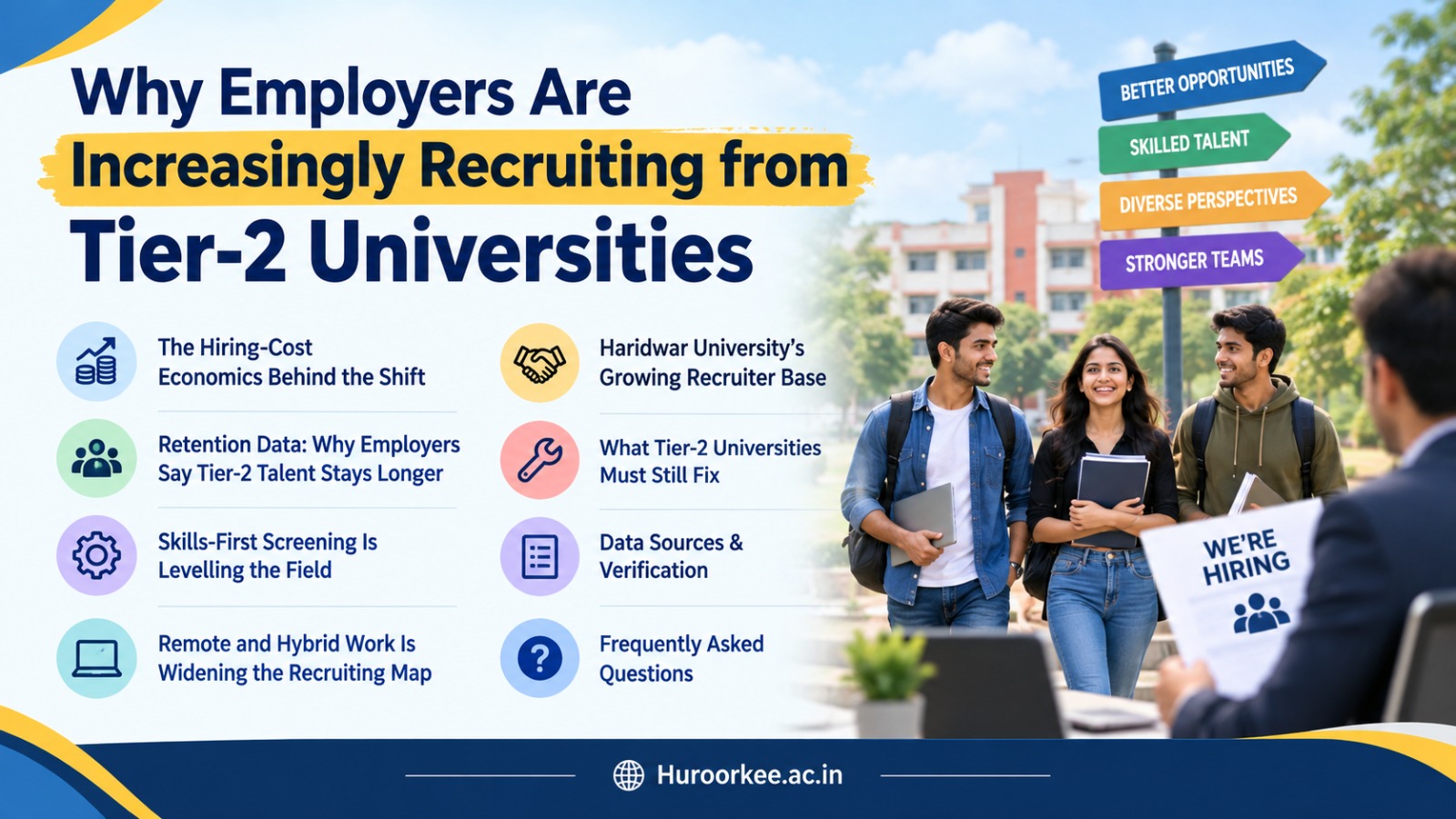
Employers are increasingly recruiting from campuses that used to sit well outside their hiring radius, and this is not a leftover pandemic habit. Talent-acquisition teams at IT services companies, Global Capability Centres (GCCs), and product start-ups are now building pipelines through tier-2 engineering, management, and pharmacy colleges across Uttarakhand, Rajasthan, Madhya Pradesh, and the wider Hindi-belt states.
This piece looks at why employers are increasingly recruiting from tier-2 universities — through hiring-cost economics, retention data, skills-first screening, and remote work — and at what tier-2 institutions still need to fix to keep the momentum going. The data below comes from named industry and workforce-research sources — TeamLease, Unstop's Talent Report 2026, the India Skills Report 2026, and a report by upGrad Rekrut — together with verified information from Haridwar University's own official pages, checked on 18 September 2026.
1. The Hiring-Cost Economics Behind the Shift
2. Retention Data: Why Employers Say Tier-2 Talent Stays Longer
3. Skills-First Screening Is Levelling the Field
4. Remote and Hybrid Work Is Widening the Recruiting Map
5. Haridwar University’s Growing Recruiter Base
6. What Tier-2 Universities Must Still Fix
The Hiring-Cost Economics Behind the Shift
Metro hiring has become expensive on more than one front. Salaries in Bengaluru, Pune, and the National Capital Region (NCR) keep climbing, competition for the same shortlist of candidates is intense, and counter-offers are common once a candidate enters the interview pipeline. Workforce-solutions firm TeamLease has flagged this directly, noting that the business case for regional hiring “extends far beyond salary savings,” pointing instead to steadier candidate pipelines, lower poaching pressure, and a talent pool that isn't already juggling several competing offers (TeamLease, 2026).
That is the practical reason recruiters are increasingly recruiting from tier-2 universities rather than treating it as a goodwill gesture: a tier-2 campus drive run through a well-organised Training & Placement Cell can close a batch of offers faster, at a lower cost per hire, than repeated rounds of off-campus hiring in an oversaturated metro market. Digital hiring platforms and mobile-first recruitment tools have also cut the logistical cost of running these drives in smaller cities, so a recruiter no longer needs a large in-city team to evaluate a tier-2 campus.
Retention Data: Why Employers Say Tier-2 Talent Stays Longer
Cost per hire is only half the argument; what happens after the offer letter matters just as much. In a 2026 HR-leaders survey by upGrad Rekrut, nearly 79% of HR leaders said talent retention in tier-2 and tier-3 cities is equal to, or better than, retention in tier-1 metros, and the same report projected that the share of tech hiring coming from these cities would rise from 12.3% to 19.7% by FY27 (upGrad Rekrut, reported by Storyboard18, 21 January 2026).
TeamLease's own analysis points to the same pattern and offers a reason for it: employees hired locally in smaller cities tend to have deeper family ties to the region and fewer competing offers pulling them away within the first year, which shows up as stronger workforce stability for the employer (TeamLease, 2026). It's worth being precise here — this is retention data on tier-2/tier-3 city-based hiring broadly, not a controlled study isolating “tier-2 university graduates” as a category, so employers should treat it as a directional signal rather than a guarantee for every role or sector.
Skills-First Screening Is Levelling the Field
College pedigree is losing ground as the first filter in hiring. According to Unstop's State of Campus Hiring in India 2026 report, which draws on a HirePro study of college hiring practices, 21% of companies say they have fully adopted skills-first hiring, while 51% still factor in CGPA as part of their screening (Unstop / HirePro, published 6 August 2026). That 21% is small in absolute terms, but it marks a real shift away from resume-based shortlisting toward coding tests, case studies, communication assessments, and portfolio reviews — formats where a well-prepared tier-2 candidate can perform on par with a tier-1 one.
This shift also shows up in outcome data: the India Skills Report 2026, published by Wheebox-ETS in partnership with CII, AICTE, and the Association of Indian Universities, found that Computer Science and IT graduates recorded the highest employability of any stream, at roughly 80%, driven largely by AI, data-analytics, and automation-related skilling rather than the reputation of any single institution (India Skills Report 2026, reported 12 November 2025). For tier-2 universities, this means the return on investment in structured skilling — coding practice, certifications, and applied projects — is now higher than the return on chasing brand recognition alone.
Remote and Hybrid Work Is Widening the Recruiting Map
The third driver is simpler: distance now matters less. TeamLease's analysis of hiring trends in tier-2 and tier-3 cities notes that combining remote and hybrid work models with government investment in digital connectivity and initiatives such as Skill India has let employers “hire based on skills rather than location” (TeamLease, 2026). A recruiter based in Gurugram or Bengaluru can now onboard a graduate from Roorkee or Meerut without relocating them, removing one of the biggest historical barriers tier-2 candidates faced — the cost and disruption of moving to a metro just to be considered for a role.
Also, according to TeamLease's fresher hiring outlook, overall fresher hiring intent for HY2 2026 rose to 75%, up from 73% in HY1 (TeamLease EdTech Career Outlook Report, reported by The Hans India, 12 August 2026), which suggests more of that fresher demand has room to reach non-metro campuses. For roles in software support, back-office operations, digital marketing, and increasingly GCC-linked technical work, the hiring conversation has shifted from “which city is this candidate in” to “can this candidate do the job,” and that reframing benefits tier-2 campuses directly.
Haridwar University’s Growing Recruiter Base
Haridwar University's own Training & Placement Cell has been adding companies to its recruiter list over the past several years rather than relying on a fixed set of names, in line with the university's stated goal of turning every student into an employable asset across its engineering, computing, management, pharmacy, and agriculture programmes.
HU was the first university in North India to partner with the NASSCOM Foundation and L&T EduTech for industry-oriented, application-based training, and its placement drives have included recruiters such as TCS, Wipro, Infosys, HCL, Capgemini, Cognizant, IBM, Accenture, Amazon, Google, Microsoft, and Oracle, alongside regional and sector-specific employers (Haridwar University, Placement Overview page, verified 18 September 2026). Students and parents can review the current recruiter list on HU's official recruiters page.
What Tier-2 Universities Must Still Fix
The trend favours tier-2 institutions, but it isn't automatic. Recruiters running skills-first assessments still expect a baseline of coding proficiency, communication skills, and project work that many tier-2 colleges don't consistently build into the curriculum — a gap that shows up quickly in a technical interview, regardless of how the resume looks. Universities also need to fix visibility: a strong recruiter list means little if it isn't backed by placement data, resume-building support, and mock-interview practice that a candidate can point to before a company commits to a campus drive.
Structured, verifiable industry partnerships — MoUs, certification tie-ups, live projects — do more to earn a recruiter's attention than one-off placement drives, and tier-2 universities that publish this information clearly on their own websites make it easier for both students and recruiters to trust the numbers. HU's own take on this gap is covered in more depth on its blog on certifications versus degrees and what recruiters actually want, though every institution in this category, HU included, has room to formalise how outcomes are tracked and reported.
If you're weighing a tier-2 university because of the trends above, look at how the institution backs its skilling claims. Haridwar University's academic programmes are built around applied, industry-aligned training across computing, engineering, management, pharmacy, and agriculture, and its Fees & Scholarships page lists merit-based scholarships of up to 80% on first-year tuition for top JEE ranks or board percentages, along with separate category-specific waivers for sports quota, domicile, and gender-based schemes — each governed by its own criteria, with only one scholarship applicable per student (Haridwar University, Fees & Scholarships page, verified 18 September 2026).
Students can also reach HU's Student Welfare Service for support with grievances, discipline queries, and general wellbeing during their programme.
Ready to Build Market-Ready Skills for Top Recruiters?
Join Haridwar University to access industry-tailored curricula with NASSCOM & L&T EduTech, dedicated placement mentorship, and generous merit scholarships.
Frequently Asked Questions
Why are employers increasingly recruiting from tier-2 universities?
Lower hiring costs, steadier retention, and skills-first screening formats mean recruiters can build strong batches without relying only on tier-1 campuses. Remote and hybrid work has made location less of a filter too.
Do tier-2 university graduates really stay in jobs longer?
Industry surveys, including one by upGrad Rekrut, show HR leaders reporting equal or better retention for talent based in tier-2 and tier-3 cities compared with tier-1 metros. This is city-level workforce data, not a claim specific to every individual tier-2 graduate.
What does "skills-first hiring" mean for a tier-2 student?
It means recruiters weigh coding tests, project work, and communication assessments more heavily than college brand or CGPA alone, giving a well-prepared tier-2 candidate a real shot at the same shortlist as a tier-1 candidate.
Has remote work made college location less important to recruiters?
Yes. Hybrid and remote roles let employers hire graduates without requiring relocation, so recruiters increasingly evaluate skills over which city or campus a candidate comes from.
Which companies recruit from Haridwar University?
HU's placement drives have included TCS, Wipro, Infosys, HCL, Capgemini, Cognizant, IBM, Accenture, Amazon, Google, Microsoft, and Oracle, among other recruiters, and the university adds new companies to this list most years.
What should tier-2 universities improve to attract more recruiters?
Consistent technical and communication skilling, transparent placement data, and formal industry partnerships matter more than a one-off placement drive. Visible, verifiable outcomes build recruiter trust over time.
How does Haridwar University prepare students for skills-first hiring?
HU runs industry-oriented training through its NASSCOM Foundation and L&T EduTech partnership, alongside resume-building support and pre-placement activities coordinated by its Training & Placement Cell.
Are scholarships available at Haridwar University?
Yes. HU's Fees & Scholarships page lists merit-based tuition scholarships tied to JEE rank or board percentage, plus separate sports-quota, domicile, and gender-based waivers, with only one scholarship applicable per student.
How can I apply to Haridwar University?
Students can apply directly through HU's official Apply Now page, where the current admission process and entrance requirements are listed.