

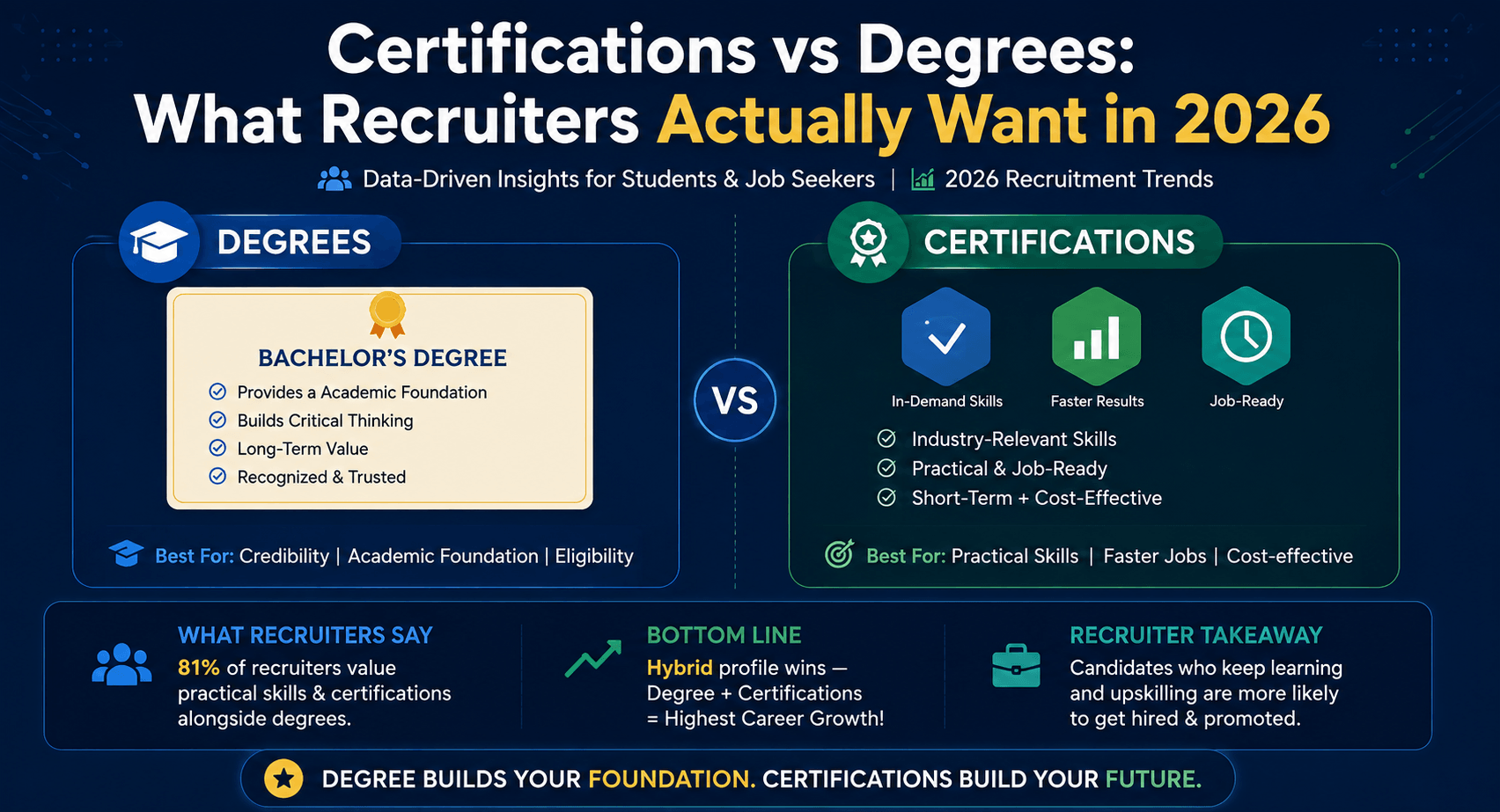
Every admission season, the same question comes up in counselling rooms: chase a degree, a certification, or both? Ask a campus recruiter about certifications that recruiters actually want, and the answer is more specific than either side of the debate admits — a certification almost never replaces a degree, but it does something a degree alone cannot: it proves you can do one particular task, right now.
That is really what the certifications vs degrees debate is about heading into 2026 — not degree-or-certificate, but what each credential is actually being asked to prove. This piece walks through what recruiters screen for at each career stage, where certificates genuinely outperform degrees, where they cannot, and how the smartest students are combining both.
Table of Contents
- What Recruiters Screen For at Each Career Stage
- Where Certifications Beat Degrees
- Where Degrees Still Win: Regulated Professions and Core Engineering
- The 2026 Answer: The Degree + Certification Stack
- What the Hiring Data Actually Shows
- Advice by Student Type
- How HU Builds Certifications Into the Degree
- Frequently Asked Questions
What Recruiters Screen For at Each Career Stage
Hiring is not one filter; it is three, applied in sequence.
- At the fresher stage (campus placement, 0 years' experience): The degree and branch are the eligibility gate. Recruiters visiting a campus set a minimum qualification before they look at anything else — this is exactly why HU's own Placement Overview page opens with programme-wise recruiter eligibility. A certification cannot get a student into a drive the degree does not qualify them for.
- At 1–3 years of experience: The filter shifts. Recruiters increasingly look at demonstrated, current skills over college pedigree — this is the “skills-first” hiring shift multiple industry bodies now track. Certifications, projects and internships start doing more work here than the degree does.
- At 5+ years: Portfolio and outcomes dominate. The degree becomes a checkbox on the application form; certifications signal that a professional is still learning, not coasting.
Where Certifications Beat Degrees
In fast-moving technical domains, a certificate can beat a degree simply because it updates faster than a three- or four-year curriculum ever can. Cloud platform certifications, specific data and AI toolchains, cybersecurity product certifications and analytics-tool certificates are the clearest examples — the tool changes every 12–18 months, and a certification syllabus can be rewritten in a fraction of that time.
This is also where the job numbers back the certificate-friendly roles most strongly. Computer Science and IT engineering graduates recorded 80% and 78% employability respectively in the India Skills Report 2026, the highest of any stream, with AI and ML-linked roles showing the sharpest growth. In these roles specifically, a well-chosen, current certification is often the fastest way to close the gap between what a degree teaches and what a live project needs.
Where Degrees Still Win: Regulated Professions and Core Engineering
Certifications cannot substitute a licensing degree in any regulated profession. Chartered Accountancy is the clearest example: entry into the profession still runs through the Institute of Chartered Accountants of India's own Foundation–Intermediate–Articleship–Final structure, and no private certificate shortens or replaces that path — students should always confirm the current structure directly on ICAI's official course pages rather than a coaching blog, since ICAI updates its scheme periodically.
Core engineering works the same way, but the regulator depends on the programme, not the word “engineering” alone. As per AICTE's own charter, technical education specifically covers engineering and technology, architecture, town planning, management, pharmacy and applied arts — and AICTE's approval framework governs institutions offering these programmes. A plain B.Com degree, by contrast, is not a technical programme in this sense, so it sits under UGC's academic framework rather than needing AICTE approval — a distinction students frequently get wrong when comparing course brochures.
For nursing, pharmacy and agriculture-linked programmes too, the professional council — Indian Nursing Council, Pharmacy Council of India, ICAR, as applicable — remains the non-negotiable layer beneath any stacked certification.
The 2026 Answer: The Degree + Certification Stack
The practical resolution to certifications vs degrees in 2026 is not either/or — it is sequencing. The government's own framework now supports this directly: the University Grants Commission's National Credit Framework (NCrF), notified in 2023, lets credits earned through vocational and skill-based learning be recognised alongside formal academic credits, so a well-aligned certification can, in principle, feed back into a student's degree record rather than sitting outside it as a separate line on a resume.
In effect, the degree still opens the door — it is what gets a candidate past the eligibility filter recruiters apply first — while the certification decides how fast the candidate moves once inside. Read together with what recruiters actually screen for at each stage, that is the most defensible answer to the certifications vs degrees question this admission cycle.
What the Hiring Data Actually Shows
The numbers, read as ranges rather than promises, tell a consistent story. National graduate employability rose to 56.35% in the India Skills Report 2026, up from 54.81% the previous year — a genuine, if gradual, improvement in job-readiness across streams.
Within that overall number, the spread by stream is wide. Computer Science and IT engineering graduates led at 80% and 78% employability, while MBA graduate employability eased slightly to about 72.76%, and employability among ITI and polytechnic graduates trailed at roughly 46% and 33% respectively. The pattern is not “degrees don't matter” — it is that stream choice and skill currency now matter as much as the degree itself.
HU's own placement figures sit inside this broader trend: an 86–95% placement rate (varies by year and programme), 200+ recruiting companies on campus each cycle, and an average package of around ₹6–6.5 LPA (highest ₹60 LPA), as listed on the university's Placement Overview page — numbers worth checking against the live page before you rely on them, since placement data updates every season.
Advice by Student Type
Class 12 pass-outs choosing a UG programme
Pick the degree and its recognised regulator first — this decides eligibility for every future campus drive. Certification planning comes after admission, not before.
Final-year undergraduates
Use the last two semesters for one or two role-specific certifications aligned to your target job — a cloud, data or AI-tool certificate mapped to an actual job description, not a long, unrelated list.
Working graduates reskilling mid-career
Check whether your target certification is NCrF-aligned; if it is, it may convert into bankable academic credit rather than sitting outside your degree record. HU's Academic Overview page outlines how credit-linked electives are structured across its five colleges.
Aspirants for regulated professions (CA, core engineering, pharmacy, nursing)
Treat certifications as supplementary, never substitutive. The licensing body's own scheme is the one requirement that cannot be shortened by a certificate.
How HU Builds Certifications Into the Degree
Rather than leaving students to arrange certifications on their own, several HU programmes carry a certification component inside the degree itself. The B.Tech. Hons. ECE with AI pathway includes a VLSI certification associated with IIT/NIT, the MBA with AI tracks in Finance, HR and Marketing carry IIM/IIT/NIT-linked certification components, and the B.Sc. Agriculture (Hons.) with AI programme is bundled with an ICAR-linked certification. Current fee structures for these certification-embedded variants are listed on HU's Fees & Scholarships page for the 2026–27 session.
Frequently Asked Questions
1. Are certifications enough without a degree for tech jobs in 2026?
For most structured, campus-recruited roles, no — the degree remains the eligibility filter recruiters apply first. A certification is the differentiator once you clear that filter, not a replacement for it.
2. Which certifications matter most for CS/IT hiring right now?
Cloud platform, data/AI toolchain and cybersecurity product certifications matter most, mirroring the 78–80% employability CS and IT streams already show in national data.
3. Can a certificate replace a professional degree like CA or a core engineering degree?
No. Regulated professions run through their statutory body's own scheme — ICAI for Chartered Accountancy, AICTE-governed norms for technical programmes — and no private certificate substitutes that path.
4. What is the National Credit Framework and why does it matter here?
It is a UGC-led framework letting certified vocational and skill learning convert into recognised academic credit, effectively formalising the degree-plus-certification stack.
5. Do recruiters currently prefer an MBA or a certification-backed specialisation?
MBA employability has eased slightly in the latest data, so a relevant certification alongside a management degree can help a candidate stand out rather than relying on the degree alone.
6. How many certifications should a student realistically pursue during a degree?
One or two, chosen against a specific target role, generally works better than a long list of unrelated certificates.
7. Does Haridwar University offer certification-embedded degree programmes?
Yes — select B.Tech, MBA and B.Sc. Agriculture programmes carry IIT/NIT/IIM or ICAR-linked certification components; current details are on HU's fees and academics pages.
8. Are government-recognised micro-credentials treated the same as private course certificates by employers?
Not automatically — weight depends on the issuing body and whether the credential is NCrF-aligned, which affects whether it can convert into formal academic credit.
9. What should a Class 12 student prioritise first — degree selection or certification planning?
Degree and regulator recognition first, since that determines eligibility for future placements; certification planning is a decision to make after admission, mapped to career stage.