

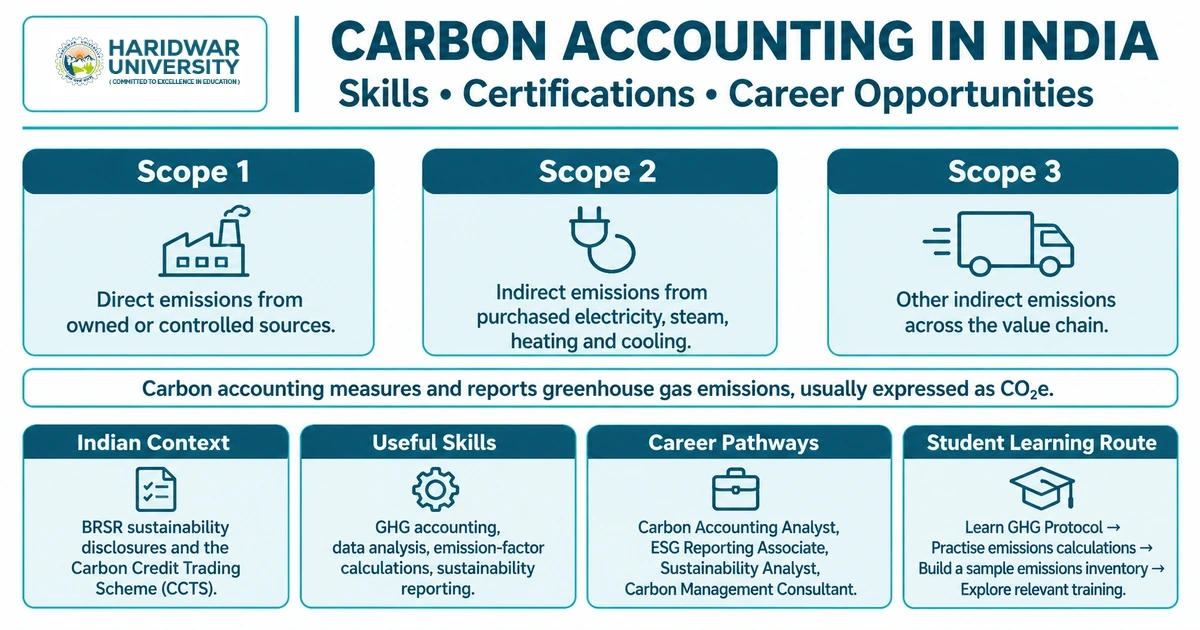
Carbon Accounting in India: Skills, Certifications & Career Opportunities
Mr. Javed Ali
Head, Business Studies, Haridwar University
Businesses are increasingly expected to explain not only their financial performance but also their environmental impact. How much fuel does a factory consume? What emissions come from purchased electricity? How much carbon is embedded in the materials it buys or the products it transports? Answering these questions requires reliable carbon accounting.
In India, sustainability disclosures, supply-chain expectations and the development of the domestic carbon market are making greenhouse gas (GHG) measurement an important business function. The Securities and Exchange Board of India (SEBI) requires the top 1,000 listed entities, by market capitalisation, to publish Business Responsibility and Sustainability Reports (BRSR). For professionals entering finance, management, environmental science or engineering, carbon accounting offers a way to connect academic knowledge with practical business requirements.
This is a skill worth understanding because it combines environmental knowledge with data analysis, financial reasoning and corporate reporting. A certification can provide structured learning, but the ability to measure, interpret and explain emissions is what makes that knowledge useful.
Table of Contents
- 1. What Carbon Accounting Means for Businesses
- 2. How Scope 1, Scope 2 and Scope 3 Emissions Work
- 3. Why Carbon Accounting Is Becoming Important in India
- 4. Skills Required to Work in Carbon Accounting
- 5. Carbon Accounting Certifications and Courses in India
- 6. Career Opportunities in Carbon Accounting
- 7. How Students Can Start Learning Carbon Accounting
- 8. Frequently Asked Questions (FAQs)
- 9. Building a Foundation for Climate-Related Careers
1. What Carbon Accounting Means for Businesses
Carbon accounting is the process of identifying, measuring, calculating and reporting the greenhouse gas emissions associated with an organisation, activity, product or project.
It converts operational information, such as electricity consumption, fuel purchases, transportation and production activity, into emissions data, generally expressed as carbon dioxide equivalent (CO₂e). This common unit allows different greenhouse gases to be compared according to their global warming potential.
For example, a manufacturing company may need to calculate emissions from its boilers, electricity consumption, company vehicles and purchased raw materials. Carbon accounting helps it establish an emissions inventory, identify major sources and assess where reductions are possible.
The GHG Protocol Corporate Accounting and Reporting Standard provides widely used guidance for preparing organisational greenhouse gas inventories. It is particularly important because businesses need consistent methods rather than estimates based on assumptions or incomplete records.
Carbon accounting is also fundamentally different from carbon offsetting. Measuring emissions establishes the organisation's footprint; purchasing carbon credits is a separate activity that may be used within a wider climate strategy. One should never be treated as a substitute for the other.
2. How Scope 1, Scope 2 and Scope 3 Emissions Work
The GHG Protocol classifies organisational emissions into three scopes. Understanding these categories is the first technical step in carbon accounting:
| Emission Scope | Regulatory Meaning | Business Example |
|---|---|---|
| Scope 1 | Direct emissions from owned or controlled sources | Fuel burned in company boilers, furnaces, and delivery vehicles |
| Scope 2 | Indirect emissions from purchased electricity, steam, heating and cooling | Grid electricity consumed by an office, campus, or manufacturing facility |
| Scope 3 | All other indirect emissions across the upstream and downstream value chain | Purchased raw materials, business travel, supply-chain logistics, and product disposal |
Consider an automobile manufacturer. Fuel burned in its company-owned delivery vehicles contributes to Scope 1. Electricity purchased for its manufacturing plant contributes to Scope 2. Emissions associated with steel production by suppliers, employee commuting and distribution fall under Scope 3, depending on the activity and applicable category.
Scope 3 can be particularly challenging because the information is spread across suppliers, customers and other business partners. Companies need supplier questionnaires, purchasing records, transport data and recognised emission factors to estimate these emissions accurately. The GHG Protocol Corporate Value Chain (Scope 3) Standard provides structured guidance for identifying and assessing value-chain emissions.
3. Why Carbon Accounting Is Becoming Important in India
Three primary policy and market developments make carbon accounting indispensable for Indian enterprises:
1. BRSR and Mandatory Corporate Disclosures
SEBI’s Business Responsibility and Sustainability Report (BRSR) framework requires the top 1,000 listed entities by market capitalisation to make standardized sustainability disclosures. The BRSR Core framework introduces a phased assurance mechanism covering selected KPIs, extending across all top 1,000 listed companies by FY 2026–27. Relevant updates on value-chain disclosure procedures are detailed in the official SEBI BRSR framework documentation.
2. India’s Carbon Credit Trading Scheme (CCTS)
Notified in June 2023, the Carbon Credit Trading Scheme (CCTS) establishes formal compliance and offset mechanisms under the Indian Carbon Market. Under the compliance mechanism, notified energy-intensive industrial entities are assigned greenhouse gas emission-intensity reduction targets expressed in tonnes of CO₂e per unit of production. The Bureau of Energy Efficiency (BEE) Indian Carbon Market portal details the operational mechanisms governing these targets.
3. Global and Domestic Supply-Chain Reporting
Businesses supplying large domestic conglomerates and international multinational buyers increasingly face contractual mandates to furnish audited environmental and emissions data. This pushes carbon accounting and energy audits deep into mid-sized industrial suppliers, vendors, and logistics providers.
These developments do not mean every single enterprise must hire a full-time dedicated carbon accountant. They do, however, explain why forward-looking organisations urgently seek professionals who understand emissions data, carbon calculation protocols, and statutory reporting methods.
4. Skills Required to Work in Carbon Accounting
Carbon accounting is inherently interdisciplinary. A professional must understand physical environmental measurements while remaining comfortable auditing financial ledgers and operational spreadsheets.
- GHG accounting fundamentals: Understanding distinct greenhouse gases, global warming potentials (GWP), CO₂e conversion, organizational and operational boundaries, and emissions scopes.
- Data collection and validation: Extracting reliable activity data from electricity utility bills, fuel invoices, factory production logs, logistics waybills, and vendor questionnaires.
- Emission factor calculations: Selecting and applying verified regional and international emission factors (such as CEA CO₂ baseline database for the Indian power grid) using recognised methodologies.
- Advanced Excel and data analysis: Structuring large environmental datasets, audit trails, error validation, formula modelling, and automated reporting.
- Sustainability frameworks: Applying the GHG Protocol, BRSR disclosure standards, GRI, and ISO 14064 standards.
- Communication and audit documentation: Articulating calculation methodologies, assumptions, data gaps, and uncertainty margins clearly to auditors and senior leadership.
The Core Calculation Model
For instance, if a manufacturing plant consumes 10,000 kWh of grid electricity, a carbon accountant estimates indirect emissions using the formula:
Emissions (kg CO₂e) = Activity Data (kWh) × Emission Factor (kg CO₂e/kWh)
The mathematical calculation is straightforward; the professional rigour lies in verifying that the consumption data is complete and the applied emission factor is geographically and temporally accurate.
5. Carbon Accounting Certifications and Courses in India
Relevant certifications help learners build structured knowledge, but courses differ significantly in scope, examination rigour, and professional recognition. Prospective learners should evaluate course curricula, awarding body credentials, and prerequisites before enrolling:
| Programme / Provider | Main Learning Focus | Suitable Audience |
|---|---|---|
| NQR Micro-credential in GHG Accounting | GHG accounting methodologies and BRSR corporate sustainability reporting | Eligible undergraduate and postgraduate students |
| GHG Management Institute Courses | Organisational and project-level GHG inventory accounting and verification | Beginners, sustainability analysts, and consultants |
| TÜV SÜD ISO 14064 Lead Verifier | ISO 14064 series GHG inventory preparation, carbon footprint auditing, and verification | Learners and practitioners with foundational GHG knowledge |
| Bureau Veritas ISO 14064 Workshop | Corporate carbon footprint accounting, emissions quantification, and ISO 14064 compliance | Working corporate professionals, ESG executives, and auditors |
1. NQR Micro-credential in GHG Accounting and Sustainability Reporting
The National Qualification Register (NQR) lists a micro-credential titled GHG Accounting and Sustainability Reporting, developed with a focus on climate change, greenhouse gas calculation protocols, and BRSR reporting. It is indexed at NSQF Level 6, encompassing a 30-hour mandatory module and one academic credit, with validity listed until 31 January 2027. Review the official NQR qualification record to verify current accredited training providers.
2. GHG Management Institute (GHGMI)
The online programmes from GHG Management Institute provide comprehensive training on organisational inventories, carbon project accounting, and verification. Individual courses generally require 16 to 20 hours of study, with a Certificate of Proficiency awarded to candidates who pass the formal examination with at least 70%.
3. TÜV SÜD ISO 14064 Lead Verifier Programme
TÜV SÜD provides an intensive four-day ISO 14064 Series GHG Accounting Lead Verifier course. It covers organizational GHG inventories, corporate carbon footprints, and third-party verification procedures. While valuable for aspiring auditors, beginners should first master foundational spreadsheet calculations and basic GHG Protocol principles before pursuing lead verifier credentials.
6. Career Opportunities in Carbon Accounting
Carbon accounting competencies support multiple professional career paths spanning corporate operations, ESG compliance, consulting, and third-party verification:
| Career Role | Typical Responsibilities |
|---|---|
| Carbon Accounting Analyst | Preparing corporate emissions inventories, validating activity data, and maintaining carbon audit models. |
| ESG Reporting Associate | Aggregating cross-departmental sustainability metrics for SEBI BRSR filings, CSRD compliance, and investor disclosures. |
| GHG Inventory Analyst | Calculating Scope 1, Scope 2, and upstream/downstream Scope 3 emissions according to the GHG Protocol. |
| Sustainability Analyst | Monitoring enterprise environmental performance, energy efficiency gains, waste metrics, and decarbonisation roadmaps. |
| Carbon Management Consultant | Advising manufacturing and corporate clients on decarbonisation pathways, marginal abatement cost curves, and carbon offsets. |
| Carbon Auditor or Verifier | Independently validating corporate GHG inventories against ISO 14064 standards and national carbon trading guidelines. |
These roles are not interchangeable. Recent graduates typically start in ESG reporting or emissions data analysis, while third-party verification and specialized strategic consulting roles require substantial industry experience and formal auditor credentials.
Industry demand is clearly reflected in corporate openings. For example, multinational materials science leader Corning has actively recruited for a Supply Chain Data and Carbon Accounting Specialist focusing on Scope 3 calculations, vendor sustainability audits, and emissions modelling (explore Corning careers). Salary packages in India vary widely based on technical expertise, sector specialization, and whether the role entails compliance reporting or independent assurance.
7. How Students Can Start Learning Carbon Accounting
Students do not need to wait until graduation to build competitive carbon accounting skills. A structured progression during undergraduate or postgraduate study establishes strong credentials:
Learn the science behind greenhouse gases, radiative forcing, global warming potentials, and carbon life-cycle analysis.
Understand equity share vs. operational control boundary criteria, Scope 1, 2, and 3 accounting rules, and emission factor databases.
Practice data cleaning, pivot tables, error auditing, and automated emissions inventory workbooks in Microsoft Excel.
Download and review published BRSR filings of top listed companies to see how real-world data is structured and disclosed.
Build a portfolio project estimating energy and fuel emissions for a local college campus or hypothetical office, documenting assumptions and audit trails.
Target recognized foundational credentials such as NQR or GHGMI courses to validate your competencies to prospective employers.
Commerce and business students excel in financial disclosures, audit trail documentation, and ESG reporting. Engineering, environmental science, and agriculture students bring vital technical knowledge regarding thermodynamic energy balances, industrial machinery, and agricultural emission cycles. At Haridwar University, students can explore academic pathways through the Roorkee College of Business Studies, the Roorkee College of Engineering, and the Roorkee College of Agricultural Sciences, supported by the university’s Research and Innovation ecosystem.
For related career planning, readers can explore our practical guides to sustainability jobs in India, high-demand career options after B.Com without CA, and the adoption of AI in finance and accounting.
8. Frequently Asked Questions (FAQs)
1. What qualifications are required to become a carbon accountant?
A bachelor’s or master’s degree in commerce, management, environmental science, or engineering provides an excellent entry foundation. Employers value practical proficiency in GHG Protocol calculation standards, emissions factor databases, advanced Excel modelling, and statutory sustainability disclosure frameworks such as SEBI BRSR.
2. Can commerce students learn carbon accounting?
Yes. Commerce and B.Com/BBA/MBA students are exceptionally well-suited for carbon accounting because the discipline mirrors financial auditing: validating activity ledgers, maintaining audit trails, reconciling supplier invoices, and assembling corporate reports. They simply need to learn environmental GHG Protocol principles alongside their core accounting knowledge.
3. Is carbon accounting the same as ESG reporting?
No. Carbon accounting specifically quantifies and calculates greenhouse gas emissions (Scope 1, 2, and 3). ESG reporting is a broader corporate framework covering diverse environmental, social, and governance metrics (such as water usage, occupational health, diversity, board oversight, and anti-corruption policies), where GHG emissions represent one critical quantitative pillar.
4. Which certification is suitable for beginners?
Introductory credentials like the NQR Level 6 micro-credential in GHG Accounting and Sustainability Reporting or foundational courses from the GHG Management Institute offer accessible, structured entry points. Candidates should verify prerequisite requirements and fee structures before applying.
5. Can I learn carbon accounting for free?
Yes. The GHG Protocol publishes its Corporate Standard and Scope 3 Guidance freely online, and government portals provide access to the CEA CO₂ baseline database. However, obtaining an accredited professional certificate or proctored exam credential typically involves an examination fee.
6. What is the difference between carbon accounting and carbon auditing?
Carbon accounting involves the internal gathering of operational activity data, emission calculations, and assembling the corporate GHG inventory. Carbon auditing (or verification) is an independent, third-party assessment conducted by accredited verifiers to evaluate whether the inventory complies with standards like ISO 14064 or SEBI guidelines.
7. Are there carbon accounting jobs in India?
Yes. Driven by SEBI’s BRSR mandates, the Indian Carbon Market (CCTS), and global supplier export regulations, organizations actively recruit for titles including Carbon Accounting Analyst, ESG Reporting Associate, GHG Inventory Analyst, and Sustainability Consultant across manufacturing, IT, consulting, and finance.
9. Building a Foundation for Climate-Related Careers
Carbon accounting brings environmental responsibility directly into the language of enterprise business: verifiable figures, documented methodologies, rigorous standards, and strategic decarbonisation investments. India’s BRSR compliance guidelines and the Carbon Credit Trading Scheme create an expanding domestic market, while global supply-chain requirements make emissions measurement relevant for companies of every scale.
My recommendation to aspiring professionals is to treat carbon accounting as a high-value analytical discipline rather than a superficial certificate. Master the GHG Protocol, gain fluency in Scope 1, 2, and 3 calculations, and cultivate solid business data analysis skills. Combining a rigorous academic foundation with practical carbon modelling empowers graduates to seize emerging opportunities across corporate sustainability and green finance.
Build Your Future in Sustainable Business & Technology at Haridwar University
Master corporate accounting, data analytics, sustainable business management, and new-age engineering. Benefit from multidisciplinary labs, corporate internships, career mentorship, and merit scholarships up to 80%. Admissions open for the 2027-28 academic session.