

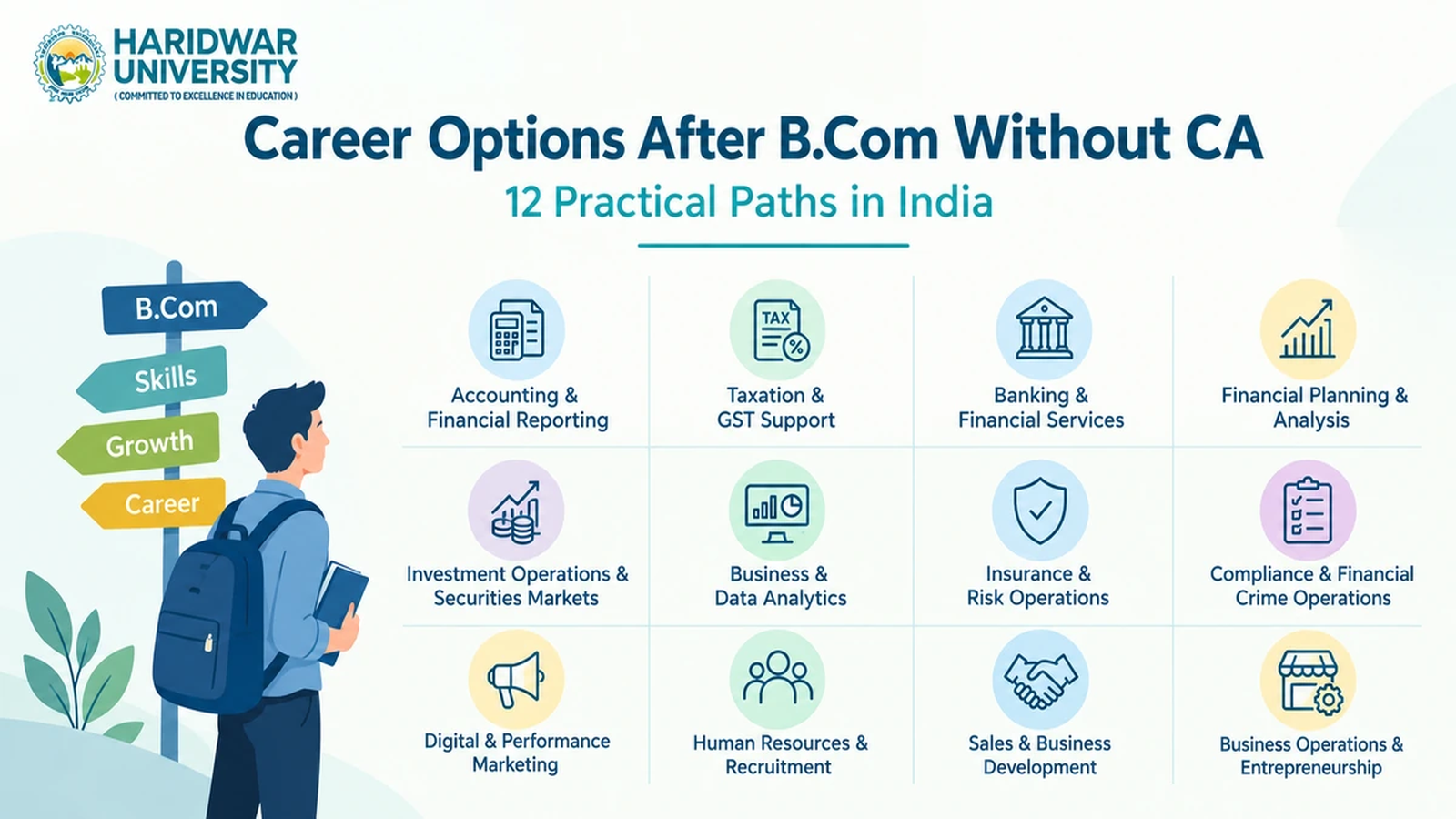
A Bachelor of Commerce (B.Com) degree can lead to much more than Chartered Accountancy (CA). Graduates can enter accounting, corporate banking, financial analysis, business analytics, performance marketing, human resources, and several other expanding commercial fields, depending on their individual skills and career ambitions.
In my view as an educator and business mentor, the more useful question is not whether CA is the only worthwhile option. It is which career matches your strengths, how you can qualify for an entry-level role, and whether further study will justify the time and expense.
When evaluating career options after B.Com without CA, I encourage students to distinguish between jobs they can pursue soon after graduation and specialist roles that require additional technical or postgraduate training. Here are 12 practical paths to consider.
Table of Contents
- • 1. Accounting and Financial Reporting
- • 2. Taxation and GST Support
- • 3. Banking and Financial Services
- • 4. Financial Planning and Analysis (FP&A)
- • 5. Investment Operations and Securities Markets
- • 6. Business and Data Analytics
- • 7. Insurance and Risk Operations
- • 8. Compliance and Financial Crime Operations
- • 9. Digital and Performance Marketing
- • 10. Human Resources and Recruitment
- • 11. Sales and Business Development
- • 12. Business Operations and Entrepreneurship
- • Choosing the Right Career After B.Com
- • Frequently Asked Questions (FAQs)
- • A Career Path Built on Skills and Informed Choices
1. Accounting and Financial Reporting
Accounting remains a practical starting point for commerce graduates who understand financial statements and enjoy working with numbers. Entry-level roles include accounts assistant, junior accountant, accounts payable executive, and accounts receivable executive.
Employers expect familiarity with core accounting principles, bank reconciliation, invoice processing, advanced spreadsheet models in Excel, and accounting software such as Tally Prime. As responsibilities grow, professionals can move into corporate financial reporting, management accounting, or corporate finance operations.
Best suited to: Graduates who prefer structured, detail-oriented work and want to build solid corporate experience while studying further, if needed. For higher earning trajectories, review our guide to high-paying careers after B.Com.
2. Taxation and GST Support
Every operating business needs professionals who can maintain accurate tax records, organise invoices, support GST-related documentation, and assist with compliance deadlines. Graduates may begin as tax assistants, GST support executives, or junior tax associates in accounting firms and corporate finance teams.
A sound understanding of GST filing mechanisms, income-tax basics, TDS reconciliations, and accounting software is invaluable. However, graduates should understand the limits of their responsibilities: certain professional services, formal audit sign-offs, and representations require statutory authorisations or specific qualifications.
Best suited to: Graduates interested in taxation, fiscal regulatory processes, and detail-heavy financial compliance work.
3. Banking and Financial Services
Banking offers both direct private-sector recruitment opportunities and public competitive examination routes. Depending on the vacancy, graduates can explore customer service, branch banking operations, loan processing, relationship support, and probationary officer-level positions.
Public-sector bank recruitment examinations, including those conducted through the Institute of Banking Personnel Selection (IBPS) and SBI, have their own notifications, eligibility conditions, and multi-tier selection stages. Private banks and non-banking financial companies (NBFCs) recruit commerce graduates directly into sales, credit appraisal, operations, and customer-facing relationship roles. Communication, numerical reasoning, and accuracy are vital across these positions.
Best suited to: Graduates comfortable with customer interaction, structured branch banking processes, or competitive public banking examinations.
4. Financial Planning and Analysis (FP&A)
Financial planning and analysis, commonly called FP&A, involves helping organisations prepare quarterly budgets, compare actual results against forecasts, and understand underlying business drivers.
An entry-level finance analyst or reporting analyst assists with spreadsheet financial models, departmental expense tracking, monthly performance presentations, and budget variance analysis. Strong Excel skills, deep financial statement interpretation, and clear written communication provide a strong foundation. Power BI and Tableau also help candidates present complex financial data visually.
Best suited to: Graduates who enjoy analysing commercial numbers and explaining what those numbers mean for strategic business leadership decisions.
5. Investment Operations and Securities Markets
Investment banks, institutional brokerages, mutual fund asset management companies (AMCs), and depository participants employ commerce graduates in trade operations, client servicing, transaction reconciliation, settlement support, and corporate actions.
A commerce graduate can investigate entry-level roles in these areas and then target certifications offered by the National Institute of Securities Markets (NISM), such as Mutual Fund Distributors (Series V-A) or Securities Operations and Risk Management (Series VII). While certifications validate foundational knowledge, real-world analytical abilities and adherence to regulatory compliance drive career advancement.
Best suited to: Graduates fascinated by capital markets, equity research workflows, financial instruments, and regulated investment services.
6. Business and Data Analytics
Modern businesses rely on real-time data to optimize sales conversions, contain cost structures, understand customer churn, and improve operational throughput. Commerce graduates bring strong domain intuition about profit margins, balance sheets, and unit economics that purely technical students often lack.
To enter this field, pair your commerce background with technical capabilities: start with Excel data cleaning and pivot tables, learn dashboard design in Power BI, and master basic SQL queries for relational databases. Candidates should build portfolio projects, such as analyzing regional sales performance or comparing marketing spend ROI.
Best suited to: Problem solvers who enjoy quantitative analysis, data storytelling, and working with modern visualization and data tools.
7. Insurance and Risk Operations
Insurance companies, third-party administrators (TPAs), and corporate insurance brokers need personnel for policy administration, claims processing, customer support, document scrutiny, and underwriting assistance.
A B.Com graduate can enter via operational or claims support roles, steadily building subject expertise across life, health, or general insurance products. Analytical roles in risk assessment examine loss ratios, claims fraud patterns, and customer financial solvency. Attention to detail and clarity in explaining policy terms are essential assets.
Best suited to: Graduates who favor process-driven environments and want to learn how financial risk is quantified and managed.
8. Compliance and Financial Crime Operations
Financial institutions, multinational corporations, and fintech firms maintain specialised compliance divisions responsible for Know Your Customer (KYC) verification, Anti-Money Laundering (AML) monitoring, sanctions screening, and transaction surveillance.
Common entry titles include KYC analyst, compliance operations associate, or fraud operations investigator. These positions demand a high degree of precision, a solid grasp of corporate law, meticulous record-keeping, and strict adherence to regulatory standards set by central banks and statutory watchdogs.
Best suited to: Methodical graduates who are investigative, attentive to detail, and comfortable working within rigorous legal and regulatory frameworks.
9. Digital and Performance Marketing
Commerce graduates who understand consumer behavior, pricing strategy, and ROI metrics are well positioned to thrive in performance marketing. Roles include digital marketing executive, SEO analyst, performance marketing associate, and content strategy coordinator.
Leading agencies and tech companies look for candidates who understand audience targeting, cost-per-acquisition (CPA), conversion rate optimization (CRO), and ad analytics. A focused project portfolio showcasing keyword research, a live campaign case study, or Google Analytics reporting delivers immense credibility. Learn more about this path in our guide to digital marketing careers after BBA and B.Com.
Best suited to: Graduates who desire an energetic blend of creative communication, brand messaging, and data-driven marketing analytics.
10. Human Resources and Recruitment
Corporate HR divisions oversee talent acquisition, employee onboarding, compensation structures, compliance documentation, and employee engagement programs. Entry-level opportunities include recruitment coordinator, HR assistant, and talent acquisition specialist.
Effective interpersonal communication, organizational acumen, emotional intelligence, and spreadsheet proficiency form the baseline skillset. For long-term leadership in corporate HR or industrial relations, completing an advanced postgraduate management degree is strongly recommended.
Students seeking management qualifications can evaluate the specialized curriculum of our MBA with AI program, as well as the MBA with AI overview guide, which offers in-demand concentrations across Finance, Human Resource Management, and Marketing.
Best suited to: Individuals who enjoy working with people, coordinating organizational processes, and driving talent development.
11. Sales and Business Development
Sales and business development represent direct revenue drivers across IT software (SaaS), retail banking, insurance, ed-tech, real estate, and B2B commercial services. Responsibilities center on generating leads, conducting client presentations, negotiating terms, and managing accounts.
Performance is evaluated directly on deal closures, revenue pipeline, and client retention. While entry-level sales targets require resilience and drive, professionals with sharp commercial instincts and consultative selling skills quickly advance to regional sales management and strategic account executive roles with lucrative performance incentives.
Best suited to: Proactive communicators who relish competitive targets, client negotiations, and relationship building.
12. Business Operations and Entrepreneurship
Operations teams ensure businesses run smoothly by coordinating vendor logistics, inventory flow, customer order fulfillment, and workflow optimization. Entry-level graduates can start as operations associates, procurement coordinators, or e-commerce catalog specialists.
Alternatively, commerce graduates can venture into entrepreneurship. Running a business successfully demands solid mastery of operating margins, cash-flow management, working capital, vendor contracts, and regulatory filings. Government initiatives such as the Startup India Learning Program offer structured guidance on testing concepts, preparing pitch decks, and building viable enterprise models.
Best suited to: Resourceful organizers and aspiring founders who want to build, optimize, and scale operational business units.
Choosing the Right Career After B.Com: Practical Decision Matrix
The best career options after B.Com without CA depend on your immediate priority upon graduation. Use this strategic decision matrix to narrow your focus:
Before spending money on random certification courses, review at least 10 relevant job descriptions on major hiring portals. Note which skills appear repeatedly, which qualifications are non-negotiable, and which are merely preferred. This simple exercise saves you from spending money on certifications employers do not prioritize.
For students weighing an undergraduate foundation or comparing degree choices, our comprehensive comparison of B.Com vs BBA at Haridwar University offers essential context on curricula, skill outcomes, and industry specializations. You can also explore our modern undergraduate curriculum in B.Com with AI.
Frequently Asked Questions (FAQs)
1. Can I get a job after B.Com without CA?
Yes. Commerce graduates can apply for numerous entry-level corporate positions in accounting, taxation support, banking operations, HR coordination, digital marketing, and business analytics. Specific hiring eligibility depends on employer requirements.
2. Which career is best after B.Com without CA?
There is no single best option for everyone. Corporate accounting suits those who enjoy financial records and structure, while business analytics appeals to students strong in data and technology. Evaluate daily workflows, entry criteria, and 5-year growth paths before deciding.
3. Can a B.Com graduate become a financial analyst?
Yes, entry-level financial analyst and FP&A positions routinely hire commerce graduates. Mastering financial statement modeling, advanced Excel, reporting decks, and dashboard tools dramatically elevates your job readiness.
4. Which skills should I learn after B.Com to improve employability?
Start by mastering advanced Excel, business communication, and presentation design. Depending on your chosen track, add specialized technical tools such as Tally Prime, Power BI, SQL, or Google Analytics.
5. Are professional certifications necessary after B.Com?
Not for every job. While certain regulated roles in securities markets demand NISM certifications, most employers prioritize demonstrated practical skills, analytical thinking, and real project experience over generic certificates.
6. Can I pursue an MBA after B.Com?
Yes, B.Com graduates are ideal candidates for MBA programs. An MBA provides deep management training and accelerates career progression into executive positions in Finance, Marketing, HR, and Analytics.
7. Can I start a business after B.Com?
Yes. While a commerce degree imparts valuable financial literacy, building a company requires validating customer demand, controlling operational costs, complying with GST/licensing laws, and prudent cash flow management.
15. A Career Path Built on Skills and Informed Choices
Choosing a career after B.Com does not mean hunting for a single magic qualification that guarantees success. It means understanding where your commerce knowledge can be applied, identifying the concrete skills employers expect, and deciding how much further training your chosen path requires. Whether you begin with accounting, banking, financial analysis, business analytics, or performance marketing, practical experience and continuous learning will shape your progress.
I encourage graduates to assess real job descriptions, evaluate the return on investment of postgraduate degrees, and develop skills aligned with defined career goals. CA is one prestigious route, but it is certainly not the only way to build a thriving career in commerce.
A focused choice, backed by relevant technical skills and consistent effort, will turn your B.Com degree into a powerful springboard for long-term professional success.
Launch Your Career in Commerce, Finance & Business Leadership
Haridwar University offers industry-integrated programs including B.Com with AI and MBA with AI, equipping you with modern financial tools, analytics, and leadership capabilities for top corporate recruiters.