

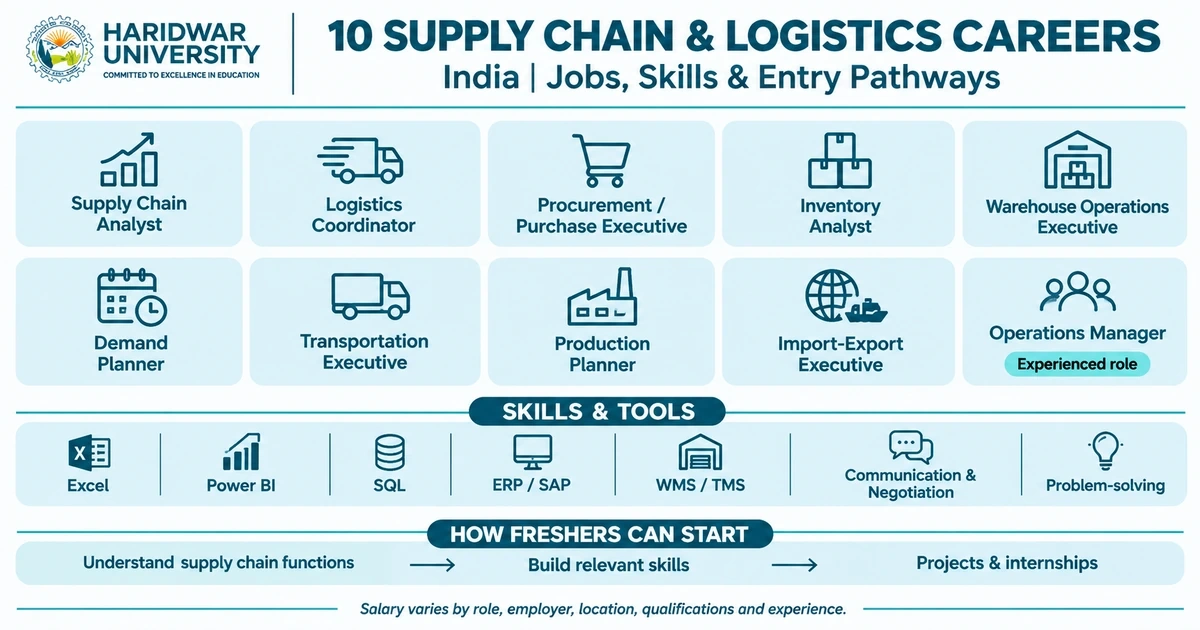
Supply Chain & Logistics Careers in India: 10 Jobs, Salaries & Skills
Mr. Prajwal Chaudhary
Head, Training & Placement, Haridwar University
A product may be designed in one city, manufactured in another, stored in a warehouse and delivered to a customer hundreds of kilometres away. The people coordinating these movements work in supply chain management and logistics. Their decisions affect delivery time, inventory, production costs and customer satisfaction.
For students exploring supply chain management careers, this is a field worth understanding beyond the familiar image of transport and warehousing. India's logistics sector employs more than 22 million people, according to a 2025 Government of India backgrounder released on the National Logistics Policy. Massive national investments in dedicated freight corridors, digital logistics platforms and multimodal transport parks are fundamentally reshaping how goods move across the country.
From a campus placement perspective, I would encourage students to look beyond senior job titles such as logistics manager. Sustainable careers usually begin with functional entry roles in purchasing, inventory control, operations scheduling, dispatch documentation, or supply chain data analysis. Understanding these entry points is often far more valuable than focusing solely on executive positions.
Table of Contents
- 1. Understanding Supply Chain Management and Logistics
- 2. Why Supply Chain Careers Matter in India
- 3. 10 Supply Chain and Logistics Jobs in India
- 4. Supply Chain and Logistics Salaries in India
- 5. Skills and Tools Employers Look For
- 6. Industries Hiring Supply Chain Professionals
- 7. How Freshers Can Enter the Field
- 8. Frequently Asked Questions (FAQs)
- 9. Building a Career in a Connected Economy
1. Understanding Supply Chain Management and Logistics
Supply chain management covers the comprehensive lifecycle of sourcing raw materials, planning manufacturing, collaborating with vendors, controlling warehouse stock, and delivering finished goods. Logistics is a vital component within this wider system, focusing primarily on physical transport, inventory warehousing, order fulfillment, and distribution networks.
Consider a pharmaceutical enterprise. Its corporate supply chain team plans active ingredient procurement, coordinates production schedules, manages buffer stocks, and aligns production with national demand. Its logistics operations team ensures that temperature-sensitive finished medicines safely reach regional distribution centres, retail pharmacies, and hospitals without cold-chain interruption.
This distinction is critical when planning career steps. A business graduate who enjoys analytical modelling and quantitative forecasting may thrive as a demand planner or supply chain analyst, while someone drawn to dynamic ground execution and vendor negotiation may excel in warehouse operations, freight forwarding, or procurement.
2. Why Supply Chain Careers Matter in India
The strategic importance of logistics cuts across modern manufacturing, fast-moving consumer goods (FMCG), e-commerce marketplaces, agriculture, automotive assembly, and healthcare. Every organisation that purchases parts, manages stock, or delivers products depends fundamentally on resilient supply chain operations.
The Government of India’s National Logistics Policy and PM GatiShakti National Master Plan aim to bring India’s logistics costs down to global benchmarks through multi-modal connectivity and digitized clearance networks (review the PIB release on PM GatiShakti progress). Unified digital platforms such as the Unified Logistics Interface Platform (ULIP) integrate statutory databases across customs, shipping lines, railways, and highways, creating high visibility across cargo flows.
Hiring Demand Indicator: Randstad 2025 Report
According to the Randstad India Talent Insights Report 2025, supply chain and logistics professionals ranked second in junior-level hiring demand across manufacturing and automotive sectors at 13.33%, with robust demand sustained through middle and senior management tiers.
This does not mean every graduate walks into a management role on day one. It proves that operational and supply chain analytical skills remain universally relevant across industrial sectors rather than restricted to a single narrow employer category.
3. 10 Supply Chain and Logistics Jobs in India
The following roles illustrate distinct functional divisions across the supply chain lifecycle. Entry-level graduates should focus especially on functional coordinator and junior analyst titles:
1. Supply Chain Analyst
Analysts examine purchasing trends, warehouse turnaround times, delivery metrics, and freight costs to eliminate bottlenecks and excess stock. Entry routes include Junior Data Analyst and Reporting Associate. Essential tools include Advanced Excel, SQL, Power BI, and statistical modelling.
2. Logistics Coordinator
This role monitors active cargo consignments, liaises with 3PL carriers, verifies delivery waybills, and maintains operational paperwork. Freshers typically join as Logistics Executives. Strong stakeholder communication, spreadsheet tracking, and quick problem resolution are vital.
3. Procurement or Purchase Executive
Procurement teams source raw materials and services, evaluate competitive vendor tenders, negotiate commercial pricing, issue purchase orders (POs), and track supplier SLAs. Key skills include vendor negotiation, commercial contract literacy, and price reconciliation.
4. Inventory Analyst
Inventory specialists balance holding costs against stockout risks. They calculate economic order quantities (EOQ), track re-order thresholds, and conduct ABC inventory analyses. Familiarity with inventory spreadsheets and basic ERP modules provides a strong start.
5. Warehouse Operations Executive
Warehouse operations teams oversee cargo receiving, barcode scanning, binning, picking, packaging, and dispatch staging. Hands-on experience with modern Warehouse Management Systems (WMS) and safety protocols is highly valued by fulfillment hubs.
6. Demand Planner
Demand planners project future SKU demand using historical sales trends, promotional calendars, seasonal spikes, and market intelligence. This mathematical and business-facing role bridges sales targets with production capacity.
7. Transportation Executive
Transportation teams manage fleet dispatch, optimize delivery route sequences, monitor transit turn-around times (TAT), and ensure compliance with electronic waybill (e-Way Bill) regulations. Route optimization and freight dispute handling are essential skills.
8. Production Planner
Operating on factory floors, production planners align master assembly schedules with bill of materials (BOM) availability, plant machine hours, and labour shifts. Knowledge of material requirements planning (MRP) and lean manufacturing principles is critical.
9. Import-Export Executive
These professionals manage cross-border customs clearances, international bills of lading, letters of credit (LC), HS code classifications, and maritime container freight bookings. Thorough knowledge of international trade documentation and Incoterms is indispensable.
10. Operations Manager
Operations managers lead large facilities, multi-site fulfillment centres, and cross-docking operations. They drive cost containment, service quality levels, and team safety. This is a mid-to-senior leadership milestone achieved after building successful field experience.
For an international functional framework, the Association for Supply Chain Management (ASCM) Career Guide systematically maps roles across Plan, Source, Make, Deliver, and Return operational pillars.
4. Supply Chain and Logistics Salaries in India
Remuneration across supply chain management depends heavily on functional specialization, employer scale, plant geography, and technical analytical competence. A logistics field coordinator, procurement executive, and enterprise supply chain analyst operate with completely different skill requirements and salary benchmarks.
Entry-level graduates typically enter roles such as logistics executive, junior inventory analyst, or purchase executive. As professionals build competence in ERP navigation (such as SAP MM/SD), supply chain data visualization, and vendor contract negotiations, their career trajectories accelerate rapidly towards regional management. Prospective candidates should evaluate live campus placement records and local industrial job postings rather than relying on generalized single-number industry averages.
5. Skills and Tools Employers Look For
While theoretical business knowledge is beneficial, supply chain execution is fundamentally about dependable coordination under tight schedules. A delayed supplier confirmation, an inaccurate stock ledger, or a missing shipping document cascades immediately across production lines. Key capabilities include:
- Advanced Microsoft Excel: Pivot tables, VLOOKUP/XLOOKUP, conditional aggregation, and inventory modelling.
- Power BI and Tableau: Creating operational dashboards tracking on-time in-full (OTIF) delivery, turnaround times, and stock aging.
- SQL Fundamentals: Querying enterprise databases to extract structured transactions and inventory logs.
- Enterprise Resource Planning (ERP): Understanding how ERP architectures (e.g., SAP, Oracle) interconnect purchasing, inventory, manufacturing, and billing.
- WMS & TMS Systems: Practical familiarity with warehouse management systems and transport tracking software.
- Communication & Commercial Negotiation: Coordinating firmly and professionally with transport contractors, warehouse supervisors, suppliers, and internal clients.
- Real-time Problem Solving: Swiftly re-routing shipments during transit breakdowns, carrier strikes, or unexpected factory stockouts.
6. Industries Hiring Supply Chain Professionals
Supply chain and logistics talent is recruited wherever raw commodities, components, or consumer products must be moved, stored, or distributed:
| Industry Sector | Primary Operational Focus |
|---|---|
| E-Commerce & Quick-Commerce | Automated fulfillment centres, high-velocity sorting, dark store restocking, and hyper-local last-mile delivery. |
| Fast-Moving Consumer Goods (FMCG) | National distributor networks, stock freshness rotation, bulk warehousing, and primary freight logistics. |
| Manufacturing & Automotive | Just-in-Time (JIT) supplier sequencing, line-side delivery, inbound raw material tracking, and global parts sourcing. |
| Pharmaceuticals & Healthcare | Strict cold-chain temperature preservation, serialized track-and-trace packaging, and regulatory compliance. |
| Third-Party Logistics (3PL & 4PL) | Multi-client contract warehousing, intermodal freight forwarding, customs brokerage, and cross-docking operations. |
7. How Freshers Can Enter the Field
A specialized logistics degree is valuable, but it is by no means the only pathway into the industry. Major enterprises actively hire graduates across business administration, commerce, and engineering, training them in their specific operating protocols:
Understand procurement lifecycles, lead times, safety stocks, warehousing layouts, and multimodal freight modes.
Practice data cleansing, automated inventory tracking, and operational metric reporting in Excel and Power BI.
Create a real-world inventory reconciliation model, build an order fulfillment simulator, or map a supplier-to-store logistics network.
Seek summer internships with manufacturers, retail distributors, cold-storage facilities, or freight agencies.
Search for roles such as Procurement Assistant, Purchase Trainee, Logistics Coordinator, Inventory Executive, or Warehouse Operations Associate.
At Haridwar University, students can pursue comprehensive management foundations through the Roorkee College of Business Studies, offering industry-aligned programmes including BBA with AI, B.Com with AI, and MBA with AI. For further insights into career choices after business studies, explore our detailed guide on career options after BBA.
8. Frequently Asked Questions (FAQs)
1. Is supply chain management a good career in India?
Yes. Powered by India’s 22-million-strong logistics workforce, national logistics reforms like PM GatiShakti, and booming manufacturing and e-commerce sectors, supply chain offers extensive career pathways across planning, procurement, analytics, and warehouse operations.
2. What is the salary of a logistics fresher in India?
Fresher compensation depends on functional designation, employer scale, and technical proficiency. Entry-level logistics coordinators, purchase executives, and warehouse associates command competitive starting compensation that grows steadily with ERP competence and operations management experience.
3. Which supply chain job is suitable for freshers?
Excellent starting roles for new graduates include Procurement Assistant, Purchase Executive, Logistics Coordinator, Inventory Executive, Transportation Associate, and Operations Trainee.
4. Which degree is best for supply chain management?
Degrees in Business Administration (BBA, MBA), Commerce (B.Com), and Engineering (Mechanical, Production, Industrial) provide solid routes into the field. The ideal degree depends on whether you lean towards commercial management, quantitative analytics, or plant floor operations.
5. Is logistics a stressful job?
Roles in active freight execution, dispatch scheduling, and warehouse management operate under strict delivery deadlines and occasional vendor delays. Strategic planning, procurement, and data analyst positions have more predictable project-driven cadences.
6. Which skills are important for supply chain analyst jobs?
Advanced Excel modelling, SQL database querying, Power BI dashboarding, and practical familiarity with inventory KPIs (lead times, safety stock, turnover ratios) are essential to convert data insights into actionable operational decisions.
7. Can a BBA graduate work in logistics and supply chain?
Yes. BBA graduates regularly secure positions in procurement coordination, transport operations, inventory control, and retail vendor management. Practical spreadsheet competence and internship exposure strongly reinforce campus applications.
9. Building a Career in a Connected Economy
Supply chain and logistics careers go far beyond simply transporting freight from point A to point B. They encompass strategic enterprise decisions regarding cost optimization, supplier relationships, inventory safety buffers, digital visibility platforms, and exceptional customer delivery standards.
My counsel to students is straightforward: identify the functional domain that matches your temperament, master the core digital tools used in that area, and understand the ground reality behind each job title. A prepared graduate who can demonstrate practical project competence and analytical clarity will build an enduring career in India’s expanding, interconnected economy.
Build Your Management & Supply Chain Career at Haridwar University
Master business operations, logistics planning, data analytics, and corporate finance. Study with experienced faculty, modern business labs, corporate internships, and merit scholarships up to 80%. Admissions open for the 2027-28 academic session.