

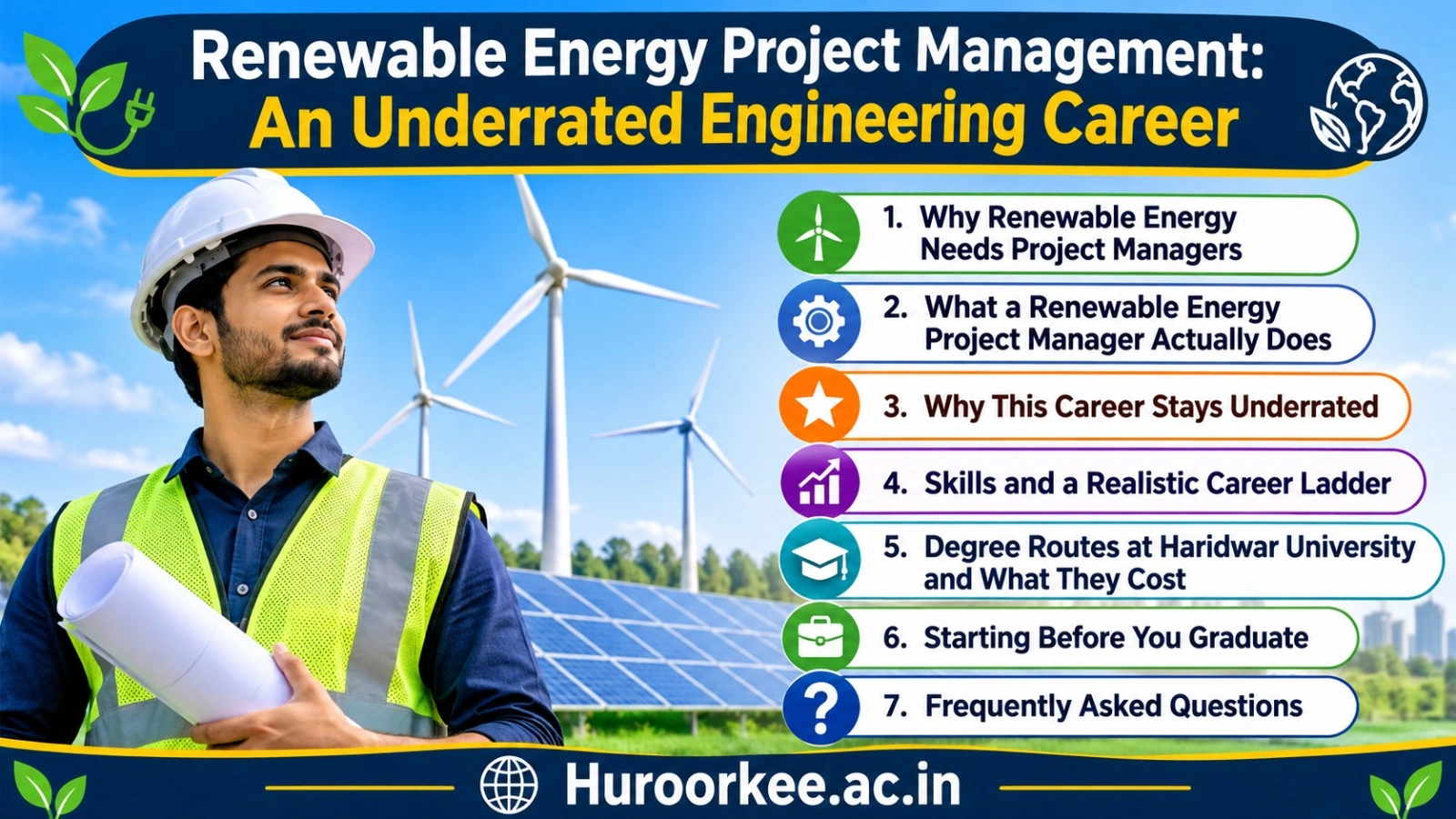
Renewable Energy Project Management: An Underrated Engineering Career
Dr. Aadesh K. Arya
Pro Vice-Chancellor, Haridwar University
Mention clean energy to a room of engineering students and most picture a technician on a rooftop or a researcher in a lab. Few picture the person who makes sure the panels, the cables, the permits and the grid connection all arrive in the right order. This guide to Renewable Energy Project Management: An Underrated Engineering Career looks at that missing job. It explains what the role involves, why it stays out of the headlines, and how a student at Haridwar University can build towards it, using government sources instead of guesswork.
| Project Phase | What the Manager Handles | Engineering Base |
|---|---|---|
| Planning and site selection | Land studies, resource assessment, feasibility, budget | Civil, electrical or mechanical basics |
| Approvals and land | Clearances, right of way, agreements with agencies | Documentation and negotiation |
| Procurement and construction | Vendors, schedules, quality, safety on site | Scheduling and quality control |
| Grid connection and commissioning | Testing, utility coordination, handover | Electrical and power systems |
| Operations handover | Performance tracking, maintenance planning | Data analysis |
Table of Contents
- 1. Why Renewable Energy Needs Project Managers
- 2. What a Renewable Energy Project Manager Actually Does
- 3. Why This Career Stays Underrated
- 4. Skills and a Realistic Career Ladder
- 5. Degree Routes at Haridwar University and What They Cost
- 6. Starting Before You Graduate
- 7. Frequently Asked Questions
1. Why Renewable Energy Needs Project Managers
The scale of the build-out
A PIB release dated 8 April 2026 notes that India’s renewable capacity grew from 76.38 GW in March 2014 to 274.68 GW in March 2026. The country added a record 55.29 GW of non-fossil capacity in 2025-26 alone, and the Ministry of New and Renewable Energy is working towards 500 GW of non-fossil capacity by 2030 (see the official PIB release on India’s renewable capacity).
Why capacity needs coordination
Every gigawatt is really a complex network of separate operational jobs: land acquisition, statutory approvals, module procurement, substation engineering, civil groundwork, installation crews, and high-voltage transmission interconnects. Someone has to hold the schedule together. That person rarely appears in celebratory press releases, yet without them, capacity on paper never turns into real power on the grid. Project delay is exceptionally costly, because a completed solar park or wind farm waiting on a transmission bay earns zero revenue.
2. What a Renewable Energy Project Manager Actually Does
From site to switch-on
The arc runs from site feasibility through to final commercial operation. A project manager starts well before civil ground-breaking: reviewing geotechnical studies, topographical surveys, land title clearances, and environmental consents. Once construction begins, they direct procurement pipelines, monitor contractor milestones, ensure quality compliance, and oversee grid synchronization. Solid engineering judgement is non-negotiable at every stage; a manager who cannot read a single-line diagram (SLD) or civil foundation drawing cannot effectively hold contractors accountable.
The bottlenecks that fill their days
The operational reality is demanding. In early 2026, the central government constituted a high-level task force to systematically address regulatory approvals, right-of-way (RoW) constraints, grid bay allocation, and construction logistics for wind projects, sorting approximately 66 GW of identified wind sites into three clearance zones. Those are the precise problems an energy project manager resolves daily. Readers can explore our broader guide to renewable energy jobs in India for an overview of adjacent technical roles.
Safety, quality and cost
Beyond approvals, the manager guards three competing priorities simultaneously: safety on site, build quality, and capital budget. These priorities constantly pull in opposing directions. A rushed shortcut that saves a week can cost months of legal liability or equipment damage if an inverter station or foundation fails after commissioning. Seasoned managers learn to identify risks early, price contingencies realistically, and communicate transparently with clients and site engineers.
3. Why This Career Stays Underrated
Hidden behind the technology
Headlines naturally gravitate towards record gigawatt tenders, ultra-efficient perovskite solar cells, and green hydrogen subsidies. Delivery is invisible precisely when it runs smoothly. Job titles blur the picture too: the vital coordination work often sits under varied designations such as site engineer, planning engineer, execution lead, or contracts manager.
Where the demand points
According to official data from the PIB backgrounder on PM Surya Ghar, the flagship rooftop solar initiative alone is projected to generate roughly 17 lakh direct jobs across manufacturing, logistics, supply chain, installation, and maintenance. In FY 2025-26, over 22.7 lakh households benefited from the scheme, and 1,24,793 candidates received certified training across solar, wind, and green hydrogen. Large field workforces of rooftop installers and field technicians require competent project planners and site supervisors to lead them.
What it means for a student
If you are deciding between a narrow technical specialism and an execution-focused coordination role, you do not need to lock in your decision on day one. Start by building a solid foundation in core engineering, volunteer for responsibility in laboratory team projects, and allow your operational interests to develop. The trajectory from graduate engineer trainee to site supervisor and project manager is steady, and each career step rewards engineers who communicate clearly and solve technical roadblocks.
4. Skills and a Realistic Career Ladder
A ladder visible in the national register
The National Qualifications Register (NQR) features formal benchmarks such as the Green Energy Supervisor – Solar qualification (awarded by Tata Power), mapping clear progression pathways to Site Supervisor and Solar PV Project Manager. Review the NQR listing for qualification 14506, whose core modules cover electrical systems, solar PV plant lifecycles, and industrial environmental health and safety (EHS).
Skills worth building
Electrical and civil engineering fundamentals come first, followed by project scheduling (Primavera P6, MS Project), procurement protocols, and contract management. Plain, authoritative communication with site contractors, utility engineers, and local authorities is vital. Strong technical writing is equally crucial: detailed site daily progress reports (DPRs), variation claims, and commissioning documentation form the legal record that protects projects from disputes.
A note on remuneration
We do not quote speculative salary figures here. Central government documentation publishes no statutory pay benchmarks for private renewable energy project managers. Students should assess live industry postings, evaluate developer reputations, and secure written employment contracts.
5. Degree Routes at Haridwar University and What They Cost
A career in renewable energy project management typically starts from a core engineering branch, with project management, financial modelling, and regulatory skills added through practical work. Haridwar University offers accredited engineering and management pathways for the 2027-28 academic session:
| Programme | Duration | Year 1 Tuition | Each Later Year |
|---|---|---|---|
| B.Tech. (Hons.) Electrical & Electronics Engineering with AI | 4 years | ₹1,27,000 | ₹1,10,000 |
| B.Tech. (Hons.) Mechanical Engineering with AI | 4 years | ₹1,27,000 | ₹1,10,000 |
| B.Tech. (Hons.) Civil Engineering with AI | 4 years | ₹1,27,000 | ₹1,10,000 |
| M.Tech. Electrical & Electronics Engineering | 2 years | ₹78,000 | ₹70,000 |
| MBA with Artificial Intelligence | 2 years | ₹1,77,000 | ₹1,60,000 |
Scholarships and accommodation costs
Haridwar University provides attractive merit-based tuition scholarships in Year 1 based on JEE Main ranks, Class 12 aggregate percentages, or CUET scores:
- Above 90%: 80% tuition fee waiver
- Above 80% up to 90%: 50% tuition fee waiver
- Above 70% up to 80%: 20% tuition fee waiver
- Above 60% up to 70%: 10% tuition fee waiver
- Girls’ Scholarship: 25% first-year tuition waiver across technical disciplines
Note: A student may claim only one scholarship scheme. Annual hostel accommodation fees range from ₹85,000 to ₹1,05,000 depending on room occupancy. Detailed guidelines are available on our fee structure and scholarships page.
6. Starting Before You Graduate
Treat every university capstone project as a simulated delivery contract: write the work breakdown structure (WBS), quantify critical path risks, and track costs. Pursue site internships at substation installations or EPC firms, even for a few weeks, and closely observe how site superintendents organize subcontractors. Study MNRE tender announcements to understand how technical specifications are formulated, master project management software, and practice drafting crisp, professional site reports.
Financial and administrative readiness matters too. Haridwar University’s Student Welfare Services assists students with education loans, banking documentation, and responsive grievance redressal through dedicated Student Care Centres in each academic block. This combination of hands-on technical training and supportive infrastructure is what makes renewable energy project management an outstanding career choice for ambitious engineering graduates.
7. Frequently Asked Questions
Is renewable energy project management a good career for engineers?
Yes. With India’s renewable capacity reaching 274.68 GW and marching towards the 500 GW target by 2030, capital execution and commissioning represent critical bottlenecks. Skilled project managers ensure complex renewable assets are built safely, on time, and within budget.
Which engineering branch suits this career best?
Electrical (EEE), Mechanical (ME), and Civil Engineering (CE) all feed naturally into this field. Electrical engineers manage power evacuation, switchyards, and inverters; civil engineers oversee foundations, roads, and land grading; mechanical engineers lead turbine erection and tracking structures.
Do I need a project-management certification?
Statutory regulations do not mandate a PMP or CAPM certificate for entry-level roles. Demonstrable site experience, familiarity with project management software, and rigorous understanding of power engineering standards carry substantial weight with EPC contractors.
Does Haridwar University offer a renewable energy programme?
The university offers comprehensive core engineering degrees in Electrical & Electronics Engineering (EEE), Mechanical Engineering (ME), and Civil Engineering (CE) with AI specialisations, alongside MBA and M.Tech. programmes, allowing students to focus on renewable energy electives and practical projects.
What do the related HU programmes cost?
B.Tech. (Hons.) programmes in EEE, ME, and CE with AI are ₹1,27,000 in Year 1 and ₹1,10,000 per subsequent year. M.Tech. EEE is ₹78,000 in Year 1, and MBA with AI is ₹1,77,000 in Year 1. Complete details are presented in the fee table above.
Are scholarships available?
Yes. Haridwar University awards first-year tuition scholarships ranging from 10% to 80% based on merit in Class 12, JEE Main, or CUET, in addition to a 25% first-year scholarship for female students.
What salary can a renewable project manager expect?
Government documentation does not provide statutory pay scales for private renewable energy firms. Candidates should review current commercial job postings, assess employer profiles, and obtain written compensation packages.
Can a mechanical or civil graduate move into this field?
Absolutely. The national qualifications framework recognises graduates from diverse technical disciplines for solar supervisory roles. Mechanical and civil engineers should supplement their core skills with practical electrical grid and substation concepts.
How can I start while still studying?
Treat course projects as execution assignments, pursue field internships with EPC developers, master project scheduling software, and monitor national policy tenders released by MNRE and SECI.
Power Your Engineering Career in Renewable Energy at Haridwar University
Master clean power systems, smart grid integration, mechanical design, and engineering project execution. Learn with industry-aligned laboratories, corporate internships, career mentorship, and merit scholarships up to 80%. Admissions open for the 2027-28 academic session.