

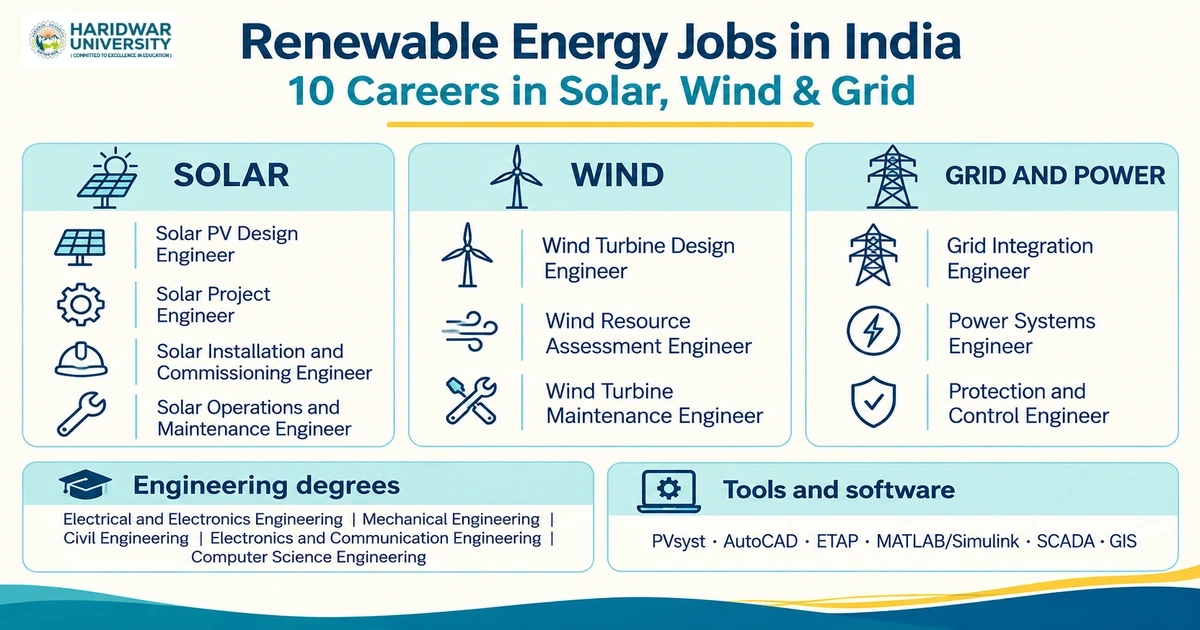
Renewable Energy Jobs in India: 10 Careers in Solar, Wind & Grid
Dr. Ekta Jain
Associate Professor & HOD, Applied Science, Haridwar University
India’s renewable energy transition is creating work well beyond solar-panel installation and wind-farm maintenance. Engineers are needed to design photovoltaic systems, assess wind resources, manage project execution, maintain turbines, and connect variable power generation to the electricity grid. For students choosing an engineering specialisation, the opportunity lies in understanding how these parts of the energy system work together.
The scale of the shift is already measurable. The Ministry of New and Renewable Energy (MNRE) reported 274.69 GW of installed renewable energy capacity by March 2026, including large hydropower. Meanwhile, a 2026 CEEW-NRDC study found that selected clean-energy sectors added approximately 6.5 lakh workers between FY2023 and FY2026. These figures point to a growing sector, but they also raise a more useful question for students: what skills and roles sit behind that growth?
Table of Contents
- 1. Why Renewable Energy Careers Are Growing in India
- 2. How India’s Renewable Energy Workforce Is Changing
- 3. 10 Renewable Energy Jobs in Solar, Wind and Grid Systems
- 4. Engineering Degrees That Lead to Renewable Energy Careers
- 5. Technical Skills and Software Used in Renewable Energy Jobs
- 6. Salary Expectations and Entry-Level Opportunities
- 7. How Students Can Prepare for Renewable Energy Careers
- 8. Frequently Asked Questions (FAQs)
- 9. Building a Career in India’s Clean Energy Transition
1. Why Renewable Energy Careers Are Growing in India
The capacity figures tell only part of the story. Every new solar park requires people to assess sites, design electrical systems, coordinate construction, and maintain equipment. Wind projects need professionals who understand aerodynamics, mechanical systems, resource assessment, and turbine reliability. As renewable generation becomes a larger part of the electricity mix, grid planning and power-system engineering become increasingly important too.
India’s installed renewable capacity, including large hydropower, rose to 274.69 GW by March 2026, according to the MNRE’s Renewable Energy Statistics 2025–26. Solar accounted for the largest share, followed by wind and large hydropower. For students, this means renewable energy jobs are not confined to one technology or one type of employer. They span engineering consultancies, equipment manufacturers, project developers, utilities, and operations companies.
2. How India’s Renewable Energy Workforce Is Changing
A useful indicator comes from the CEEW-NRDC report Driving Energy Transition: Workforce, Skills, and Gender in India’s Renewable Energy Sector, published in June 2026. It estimates that selected clean-energy sectors added 657,845 workers between FY2023 and FY2026. Rooftop solar accounted for 62% of those workforce additions.
The report also estimates that meeting India’s 500 GW non-fossil capacity target, alongside the goals of the National Green Hydrogen Mission, could generate more than 44 lakh full-time-equivalent jobs. This is a projection, not a count of jobs already available. The distinction matters: installed capacity, workforce additions, and future employment estimates measure different things.
One finding deserves attention from students: employment is generated across a project’s life cycle. Design and construction create one set of opportunities; operations, maintenance, and system upgrades create another. A career in renewable energy can therefore involve fieldwork, design offices, laboratories, software, or power-system control rooms.
Renewable energy is also closely connected with electric mobility and battery technology. Students exploring these adjacent sectors can also read our comprehensive guides to EV careers in India and lithium-ion battery careers in India.
3. 10 Renewable Energy Jobs in Solar, Wind and Grid Systems
The following roles illustrate the range of technical work behind solar and wind generation and the systems that connect them to the grid.
Solar Careers
1. Solar PV Design Engineer: Plans photovoltaic systems for rooftops or ground-mounted utility sites. The work includes estimating energy generation, selecting modules and central/string inverters, preparing electrical single-line diagrams (SLD), assessing 3D shading, and specifying Balance of System (BoS) components. Knowledge of electrical engineering, solar PV principles, and simulation software is valuable.
2. Solar Project Engineer: Coordinates the technical and operational stages of a solar installation. They work with design teams, EPC contractors, equipment suppliers, and site personnel to keep construction aligned with engineering drawings, technical specifications, safety standards, budgets, and schedules.
3. Solar Installation and Commissioning Engineer: Oversees installation checks, electrical continuity testing, insulation resistance validation, and grid-synchronization commissioning before a solar plant begins feeding commercial power. Practical electrical testing knowledge is essential.
4. Solar Operations and Maintenance (O&M) Engineer: Once a plant is operating, output must be actively monitored and equipment maintained. O&M engineers analyze performance ratio (PR) losses, inspect string combiner boxes and inverters, review telemetry data, and coordinate preventive maintenance and thermographic drone inspections.
Wind Careers
5. Wind Turbine Design Engineer: Works on structural assemblies and mechanical subsystems such as composite blades, nacelles, planetary gearboxes, yaw drives, and tubular steel towers. Mechanical engineering, composite materials, aerodynamics, fluid mechanics, CAD, and finite element simulation are relevant foundations.
6. Wind Resource Assessment Engineer: Before a wind park is funded or built, meteorological mast data must be analyzed for wind speed distribution, wind shear, turbulence intensity, and directional consistency. These engineers utilize statistical modelling, meteorology, and Geographical Information Systems (GIS) to estimate net Annual Energy Production (AEP).
7. Wind Turbine Maintenance Engineer: Inspects and services hydraulic pitch systems, yaw drives, generators, brake calipers, and electrical control panels inside the nacelle. Working at height and rigorous safety compliance (GWO standards) are central to this field-oriented engineering role.
Grid and Power-System Careers
8. Grid Integration Engineer: Solar and wind generation fluctuates with weather. Grid Integration Engineers study how renewable plants interconnect with state and central transmission networks while meeting strict grid codes (Central Electricity Authority regulations) regarding voltage ride-through (LVRT/HVRT), frequency support, reactive power compensation, and harmonic limits.
9. Power Systems Engineer: Conducts load-flow studies, short-circuit calculations, transient stability analysis, and dynamic contingency simulations. They model the impact of high-penetration renewable generation on legacy transmission infrastructure using specialized power-system software.
10. Protection and Control Engineer: Ensures electrical faults across substations, power transformers, switchyards, and transmission lines are detected and isolated within milliseconds. They configure numerical protection relays, current/potential transformers (CT/PT), SCADA tele-protection, and circuit breakers.
4. Engineering Degrees That Lead to Renewable Energy Careers
There is no single degree that leads to every renewable energy job. The best starting point depends on the type of subsystem a student wants to specialize in:
| Engineering Background | Related Career Directions |
|---|---|
| Electrical & Electronics Engineering (EEE) | Solar PV design, substation engineering, grid integration, power systems analysis, protection and control, and inverter engineering. |
| Mechanical Engineering | Wind turbine structural design, drivetrain maintenance, solar tracker mechanics, hydraulic pitch systems, and thermal power plant retrofits. Read our guide to B.Tech Mechanical Engineering specialisations. |
| Civil Engineering | Solar module mounting structure (MMS) foundations, geotechnical soil testing, wind turbine gravity base design, access roads, and stormwater drainage. |
| Electronics & Communication Engineering (ECE) | SCADA sensor networks, IoT solar weather stations, programmable logic controllers (PLC), remote telematics, and optical fiber substation automation. |
| Computer Science & Engineering (CSE) | Renewable power forecasting algorithms, energy trading analytics, cloud performance monitoring dashboards, and smart grid cybersecurity. |
Students exploring engineering options can review the engineering programmes listed by Haridwar University and compare core courses with their chosen clean-energy goals.
5. Technical Skills and Software Used in Renewable Energy Jobs
Employers look for engineers who can apply classroom theory to real project workflows. Software proficiency should always be acquired with a clear engineering objective:
- PVsyst: The global standard for sizing, simulating, and estimating solar PV energy yields, string configuration, and detailed loss diagrams (thermal, soiling, clipping, shading).
- AutoCAD: Fundamental for creating 2D/3D electrical layout drawings, string routing, cable tray cross-sections, and substation schematics.
- ETAP / PSCAD: Industry-standard power system simulation tools used for load-flow, short-circuit, relay coordination, and grid transient studies.
- MATLAB / Simulink: Essential for modelling wind generator dynamics, maximum power point tracking (MPPT) algorithms, and battery-storage power conversion systems.
- SCADA Platforms: Supervisory Control and Data Acquisition systems allowing operators to monitor inverters, transformers, breakers, and meteorological sensors in real time.
- GIS (QGIS / ArcGIS): Used for geospatial terrain analysis, land contour mapping, shading topography, and transmission line right-of-way planning.
6. Salary Expectations and Entry-Level Opportunities
Renewable energy salaries vary considerably depending on role specialization, employer category (OEM, IPP, EPC developer, utility), project scale, and geographic mobility.
A January 2025 foundit Insights Tracker report listed an indicative salary range of approximately ₹6.45 lakh to ₹15.36 lakh per year for Renewable Energy Engineers in India. This represents a broad industry-reported spectrum across varied experience levels rather than a guaranteed fresher package. Entry-level engineering graduates (GETs) typically start across site engineering, PV drafting, testing, and commissioning, with rapid package progression as project execution and design expertise grow.
7. How Students Can Prepare for Renewable Energy Careers
Students should build concrete evidence of practical competence well before their final semester. Rather than collecting generic certificates, focus on tangible capstone projects:
- Solar PV Rooftop Layout: Prepare a complete AutoCAD layout and PVsyst yield simulation for an institutional building rooftop, documenting string sizing and calculated PR losses.
- Wind Turbine Aerodynamic Study: Model aerodynamic forces on turbine blade profiles using CFD or open aerodynamic tools, analyzing lift-to-drag ratios.
- Power-System Grid Simulation: Model a standard IEEE bus distribution network in ETAP or MATLAB, simulating the voltage impact of adding a 5 MW solar plant.
- Renewable Energy Data Analytics: Use Python (Pandas, Matplotlib) to analyze public solar radiation and weather datasets, developing a basic generation forecast model.
- Telemetry Monitoring Dashboard: Build a simulated SCADA dashboard using Python, Node-RED, or Grafana displaying real-time inverter power, string voltages, and temperature alerts.
Safety Note: Practical projects must be conducted via software simulations, analytical datasets, or supervised laboratory benches. Never attempt experiments on high-voltage live utility infrastructure without certified supervisory oversight.
To prepare for industrial exposure, Haridwar University students can consult our guide on securing and maximizing B.Tech internships. Those interested in the computing side of smart grid energy management can also examine career options after B.Tech CSE.
8. Frequently Asked Questions (FAQs)
1. Is renewable energy a good career option in India?
Yes. India’s national target of 500 GW of non-fossil energy capacity by 2030 is driving strong demand across solar design, wind farm installation, substation engineering, power system analysis, and grid integration.
2. Which engineering branch is best for renewable energy jobs?
Electrical and Electronics Engineering (EEE) has the most direct application to solar design, power systems, and grid integration. Mechanical Engineering connects directly with wind turbines and structural trackers, while Civil, ECE, and Computer Science graduates find valuable roles across site design, SCADA automation, and forecasting.
3. Can a fresher get a job in the solar energy sector?
Yes. Engineering graduates commonly enter through Graduate Engineer Trainee (GET) positions, junior solar design engineering, site quality inspection, testing & commissioning, and plant operations & maintenance (O&M).
4. What does a grid integration engineer do?
A Grid Integration Engineer analyzes how variable solar and wind farms connect to transmission grids, ensuring compliance with grid code regulations regarding voltage stability, frequency regulation, reactive power, and protection coordination.
5. Is coding necessary for renewable energy engineering?
Coding is not strictly mandatory for field or basic CAD design roles. However, knowledge of Python or MATLAB is highly advantageous for renewable generation forecasting, large dataset analytics, and smart grid automation.
6. Which software should a solar energy engineer learn?
PVsyst is the global industry benchmark for photovoltaic yield simulations. AutoCAD is essential for electrical single-line diagrams (SLD) and physical plant layouts. Power system tools like ETAP and SketchUp (for 3D shading) are also widely utilized.
7. Are renewable energy jobs limited to solar and wind?
No. The broader clean energy ecosystem encompasses small and large hydropower, biomass gasification, green hydrogen electrolyzer systems, battery energy storage (BESS), and high-voltage DC (HVDC) transmission.
9. Building a Career in India’s Clean Energy Transition
Renewable energy jobs in India do not represent a single homogenous career with multiple interchangeable titles. They represent a deeply interconnected suite of specialized engineering disciplines—from sizing a commercial solar array and servicing a multi-megawatt wind turbine to stabilizing regional transmission networks.
My advice to engineering students is to start with unshakeable technical fundamentals in circuits, mechanics, or thermodynamics, identify which part of the energy flow interests you most, and build tangible project and internship evidence. The sector’s exponential expansion creates undeniable opportunities, but the engineers who truly master the multi-disciplinary technology will lead India’s sustainable energy future.
Ready to Advance Your Education at Haridwar University?
Prepare for leadership in clean energy, power systems, and advanced technology. Explore our industry-aligned B.Tech programmes in Electrical, Mechanical, ECE, and Computer Science with hands-on labs and merit scholarships. Applications are open for the 2027-28 session.