

Lithium-Ion Battery Careers in India: 8 Jobs, BMS Skills & How to Start
Mr. Abhinav Bhatnagar
Head, Mechanical Engineering, Haridwar University
Lithium-ion batteries are no longer limited to electric vehicles. They are becoming critical to renewable energy storage, industrial backup power systems, consumer electronics, and India's wider clean energy transition. As this multi-gigawatt market develops, so does the acute demand for engineers who can design battery packs, develop embedded control systems, test cell safety, manage heat dissipation, and recover valuable materials.
For students exploring lithium-ion battery careers in India, the opportunity is much broader than simply becoming a generic battery engineer. Mechanical, electrical, electronics, chemical, and materials engineering graduates can each enter distinct segments of the battery value chain. The key decision is to identify which domain aligns with your skills and build concrete, demonstrable technical competencies before applying for lithium-ion battery jobs.
Table of Contents
- 1. Why Battery Technology Is Becoming a Career Opportunity in India
- 2. How the Lithium-Ion Battery Ecosystem Works
- 3. 8 Lithium-Ion Battery Careers to Explore
- 4. Which Engineering Degree Leads to Which Battery Career
- 5. Technical Skills Required for Battery Engineering Jobs
- 6. How to Start a Career as a BMS Engineer
- 7. Salary Expectations and Career Growth
- 8. Projects That Can Strengthen Your Battery Technology Profile
- 9. Frequently Asked Questions (FAQs)
- 10. Choosing Your Entry Route into Battery Technology
1. Why Battery Technology Is Becoming a Career Opportunity in India
India's battery ecosystem is developing rapidly across two major connected pillars: electric mobility and stationary grid-scale energy storage. In its Report on Optimal Generation Capacity Mix for 2029-30 (Version 2.0), the Central Electricity Authority (CEA) projected a requirement of 41.65 GW / 208.25 GWh specifically for Battery Energy Storage Systems (BESS) by 2029–30. This forms part of India's broader 60.63 GW total energy storage mandate alongside Pumped Storage Projects (PSP).
To localize the supply chain, the Government of India has approved an ₹18,100-crore Production Linked Incentive (PLI) scheme for Advanced Chemistry Cell (ACC) battery storage, targeting 50 GWh of domestic giga-scale cell manufacturing capacity.
These policy and industrial drivers are sparking substantial demand across cell production, pack assembly, embedded electronics, thermal validation, and battery recycling. The employment landscape is not confined to automobile OEMs; it encompasses solar and wind renewable developers, telecommunications backup infrastructure, uninterruptible power supply (UPS) manufacturers, and transmission utilities.
The Climate Policy Initiative's mobility workforce analysis highlights high-value job openings such as battery cell manufacturing engineers, battery pack and BMS designers, electrochemistry specialists, and hydrometallurgical recycling leads. Battery engineering represents a convergence where electrical, chemical, mechanical, and software proficiencies intersect.
This expansion is also tightly aligned with the broader electric vehicle landscape. If you want a complete panorama of the wider clean mobility job market, explore our comprehensive guide to EV careers in India, including 12 jobs beyond manufacturing, essential skills, and salary insights.
2. How the Lithium-Ion Battery Ecosystem Works
A modern lithium-ion battery is far more complex than a set of standalone electrochemical cells. It is an intricately engineered multi-disciplinary system where materials chemistry, structural mechanics, power electronics, and embedded software must function in complete synchrony.
- Cell Development and Manufacturing: Synthesizing active materials (anode, cathode, electrolyte, separator), precision electrode coating, cell assembly (cylindrical, prismatic, or pouch format), electrolyte filling, formation cycling, and quality grading.
- Module and Pack Design: Serial-parallel cell interconnection, busbar welding, structural enclosure design, impact absorption, and mechanical crash protection.
- Battery Management and Control: Continuous telemetry of cell voltages, current, and temperature, state estimation algorithms (SoC, SoH, SoP), passive/active cell balancing, and high-voltage contactor actuation.
- Thermal Management: Designing liquid cold plates, heat pipes, air cooling channels, and phase-change materials to prevent thermal runaway and maintain optimal operating temperatures (typically 15°C–35°C).
- Testing and Validation: Environmental testing, vibration and mechanical shock analysis, charge-discharge cycle endurance, nail penetration, thermal abuse, and regulatory compliance (AIS-156, UN 38.3, UL 1642).
- End-of-Life Management & Recycling: Second-life repurposing for stationary solar storage, pack discharging, shredding into "black mass", and hydrometallurgical extraction of critical minerals (lithium, nickel, cobalt, manganese).
3. 8 Lithium-Ion Battery Careers to Explore
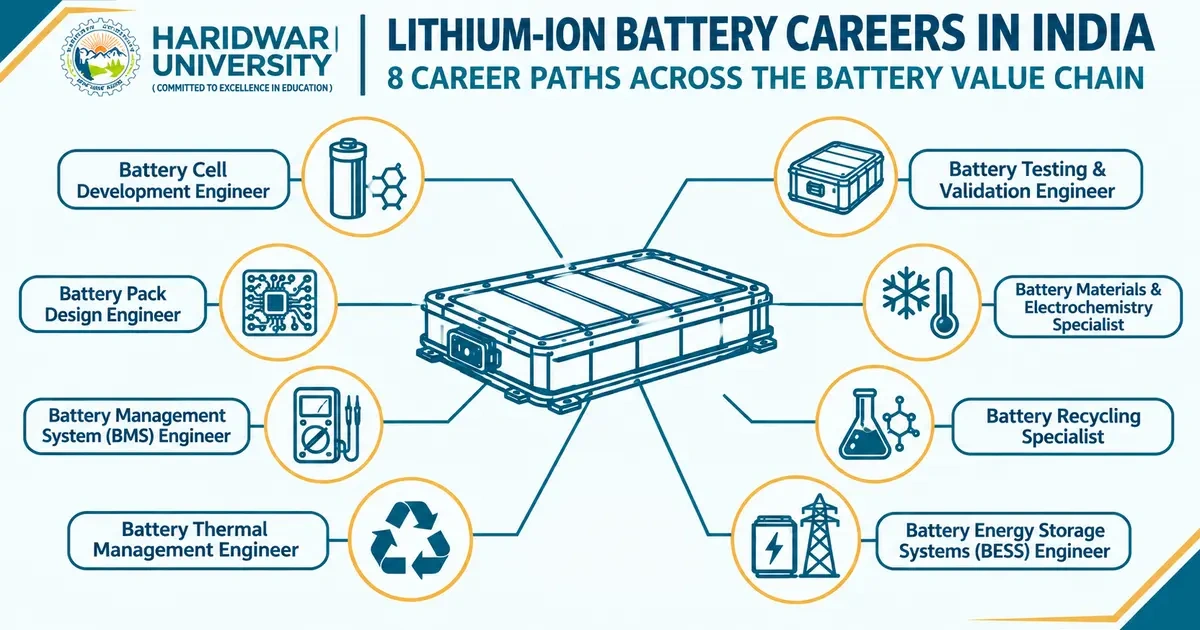
The table below summarizes eight prominent career pathways in India's battery technology sector, outlining the primary focus and recommended academic foundation for each:
| Career Role | What the Professional Works On | Useful Academic Foundation |
|---|---|---|
| 1. Battery Cell Development Engineer | Electrode formulation, electrolyte additive selection, pouch/cylindrical cell assembly, and coulombic efficiency improvement. | Chemical Engineering, Materials Science, Applied Chemistry |
| 2. Battery Pack Design Engineer | Mechanical packaging architecture, IP67/IP69K sealing, structural vibration resistance, module interconnects, and crash-safe enclosures. | Mechanical Engineering, Electrical Engineering |
| 3. Battery Management System (BMS) Engineer | Embedded firmware, analog front-end (AFE) circuit design, Kalman filtering for SoC/SoH estimation, CAN/LIN protocols, and safety cut-offs. | Electrical Engineering, ECE, Electronics |
| 4. Battery Thermal Management Engineer | Computational fluid dynamics (CFD) thermal modeling, liquid cooling plate design, dielectric fluid immersion cooling, and thermal runaway propagation mitigation. | Mechanical Engineering, Thermal Engineering |
| 5. Battery Testing and Validation Engineer | Hardware-in-the-loop (HIL) testing, climatic chamber aging tests, short-circuit validation, overcharge stress tests, and regulatory certification (AIS-156). | Electrical, Mechanical, ECE |
| 6. Battery Materials and Electrochemistry Specialist | Cathode/anode degradation mechanisms, solid-electrolyte interphase (SEI) layer growth, dendrite suppression, and solid-state battery R&D. | Chemical Engineering, Materials Science, Electrochemistry |
| 7. Battery Recycling Specialist | Automated pack disassembly, safe discharge, mechanical comminution, acid leaching, hydrometallurgical purification, and closed-loop raw material recovery. | Chemical, Materials, Environmental Engineering |
| 8. Battery Energy Storage Systems (BESS) Engineer | MW-scale grid integration, bidirectional power conversion systems (PCS), energy management systems (EMS), frequency regulation, and solar park coupling. | Electrical Engineering, Power Systems Engineering |
These distinctions are paramount. While battery careers are collaborative, they are not interchangeable. Employers hire candidates to solve very precise engineering problems: a mechanical engineer solves thermal warpage and vibration shock, whereas an electrical engineer develops high-speed telemetry and protection algorithms.
4. Which Engineering Degree Leads to Which Battery Career
Because battery technology is fundamentally interdisciplinary, students can build strong careers through diverse undergraduate routes:
- Mechanical Engineering: Ideal for battery pack enclosures, structural analysis, thermal management modeling, finite element analysis (FEA), and mechanical crash testing. Explore our in-depth curriculum guide to B.Tech Mechanical Engineering, specialisations, and core career pathways, as well as career options after B.Tech Mechanical covering core and EV roles.
- Electrical & Electronics Engineering (EEE): Tailor-made for power electronics, bidirectional inverters, high-voltage safety contactors, battery protection circuitry, and grid-scale BESS integration.
- Electronics & Communication Engineering (ECE): Provides the ideal foundation for BMS microcontrollers, embedded C firmware, CAN/SPI sensor communication buses, and IoT battery telematics.
- Chemical & Materials Engineering: Essential for cathode synthesis, electrolyte optimization, slurry mixing, roll-to-roll calendering, and hydrometallurgical recycling.
Students can explore these core disciplines across the engineering programmes listed by Roorkee College of Engineering. While specialized postgraduate degrees (M.Tech/Ph.D.) are advantageous for deep materials synthesis and electrochemistry R&D, a solid B.Tech combined with demonstrable project work qualifies graduates directly for pack design, BMS engineering, and testing roles.
5. Technical Skills Required for Battery Engineering Jobs
Modern battery recruiters evaluate candidates based on actionable, hands-on engineering competencies rather than generic classroom theory:
- Electrochemical Fundamentals: Nernst equation, open-circuit voltage (OCV) curves, C-rates, internal resistance (ESR), lithium plating risks, and thermal runaway kinetics.
- CAD and Structural Tools: SolidWorks, CATIA, or Siemens NX for pack layout, sheet metal design, busbar routing, and IP sealing.
- Simulation & Thermal Analysis: ANSYS Fluent, COMSOL Multiphysics, or MATLAB/Simscape for CFD cooling simulation and electro-thermal coupled models.
- Embedded Software & Modeling: C, Embedded C, Python, MATLAB/Simulink for Model-Based Design (MBD) and state estimation filters.
- Communication & Diagnostics: CAN 2.0B, CAN FD, SPI, I2C, UART, and industrial protocols like Modbus and OCPP.
- Standards & Testing: Automotive and stationary standards including AIS-156 Amendment 3, IS 16893, UN 38.3, and IEC 62619.
Recruiter Benchmark: Job descriptions from Tier-1 engineering employers like Bosch, Tata AutoComp, Exide, and Ather Energy consistently demand proficiency in MATLAB/Simulink for control logic, Python for test data analysis, and familiarity with CAN bus debugging tools (like Vector CANoe or PCAN). Study these job postings before picking which software tools to learn.
6. How to Start a Career as a BMS Engineer
Battery Management Systems (BMS) represent one of the fastest-growing and highest-paying career niches in the battery industry because they sit directly at the intersection of electronics, firmware, and electrochemistry.
The core responsibilities of a BMS engineer involve developing hardware and software to enforce the Safe Operating Area (SOA) of each cell:
- State of Charge (SoC) Estimation: Implementing Coulomb counting combined with Extended Kalman Filtering (EKF) to provide accurate remaining range.
- State of Health (SoH) Estimation: Tracking capacity degradation and internal resistance increases over thousands of charge cycles.
- Cell Balancing: Designing passive resistive bleed circuits or active inductive/capacitive energy transfer topologies to equalize charge across series-connected cells.
- Safety & Thermal Protection: Instantaneous overvoltage, undervoltage, overcurrent, and thermal cutoff control.
Recommended Learning Progression: Begin with microcontrollers (STM32, ESP32, or Arduino) and basic circuit simulations. Next, master Embedded C and study analog front-end (AFE) ICs (such as TI BQ76952 or ADI LTC6811). Use MATLAB/Simulink to simulate cell balancing algorithms. Safety Caution: Always begin with low-voltage bench setups (1S–4S cells) and software simulations. Never handle high-voltage battery assemblies without professional lab supervision, as high-energy packs present severe fire and arc-flash hazards.
7. Salary Expectations and Career Growth
Compensation in the Indian battery sector reflects the high specialization of the work. Freshers and early-career engineers can anticipate progressive compensation brackets as technical mastery grows:
Testing & Quality Technicians
₹2.5 – 4.8 LPA
Indicative entry-level packages for diploma and junior test operators handling test cyclers, data acquisition, and module assembly.
Graduate Engineer Trainee (GET)
₹4.5 – 7.0 LPA
Standard entry packages for B.Tech graduates entering mechanical pack design, CAD drafting, validation, and electrical integration.
Specialized BMS & R&D Engineers
₹7.5 – 15.0 LPA
Packages for engineers with 1–3 years experience in embedded BMS firmware, Kalman filter tuning, or advanced thermal CFD design.
The engineering career ladder progresses from Graduate Engineer Trainee to Design/Validation Engineer, Senior Battery Specialist, Lead Systems Architect, and Engineering Director. Research-oriented engineers frequently move into high-paying advanced materials R&D centers after post-graduate research.
8. Projects That Can Strengthen Your Battery Technology Profile
A portfolio of practical projects is the most effective way to validate your skills to prospective employers. Five high-impact project ideas for undergraduate engineers include:
- Battery SoC Estimation Algorithm: Use public battery cycling datasets (such as NASA Ames or Oxford Battery datasets) in Python or MATLAB to model Coulomb counting and Kalman filtering.
- Cell Balancing Circuit Simulation: Model a 4-cell series battery pack in Simulink or LTspice, introduce cell voltage imbalances, and demonstrate passive vs. active balancing efficiency.
- Microcontroller-Based Temperature Monitor: Build a physical demonstration using an Arduino/STM32 board with NTC thermistors or digital DS18B20 sensors to log multi-point cell thermal maps over UART.
- Battery Cycle-Life Degradation Analysis: Analyze real-world charge-discharge data in Python using Pandas and Matplotlib to plot capacity fade and internal resistance spikes across temperature ranges.
- CAN Bus Telemetry Interface: Create a CAN bus simulator between two microcontrollers (using MCP2515 transceivers) that broadcasts simulated cell voltages, current, and fault flags.
Document your code, simulation results, and engineering trade-offs on GitHub or in an engineering portfolio. Furthermore, refer to our practical advice on how to make B.Tech internships more useful for career development to maximize your industrial exposure.
9. Frequently Asked Questions (FAQs)
1. Are battery engineers in demand in India?
Yes, driven by national EV adoption targets and large-scale renewable grid integration mandates (BESS), demand for battery engineers across cell manufacturing, pack packaging, BMS development, and testing is growing rapidly.
2. What does a BMS engineer do in a lithium-ion battery?
A BMS engineer develops the electronic hardware and embedded firmware responsible for monitoring cell voltages, calculating remaining charge (SoC) and battery health (SoH), balancing cells, managing temperatures, and disconnecting the pack during unsafe conditions.
3. What are the main types of Battery Management Systems?
BMS architectures are primarily classified into Centralized (single controller board for small packs), Modular (multiple slave boards communicating with a master controller), and Distributed (electronics integrated directly on each cell). The choice depends on pack voltage, physical space, and safety criticality.
4. Which engineering branch is best for battery technology careers?
There is no single best branch. Mechanical Engineering is best for physical pack packaging and thermal management; Electrical and ECE are ideal for BMS electronics, firmware, and power systems; Chemical and Materials Engineering are required for cell electrochemistry and recycling.
5. Is a master's degree necessary to become a battery engineer?
Not for all roles. A bachelor's degree (B.Tech) is fully sufficient to secure jobs in battery pack CAD design, validation testing, and BMS integration. A master's degree (M.Tech) or Ph.D. is primarily advantageous for specialized electrochemical materials research and cell chemistry R&D.
6. Can mechanical engineers work in lithium-ion battery technology?
Yes, absolutely. Mechanical engineers play a vital role in designing battery structural enclosures, vibration isolation, liquid cold plates, thermal runaway containment, and manufacturing assembly lines.
7. What is the future of battery technology beyond electric vehicles?
Beyond automotive, massive growth is occurring in stationary grid-scale energy storage (BESS) for solar and wind farms, industrial microgrids, data center uninterruptible power, and battery second-life recycling ecosystems.
10. Choosing Your Entry Route into Battery Technology
Battery technology rewards engineers who appreciate how multi-physics systems operate in synergy. A strong mechanical foundation opens direct pathways into structural pack design and fluid cooling systems; electronics and electrical proficiencies lead into embedded BMS controllers, telematics, and high-voltage grid conversion; chemical and materials training unlocks advanced cell chemistry and hydrometallurgical recycling.
My principal advice to students is to choose one specific sub-domain, study its explicit technical requirements, and build concrete evidence through laboratory experiments, capstone projects, and industrial internships. The most powerful starting point is not attempting to learn every battery chemistry at once, but establishing a rock-solid engineering foundation and applying it rigorously to solve one well-defined engineering challenge.
Ready to Advance Your Education at Haridwar University?
Explore NEP-aligned, industry-driven engineering degree programmes in Mechanical, Electrical, ECE, and Computer Science with hands-on lab training, advanced simulation tools, and dedicated placement support. Applications are open for the 2027-28 academic session.