

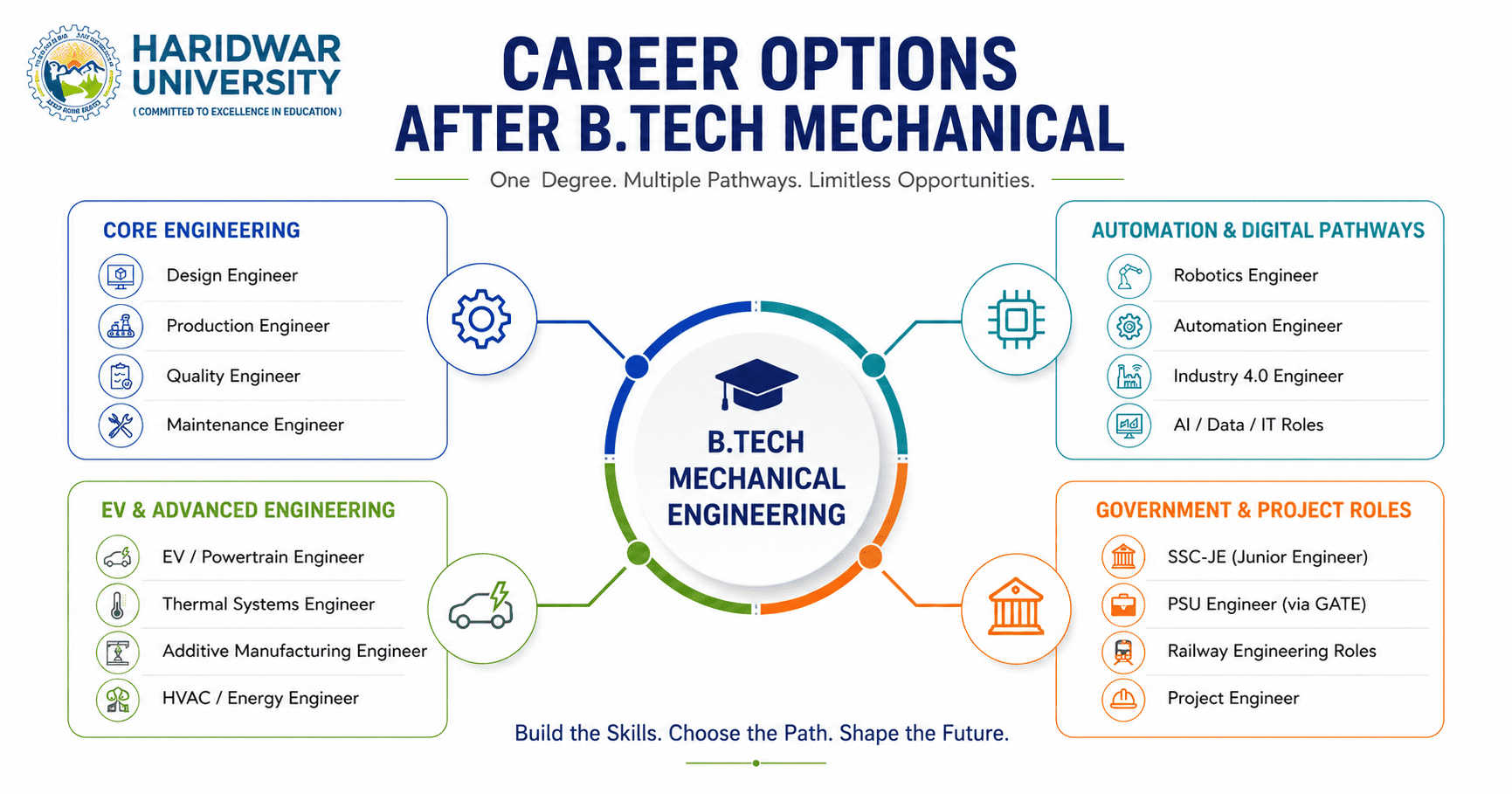
Mechanical Engineering has never been limited to machines, production floors or traditional manufacturing. The career landscape has widened dramatically to include electric mobility, robotics, automation, smart manufacturing, HVAC, additive manufacturing and prestigious government engineering roles.
In my experience with students preparing for campus placements, the better question is not whether Mechanical Engineering has a future. It is which direction a Mechanical graduate should build towards. At Haridwar University, our B.Tech Mechanical Engineering with AI Specialization combines core mechanical engineering with emerging areas such as robotics, predictive maintenance, Industry 4.0, CAD/CAM and applied AI systems.
Key Takeaway: A Mechanical graduate today has more than one career lane. The distinct competitive advantage goes to students who identify their preferred lane early and build the right technical skills around it.
Table of Contents
1. 12 Career Options After B.Tech Mechanical
4. Salary Outlook for Mechanical Engineers in India
5. Core Mechanical vs IT: Which Path Suits You?
6. Government Job Pathways for Mechanical Graduates
7. Skills That Make a Mechanical Graduate Future-Ready
8. Why Mechanical Engineering at Haridwar University?
1. 12 Career Options After B.Tech Mechanical
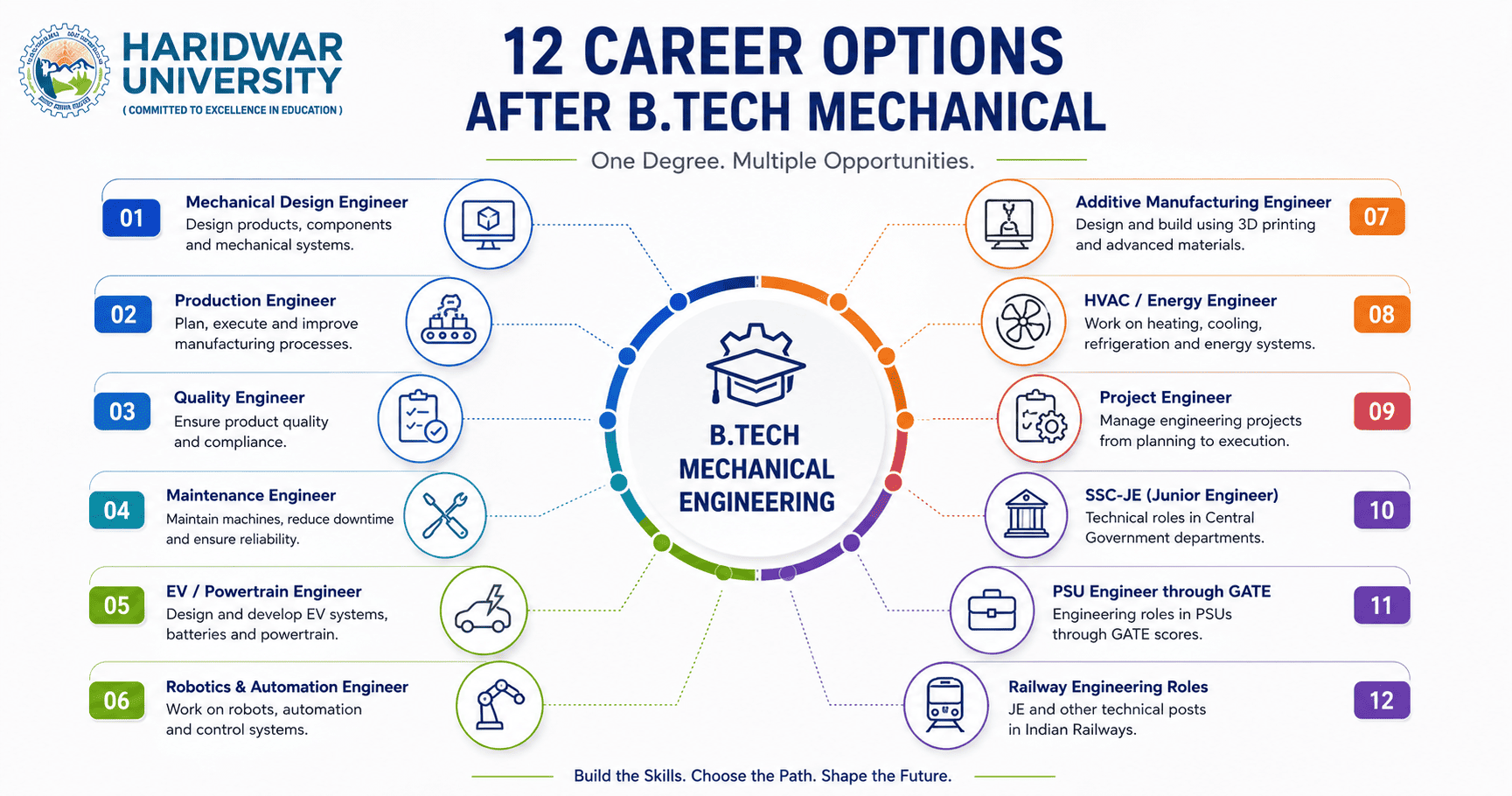
A Mechanical Engineering degree can lead to roles across core engineering, emerging technologies, project execution and the public sector.
| Category | Career Option | Typical Work | Useful Skills |
|---|---|---|---|
| Core Mechanical | Design Engineer | Product, component and machine design | CAD, CAE, SolidWorks, ANSYS |
| Core Mechanical | Production Engineer | Production planning and process improvement | Manufacturing, lean methods, process control |
| Core Mechanical | Quality Engineer | Inspection, testing and quality processes | QA/QC, GD&T, root-cause analysis |
| Core Mechanical | Maintenance Engineer | Equipment reliability and maintenance | TPM, maintenance planning, predictive tools |
| New-Age | EV / Powertrain Engineer | EV systems, thermal systems and powertrain components | EV systems, batteries, MATLAB/Simulink |
| New-Age | Robotics & Automation Engineer | Robots, automation and industrial control | PLC, robotics, Python, controls |
| New-Age | Additive Manufacturing Engineer | 3D printing, prototyping and advanced manufacturing | CAD, DfAM, materials, 3D printing |
| New-Age | HVAC / Energy Engineer | Heating, cooling, refrigeration and energy systems | HVAC design, CFD, energy systems |
| Project / Industry | Project Engineer | Engineering project planning and execution | Project planning, AutoCAD, Excel, MS Project |
| Government | SSC-JE | Junior Engineer roles in Central Government organisations | Technical subjects, SSC-JE preparation |
| Government | PSU Engineer through GATE | Engineering roles in participating PSUs | GATE core subjects, technical interview |
| Government | Railway Engineering Roles | JE and other eligible technical posts | Mechanical fundamentals, RRB examination |
The first eight career paths are closely connected with areas already identified in HU's Mechanical Engineering programme, including design, manufacturing, quality, maintenance, automation, HVAC and project engineering.
2. Core Mechanical Careers
The traditional Mechanical roles remain continuously relevant because every manufacturing, industrial, or engineering operation still requires professionals who understand physical systems.
Mechanical Design Engineer
Design engineers work on components, products and mechanical systems using CAD and simulation tools. Strong knowledge of engineering drawing, CAD/CAE, materials and design principles is essential.
Production Engineer
Production engineers work closer to the manufacturing floor. Their responsibilities include production scheduling, lean process improvement, resource utilisation and plant efficiency.
Quality Engineer
Quality roles ensure components meet stringent specifications. Inspection, non-destructive testing, documentation, GD&T, root-cause analysis and QA systems are vital.
Maintenance Engineer
Maintenance engineers focus on machine availability and reliability. The role increasingly integrates Total Productive Maintenance (TPM), IoT sensors and data-based predictive monitoring.
3. New-Age Mechanical Careers
This is where Mechanical Engineering is evolving most dynamically across high-growth industrial sectors:
EV and Powertrain Engineering
Mechanical graduates can move into electric mobility through vehicle architecture, battery thermal management systems, powertrain components, and dynamometer testing. A graduate targeting EVs should combine mechanical principles with battery chemistry basics, electric motors, vehicle dynamics, MATLAB/Simulink and power electronics.
Robotics and Automation
Modern manufacturing combines structural mechanics with sensors, programmable logic controllers (PLCs), vision systems, and multi-axis robotics. Haridwar University's Mechanical curriculum actively embeds industrial robotics, automation cells, and Industry 4.0 concepts.
Additive Manufacturing (3D Printing)
Additive manufacturing uses digital CAD models to fabricate complex functional parts layer by layer. Mechanical engineers in this domain work on Design for Additive Manufacturing (DfAM), metal/polymer 3D printing, rapid prototyping, and advanced materials engineering.
HVAC and Energy Engineering
Heating, Ventilation, Air-Conditioning, and Refrigeration (HVAC) systems remain an indispensable career avenue. With global emphasis on energy efficiency, green building ratings, and computational fluid dynamics (CFD) airflow simulation, specialized mechanical engineers are in strong demand.
Smart Projects: For students interested in combining Mechanical Engineering with AI, see our guide on 25 AI Projects Every Engineering Student Should Build, which details predictive maintenance algorithms and smart manufacturing pipelines.
4. Salary Outlook for Mechanical Engineers in India
Compensation depends heavily on employer profile, location, industry sector, specialized software skills, and relevant project experience. According to AmbitionBox 2026 data, based on over 53,000 reported Mechanical Engineer salaries, the overall compensation spans ₹1.7–9.1 LPA for 1–9 years of experience.
| Experience Level | AmbitionBox Indicative Salary Range |
|---|---|
| 1 Year (Entry Level) | ₹1.7 – ₹5.3 LPA |
| 3 Years (Mid Level) | ₹1.8 – ₹7.0 LPA |
| 7 Years (Senior Level) | ₹2.5 – ₹12.5 LPA |
*These figures represent indicative industry market benchmarks, not guaranteed Haridwar University placement packages. Specialized roles, premium tech tool mastery, and MNC employers create substantial upward variance.
5. Core Mechanical vs IT: Which Path Suits You?
A Mechanical graduate does not have to choose between staying completely traditional and abandoning engineering for software. The right choice depends on the type of problems you genuinely enjoy solving:
| Choose Core / New-Age Mechanical if you... | Consider IT / Tech roles if you... |
|---|---|
| Enjoy machines, physical systems and hands-on hardware | Enjoy coding, software development and syntax logic |
| Like 3D design, simulation, and tangible product development | Prefer web/mobile applications and digital products |
| Want manufacturing, automotive, aerospace or energy roles | Want pure software engineering, data science, or cloud infrastructure |
| Enjoy production efficiency, plant operations and automation | Enjoy algorithms, database management and backend architectures |
| Prefer multidisciplinary engineering problems involving physics | Prefer problems based mainly on code, logic pipelines and digital data |
The Hybrid Middle Path: Mechanical graduates can build programming, data science, and AI skills while remaining anchored in engineering. That powerful combination is in immense demand across automation, digital twins, predictive maintenance, and smart manufacturing.
6. Government Job Pathways for Mechanical Graduates
Public sector and government engineering careers remain a prestigious, high-stability avenue after B.Tech Mechanical:
1. Staff Selection Commission Junior Engineer (SSC-JE)
The Staff Selection Commission conducts annual recruitments for Junior Engineer (Civil, Mechanical, Electrical) posts across central departments (CPWD, MES, CWC). These Group 'B' non-gazetted posts operate at Level 6 of the 7th CPC Pay Matrix (₹35,400–₹1,12,400). Track notifications on the official SSC Portal.
2. PSU Jobs Through GATE
The Graduate Aptitude Test in Engineering (GATE) opens premier entry-level Executive Trainee / Engineer positions across leading Maharatna and Navratna Public Sector Undertakings (PSUs), including BHEL, GAIL, HAL, IOCL, NTPC, ONGC, and others. Note that while GATE scores are used for shortlisting, qualifying GATE is a competitive screening criterion and not a direct job guarantee.
3. Railway Engineering Roles (RRB-JE / SSE)
Railway Recruitment Boards recruit technical personnel under the Mechanical & Allied Engineering group for Indian Railways workshops, loco sheds, and production units. Track centralized employment notices via official Railway Recruitment Board portals.
7. Skills That Make a Mechanical Graduate Future-Ready
A degree provides the foundation; targeted industry skills decide how effectively you leverage it.
| Skill Area | What to Build & Master |
|---|---|
| Mechanical Fundamentals | Core machine design, strength of materials, thermodynamics, fluid mechanics, manufacturing processes |
| Design & Simulation Tools | AutoCAD, SolidWorks, CATIA, ANSYS FEA, and CFD simulation packages |
| Digital & Computational Skills | Python scripting, MATLAB/Simulink modeling, and engineering data analytics |
| Industrial Automation | PLC ladder programming, industrial robotics kinematics, SCADA, sensor interfacing |
| Emerging Technologies | EV powertrain architectures, battery management systems, Industry 4.0, additive manufacturing (3D printing) |
| Professional Employability | Technical communication, quantitative aptitude, structured problem-solving, project leadership |
| Hands-On Exposure | Industrial internships, capstone design projects, and documented portfolio prototypes |
At Haridwar University, the Mechanical Engineering curriculum integrates three structured industry internships, extensive laboratory practicals, minor/major capstone projects, and innovation lab challenges to build tangible proof of capability on your resume.
8. Why Mechanical Engineering at Haridwar University?
The modern value of a Mechanical degree rests on how effectively classical engineering merges with cutting-edge digital intelligence. Haridwar University's B.Tech Mechanical Engineering with AI combines foundational mechanical mechanics with:
- Applied Artificial Intelligence and predictive maintenance models.
- Dedicated Robotics and Advanced Manufacturing laboratories.
- Industry 4.0 smart factory concepts, CAD/CAM/CAE integration, and CNC machining.
- Comprehensive placement training, aptitude coaching, and mock technical interviews via the HU Training & Placement Cell.
9. Frequently Asked Questions (FAQs)
Q1: What can I do after B.Tech Mechanical Engineering?
You can pursue careers in mechanical design, production, quality control, maintenance engineering, electric vehicles (EVs), robotics & automation, HVAC, additive manufacturing, industrial project engineering, and central government/PSU engineering services.
Q2: Is Mechanical Engineering a good career in 2026?
Yes. Mechanical graduates can work across established heavy industries as well as booming emerging sectors such as electric mobility, smart robotics, industrial automation, and advanced additive manufacturing.
Q3: Can a Mechanical Engineer work in the EV industry?
Yes. With specialized knowledge in EV systems, battery pack design, thermal management, electric powertrains, and simulation tools (like MATLAB/Simulink), Mechanical graduates are actively hired by EV manufacturers.
Q4: Can Mechanical Engineers move into IT and tech roles?
Yes. Students who master Python programming, data analytics, machine learning, or software tools can seamlessly transition into technology roles, especially in industrial IoT and simulation software domains.
Q5: What government jobs are available after B.Tech Mechanical?
Key options include SSC-JE (Junior Engineer in CPWD/MES), Railway Junior Engineer (RRB-JE), and executive positions in leading PSUs (BHEL, IOCL, ONGC, NTPC) through GATE.
Q6: What skills should I learn after B.Tech Mechanical?
Focus on solid CAD/CAE proficiency (SolidWorks, ANSYS), computational scripting (Python, MATLAB), industrial automation (PLCs, robotics), emerging EV/3D-printing systems, and practical project portfolios.
Q7: What is the salary of a Mechanical Engineer in India?
Salary varies based on skills, location, and industry sector. Industry benchmark data (AmbitionBox 2026) reports an indicative range of ₹1.7–9.1 LPA for engineers with 1–9 years of experience, with premium compensation in specialized high-tech domains.
Q8: Which Mechanical Engineering career should I choose?
Choose based on your core interests: design & physics suit core CAE/design roles; electric mobility interests lead to EV engineering; programming and electronics support robotics and smart automation.
10. Building Your Mechanical Engineering Career
Mechanical Engineering in 2026 is not a single narrow career. It is an expansive foundation from which you can branch into design, production, quality, maintenance, EVs, robotics, additive manufacturing, HVAC, project management or prestigious public sector organizations.
Choose your direction early, build the technical toolset that direction demands, and use hands-on internships to prove your capabilities.
Launch Your Engineering Career at Haridwar University
Explore B.Tech Mechanical with AI, world-class labs, industry internships, and career mentorship.