

How to Prepare for UPSC During College: A Realistic Timeline and Study Plan
Mr. Prajwal Chaudhary
Head, Training & Placement, Haridwar University
Preparing for the Union Public Service Commission (UPSC) Civil Services Examination while pursuing a degree is possible, but it requires more than a timetable downloaded from the internet. Students must manage lectures, assignments, practicals, semester examinations and personal commitments alongside a syllabus that demands sustained reading, revision and analytical thinking.
For students considering more than one public-sector route, our guide to government exam preparation during college offers a broader perspective on managing competitive preparation alongside a degree.
When students ask me how to prepare for UPSC during college, I recommend starting with a different question: What can I consistently complete without compromising my degree? A realistic plan builds knowledge gradually, uses previous-year papers to guide priorities and adapts to the university calendar. The objective is not to study like a full-time aspirant from the first semester. It is to graduate with a stronger foundation and a clearer understanding of the examination.
Table of Contents
- 1. A Realistic UPSC Preparation Timeline During Graduation
- 2. A Subject Strategy That Connects the Syllabus With Daily Study
- 3. A Practical UPSC Timetable for College Students
- 4. A Sustainable Way to Balance UPSC Preparation With University Exams
- 5. Common Preparation Mistakes That Waste Time
- 6. A Weekly Progress Checklist for College Aspirants
- 7. Frequently Asked Questions (FAQs)
- 8. Build Consistency Before Increasing Study Hours
1. A Realistic UPSC Preparation Timeline During Graduation
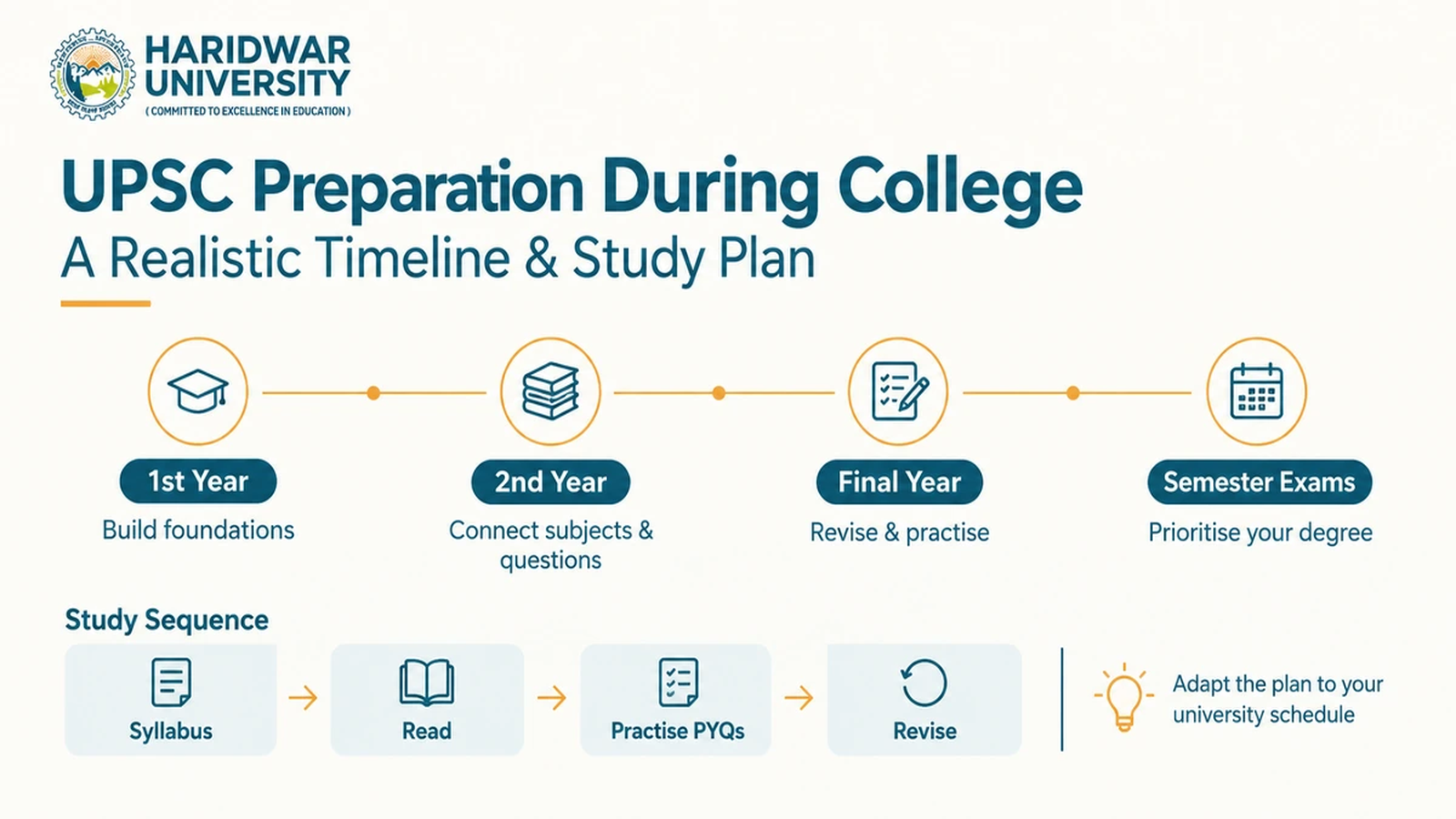
I would not prescribe the same schedule to a first-year student and someone approaching their final semester. Their academic responsibilities and familiarity with the syllabus are different. The following timeline is a flexible framework, not an official UPSC schedule or a guarantee of clearing the examination.
First year: Build familiarity before chasing speed
Start by understanding the examination structure through the official UPSC website. Read the relevant Civil Services Examination notification and syllabus, and look at previous-year question papers before buying multiple books or joining a test series.
The aim is to understand what the examination tests and how its questions are framed. Begin with selected NCERT textbooks, particularly those relevant to history, geography, political science and economics. Use the official NCERT textbook portal rather than relying on unverified copies.
Second year: Move from reading to application
Once the foundations are in place, connect each subject to previous-year questions. For example, after studying Parliament, examine how questions test constitutional provisions, institutional functions and their application. This helps distinguish useful preparation from passive reading.
This is also a sensible stage to explore optional subjects for the Mains examination. Consider your genuine interest, familiarity with the syllabus, access to reliable study material and ability to practise answers. Do not select an optional solely because a topper chose it.
Final year: Consolidate and make an informed decision
Use the final year to assess your progress honestly. Can you recall important concepts without repeatedly consulting notes? Can you answer questions within the prescribed time? Have you reviewed mistakes from practice tests?
Your degree still matters. Complete assignments, practical work and examinations properly. If your preparation is strong enough, you can plan the next stage around the official eligibility conditions and examination calendar. Otherwise, use the evidence from your practice to identify what needs further work.
2. A Subject Strategy That Connects the Syllabus With Daily Study
A long reading list is not a strategy. I advise students to work through a repeatable sequence: syllabus, foundational reading, previous-year questions, concise notes, revision and practice.
The table is a working framework, not a substitute for the current official syllabus. The exact syllabus and examination requirements should always guide what you study.
Before adding paid resources to your list, explore the university’s library and digital learning resources to understand which learning facilities and resources are available to students.
Use current affairs to strengthen static subjects
Reading a newspaper for several hours is unnecessary if you cannot connect its contents to the syllabus. Choose a reliable newspaper or current-affairs source and focus on developments with a clear link to governance, the economy, international relations, the environment, science or social issues.
For example, a report on water management can lead you to revise river systems, local governance, environmental concerns and relevant public policy. Record the central issue, essential facts, different perspectives and possible solutions. Avoid copying entire articles into your notes.
Let previous-year questions decide what needs attention
The UPSC previous-year question papers are among the most useful free resources available to aspirants. Use them from the beginning, not only after completing the syllabus.
Attempt questions after studying a topic and classify mistakes: a knowledge gap, confusion between concepts, misreading the question or poor time management. Each category requires a different remedy.
For Prelims, practise accuracy and elimination. For Mains, work on answering the actual demand of the question, organising arguments and supporting points with relevant examples. These are related skills, but they are not interchangeable.
3. A Practical UPSC Timetable for College Students
A useful UPSC study plan for beginners should fit around actual classes, travel and coursework. The following example assumes a reasonably manageable college day. Adjust it to your timetable rather than treating every slot as compulsory.
This is an illustrative schedule, not a prescribed number of hours or a promise of success. Students with long commutes, laboratory sessions or demanding practical courses may need a lighter weekday plan and longer weekend sessions.
A useful rule is to assign one primary task to each session. “Study polity” is vague. “Read the chapter on Parliament, make a one-page summary and attempt ten relevant questions” gives you a clear endpoint.
Keep a small buffer for unfinished work. A timetable that collapses after one missed session is poorly designed.
4. A Sustainable Way to Balance UPSC Preparation With University Exams
Semester examinations change the priority order. During an ordinary academic week, you may be able to study a UPSC subject daily. During internal assessments or final examinations, university coursework may need to take precedence.
I recommend dividing the academic calendar into three operating modes:
- Normal weeks: Maintain regular subject study, current affairs and question practice.
- Assessment weeks: Prioritise assignments, practicals and university revision. Keep UPSC continuity through brief revision or occasional current-affairs reading where manageable.
- Semester breaks: Use the extra time for a larger topic, backlog recovery, revision or a diagnostic test.
Do not interpret a temporary reduction in study hours as failure. The more important question is whether you return to a consistent routine after the academic pressure eases.
Students can also use their degree to develop transferable skills. Research assignments strengthen source evaluation; presentations improve structured communication; and analytical coursework can help students practise reasoning. These skills do not replace UPSC-specific preparation, but they can complement it.
5. Common Preparation Mistakes That Waste Time
Several avoidable habits make preparation harder than it needs to be:
6. A Weekly Progress Checklist for College Aspirants
At the end of each week, review your work instead of automatically adding more hours to the next week's timetable:
- Did I complete the core topic I planned to study?
- Can I recall its main concepts without looking at my notes?
- Did I attempt relevant previous-year or practice questions?
- Did I review mistakes and identify their causes?
- Did I revise earlier material instead of studying only new topics?
- Did I keep up with university assignments, practicals and deadlines?
- Have I selected realistic priorities for the coming week?
Keep the record simple. A notebook or spreadsheet with the topic, practice completed, mistakes found and next revision date is enough. A weekly review also helps you recognise when your plan is too ambitious.
The habit of reviewing errors is useful across different assessments, although UPSC preparation must remain aligned with its own syllabus and question formats; students can also explore HU’s guide to aptitude and coding interview preparation for placement-related practice.
If you repeatedly leave tasks unfinished, reduce the workload and protect the most important activities. A smaller plan completed consistently is more useful than an impressive plan abandoned after a fortnight.
7. Frequently Asked Questions (FAQs)
1. Can I prepare for UPSC while studying in college?
Yes. You can build subject foundations, read the syllabus, study current affairs and practise questions alongside your degree. The pace depends on your academic workload, starting point and available time.
2. When should I start UPSC preparation during graduation?
You can begin by understanding the examination and syllabus in your first year. Start with manageable study sessions and gradually increase subject coverage as your familiarity and academic schedule allow.
3. How many hours should a college student study for UPSC daily?
There is no universally correct number. Begin with a realistic period you can sustain alongside lectures and assignments. Judge progress by comprehension, revision and question performance rather than hours alone.
4. Which subjects should I study first for UPSC?
Start by reviewing the official syllabus and previous-year papers. Many beginners find it practical to establish foundations in polity, history, geography and economics before expanding their coverage. Adjust the sequence to your existing knowledge.
5. Are NCERT textbooks enough for UPSC preparation?
NCERT textbooks are useful for building foundational understanding, but they should not be treated as a complete preparation strategy. The syllabus, relevant additional resources, current affairs, revision and question practice also matter.
6. Should I join UPSC coaching during college?
Coaching is a personal decision, not a universal requirement. Consider whether you need structured teaching, feedback or mentoring, and compare the cost and time commitment with a self-study plan. Check the quality of any programme before enrolling.
7. Should I postpone UPSC preparation during semester examinations?
You may need to reduce or temporarily pause demanding UPSC tasks during major university examinations. Protect your academic performance, maintain light revision if practical and return to your regular plan once the examination period ends.
8. Build Consistency Before Increasing Study Hours
Preparing for UPSC during college is a long-term exercise in prioritisation. You do not need to master every subject in your first semester, nor should you measure your progress against someone who has already graduated and studies full-time.
I encourage students to begin with the syllabus, use official question papers, build a manageable subject sequence and review their progress each week. Keep your university commitments visible in the same plan. When your preparation becomes more demanding, increase the workload on the basis of evidence from your practice, not pressure from someone else's timetable.
UPSC preparation is one possible career direction, but it should sit within a considered plan for your degree and future work; our career guidance articles offer further perspectives on students’ academic and professional decisions.
The best starting point is a routine you can repeat next week. Build that foundation first, and let your study plan develop with your knowledge, academic responsibilities and readiness for the examination.
Plan Your Civil Services & Higher Career Trajectory at Haridwar University
Haridwar University provides comprehensive academic mentorship, extensive digital library facilities, and competitive exam guidance to help students excel in both graduation and national civil services.