

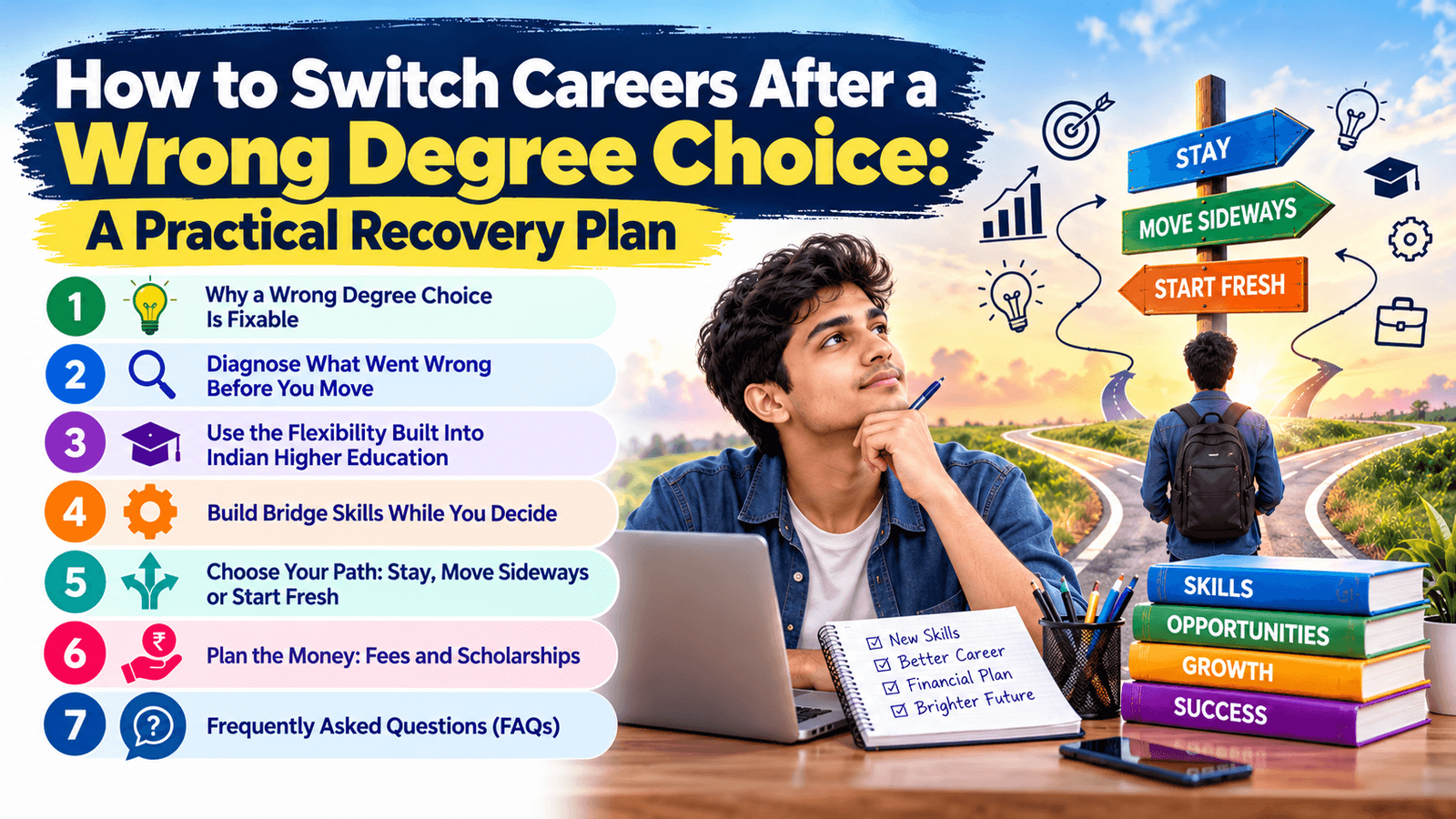
How to Switch Careers After a Wrong Degree Choice: A Practical Recovery Plan
Dr Aadesh K. Arya
Pro Vice-Chancellor, Haridwar University
Almost every university counsellor meets the same student sooner or later: someone who picked a degree because of family pressure, a high cut-off list or a friend’s casual suggestion, and now sits in class wondering where it all went wrong. If that is you, pause and take a breath. The question of how to switch careers after a wrong degree choice has no single magic formula, but it does follow a practical, orderly sequence.
This guide walks you through that sequence—from honest self-assessment and diagnosing the real root cause, to leveraging National Education Policy (NEP) credit rules, bridging technical skills, and planning your budget realistically. Haridwar University (formerly Roorkee College of Engineering, established in 2010 in Roorkee, Uttarakhand) serves here as a transparent case study because its academic options, fee structures, and scholarship criteria are fully documented for prospective students.
Table of Contents
- 1. Why a Wrong Degree Choice Is Fixable
- 2. Diagnose What Went Wrong Before You Move
- 3. Use the Flexibility Built Into Indian Higher Education
- 4. Build Bridge Skills While You Decide
- 5. Choose Your Path: Stay, Move Sideways or Start Fresh
- 6. Plan the Money: Fees and Scholarships at Haridwar University
- 7. Frequently Asked Questions (FAQs)
1. Why a Wrong Degree Choice Is Fixable
A mistake is information, not a life sentence
Choosing an undergraduate course at seventeen or eighteen years old, with minimal exposure to the real industrial workplace, is educated guesswork. Inevitably, some guesses miss the mark. The most productive response is to treat that realization as vital data: you now know with certainty what you do not enjoy, which is vastly more clarity than you had before you enrolled. Corporate recruiters and university admission officers meet career switchers every day; what matters most is demonstrating that your subsequent step is conscious, strategic, and backed by action.
Count the true cost of staying versus leaving
Countless students remain trapped in unsuitable programmes solely because of the "sunk cost fallacy"—having already paid two semesters of tuition. That money is spent regardless. The genuine question is: What will the next two to three years cost you in mental exhaustion, eroded motivation, and depressed career prospects if you stay, compared to making a decisive transition? Create two columns and write those trade-offs down plainly.
2. Diagnose What Went Wrong Before You Move
Separate the academic discipline from environmental circumstances
Before terminating an academic programme, distinguish whether you dislike the underlying subject matter or the specific circumstances surrounding it—such as poor teaching pace, isolated campus life, or examination pressure. A student overwhelmed by rote learning may excel in the same field within an experiential, project-centric environment. Conversely, if the day-to-day work itself drains you, transitioning disciplines is essential. Identify the tasks that energise you: building practical systems, writing code, numerical analysis, or creative commercial strategy.
Consult institutional support before taking abrupt steps
Do not shoulder this burden in isolation. Haridwar University provides professional student counselling through its dedicated Counselling and Assistance cell, providing confidential one-on-one sessions with psychological counsellors. Additionally, its Student Welfare Service operates a centralized Student Care Centre promising prompt resolution within 24 hours. Availing yourself of professional institutional guidance prevents emotional, hasty departures.
3. Use the Flexibility Built Into Indian Higher Education
National regulatory reforms under the National Education Policy (NEP 2020) have significantly lowered the friction of changing academic pathways. What once demanded a complete, punishing restart is now supported by statutory frameworks:
- The Academic Bank of Credits (ABC): Established by the Ministry of Education and regulated by the University Grants Commission (UGC), the Academic Bank of Credits digitally records, stores, and transfers academic credits accumulated by students across recognised institutions. As documented in official PIB guidelines, earned credits remain valid for redemption for up to seven years.
- Multiple Entry and Multiple Exit Framework: Under NEP 2020, students are no longer faced with an "all-or-nothing" graduation ultimatum. A learner completing one year can exit with an Undergraduate Certificate; two years earn an Undergraduate Diploma; while three or four years yield a Bachelor's Degree. Time spent in a previous course does not have to be wasted; it can result in a tangible credential.
- Essential Due Diligence: Academic credits are useful only if the receiving university’s statutory bodies accept them. Always verify that your current institution is registered on ABC and obtain written confirmation from the prospective university regarding how many credits transfer into your desired curriculum.
4. Build Bridge Skills While You Decide
Validating your new career choice requires preliminary hands-on exploration before committing thousands in tuition:
- Structured Free Learning Platforms: The Ministry of Education’s SWAYAM initiative offers thousands of university-level foundational courses completely free of charge. Enrol in a beginner module in your target discipline—whether basic Python, financial accounting, or digital business—and complete it to assess your true affinity.
- National Career Service (NCS): Maintained by the Ministry of Labour and Employment, the National Career Service provides free occupational counselling, skills mapping, and vocational assessment tools to help candidates evaluate realistic industry demands.
- Construct Tangible Artifacts: A portfolio of tangible output speaks louder than certificates. If pivoting toward software or data analysis, build a functional web application or analyze a public Kaggle dataset. If transitioning toward commercial marketing, draft a comprehensive business model canvas.
5. Choose Your Path: Stay, Move Sideways or Start Fresh
Students recovering from an incompatible degree typically choose between three distinct routes:
- Complete the Degree While Building Parallel Capabilities: If you are in your final year or within semesters of graduation, finishing the degree while building verifiable competencies in your target domain is usually the fastest, most economical approach. Your foundational degree proves discipline and academic completion, while technical certifications and capstones demonstrate vocational relevance.
- Lateral Entry or Related Academic Transition: If your initial discipline overlaps with your new focus (e.g., polytechnic diploma or core science), lateral-entry admissions allow direct admission into the second year. Haridwar University provides approved lateral-entry programmes across B.Tech. CSE, AI & ML, ECE, and B.Pharm across its five specialised faculties outlined on the Academic Programmes portal.
- A Fresh Start with Transparent Admission Protocols: If the mismatch is fundamental, restarting fresh in a purpose-fit discipline is an authentic choice. Review the formal Admission Overview at HU, which requires standard documentation including intermediate marksheets, migration certificates, and a standard gap-period affidavit to legitimize your transition period.
6. Plan the Money: Fees and Scholarships at Haridwar University
Financing a career change requires transparent budgeting. Below is an indicative overview of first-year fee structures for popular career-pivot programmes at Haridwar University for the 2026–27 session, verified via the official Fees and Scholarships schedule:
| Programme | Duration | First-Year Total Fee (2026–27) |
|---|---|---|
| BCA (Bachelor of Computer Applications) | 3 Years | ₹82,000 |
| BBA (with Artificial Intelligence) | 3 Years | ₹82,000 |
| B.Com (with Artificial Intelligence) | 3 Years | ₹67,000 |
| B.Sc. Computer Science (Data Science) | 3 Years | ₹67,000 |
| B.Tech. Hons. (Computer Science & Engineering) | 4 Years | ₹1,32,000 |
Fee Inclusions, Scholarships & Financing:
Published first-year totals encompass tuition, enrolment, admission, examination and uniform fees. Residential hostel charges range from ₹85,000 (standard accommodation) to ₹1,05,000 (deluxe air-conditioned accommodation), inclusive of mess and laundry.
HU offers generous tuition fee scholarships—including a 25% first-year tuition concession for female learners, merit slabs for recent Class 12 graduates, and institutional documentation support for nationalized bank education loans through our Payment & Loan Assistance desk.
7. Frequently Asked Questions (FAQs)
1. Can I really change my career after choosing the wrong degree?
Yes. National credit systems, lateral-entry options, bridge credentials and fresh admissions all exist for this purpose. Diagnose what went wrong first, select the most efficient transition route, and ensure credit transfer is confirmed before exiting.
2. Should I leave my current course immediately?
Usually not. Check how many semesters you have completed, whether your institution is registered with the Academic Bank of Credits (ABC), and what the receiving institution accepts. Exit only when your next step is formally documented in writing.
3. What is the Academic Bank of Credits?
The Academic Bank of Credits (ABC) is a Ministry of Education platform, regulated by the UGC under NEP 2020, that digitally stores earned academic credits so learners can transfer and redeem them across registered institutions. Credits remain valid for up to seven years.
4. Will I lose a year if I change programmes?
It depends on whether your target programme allows lateral entry, accepts transfer credits, or requires a restart from the first year. Request a formal credit evaluation prior to paying admission fees.
5. Which documents does Haridwar University ask for?
The admission overview lists High School and Intermediate marksheets and certificates, a transfer or migration certificate, an affidavit explaining any gap period, valid address proof, self-attested document copies and photographs.
6. How much is the seat confirmation amount?
A student deposits ₹25,000 by cash, cheque, Demand Draft, NEFT or RTGS to confirm a provisional seat in their selected programme, with comprehensive fee schedules published online.
7. Can career switchers get Haridwar University scholarships?
Yes, but verify eligibility criteria. Several merit scholarships apply to recent pass-out cohorts (2025 and 2026), alongside first-year female education scholarships (25%) and sports concessions. Career changers should consult the admissions desk directly.
8. What does a first-year BCA or B.Com with AI cost?
Under the 2026-27 fee schedule, first-year total fees are ₹82,000 for BCA and ₹67,000 for B.Com with AI, covering tuition, enrolment, admission, examination and uniform fees.
9. Where can I find emotional support while I decide?
Haridwar University provides full-time psychological counselling on campus, while national helplines such as Tele-MANAS (14416) offer 24x7 confidential assistance from the Ministry of Health.
A successful career switch is less about taking a blind leap and more about executing the right sequence: assess your current position, verify your Academic Bank of Credits, build tangible bridge skills, select your optimal academic pathway, and plan your budget realistically.
Ready to Realign Your Academic & Career Future?
Haridwar University offers personalized academic counselling, lateral-entry pathways, flexible NEP-aligned degrees, and dedicated credit transfer assistance to help you build a career you love.