

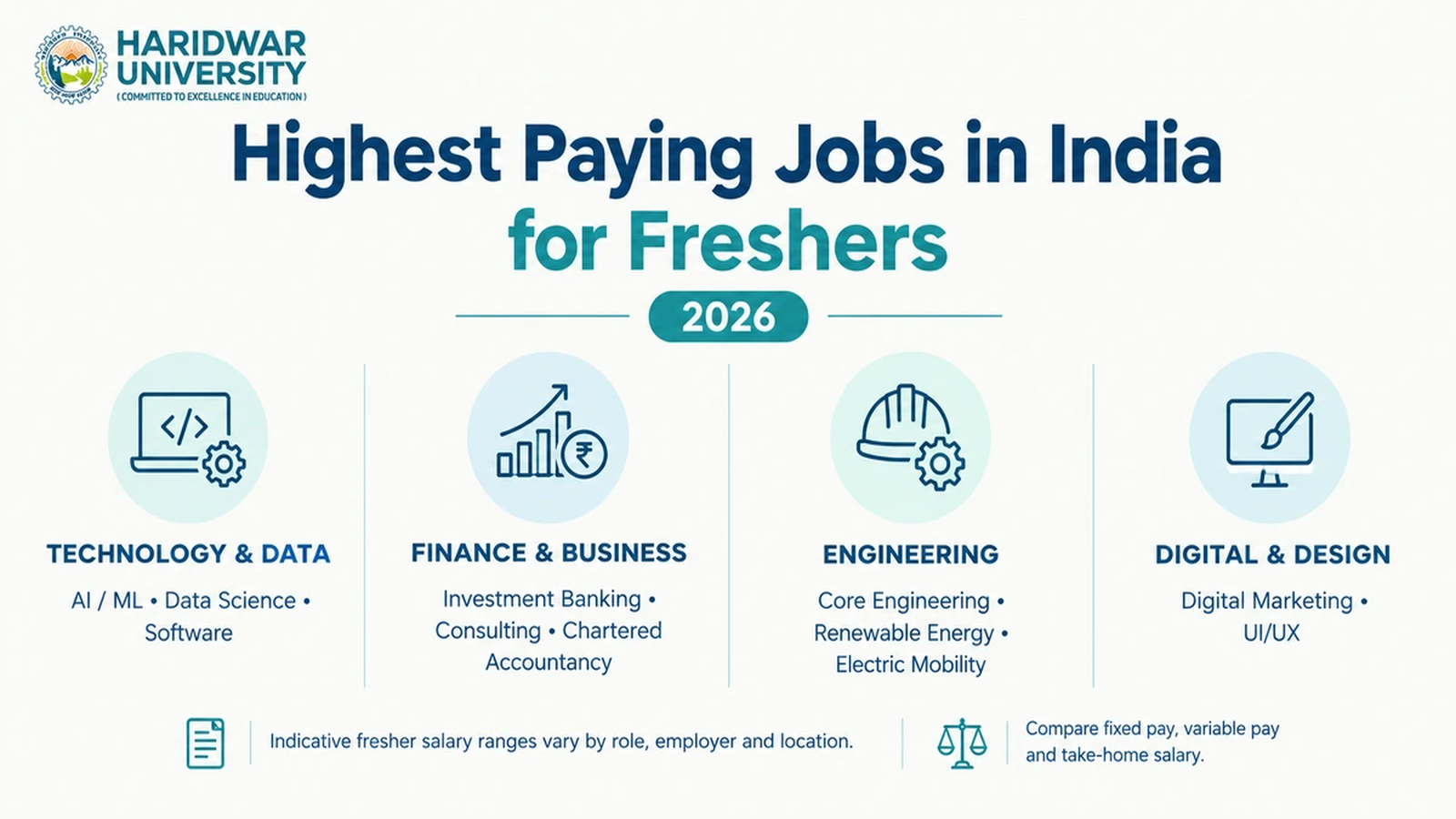
Highest Paying Jobs in India for Freshers in 2026: Salaries by Sector
Mr. Prajwal Chaudhary
Head, Training & Placement, Haridwar University
A high starting salary can give a graduate financial independence early in their career, but finding the highest paying jobs in India for freshers requires looking beyond headline packages. Two graduates with similar qualifications may receive very different offers because of their technical skills, internships, location, employer, interview performance and the responsibilities attached to the role.
I advise students to examine three things together: the salary offered, the skills required to earn it, and the opportunities the role provides for future growth. A ₹12 lakh annual package at a specialist technology firm and a ₹5 lakh package at a different employer are not directly comparable without understanding the fixed salary, variable pay, benefits and working conditions.
This guide examines promising career paths, indicative fresher salary ranges and the preparation required to compete for better-paying roles in 2026.
Table of Contents
- 1. Highest Paying Jobs in India for Freshers Across Major Sectors
- 2. Technology and Data Roles Offer Several High-Paying Entry Points
- 3. Finance, Consulting and Business Roles Reward Specialist Skills
- 4. Engineering and Emerging Industries Create Alternative Career Paths
- 5. Starting Salaries Depend on More Than the Job Title
- 6. A Practical Plan for Securing a Better First Offer
- 7. Frequently Asked Questions (FAQs)
- 8. Build a Career Around Skills, Not Just Salary Rankings
Highest Paying Jobs in India for Freshers Across Major Sectors
There is no single, reliable national ranking that establishes the highest-paying fresher job for every graduate. Published salary guides provide useful estimates, but their figures vary according to the employer, qualification, location and definition of a fresher.
The table below presents indicative annual salary ranges for selected entry-level roles, based on career guidance published by Naukri Campus, updated on 6 April 2026, alongside role-specific salary data from AmbitionBox. These sources use different methodologies and experience categories, so the figures should be treated as broad estimates rather than directly comparable national averages. Actual offers vary by employer, location, qualifications and skills.
| Career Path | Indicative Fresher Salary (Per Annum) | Useful Entry-Level Skills |
|---|---|---|
| AI and machine learning engineer | ₹6–12 lakh | Python, mathematics, model evaluation |
| Data scientist | ₹4–10 lakh | Statistics, Python, SQL, data visualisation |
| Software or full-stack developer | ₹3–10 lakh | Programming, databases, APIs, debugging |
| Cloud or cybersecurity associate | ₹3.5–10 lakh | Networking, cloud fundamentals, security principles |
| Investment banking analyst | ₹5–12 lakh | Financial modelling, Excel, valuation |
| Management consulting analyst | ₹5–12 lakh | Structured problem-solving, research, communication |
| Chartered accountant | ₹6–10 lakh | Accounting, audit, taxation, financial reporting |
| Digital marketing executive | ₹2.5–6 lakh | SEO, analytics, content and campaign measurement |
| UI/UX designer | ₹3–8 lakh | User research, wireframing, prototyping |
| Core engineering graduate | ₹2.5–6 lakh | Engineering fundamentals, CAD or relevant technical tools |
Salary note: These figures are indicative estimates for career planning, not guaranteed offers or official national averages. Naukri Campus provides fresher salary estimates across several career paths, while AmbitionBox provides role-specific salary data, including software engineering trainee and data-related roles. The available data does not independently verify every range in this table; figures may vary with experience, employer and location.
One point deserves emphasis: a job with a high advertised salary is not automatically accessible to every graduate. Some investment banking and consulting roles are intensely competitive; AI roles may require stronger mathematics and programming than a general software position. A career choice should match both earning goals and the candidate's existing strengths.
Technology and Data Roles Offer Several High-Paying Entry Points
Technology remains an attractive route for graduates who can demonstrate practical ability rather than simply list programming languages on a CV. However, employers do not treat every technology role as interchangeable.
- AI and machine learning engineering: Suits candidates comfortable with programming, statistics, linear algebra and model evaluation. A student should be able to explain a project, the data used, the model selected and how its performance was measured. Completing a short AI course alone does not establish that level of competence.
- Data science and analytics: Combines data preparation, statistical reasoning, SQL, visualisation and business interpretation. Graduates can build relevant evidence through projects such as customer churn analysis, demand forecasting or a dashboard based on a clearly documented dataset. Entry-level data analyst roles may also provide a route towards more specialised data science positions.
- Software development: Offers a wider range of entry points, including front-end, back-end, full-stack and application development. Employers commonly assess coding fundamentals, problem-solving, databases, version control and the ability to debug an unfamiliar problem.
- Cloud computing and cybersecurity: Cloud roles draw on networking, Linux, infrastructure and deployment fundamentals, while security roles require an understanding of systems, access control, vulnerabilities and incident response. These careers can pay well, but students should avoid assuming that an advanced job title translates into an advanced fresher salary.
For students considering this direction, HU's Computer Science programme information and details on B.Tech Computer Science Engineering provide a starting point for exploring computing education. Before linking a specific specialisation to a career outcome, verify the relevant programme page, curriculum and current eligibility details.
Finance, Consulting and Business Roles Reward Specialist Skills
High-paying jobs are not limited to engineering graduates. Commerce, finance, economics and management students can also pursue competitive opportunities, particularly when they develop a specialist skill set.
- Investment banking analysts: Assist with financial analysis, company valuation, transaction research and financial models. Strong Excel skills, accounting knowledge and attention to detail are useful foundations. Graduate recruitment for these roles can be selective, and the highest packages should not be treated as the standard outcome for all finance graduates.
- Management consulting analysts: Research business problems, interpret data, compare options and present recommendations. Employers value structured thinking and concise communication alongside academic performance. Case-interview practice can help candidates learn to break a broad business question into manageable parts.
- Chartered accountants: Can pursue roles in audit, taxation, financial reporting, risk and corporate finance after completing the relevant professional qualification. The distinction matters: becoming a CA requires a defined qualification pathway, not simply a general commerce degree.
- Digital marketing and business analytics: Offer other routes for graduates interested in commercial problem-solving. Employers may look for evidence of campaign measurement, search optimisation, customer research, spreadsheet analysis or dashboard creation. A portfolio showing what changed because of your work is more persuasive than a list of tools.
Students exploring management careers can review career pathways after MBA and confirm current MBA specialisations and curriculum directly with the university.
Engineering and Emerging Industries Create Alternative Career Paths
Core engineering deserves a place in any discussion of the highest paying jobs in India for freshers. Mechanical, electrical, civil and related graduates may enter design, manufacturing, quality, testing, project support, maintenance or technical sales. Starting pay varies widely by industry, employer, site location and the technical demands of the position.
Renewable energy, electric mobility and industrial automation also create opportunities for engineers who can combine core engineering knowledge with newer tools. For example, a mechanical graduate interested in electric vehicles could develop relevant skills in CAD, manufacturing processes, battery fundamentals or quality systems. An electrical graduate might explore power systems, controls or renewable-energy operations.
These sectors should not be marketed as guaranteed high-salary routes. Some entry-level core engineering jobs pay less than specialist software roles, while niche technical positions may offer stronger progression as experience grows. Candidates should compare actual vacancies and eligibility requirements rather than rely on broad claims about an industry's future.
Students can also read HU's practical guide to career options after B.Tech Mechanical Engineering for examples of pathways across core engineering, electric mobility and related technical areas.
Starting Salaries Depend on More Than the Job Title
When comparing the highest paying jobs in India for freshers, I recommend looking at the complete offer rather than the headline annual figure.
| Offer Component | What Candidates Should Check |
|---|---|
| Fixed salary | The guaranteed annual pay before applicable deductions |
| Variable pay | Performance-linked compensation and the conditions for receiving it |
| Joining or retention bonus | Eligibility, payment date and any repayment clause |
| Employer benefits | Insurance, retirement contributions and other benefits |
| Location and work pattern | Relocation costs, commute, shifts and remote-work terms |
| Role and progression | Responsibilities, training, appraisal cycle and likely skill development |
Consider two hypothetical offers. Offer A advertises ₹8 lakh CTC, including a substantial variable component. Offer B advertises ₹7 lakh CTC, with a larger fixed component. Offer A may look better in a headline comparison, but Offer B could provide more predictable monthly earnings. The actual result depends on the written offer and payroll structure.
CTC is not the same as take-home salary. Provident fund contributions, tax, insurance and other deductions can affect the amount credited to an employee's bank account. Ask the recruiter for a written compensation breakdown before making a decision.
A Practical Plan for Securing a Better First Offer
A strong first offer is usually the result of preparation over several months, not a last-minute CV change. I encourage students to work through five priorities:
- Choose a role family: Decide whether your immediate target is software development, data analytics, finance, core engineering, marketing or another field. This helps you focus your preparation.
- Build evidence of ability: Complete one or two relevant projects, explain your individual contribution and document the outcome. Avoid copying projects you cannot confidently discuss.
- Practise role-specific assessments: Technical candidates should work on coding, debugging and fundamentals. Business candidates should practise numerical reasoning, case questions, research and presentations.
- Prepare a clear CV and interview narrative: Be ready to explain your skills, project decisions, setbacks and learning. Honest, specific answers are stronger than memorised claims.
- Compare offers carefully: Review the job description, fixed pay, variable compensation, location, bond or service conditions and growth opportunities before accepting.
Students can use HU's placement-drive process and eligibility guide to understand recruitment stages and preparation expectations. HU also publishes guidance on internships during B.Tech, which explains how practical experience helps students build verifiable evidence of their skills.
Frequently Asked Questions (FAQs)
1. Which job has the highest salary in India for freshers?
There is no single highest-paying job for every fresher. Specialist AI, software, investment banking and consulting roles can offer competitive starting packages, but salaries depend on the employer, candidate profile and recruitment process.
2. Is ₹7 lakh per annum a good salary for a fresher?
It can be a strong starting offer for many graduates, but its value depends on fixed pay, variable compensation, location, living costs and the responsibilities of the job. Compare take-home pay and career prospects, not CTC alone.
3. Can freshers earn ₹10 lakh per annum in India?
Yes, some graduates secure offers at or above ₹10 lakh per annum, particularly in competitive specialist roles and selective recruitment processes. It is not a typical or guaranteed outcome across all employers, courses or institutions.
4. Which technology job is best for freshers?
Software development, data analytics, AI and machine learning, cloud computing and cybersecurity are all worth considering. The best fit depends on your programming ability, mathematical foundation, interests and the skills required in actual vacancies.
5. Can commerce graduates get high-paying jobs?
Yes. Commerce graduates can explore accounting, finance, investment analysis, consulting, business analytics and digital marketing. Some routes, such as chartered accountancy, require a professional qualification or a specific training pathway.
6. Does a higher CTC always mean a higher monthly salary?
No. CTC can include variable pay, employer contributions, bonuses and benefits that are not paid as regular monthly cash. Review the written compensation structure and ask the employer to clarify expected fixed monthly earnings.
7. How can freshers improve their chances of getting a better salary?
Build skills that match a specific role, complete relevant projects or internships, practise assessments and interviews, and research employers before applying. A clear demonstration of ability is more useful than collecting unrelated certificates.
Build a Career Around Skills, Not Just Salary Rankings
The highest paying jobs in India for freshers can be a useful starting point for career research, but a salary table should not make the decision for you. The stronger approach is to identify a role that suits your abilities, check the qualifications employers actually request, and build evidence that you can do the work.
In my view, the first job should be assessed on three measures: the quality of the learning opportunity, the fairness and clarity of the offer, and the skills it helps you develop for your next move. A competitive salary matters. So does choosing a role where you can become more capable, take on greater responsibility and improve your earning potential over time.
Accelerate Your High-Paying Career with Haridwar University
Haridwar University equips students with industry-aligned technical curricula, practical capstone projects, pre-placement interview bootcamps, and direct recruitment access to 300+ leading corporate employers.