

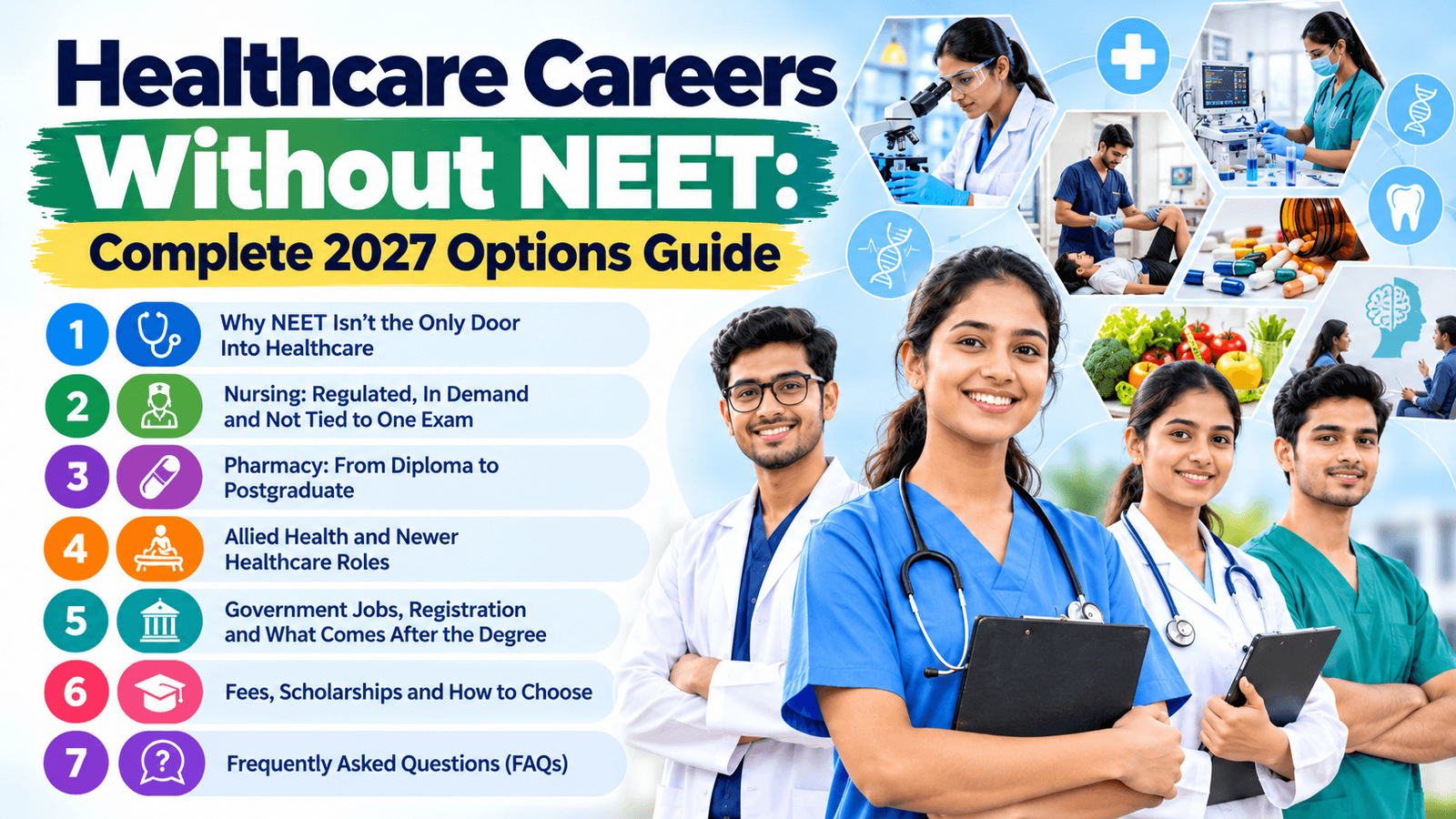
Missed the NEET cut-off, or never planned to sit the examination at all? You have not run out of viable options. Healthcare Careers Without NEET are real, highly regulated, in continuous national demand, and plentiful: clinical nursing, pharmaceutical manufacturing, regulatory affairs, hospital diagnostics, and healthcare informatics that keep modern health systems functioning.
This comprehensive guide lays out verified professional healthcare routes, statutory eligibility frameworks, licensing criteria, and official educational costs at Haridwar University using published institutional data.
Advisory Note: Admission guidelines shift by state and counselling cycle. Treat this as a practical roadmap, and verify current notifications before submitting application forms.
Table of Contents
- • 1. Why NEET Isn’t the Only Door Into Healthcare
- • 2. Nursing: Regulated, In Demand and Not Tied to One Exam
- • 3. Pharmacy: From Diploma to Postgraduate
- • 4. Allied Health and Newer Healthcare Roles
- • 5. Government Jobs, Registration and What Comes After the Degree
- • 6. Fees, Scholarships and How to Choose at Haridwar University
- • 7. Frequently Asked Questions (FAQs)
1. Why NEET Isn’t the Only Door Into Healthcare
The National Eligibility cum Entrance Test (NEET-UG) is substantially narrower than most families realise. Under the National Testing Agency (NTA) guidelines, NEET governs admissions specifically to MBBS, BDS, and AYUSH programmes (BAMS, BUMS, BSMS, BHMS)—the doctor and dentist track.
However, clinical physicians comprise only a fraction of any healthcare ecosystem. Hospitals, pharma research complexes, and clinical research organizations depend on nurses, pharmacologists, formulation scientists, regulatory auditors, and biomedical technologists.
While NEET scores are accepted for B.Sc (Hons) Nursing in selected central institutes (such as Military Nursing Service institutions), mainstream nursing and pharmacy admissions across India are administered via state entrance examinations, university-level assessments, or direct Class 12 science merit. For an in-depth comparative overview, read our guide on careers after 12th PCB without NEET.
2. Nursing: Regulated, In Demand and Not Tied to One Exam
Statutory Regulatory Guidelines
The Indian Nursing Council (INC) mandates minimum eligibility as Class 12 with Physics, Chemistry, Biology, and English at 45% aggregate. Individual universities often set a higher benchmark; Haridwar University requires at least 50% in Class 12 PCB.
B.Sc. Nursing with AI Curriculum at HU
The 4-year B.Sc. Nursing (with AI) at Haridwar University combines clinical patient care with modern health informatics, electronic health record (EHR) analytics, and telemedicine training through Roorkee College of Allied Health Sciences.
Approved by the Indian Nursing Council and State Nursing Council, the programme includes extensive clinical rotations in affiliated multi-speciality tertiary hospitals and structured licensure examination preparation (NCLEX and state nursing exams). Compare course pathways in our analysis of B.Pharm vs B.Sc. Nursing.
3. Pharmacy: From Diploma to Postgraduate
Pharmacy represents the single clearest example of premier healthcare careers independent of NEET. Under the Pharmacy Council of India (PCI) Education Regulations, admission eligibility is based strictly on Class 12 science with English, Physics, Chemistry, and either Mathematics or Biology (PCM or PCB).
The Pharmacy Academic Ladder at Haridwar University
- D.Pharm (2 Years): Foundational professional diploma enabling registration as a registered community/hospital pharmacist. Read our guide on careers after D.Pharm.
- B.Pharm (4 Years): Professional bachelor’s degree qualifying graduates for drug discovery, industrial manufacturing, regulatory affairs, and clinical trials. Explore our PCI-approved B.Pharm programme.
- B.Pharm Lateral Entry (3 Years): Direct admission into Year 2 for D.Pharm certificate holders, allowing diploma graduates to upgrade seamlessly.
- M.Pharm Pharmaceutics (2 Years): Advanced postgraduate specialization in novel drug delivery systems, nano-formulations, and regulatory compliance.
D.Pharm provides the fastest, most cost-effective path to professional healthcare licensing. B.Pharm unlocks lucrative industrial pharmaceutical careers, clinical research management, and global regulatory roles.
4. Allied Health and Newer Healthcare Roles
Beyond bedside nursing and pharmacy, modern clinical operations rely on specialized allied healthcare practitioners. Under the landmark National Commission for Allied and Healthcare Professions (NCAHP) Act of 2021, India established a unified national regulatory body covering 56 distinct professions across 10 specialized categories:
- Medical Laboratory Sciences (Clinical Biochemists, Histopathologists)
- Radiology and Imaging Technology (MRI, CT, X-Ray Technologists)
- Operation Theatre and Anaesthesia Technology
- Cardiovascular and Perfusion Technology
- Physiotherapy and Occupational Therapy
The NCAHP portal maintains a centralized national register, guaranteeing standardized qualifications and international license reciprocity for Indian allied healthcare graduates worldwide.
5. Government Jobs, Registration and What Comes After the Degree
Healthcare degrees without NEET open prestigious public-sector career paths across state and central healthcare institutions:
Central Nursing Officer Recruitment (AIIMS NORCET)
The All India Institute of Medical Sciences (AIIMS) conducts the national Nursing Officer Recruitment Common Eligibility Test (NORCET). The NORCET notice mandates a B.Sc. Nursing degree from an INC-recognised institution for Pay Level 7 appointments (starting basic pay ₹44,900 plus allowances). Institutional recognition is the primary criterion for qualification.
Government Pharmacist and Drug Inspector Posts
State Public Service Commissions, Railways (RRB), ESIC hospitals, and the Central Drugs Standard Control Organisation (CDSCO) recruit registered pharmacists and Drug Inspectors. Review our dedicated guide on government jobs after B.Pharm for exam patterns and syllabus details.
6. Fees, Scholarships and How to Choose at Haridwar University
Transparent educational investment is essential for sound planning. Below is the verified schedule from Haridwar University’s Fee Structure 2026-27:
Fees cover tuition, enrolment, admission, examination, and uniform fees. Annual hostel charges range from ₹85,000 (standard), ₹95,000 (semi-deluxe), to ₹1,05,000 (deluxe AC), covering accommodation, mess meals, and laundry. Review full details on our Fees & Scholarships page.
Merit Scholarships Scheme
Merit fee waivers apply to first-year tuition based on qualifying Class 12 board marks:
- Above 90%: 80% tuition scholarship (50% for D.Pharm)
- Above 80% up to 90%: 50% tuition scholarship
- Above 70% up to 80%: 20% tuition scholarship
- Above 60% up to 70%: 10% tuition scholarship
A 25% first-year tuition scholarship is reserved for female students. Students also have access to education loan facilitation through partner banks and 24-hour student care assistance detailed on our Student Welfare Service page and Admissions Overview.
Frequently Asked Questions (FAQs)
1. Can I study nursing without NEET?
Yes, across the majority of institutions. While central defence institutions (such as Military Nursing Service) mandate NEET, general nursing admissions across state universities follow state entrance exams or Class 12 merit. Haridwar University admits candidates via NEET, state entrance, or direct Class 12 merit.
2. Do I need NEET for B.Pharm or D.Pharm?
No. Pharmacy Council of India guidelines mandate Class 12 science with Physics, Chemistry, and Mathematics or Biology, with no NEET requirement.
3. Which Class 12 subjects do I need for healthcare degrees?
B.Sc. Nursing requires Physics, Chemistry, Biology, and English (minimum 50% at HU). Pharmacy programmes accept either PCM or PCB.
4. Can a D.Pharm holder move on to B.Pharm?
Yes. Diploma holders can enrol directly in Year 2 of B.Pharm via lateral entry, completing the degree in three years.
5. How much does B.Sc. Nursing cost at Haridwar University?
Under the 2026-27 schedule, B.Sc. Nursing tuition and academic charges are ₹1,90,000 per year, totaling ₹7,60,000 across four years.
6. What is the lowest-cost healthcare programme at HU?
D.Pharm is the lowest-cost programme, totaling ₹1,55,000 over two years (₹80,000 in Year 1 and ₹75,000 in Year 2).
7. Will a high Class 12 score reduce my fees?
Yes. Scores above 90% in Class 12 earn up to an 80% tuition waiver in Year 1. A 25% waiver is also available for female applicants.
8. Does recognition really matter for government healthcare jobs?
Recognition is mandatory. Major central notifications (such as AIIMS NORCET) require degrees from colleges recognised by the Indian Nursing Council or State Nursing Councils. HU holds full statutory approvals from INC and PCI.
9. Are other allied-health courses offered at Haridwar University?
HU currently conducts B.Sc. Nursing, B.Pharm, B.Pharm Lateral Entry, D.Pharm, and M.Pharm Pharmaceutics under its health sciences faculty.
Launch Your Rewarding Healthcare Career Without NEET
Haridwar University provides PCI and INC-approved nursing and pharmacy programmes with cutting-edge AI healthcare training, advanced laboratories, and clinical hospital rotations.