

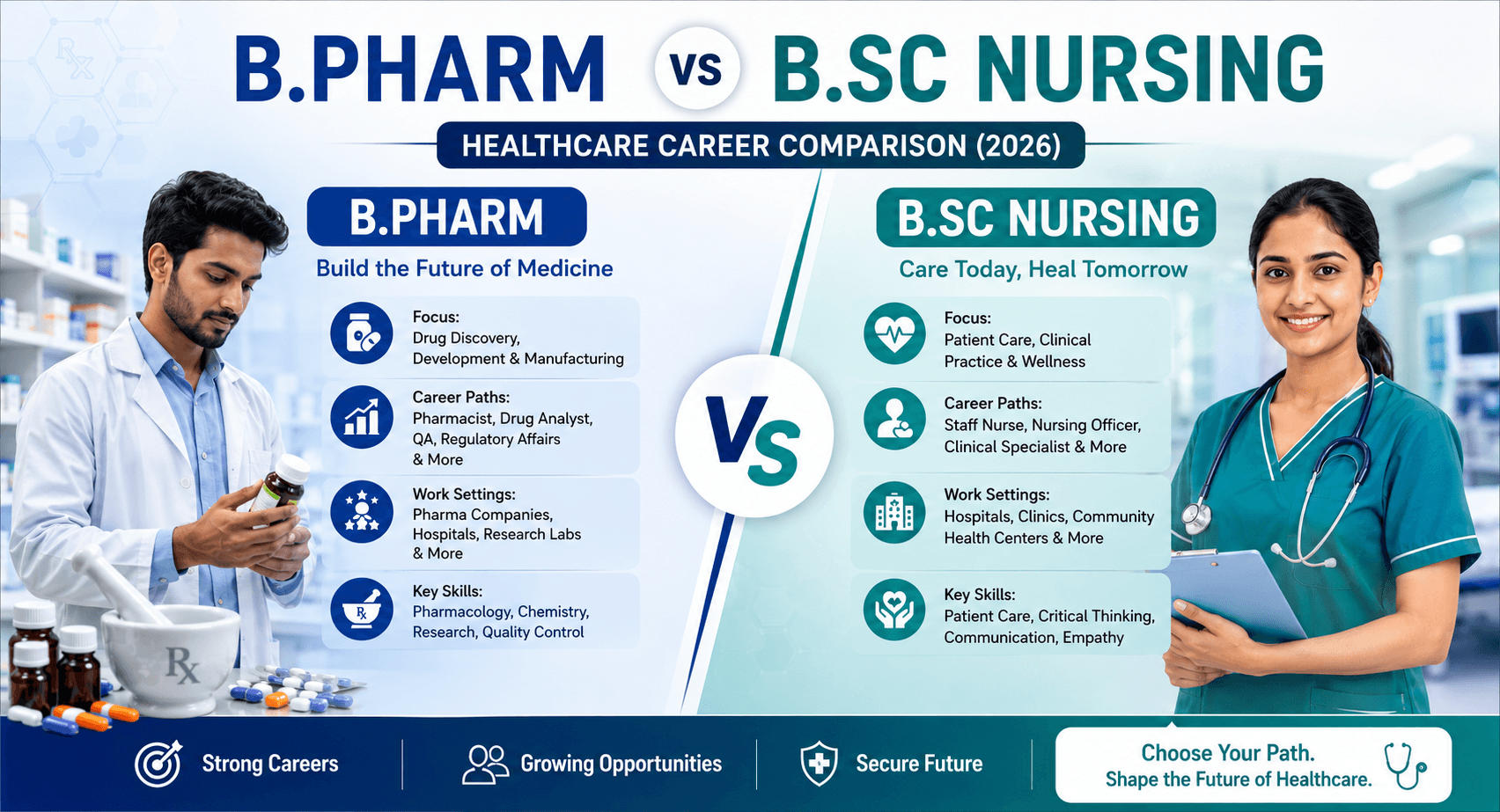
Every year, thousands of PCB students staring at a Class 12 mark sheet reach the same fork in the road: a pharmacy degree that lives in labs and formulations, or a nursing degree that lives at the bedside. The B.Pharm vs B.Sc Nursing Haridwar University decision is really a decision about the kind of healthcare professional you want to become — one who designs and tests medicines, or one who delivers care directly to patients. Both are respected, PCI- and INC-regulated four-year programmes offered under Haridwar University's Roorkee College of Allied Health Sciences, both open doors to government jobs, and both can take you abroad. This guide compares the two courses across duration, curriculum, careers, salaries, government routes, higher study and verified fee data — so you can make an informed choice for the 2026 admission cycle.
Table of Contents
- 1. Quick Comparison at a Glance
- 2. Duration and Eligibility
- 3. Curriculum Nature: Lab and Chemistry vs Clinical and Patient Care
- 4. Career Roles and Salary Ceilings
- 5. Government Job Routes for Each Stream
- 6. Abroad Opportunities: Pharma Regulatory vs NCLEX Nursing
- 7. Work-Life Realities
- 8. Higher-Study Paths: M.Pharm vs M.Sc Nursing
- 9. Fees at Haridwar University (2026-27)
- 10. Personality-Fit Decision Framework
- 11. Frequently Asked Questions
1. Quick Comparison at a Glance
| Parameter | B.Pharm | B.Sc Nursing |
|---|---|---|
| Duration | 4 years (8 semesters) | 4 years, incl. clinical internship |
| Regulator | Pharmacy Council of India (PCI) | Indian Nursing Council (INC) |
| Eligibility | 10+2 with PCB/PCM, min. 45-50% | 10+2 with PCB, age 17-35 years |
| Curriculum Nature | Lab, chemistry, drug formulation | Clinical postings, patient care |
| Core Skill Built | Analytical precision, research | Empathy, clinical judgement |
| Govt Entry Route | Drug Inspector, Govt Pharmacist | Nursing Officer (NORCET), State Health Dept. |
| Abroad Pathway | FPGEE (USA), GPhC (UK) | NCLEX-RN (USA), OET/CBT (UK, Gulf) |
| Higher Study | M.Pharm → Ph.D. | M.Sc Nursing → Ph.D. |
2. Duration and Eligibility
B.Pharm — Duration and Eligibility
B.Pharm is a four-year, eight-semester undergraduate degree regulated by the Pharmacy Council of India (PCI). Eligibility calls for a 10+2 pass with Physics and Chemistry as compulsory subjects, plus Mathematics or Biology as the third subject, with most institutions asking for 45-50% aggregate marks — PCI treats Maths and Biology as interchangeable in the third-subject slot, so both PCB and PCM students can apply. At Haridwar University, the B.Pharm (with AI) programme follows this PCI framework, and D.Pharm holders can also enter directly into the second year through the lateral-entry route.
B.Sc Nursing — Duration and Eligibility
B.Sc Nursing is also a four-year programme, including a compulsory clinical internship, and is regulated by the Indian Nursing Council (INC). Eligibility is stricter on the science side: candidates need 10+2 with Physics, Chemistry and Biology (PCB), generally with a minimum aggregate, and must fall within the INC's prescribed admission age band of 17 to 35 years. Unlike B.Pharm, a Maths-only background does not qualify a student for nursing — Biology is compulsory. HU's B.Sc Nursing (with AI) programme is delivered through the same Roorkee College of Allied Health Sciences, with clinical postings arranged in INC-recognised teaching hospitals.
3. Curriculum Nature: Lab and Chemistry vs Clinical and Patient Care
The B.Pharm curriculum is built around pharmaceutics, pharmaceutical chemistry, pharmacology, pharmacognosy, biostatistics and hospital-and-community pharmacy. It is lab-heavy and largely theory-and-experiment driven, with direct patient contact limited mostly to hospital-pharmacy postings and internships. B.Sc Nursing, in contrast, integrates anatomy, physiology, nursing foundations, medical-surgical nursing, community health nursing and mental health nursing with clinical rotations from the very first year — students work in real hospital wards under supervision almost throughout the course. If you enjoy precise, repeatable lab work, B.Pharm's rhythm will suit you; if you want hands-on human interaction from day one, nursing's clinical exposure is the bigger draw.
4. Career Roles and Salary Ceilings
Pharmacy Career Ladder
- Hospital or retail pharmacist → Production/QA/QC chemist in a pharma company → Regulatory affairs officer → Drug Inspector → R&D scientist (after M.Pharm/Ph.D.) or independent pharmacy owner.
Nursing Career Ladder
- Staff nurse → Senior staff nurse / ward in-charge → Assistant/Deputy Nursing Superintendent → Chief Nursing Officer, or Nurse Educator/Nurse Practitioner after an M.Sc Nursing.
On salary trajectories: a fresh AIIMS Nursing Officer recruited through NORCET starts at Pay Level-7 (basic pay ₹44,900), with gross monthly pay typically between ₹75,000 and ₹81,000 once allowances are added — a strong opening figure for a fresher. A Drug Inspector recruited centrally via UPSC/CDSCO is placed at Pay Level-8 (₹47,600 to ₹1,51,100); state-recruited Drug Inspectors, hired through the relevant State PSC, are commonly placed a notch lower at Level 6-7, with the exact level varying by state notification. Private-sector starting salaries are more modest for both streams — indicative industry figures put B.Pharm freshers around ₹2.5-4.5 LPA and B.Sc Nursing freshers around ₹3-4.5 LPA, per pharmacy- and nursing-career salary aggregators — but these are not university-guaranteed packages, and ceilings rise sharply with experience, specialisation, or a move into government or overseas roles. You can track HU's placement outcomes for allied health graduates on the HU Placements page.
5. Government Job Routes for Each Stream
For B.Pharm Graduates
- Drug Inspector via UPSC (Central Drugs Standard Control Organisation, Pay Level-8) or the respective State Public Service Commission (typically Level 6-7, varies by state).
- Government hospital, PHC, or ESIC pharmacist recruitment through state health departments.
- Pharmacist posts in Indian Railways, defence medical services and PSU hospitals.
For B.Sc Nursing Graduates
- Nursing Officer via AIIMS NORCET — a central recruitment exam placing selected candidates at Pay Level-7.
- State Nursing Officer recruitment through respective State Health/Medical Services boards.
- Armed Forces Nursing Service (Short Service Commission), Railways, and ESIC nursing posts.
6. Abroad Opportunities: Pharma Regulatory vs NCLEX Nursing
Pharmacy graduates who want to work overseas typically move into pharma regulatory affairs, clinical research, or pharmacovigilance roles, or pursue licensure routes such as the FPGEE for pharmacist registration in the United States or GPhC registration in the United Kingdom after completing conversion requirements. Nursing graduates have a comparatively well-worn international pathway: the NCLEX-RN examination, administered by the US National Council of State Boards of Nursing (NCSBN), is the standard licensing exam for nurses aiming to work in the USA, while OET or IELTS scores combined with country-specific credentialing (CBT/DataFlow/Prometric) open roles in the UK, the Gulf and Australia. With a persistent global nursing shortage, B.Sc Nursing graduates currently enjoy somewhat faster and more standardised international mobility than most B.Pharm graduates.
7. Work-Life Realities
B.Pharm careers, whether in a pharmacy, a pharma plant, or a regulatory office, are predominantly day-shift and desk-or-lab-based, though hospital pharmacists may work rotational shifts. Entrepreneurial pharmacy owners set their own hours but carry business risk and compliance responsibility. B.Sc Nursing careers, by contrast, run on rotational shifts that routinely include nights, weekends and holidays in hospital settings. The work is physically and emotionally demanding — nurses are present for a patient's most difficult moments — but it also comes with consistently strong hiring demand and a strong, immediate sense of purpose that many nurses cite as the reason they stay in the profession.
8. Higher-Study Paths: M.Pharm vs M.Sc Nursing
An M.Pharm is a two-year postgraduate degree with specialisations such as Pharmaceutics, Pharmacology, Pharmaceutical Chemistry and Quality Assurance. It is close to essential for R&D roles, teaching positions, and stronger applications for Drug Inspector and regulatory posts, and leads naturally into a Ph.D. Haridwar University offers an M.Pharm in Pharmaceutics within the same Roorkee College of Allied Health Sciences. An M.Sc Nursing, also two years, offers specialisations like Medical-Surgical, Community Health, Psychiatric, and Obstetric & Gynaecological Nursing, and is generally required to become a nurse educator, nursing superintendent, or nurse practitioner, with a Ph.D. Nursing as the natural next step for academic or senior administrative careers.
9. Fees at Haridwar University (2026-27)
Based on HU's published Fees & Scholarships page for the 2026-27 academic year, the B.Pharm (with AI) programme totals approximately ₹4.57 lakh over four years, while the B.Sc Nursing (with AI) programme totals approximately ₹7.6 lakh over four years, before scholarships. Both figures include tuition, enrolment, admission, examination and uniform fees; hostel charges are separate.
| Programme | 1st Year | 2nd Year | 3rd Year | 4th Year | 4-Year Total |
|---|---|---|---|---|---|
| B.Pharm (with AI) | ₹1,27,000 | ₹1,10,000 | ₹1,10,000 | ₹1,10,000 | ≈ ₹4,57,000 |
| B.Sc Nursing (with AI) | ₹1,90,000 | ₹1,90,000 | ₹1,90,000 | ₹1,90,000 | ≈ ₹7,60,000 |
Hostel fees range from ₹85,000 (Normal Room) to ₹95,000 (Semi-Deluxe) and ₹1,05,000 (Deluxe, AC) per year. On scholarships, HU's merit table for 2026-27 offers up to 80% off first-year tuition for the top JEE-rank/PCB-PCM/CUET-percentile bracket, tapering to 50%, 20% and 10% at lower brackets; a flat 25% applies for girl students, UK-domicile holders, and alumni or defence-family wards; and the sports quota runs up to 50% for national-level achievers, tapering to 10%. Only one scholarship applies per student. Full slab details are on the fees page linked above.
10. Personality-Fit Decision Framework
- Choose B.Pharm if you enjoy chemistry and lab work, prefer analytical or desk-based tasks, want entrepreneurship options such as owning a pharmacy, and are comfortable with regulatory detail and mostly day-shift work.
- Choose B.Sc Nursing if you are energised by direct patient contact, can stay calm in emotionally intense situations, don't mind rotational or night shifts, and want a career with consistently strong demand in India and abroad.
- Choose B.Pharm if your long-term goal is pharma-industry leadership, drug R&D, or regulatory affairs.
- Choose B.Sc Nursing if your long-term goal is clinical leadership, nurse education, or international nursing practice via NCLEX or OET.
Whichever path fits, spend time on Haridwar University's About HU page to understand the university's approvals, faculty and healthcare infrastructure before you commit.
11. Frequently Asked Questions
1. Which course is easier — B.Pharm or B.Sc Nursing?
Neither is inherently "easier." B.Pharm leans toward chemistry-heavy theory and lab work, while B.Sc Nursing demands more clinical hours and emotional resilience. Choose based on your strengths, not perceived difficulty.
2. Can a PCM student apply for B.Sc Nursing?
No. INC eligibility requires Biology as a compulsory 10+2 subject for B.Sc Nursing, unlike B.Pharm, which accepts either PCM or PCB under PCI rules.
3. What is the total fee for B.Pharm and B.Sc Nursing at Haridwar University?
Per HU's 2026-27 fee structure, B.Pharm (with AI) totals about ₹4.57 lakh over four years, and B.Sc Nursing (with AI) totals about ₹7.6 lakh over four years, before any scholarship deduction.
4. What government jobs can a B.Pharm graduate get?
Drug Inspector through UPSC or a State PSC, government hospital or ESIC pharmacist, and pharmacist posts in Railways and defence medical services.
5. What government jobs can a B.Sc Nursing graduate get?
Nursing Officer through AIIMS NORCET, state health department recruitment, Armed Forces Nursing Service, and ESIC or Railway nursing posts.
6. Can B.Pharm graduates work abroad?
Yes, through pathways like the FPGEE for US pharmacist licensure, GPhC registration in the UK, or global regulatory-affairs and pharmacovigilance roles.
7. Can B.Sc Nursing graduates work abroad?
Yes. NCLEX-RN opens nursing roles in the USA, while OET or IELTS plus local credentialing supports opportunities in the UK, the Gulf and Australia.
8. Which stream offers a higher starting salary?
Government nursing roles like AIIMS Nursing Officer often start higher (around Pay Level-7) than typical entry-level private pharmacy jobs, though Drug Inspector roles and pharma-industry careers can outpace nursing salaries with experience.
9. Is M.Pharm or M.Sc Nursing worth pursuing after graduation?
Both raise your career ceiling. M.Pharm supports R&D, teaching and quality-assurance leadership, while M.Sc Nursing supports nurse-educator and nursing-superintendent roles; either is close to essential for top-tier positions in its field.
Ready to Take the Next Step?
Whether the lab bench or the hospital ward calls to you, Haridwar University's Roorkee College of Allied Health Sciences offers PCI- and INC-approved pathways into both careers.