


B.Sc Nursing vs GNM: What Haridwar University Offers and Why (2026)
Jiya Sajeev
Head of the Nursing Department, Haridwar University
Table of Contents
- 1. Does Haridwar University Offer GNM?
- 2. B.Sc Nursing vs GNM: Quick Comparison Table
- 3. Duration and Eligibility Explained
- 4. Curriculum Depth: Diploma vs Degree
- 5. Career Ceiling: Staff Nurse vs Nursing Officer
- 6. Salary Trajectories (With Sources)
- 7. Government Job Eligibility: NORCET and Beyond
- 8. Abroad Pathway: NCLEX vs OET/CBT-OSCE
- 9. Post-Basic B.Sc Bridge for GNM Holders
- 10. B.Sc Nursing Fees at Haridwar University
- 11. Decision Framework: Which Path Should You Choose?
- 12. Frequently Asked Questions
- 13. Next Steps at Haridwar University
Introduction
If you're comparing GNM and B.Sc Nursing Haridwar University search results, start with this: Haridwar University does not currently run a diploma-level GNM course. Its Roorkee College of Allied Health Sciences offers B.Sc. Nursing (with AI) only, recognised by the Indian Nursing Council. This guide breaks down what B.Sc Nursing Haridwar University actually involves — duration, curriculum, government-job eligibility through NORCET, salary ranges, and the abroad pathway — so you can compare it honestly against a diploma-level GNM course offered elsewhere, ahead of the 2026 admission cycle.
1. Does Haridwar University Offer GNM?
No — and this is worth stating plainly before anything else. HU's Allied Health Sciences programme page lists only B.Sc. Nursing (with AI), B.Pharm, B.Pharm (LE), D.Pharm and M.Pharm as its allied health offerings. GNM — the 3-year diploma defined by the Indian Nursing Council — is not among them. If you saw "GNM at Haridwar University" mentioned elsewhere online, that information is outdated or incorrect; always cross-check against HU's live programme page before applying.
2. B.Sc Nursing vs GNM: Quick Comparison Table
Because HU only offers the degree route, the GNM column below reflects general Indian Nursing Council norms for diploma programmes elsewhere in India, not an HU offering.
| Factor | B.Sc Nursing (HU) | GNM (Diploma, not offered at HU) |
|---|---|---|
| Duration | 4 years (UG degree) | 3 years + 6-month internship (diploma) |
| Eligibility | 10+2 with Physics, Chemistry, Biology & English from a recognised board (INC norms) | 10+2 (Science with PCB, varies by state) with English, per INC/state council norms |
| Curriculum depth | Degree-level nursing science, research methods, management, leadership modules | Foundational clinical nursing & midwifery skills; narrower theory base |
| Career ceiling | Staff nurse to Nursing Officer, educator, super-specialty, PG (M.Sc Nursing) and beyond | Staff nurse roles; higher posts usually need the Post-Basic B.Sc bridge first |
| Govt. job eligibility (NORCET) | Eligible to apply immediately after INC/state council registration | Eligible only after 2 years' experience in a 50-bed+ hospital post-registration |
| Abroad pathway | Same base degree accepted for NCLEX-RN (USA) and NMC CBT/OSCE (UK) routes | Usually needs the Post-Basic B.Sc bridge before most overseas registration boards |
| Bridge option | Not applicable — already a degree | Post-Basic B.Sc Nursing (2 years) upgrades GNM to degree level, per INC norms |
| Approx. fees | ≈ ₹1.9 lakh/year at HU (2026-27 fee sheet), before scholarships | Not offered at HU; varies by state and institution elsewhere |
3. Duration and Eligibility Explained
B.Sc. Nursing (with AI) at HU is a 4-year undergraduate degree, run as four annual fee-and-academic cycles. GNM, where offered by other INC-recognised institutions, is a 3-year diploma followed by a 6-month clinical internship — roughly 3.5 years in total. Both routes require 10+2 with Physics, Chemistry, Biology and English from a recognised board as the baseline academic eligibility; exact minimum percentages and entrance-test requirements vary by institution and state, so confirm HU's current cutoff directly with its admissions office rather than relying on third-party aggregator figures.
Why this matters for planning
The extra 6-12 months for a degree isn't just "more of the same" — it buys curriculum depth, direct eligibility for competitive government exams, and a cleaner path to postgraduate study, all covered below.
4. Curriculum Depth: Diploma vs Degree
GNM curricula concentrate on foundational clinical nursing and midwifery skills needed for ward-level practice. A B.Sc Nursing degree layers on nursing research methodology, health assessment, community and mental-health nursing, nursing management and leadership, and (at HU specifically) AI-integrated modules within the B.Sc. Nursing (with AI) track. This broader base is also what makes the degree route more portable toward postgraduate study (M.Sc Nursing) and specialty residencies later.
5. Career Ceiling: Staff Nurse vs Nursing Officer (and Beyond)
Both pathways start most graduates as a staff nurse. The ceiling differs over time: degree holders move more directly into Nursing Officer posts in government/PSU hospitals, nurse-educator and nursing-administration roles, and — after further exams — specialty or super-specialty nursing. GNM holders can reach the same senior posts, but typically need the Post-Basic B.Sc Nursing bridge (Section 9) first, adding time before they qualify for degree-restricted roles.
6. Salary Trajectories (With Sources)
Private-Sector Staff Nurse Pay
According to PayScale's India data, an entry-level Staff Nurse (under 1 year of experience) earns an average total compensation of about ₹2.3 lakh/year, rising to roughly ₹3.0 lakh/year at 1-4 years of experience — figures that vary significantly by city, hospital type and shift allowances.
Government Nursing Officer Pay
Posts filled through AIIMS's NORCET exam are placed at Level 7 of the 7th Pay Commission matrix (pre-revised Pay Band-2, ₹9,300–34,800, Grade Pay ₹4,600), with a starting basic pay of ₹44,900 plus applicable DA, HRA and other allowances — generally a higher, more predictable trajectory than typical private starting packages, though gross take-home still depends on posting city.
Treat every number above as a range, not a guarantee — hospital tier, city, night-shift and specialty allowances, and annual increments all move the actual figure a graduate sees on their payslip.
7. Government Job Eligibility: NORCET and Beyond
NORCET (Nursing Officer Recruitment Common Eligibility Test), run by AIIMS New Delhi for AIIMS and several central government hospitals, is the largest centralised nursing recruitment route in India. Per recent official NORCET notifications: B.Sc (Hons.) Nursing, B.Sc Nursing and Post-Basic B.Sc Nursing graduates can apply as soon as they register with their State Nursing Council or the Indian Nursing Council. GNM diploma holders can also apply, but only after completing a minimum of 2 years' experience in a 50-bed-or-larger hospital post-registration — a real head start for degree holders. Selected Nursing Officers join at Pay Level 7, Group-B, as per the official AIIMS exam portal.
8. Abroad Pathway: NCLEX vs OET/CBT-OSCE
The exam you need abroad depends on the destination, not on whether you hold a GNM or a B.Sc:
- USA and most Canadian provinces: the NCLEX-RN licensing exam, administered under standards set by the National Council of State Boards of Nursing (NCSBN). NCLEX tests clinical judgement, not English proficiency.
- UK and Ireland: no NCLEX. Instead, the Nursing and Midwifery Council (NMC) requires its Computer-Based Test (CBT) and an OSCE, plus a healthcare-specific English test such as OET (or IELTS Academic/PTE).
- Australia and similar markets: typically an English test (OET/IELTS/PTE) plus that country's own competency assessment — again, independent of whether the base qualification was GNM or B.Sc.
In practice, a B.Sc Nursing degree is accepted more uniformly across these regulators than a bare GNM diploma, which is one reason many GNM-qualified nurses complete the Post-Basic B.Sc bridge before applying abroad.
9. Post-Basic B.Sc Bridge for GNM Holders
For nurses who already hold a GNM diploma and valid State/Indian Nursing Council registration, the Post-Basic B.Sc Nursing programme is a 2-year bridge that upgrades a diploma to a full nursing degree without repeating basic training. It's the standard route GNM graduates use to become eligible for degree-restricted posts, postgraduate study, and a wider set of abroad-registration pathways. If this route interests you specifically at HU, confirm current availability with the university, since HU's public programme listing does not show a Post-Basic B.Sc track at the time of writing.
10. B.Sc Nursing Fees at Haridwar University
Per HU's official 2026-27 fee structure, B.Sc Nursing Haridwar University fees for the B.Sc. Nursing (with AI) programme are: Year 1 total ₹1,90,000 (Semester 1: ₹1,41,000; Semester 2: ₹49,000), and ₹1,90,000 for each of Years 2, 3 and 4 — approximately ₹7.6 lakh across the full 4-year degree, inclusive of tuition, enrolment, admission, examination and uniform charges. Hostel fees (₹85,000-₹1,05,000/year depending on room type) and transport are separate. HU also lists merit-, sports- and category-based scholarships on first-year tuition; check the fee page for current eligibility slabs, since these change by admission cycle.
11. Decision Framework: Which Path Should You Choose?
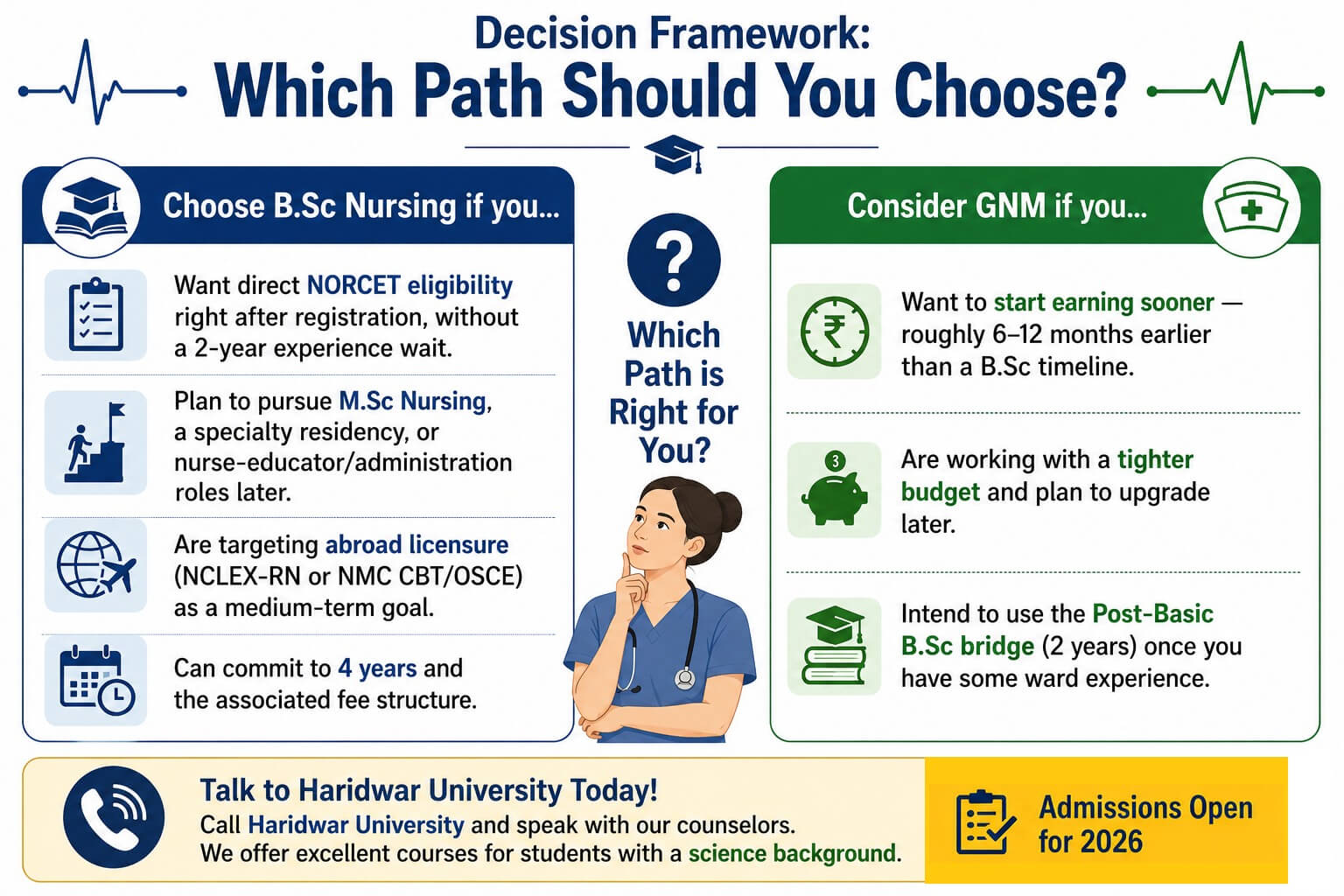
Figure: Decision Framework comparing B.Sc Nursing and GNM pathways
Choose B.Sc Nursing if you...
- Want direct NORCET eligibility right after registration, without a 2-year experience wait
- Are targeting abroad licensure (NCLEX-RN or NMC CBT/OSCE) as a medium-term goal
- Plan to pursue M.Sc Nursing, a specialty residency, or nurse-educator/administration roles later
- Can commit to 4 years and the associated fee structure
Consider GNM (elsewhere) if you...
- Want to start earning sooner — roughly 6-12 months earlier than a B.Sc timeline
- Intend to use the Post-Basic B.Sc bridge (2 years) once you have some ward experience
- Are working with a tighter education budget and plan to upgrade later
There is no universally "correct" choice — it depends on your timeline, budget, and whether government exams or overseas registration are near-term or long-term goals.
12. Frequently Asked Questions
1. Does Haridwar University offer a GNM (diploma) nursing course?
No. HU's Roorkee College of Allied Health Sciences currently lists B.Sc. Nursing (with AI) as its only undergraduate nursing programme, recognised by the Indian Nursing Council. There is no diploma-level GNM course on the university's official programme page at the time of writing.
2. Is B.Sc Nursing better than GNM overall?
Neither is universally "better." B.Sc Nursing gives deeper curriculum coverage, a higher long-term career ceiling, and immediate NORCET eligibility. GNM is shorter and gets graduates into paid clinical work sooner.
3. What is the duration of B.Sc Nursing at Haridwar University?
B.Sc. Nursing (with AI) at HU is a 4-year undergraduate degree, structured as four annual fee cycles in the university's official 2026-27 fee sheet.
4. Can a GNM diploma holder join a degree programme later?
Yes, through the Indian Nursing Council's Post-Basic B.Sc Nursing bridge, typically a 2-year programme for registered GNM nurses. Confirm directly with HU admissions whether this specific bridge is run on their campus.
5. What is the total B.Sc Nursing fee at Haridwar University?
Per HU's official 2026-27 fee structure, tuition plus admission, enrolment, examination and uniform charges total roughly ₹1.9 lakh per year across all four years, before any applicable scholarship.
6. Can B.Sc Nursing graduates apply for NORCET directly?
Yes. AIIMS's NORCET notifications allow B.Sc (Hons.)/B.Sc Nursing and Post-Basic B.Sc Nursing graduates to apply right after INC or state council registration, unlike GNM diploma holders, who need two years of prior hospital experience.
7. Do I need to clear NCLEX to work as a nurse in the UK?
No. NCLEX-RN is the licensing exam for the USA (and most Canadian provinces). The UK and Ireland instead use the NMC's Computer-Based Test and OSCE, alongside an English test such as OET.
8. Which pays more — a private staff nurse role or a government Nursing Officer post?
Government Nursing Officer posts secured via NORCET start at 7th CPC Level 7 and generally offer more stable, structured pay than typical private-sector staff-nurse packages reported on salary aggregators, though private pay varies widely by city and hospital.
9. Is Haridwar University recognised for nursing education?
Yes. HU's Roorkee College of Allied Health Sciences lists Indian Nursing Council recognition among its approvals, in addition to UGC recognition for the university as a whole.
13. Next Steps at Haridwar University
Planning Your Nursing Career for 2026?
Explore programmes, recognitions, fees, and application steps at Haridwar University.