

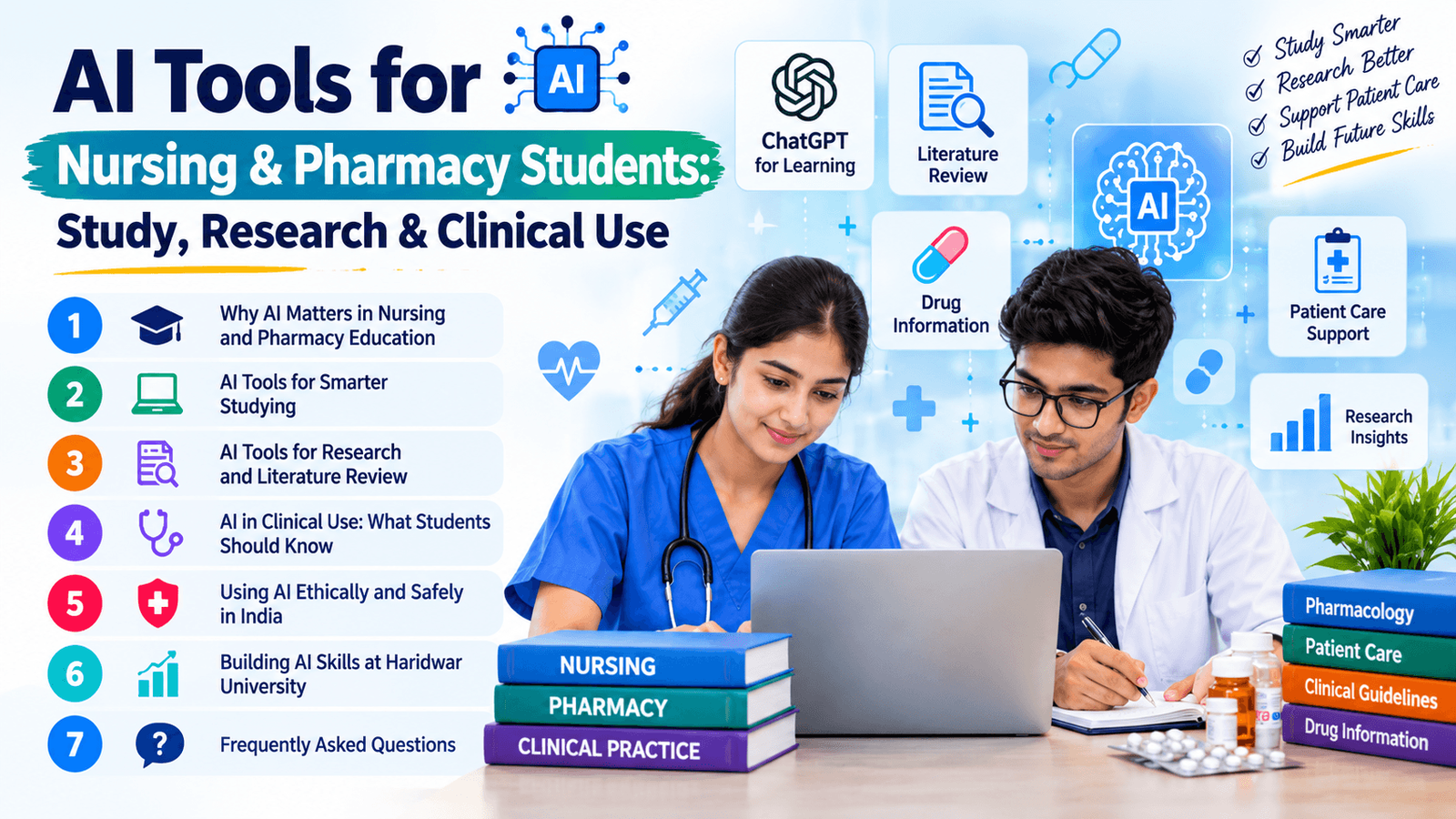
AI Tools for Nursing & Pharmacy Students: Study, Research & Clinical Use
Mr. Vishal Baliyan
Assistant Professor, Allied Sciences, Haridwar University
AI Tools for Nursing & Pharmacy Students have moved from curiosity to daily habit. Learners now ask a chatbot to explain beta-blockers, turn lecture notes into flashcards, or plan a literature search before a project deadline. At Haridwar University, where the Roorkee College of Allied Health Sciences teaches pharmacy and nursing, the real question is no longer whether students will use AI, but how well and how safely.
This guide covers study tools, research tools and the careful limits of clinical use. It also explains the ethics rules that apply in India and closes with the fees and scholarships published for its healthcare programmes. If you want to know more about the university's academic legacy and accreditations, visit the About Us page.
Table of Contents
1. Why AI Matters in Nursing and Pharmacy Education
Nursing and pharmacy are memory-heavy courses. One semester can ask you to hold drug classes, dose ranges, adverse effects, procedures and care plans in your head together. AI helps by explaining a concept in simpler words, quizzing you, or reorganising messy notes. Used this way, it behaves like a patient senior who is awake at midnight.
Where AI Helps and Where It Fails
AI is good at explaining, summarising and drafting. It is poor at knowing your patient, your hospital protocol, or whether the reference it quotes even exists. A chatbot can state a wrong fact in a confident tone, so every answer needs checking against a textbook or guideline. The World Health Organization's guidance on AI for health makes a similar point at a larger scale: ethics and human rights must sit at the heart of design, deployment and use, and the report lists six consensus principles. Learning these limits early is part of becoming a safe professional.
Core Clinical Rules for AI Use:
- AI Capabilities: Summarisation of literature, flashcard creation, initial concept explanation, drafting study schedules.
- AI Blindspots: Nuanced bedside context, real hospital formulary constraints, dosage calculation reliability, verified citations.
- Golden Rule: Never rely on unverified AI responses for medication administration or patient care plans.
2. AI Tools for Smarter Studying
AI tools for nursing and pharmacy students work best when they support learning instead of replacing it. Three habits make the difference:
Explain, Quiz, Repeat
Ask a general assistant such as Claude, ChatGPT or Gemini to explain a topic at your level, then ask for ten questions and have it mark your answers. This suits pharmacokinetics, the nursing process or aseptic technique. If a question looks doubtful, settle it from your prescribed textbook.
Tools That Stay With Your Notes
Tools that answer from documents you upload, such as NotebookLM, can reduce invented content because replies stay tied to your own slides and notes. Upload one unit and ask for a table of drug classes or a revision plan for the week before exams.
Study Support Beyond the App
Write your own answer first, then compare it with the AI's version. If stress or confusion builds up, use human help too. Haridwar University's Student Welfare Service describes a Student Care Centre in each academic block that aims to resolve student problems within 24 hours.
3. AI Tools for Research and Literature Review
Research is where students lose the most time and where AI can save the most. Begin with a real database. PubMed, maintained by the National Center for Biotechnology Information at the US National Library of Medicine, holds more than 40 million citations and abstracts of biomedical literature. Search there first, then use AI to help you read what you found.
Finding and Reading Papers
Research assistants such as Elicit or Consensus can surface papers for a plain-language question, and a general chatbot can explain a methods section that confuses you. Treat each suggestion as a lead, not proof. Open the original paper, confirm it exists, and read the abstract yourself.
Writing and Referencing Honestly
Use AI to tidy grammar, build an outline or test whether your argument flows. Do not paste a generated paragraph into a project report. Keep references in a manager such as Zotero and cite only papers you have opened, because invented citations are a known weakness of chatbots and are easy to spot.
4. AI in Clinical Use: What Students Should Know
Clinical placements are where the stakes change. Here AI is a support tool and never a decision-maker.
Safe Uses During Training
Reasonable uses include rehearsing a care-plan format after your shift, practising patient-education explanations in simple language, and revising drug-interaction questions before a viva. Pharmacy students can use AI to understand a mechanism of action, then verify doses, interactions and contraindications in an approved reference. The Pharmacy Council of India, a statutory body formed under the Pharmacy Act, 1948 to regulate the profession, sets the standards your practice is judged against, and no chatbot overrides them.
What Never to Do
Never type real patient names, record numbers or photographs into a public AI tool. Never use AI output to settle a dose or a diagnosis, and never skip your supervisor's review. For structured training, the Roorkee College of Allied Health Sciences at Haridwar University offers programmes in pharmacy, nursing, physiotherapy and other healthcare disciplines.
5. Using AI Ethically and Safely in India
India already has written guidance. In 2023 the Indian Council of Medical Research released ethical guidelines for AI in biomedical research and healthcare, covering ethical principles, ethics review, governance and informed consent. If your final-year project touches patient data, read them before you design anything.
Privacy is the second pillar. The Digital Personal Data Protection Act, 2023 governs how digital personal data may be processed. In plain terms: collect only what you need, protect it, and remove identifying details before sharing anything with a tool.
A Four-Question Checklist Before Using AI:
- Does my college policy allow this? Check institutional rules on assignment assistance.
- Have I removed identifying data? Never expose patient identities, case record numbers, or personal details.
- Will I verify the output against a trusted source? Always confirm drug doses and physiological facts in validated textbooks or pharmacopoeias.
- Can I explain the answer in my own words? Ensure you truly understand the concepts rather than copying machine text.
6. Building AI Skills at Haridwar University
Learning AI tools for nursing and pharmacy students is easier when the course itself supports it. Haridwar University names AI in several allied health courses: B.Sc. Nursing (with AI), B.Pharm (with AI), B.Pharm LE (with AI) and D.Pharm (with AI), alongside M.Pharm Pharmaceutics. Its homepage lists approvals from the University Grants Commission, the Pharmacy Council of India and the Indian Nursing Council. The university is also hosting ICSEHS-2026, its first International Conference on Smart Engineering, Health Science & AI Technologies, on 23–24 October 2026 in hybrid mode.
Fee Structure 2026-27
The official fees and scholarships page lists these figures for the allied health programmes:
| Course | Tuition Fee (₹) | 1st Year Total (₹) | 2nd Year (₹) |
|---|---|---|---|
| B.Sc. Nursing (with AI) | ₹98,000 | ₹1,90,000 | ₹1,90,000 |
| B.Pharm (with AI) | ₹62,000 | ₹1,27,000 | ₹1,10,000 |
| D.Pharm (with AI) | ₹30,000 | ₹80,000 | ₹75,000 |
| M.Pharm Pharmaceutics | ₹60,000 | ₹1,57,000 | ₹1,40,000 |
These charges include tuition, enrolment, admission, examination and uniform fees; transport is extra. Hostel fees, covering lodging, mess and laundry, are ₹85,000 for a normal room, ₹95,000 for semi deluxe and ₹1,05,000 for deluxe AC.
Scholarships
Merit scholarships apply to first-year tuition only, and a student can receive just one scholarship. Based on Class 12 marks for 2026 and 2025 pass-outs, above 90% earns 80%, above 80% to 90% earns 50%, above 70% to 80% earns 20% and above 60% to 70% earns 10%. D.Pharm has its own slab of 50%, 30%, 20% and 10% for the same bands. The page also lists a 25% first-year scholarship to promote girls' education, sports-quota awards from 10% to 50%, and a ₹5,000 academic excellence award for scoring 85% or more in a semester while clearing every subject in the first attempt.
7. Frequently Asked Questions
Which AI tools for nursing and pharmacy students are most useful?
General assistants help with explanations and quizzes, source-based tools like NotebookLM help with notes, and research assistants like Elicit help with papers. Learn one or two well instead of collecting many.
Can I use AI for my assignments?
Yes for brainstorming, outlines and language checks, provided your college policy allows it. Submit work in your own words and never present generated text as your own.
Is AI safe for clinical decisions?
No. AI can help you learn, but doses, diagnoses and care decisions must come from approved references and your supervisor. Treat every output as unverified.
How do I avoid fake references?
Search PubMed or another database first, open every paper you cite, and store sources in a reference manager. If you cannot open it, do not cite it.
Can AI explain drug interactions?
It can explain mechanisms in simple language, which helps revision. For real interactions and dosing, confirm in an approved pharmacy reference and with your faculty.
Can I enter patient data into AI tools?
No. Never share names, record numbers or photographs. Because India's DPDP Act, 2023 governs digital personal data, remove identifying details even from practice cases.
Which nursing and pharmacy programmes does Haridwar University offer?
The fees page lists B.Sc. Nursing (with AI), B.Pharm (with AI), B.Pharm LE (with AI), D.Pharm (with AI) and M.Pharm Pharmaceutics under allied health.
What are the fees for B.Sc. Nursing and B.Pharm at HU?
For 2026-27, B.Sc. Nursing (with AI) has tuition of ₹98,000 and a first-year total of ₹1,90,000. B.Pharm (with AI) has tuition of ₹62,000 and a first-year total of ₹1,27,000.
How do I apply for admission at HU?
Follow the six steps in the admission overview. It says online enquiry or registration, or a personal campus visit, is compulsory, and seat confirmation needs a ₹25,000 deposit.
Master Healthcare AI at Haridwar University
Train in cutting-edge simulation facilities and laboratories designed for tomorrow's nursing and pharmacy professionals. Learn to deploy smart health technologies responsibly and build a fulfilling healthcare career.