

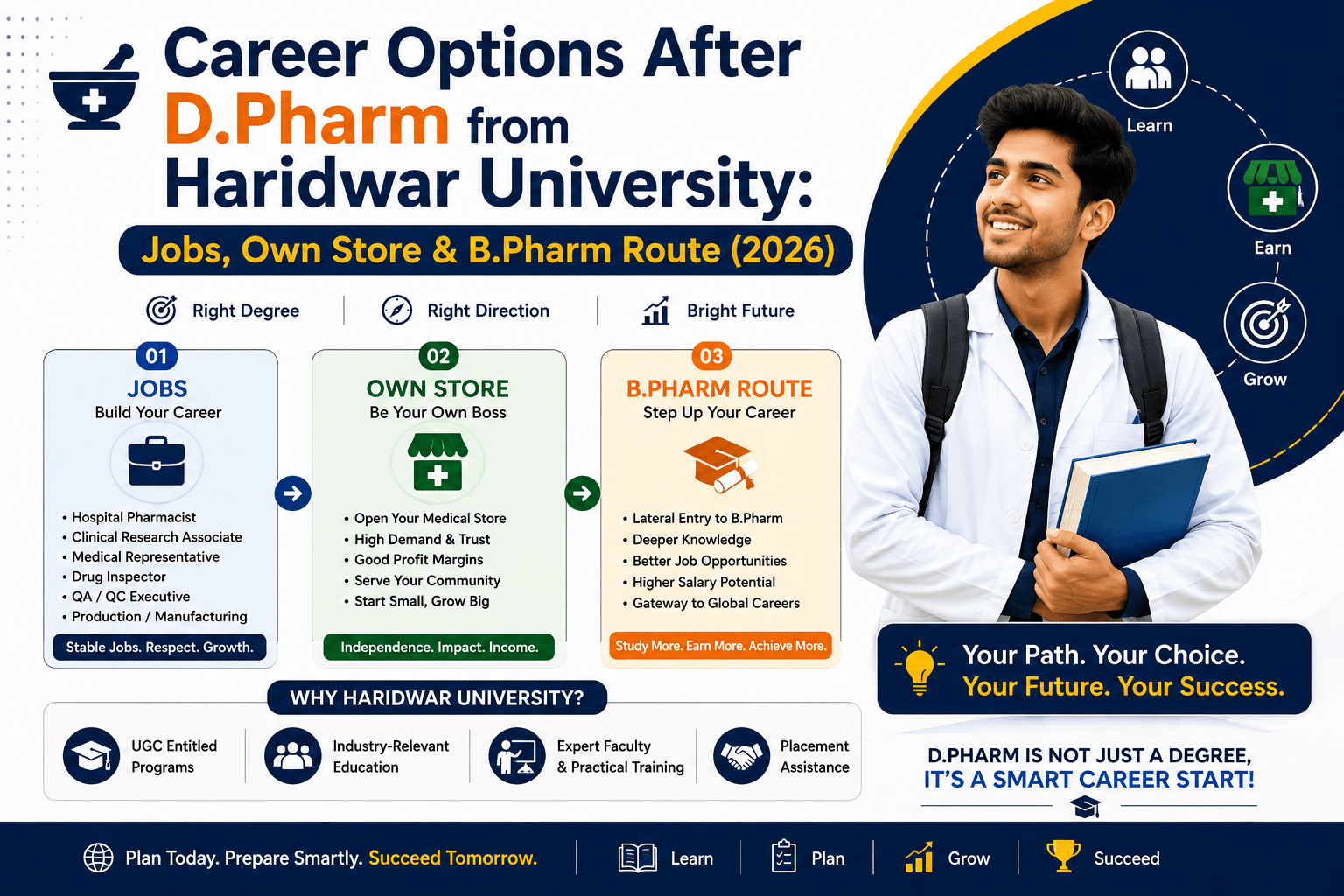
A career after D.Pharm Haridwar University opens more directly employable paths than most students expect — registered pharmacist, hospital pharmacy, government service, pharma sales, or even your own medical store. This guide walks through each route with real numbers: state registration steps, the licence process for opening a store, government exam pay scales, and the fee math behind moving from D.Pharm into a lateral-entry B.Pharm.
It draws on Haridwar University's own D.Pharm programme page and fee and scholarship data together with named government portals — the Pharmacy Council of India, the Uttarakhand Pharmacy Council, the Uttarakhand FDA, the Staff Selection Commission, and NBEMS — and dated industry salary sources, all cited where used.
Table of Contents
1. Registered Pharmacist: State Council Registration & the New HPR Step
2. Own Medical Store: Licence Steps and the Real Investment
3. Hospital Pharmacy: Where D.Pharm Graduates Fit In
4. Pharma Sales: The Medical Representative Route
5. Government Pharmacist Exams: SSC, RRB, ESIC and State Boards
6. The DPEE Effect: What Changed for the 2026 Batch
7. Lateral Entry to B.Pharm 2nd Year: The Real Decision Math
8. Salary Snapshot Across D.Pharm Career Paths
1. Registered Pharmacist: State Council Registration & the New HPR Step
A D.Pharm degree alone doesn't let you legally dispense medicines — you first need to register as a pharmacist under Section 32(2) of the Pharmacy Act, 1948, through your home state's Pharmacy Council, a process regulated nationally by the Pharmacy Council of India (PCI).
In Uttarakhand, this means applying to the Uttarakhand Pharmacy Council in Dehradun with your D.Pharm marksheets, one-year training certificate, domicile proof, and a registration fee (₹2,000 as a bank draft, per UKPC's own published fee schedule).
New Digital HPR Step (Mandatory from 12 August 2026): PCI has layered a new digital requirement on top of state registration: pharmacists must complete a Healthcare Professional Registry (HPR) profile through the DIGI-PHARMed portal under the Ayushman Bharat Digital Mission, linking their Aadhaar, ABHA ID, and state registration details. Always check PCI's own portal before applying, since exit-exam and registration circulars have been updated periodically.
2. Own Medical Store: Licence Steps and the Real Investment
Opening your own medical store is a realistic path directly out of D.Pharm, but it runs through a state drug licence, not just a shop signboard.
- Licence Forms: Retail licences are issued under Form 20 (general medicines) and Forms 20-F/20-G (Schedule X restricted drugs) of the Drugs and Cosmetics Act, 1940. Note that Form 21 is a separate licence covering Schedule C & C1 biological products (Drugs and Cosmetics Rules, 1945, rule 61).
- Regulatory Authority: Issued by your state's drug-control authority — in Uttarakhand, the Food Safety and Drug Administration, Uttarakhand (FDA), headquartered in Dehradun.
- Mandatory Conditions: A registered pharmacist (you, if your D.Pharm registration is complete) must be present on the premises during operating hours, and the shop requires a minimum prescribed floor area along with dedicated cold storage/refrigeration for temperature-sensitive drugs.
Estimated Initial Investment & Margins
As an indicative industry range — not a figure published by HU — small-to-mid retail pharmacy setups commonly report first-year capital (premises deposit, fixtures, refrigeration, billing software, and opening inventory stock) in the ₹5–15 lakh range.
Generic medicines typically carry higher margins (20–50%) compared to branded formulations (16–22%). Verify exact local costs with distributors and wholesale stockists before budgeting.
3. Hospital Pharmacy: Where D.Pharm Graduates Fit In
Hospital pharmacy departments hire D.Pharm-registered pharmacists for prescription dispensing, inventory tracking, cold-chain logistics, and ward-stock replenishment. These operational roles are distinct from a clinical pharmacist track (which typically requires B.Pharm/Pharm.D with specialized clinical training).
Hospital roles represent a dependable starting point for HU D.Pharm graduates alongside community retail, offering structured shift-based salaried employment rather than the footfall-dependent revenue of private retail.
4. Pharma Sales: The Medical Representative Route
A Medical Representative (MR) role does not require State Pharmacy Council registration. Pharmaceutical companies recruit D.Pharm, B.Pharm, and life-science graduates into commercial field sales to build professional relationships with doctors, clinics, and hospital pharmacies.
It provides the fastest entry into the corporate commercial side of pharmaceuticals, with clear promotional ladders into Area Sales Manager (ASM) and Regional Sales Manager (RSM) roles for consistent performers. Early compensation features a fixed monthly base plus performance-linked quarterly incentives.
5. Government Pharmacist Exams: SSC, RRB, ESIC and State Boards
Government pharmacist appointments offer job security, standard working hours, and central pay commission allowances. D.Pharm holders (alongside B.Pharm graduates) are directly eligible once registered with their State Pharmacy Council.
Staff Selection Commission (SSC)
Recruits pharmacists for Central Government Health Scheme (CGHS) and DGHS hospitals via Selection Post examinations at Pay Level 5 (7th CPC: ₹29,200–₹92,300; in-hand ≈₹45,000–₹56,000 at entry).
Railway Recruitment Boards (RRB)
Conducts centralized technical recruitment for Pharmacist posts across zonal railway hospitals and health units across India.
ESIC & State Health Directorates
Employees' State Insurance Corporation (ESIC) and state recruitment bodies (such as Uttarakhand Directorate of Medical & Health) release periodic pharmacist vacancies.
Note: State Council registration must be completed before applying, as registration numbers are mandatory during application and document verification. For additional sector-by-sector details, see our companion guide on Career Options After B.Pharm.
6. The DPEE Effect: What Changed for the 2026 Batch
Since the 2024-25 academic session, D.Pharm graduates cannot register as a pharmacist without first clearing the Diploma in Pharmacy Exit Examination (DPEE), introduced under the Diploma in Pharmacy Exit Examination Regulations, 2022 and conducted by the National Board of Examinations in Medical Sciences (NBEMS).
DPEE Practical Guidance for HU Students: Plan for the DPEE exam attempt as an integral milestone in your post-graduation timeline. Register as soon as final D.Pharm results are declared. Note that PCI's circular on 20 February 2026 (Ref. 14-285/2025-PCI) was a specific administrative relief for the 2022-23 admitted batch; DPEE remains compulsory for subsequent batches. The exit exam applies specifically to D.Pharm and does not currently apply to B.Pharm.
7. Lateral Entry to B.Pharm 2nd Year: The Real Decision Math
D.Pharm holders can gain direct admission into the 2nd year of B.Pharm through lateral entry, bypassing the first-year curriculum. At Haridwar University's 2026-27 fee structure (verified 2 September 2026 from the official fees and scholarships page), the comparison breaks down as follows:
| Programme Track | Year 1 | Year 2 | Year 3 | Year 4 | Programme Total |
|---|---|---|---|---|---|
| D.Pharm (with AI) — 2 Years | ₹80,000 | ₹75,000 | — | — | ₹1,55,000 |
| B.Pharm (with AI) — Direct 4 Years | ₹1,27,000 | ₹1,10,000 | ₹1,10,000 | ₹1,10,000 | ₹4,57,000 |
| B.Pharm LE (with AI) — Lateral Entry 3 Years | ₹1,27,000 | ₹1,10,000 | ₹1,10,000 | — | ₹3,47,000 |
The Decision Trade-Off
Completing D.Pharm and then taking the B.Pharm LE route totals ₹1,55,000 + ₹3,47,000 = ₹5,02,000 across 5 academic years — roughly ₹45,000 more and one year longer than enrolling directly into the 4-year B.Pharm (with AI) at ₹4,57,000.
However, the D.Pharm route provides cash-flow flexibility: a student who registers after D.Pharm can work part-time in retail or hospital pharmacies to self-fund their degree, whereas direct B.Pharm requires carrying 4 years of tuition upfront.
8. Salary Snapshot Across D.Pharm Career Paths
The figures below reflect verified entry-level benchmarks from cited industry and government sources:
| Career Path | Typical Entry-Level Pay | Verified Source |
|---|---|---|
| Retail / Community Pharmacist | ₹10,000 – ₹18,000 / month | Indeed India, pharmacist salary page (June 2026) |
| Medical Representative (Pharma Sales) | ₹15,000 – ₹25,000 / month (Avg. ₹18,050 reported + incentives) |
Indeed India (May 2026) |
| Government Pharmacist (SSC, Pay Level 5) | ₹29,200 – ₹92,300 scale (≈₹45,000–₹56,000 in-hand at entry) |
SSC Selection Post Phase-XIV Notification (ssc.gov.in) |
| Experienced Pharmacist (5+ Years, Any Sector) | ₹35,000 – ₹70,000 / month | PayScale India (2026) |
9. Frequently Asked Questions (FAQs)
Q1: Can I get a job immediately after D.Pharm, or do I need to register first?
You can be hired, but you cannot legally dispense medicines or work as a pharmacist of record until your State Pharmacy Council registration (and, since 2024-25, DPEE) is complete. Hospitals and retail chains verify registration status before confirming full employment.
Q2: Is the DPEE compulsory for every D.Pharm student?
Yes, for students from the 2024-25 academic session onward under the Diploma in Pharmacy Exit Examination Regulations, 2022. It applies specifically to D.Pharm graduates, not B.Pharm.
Q3: How much does it cost to open a medical store after D.Pharm?
Small-to-mid retail pharmacy setups commonly report first-year capital of roughly ₹5–15 lakh, covering premises deposit, shop interior fixtures, refrigeration, billing software and initial inventory stock.
Q4: Which pays better — a government pharmacist job or a private hospital role?
Government posts through SSC/State health boards start on a defined pay scale (₹29,200–₹92,300, Pay Level 5) with pension and government allowances, generally ahead of private-sector entry pay. However, private hospital and retail roles are available immediately without competing in national selection examinations.
Q5: Do I need pharmacist registration to become a Medical Representative?
No. MR roles are commercial sales positions and do not require State Pharmacy Council registration, making them a swift entry route into the pharma corporate industry.
Q6: Is lateral entry to B.Pharm 2nd year cheaper than joining B.Pharm directly?
No. At HU's current fee schedule, the direct 4-year B.Pharm (with AI) route totals ₹4,57,000, about ₹45,000 less than completing D.Pharm (₹1,55,000) followed by 3-year lateral-entry B.Pharm (₹3,47,000 = ₹5,02,000 total). However, D.Pharm enables earning and working while completing the lateral degree.
Q7: What documents does the Uttarakhand Pharmacy Council ask for at registration?
D.Pharm marksheets and diploma certificate, 500-hour / 3-month practical training certificate, Class 10 & 12 marksheets, Uttarakhand domicile certificate, Aadhaar card, prescribed application forms, and the registration fee bank draft.
Q8: Can a D.Pharm holder apply for government pharmacist exams outside their home state?
Yes for central recruiters like SSC (CGHS/DGHS) and RRB, which recruit nationwide. State-level health boards typically require local state domicile or State Council registration.
Q9: What is HPR registration, and do existing pharmacists need to do anything?
HPR (Healthcare Professional Registry) is a mandatory national digital registry under India's Ayushman Bharat Digital Mission. New registrants must complete it via the DIGI-PHARMed portal from 12 August 2026 onwards. Existing pharmacists should validate their profiles on PCI's official portal.
10. Plan Your Pharmacy Career at HU
Whichever route you're weighing — state registration and a dispensing job, opening your own medical store, or sitting for government pharmacist examinations — your foundation starts with high-calibre practical lab exposure and verified PCI-approved training.
For more details on admission eligibility and campus facilities, explore the HU Admission Overview and About Haridwar University pages.
Start Your Pharmacy Journey at Haridwar University
Explore PCI-approved D.Pharm (with AI), advanced pharmaceutics labs, and student career mentorship.