

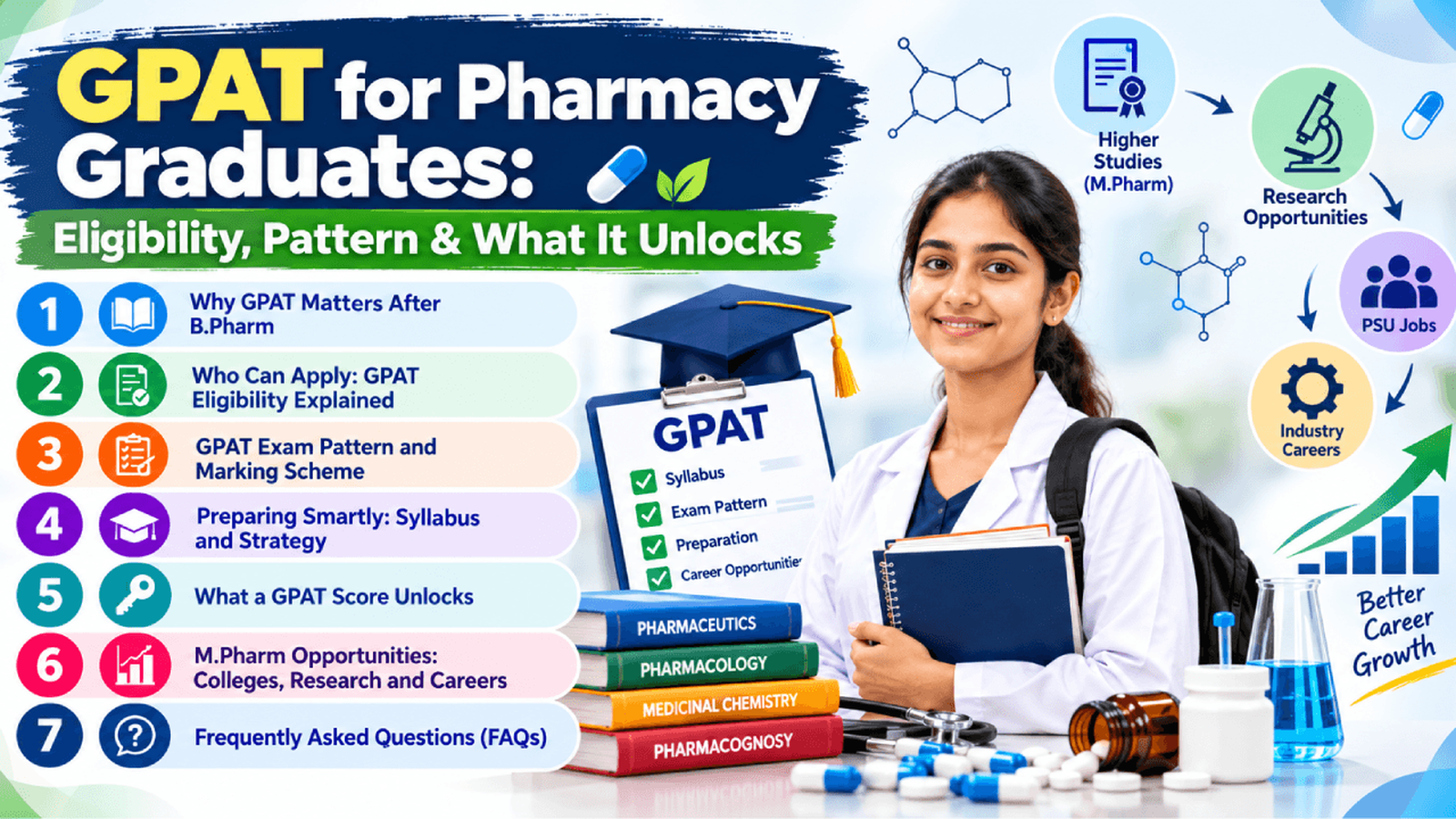
GPAT for Pharmacy Graduates: Eligibility, Pattern & What It Unlocks
Dr. Deovrat Kumar
Associate Professor & HOD, Pharmacy, Haridwar University
GPAT for Pharmacy Graduates is the national entrance test that stands between an undergraduate pharmacy degree and a postgraduate seat. You have spent four years mastering medicinal chemistry, pharmaceutics, pharmacology, and pharmacognosy; now, a single three-hour computer-based paper determines how far that groundwork can carry you into specialized postgraduate training.
In the March 2026 cycle, the National Board of Examinations in Medical Sciences (NBEMS) reported that 53,617 candidates appeared and 5,362 qualified. That places the overall qualification rate at roughly one in ten, meaning precision, systematic time budgeting, and sound conceptual mastery are decisive. This guide provides a comprehensive roadmap: who can apply, how the 125-question paper is structured, strategic subject prioritization, postgraduate stipends, and M.Pharm pathways at Haridwar University.
Table of Contents
- 1. Why GPAT Matters After B.Pharm
- 2. Who Can Apply: GPAT Eligibility Explained
- 3. GPAT Exam Pattern and Marking Scheme
- 4. Preparing Smartly: Syllabus Breakdown and Study Strategy
- 5. What a GPAT Score Unlocks: Seats, Stipends, and Research
- 6. M.Pharm at Haridwar University: Eligibility, Fees and Support
- 7. Frequently Asked Questions (FAQs)
1. Why GPAT Matters After B.Pharm
What GPAT Actually Is
GPAT stands for the Graduate Pharmacy Aptitude Test. It is conducted nationwide by the National Board of Examinations in Medical Sciences (NBEMS) as a single-session, computer-based test (CBT) for admission to Master of Pharmacy (M.Pharm) programmes across India. The March 2026 paper was administered on 7 March, with official scorecards and merit ranks announced on 7 April. Notably, following expert evaluations of candidate challenges against provisional answer keys, NBEMS awarded full credit to all appearing candidates for seven technically ambiguous questions.
Why the Score Carries Weight
Securing a qualifying GPAT score is far from a paper formality. Across 53,617 examinees, only 5,362 candidates cleared the cut-off thresholds in 2026. Because NBEMS computes category-specific percentile cut-offs, qualification serves three crucial functions simultaneously:
- Institutional Admission Priority: Top NIRF-ranked pharmacy institutes and universities utilize GPAT merit ranks as the benchmark for M.Pharm seat allocation.
- Monthly Financial Assistance: Qualified students admitted to full-time approved M.Pharm courses become eligible for the monthly postgraduate scholarship.
- Academic Credibility: A validated percentile serves as a powerful signal of foundational competence during technical interviews for corporate R&D roles.
Reputed institutions offering pharmacy education, including Haridwar University, publish regulatory approvals openly. Before shortlisting postgraduate destinations, reviewing an institution's institutional background and academic governance ensures sound career alignment.
2. Who Can Apply: GPAT Eligibility Explained
Eligibility discrepancies remain one of the most frequent reasons applications encounter hurdles during document verification. The parameters detailed below reflect the official NBEMS information bulletin:
Educational Qualifications
- Candidates must hold a Bachelor's degree in Pharmacy (B.Pharm) awarded after four years of study following 10+2.
- Graduates who entered B.Pharm through Lateral Entry (after completing a D.Pharm) are fully eligible.
- Final-year B.Pharm students are permitted to appear, provided their qualifying examination results are formally declared before institutional counselling and admission formalities close for that academic session.
Because pharmacy education is strictly regulated by statutory authorities, candidates should always verify that their undergraduate college holds active approvals. For students currently planning their undergraduate steps, exploring the complete roster of academic programmes at Haridwar University offers clarity on approved undergraduate and postgraduate courses.
Nationality, Age Limits, and Exclusions
- Nationality: Applicants must be citizens of India.
- Age Limit: There is no upper age limit specified for appearing in GPAT.
- Ineligible Qualifications: Candidates holding degrees such as B.Tech in Pharmaceutical and Fine Chemical Technology are not eligible to sit for GPAT.
- Provisional Candidature: NBEMS issues admit cards based on self-declared registration data without pre-exam verification. Verification occurs during institutional counselling; maintaining original mark sheets, degree certificates, or provisional completion certificates is indispensable.
3. GPAT Exam Pattern and Marking Scheme
While the structure of the examination is straightforward, time pacing and penalty management present real tactical challenges.
Timing Arithmetic: 86 Seconds per Question
Allocating 180 minutes across 125 questions leaves approximately 86 seconds per question. While memory-based recall items in pharmacognosy or jurisprudence can be solved in 25 to 30 seconds, numerical formulations in pharmaceutics and multi-step structure-activity relationship (SAR) deductions in medicinal chemistry demand 2 to 3 minutes. Aspirants must consciously bank surplus seconds on recall questions to finance calculation-heavy items.
Because every erroneous answer subtracts one mark, random guessing damages overall rank severely. Strategic elimination between two options is a sound statistical gamble; flipping a coin among four is destructive.
Understanding Percentile Qualifying Cut-offs
GPAT does not feature a fixed passing percentage. Instead, NBEMS determines category-wise cut-offs by merit rank. In 2026, while 10% of overall test-takers qualified, the General category cut-off was situated around the 96th percentile. This means an unreserved candidate had to outperform 96% of all examinees—placing within the top 4% nationwide. Reserved categories featured lower percentile thresholds. Because raw score cut-offs float depending on question difficulty, high conceptual accuracy remains the ultimate safeguard.
4. Preparing Smartly: Syllabus Breakdown and Study Strategy
The GPAT syllabus is effectively a comprehensive re-evaluation of your entire four-year undergraduate curriculum. Clearing it requires transitioning from semester-end rote learning to integrated conceptual application.
Subject Weightage and Prioritization
- Pharmaceutical Chemistry & Medicinal Chemistry (~38 questions): Emphasize reaction mechanisms, stereochemistry, heterocyclic nomenclature, IUPAC, SAR of major drug classes, and spectroscopic interpretations (UV, IR, NMR, Mass).
- Pharmaceutics & Biopharmaceutics (~38 questions): Focus on dosage form technology, novel drug delivery systems (NDDS), pre-formulation kinetics, dissolution models, bioequivalence, and regulatory guidelines (ICH, GMP).
- Pharmacology (~28 questions): Prioritize mechanisms of action, receptor dynamics, autonomic and central nervous systems, cardiovascular agents, chemotherapy, and toxicological adverse profiles.
- Pharmacognosy & Natural Products (~10 questions): Chemical tests, biological sources, active secondary metabolites (alkaloids, glycosides, steroids), and adulterant identification.
- Pharmaceutical Analysis & Jurisprudence (~11 questions): Chromatography techniques (HPLC, GC), titrations, Pharmacy Act, Drugs and Cosmetics Act, schedules, and clinical trial regulations.
Building a Timed Mock Routine
Divide preparation into weekly cycles combining syllabus revision with timed tests. Since the real paper permits 86 seconds per question, train by answering blocks of 25 MCQs against a 36-minute timer. As conceptual speed stabilizes, escalate to full 180-minute simulation exams during the final two months.
A sustained preparation routine also requires a stable, supportive academic environment. If academic, hostel, or administrative concerns disrupt your preparation focus, Haridwar University maintains a dedicated student welfare and grievance service to address student concerns promptly.
5. What a GPAT Score Unlocks: Seats, Stipends, and Research
Postgraduate Admissions (M.Pharm)
A validated GPAT scorecard is the standard gateway for M.Pharm admissions across state and central universities, NIPER institutes, and premier private colleges. Importantly, NBEMS conducts the entrance test only and does not administer centralized seat counselling. Each participating university or state counselling authority conducts its own admission rounds; candidates must track institutional application deadlines independently.
Monthly Postgraduate Fellowship (₹12,400 / Month)
Under Pharmacy Council of India (PCI) notifications (including circular directives updated in October 2025), GPAT-qualified candidates enrolled in full-time M.Pharm courses at approved institutions are eligible to receive a monthly scholarship of ₹12,400 throughout their two-year postgraduate duration (24 months). The stipend is disbursed directly through verified Canara Bank institutional accounts upon submission of monthly academic attendance and performance verifications.
Advanced Career Routes in R&D and Regulatory Bodies
Holding an M.Pharm significantly expands career horizons beyond conventional sales and production roles into high-value domains:
- Formulation R&D and NDDS: Designing nanoscale drug delivery vehicles, controlled-release matrices, and targeted oncological therapeutics.
- Quality Assurance & Analytical Method Development: Validation protocols using sophisticated chromatographic and spectroscopic systems under GLP/GMP conditions.
- Regulatory Affairs: Interfacing with national statutory bodies such as the Central Drugs Standard Control Organisation (CDSCO) and international agencies (US FDA, EMA) for drug dossiers and clinical trials. For broader industry context, review our comprehensive breakdown of pharma industry career pathways in India.
- Academic Lecturerships & Ph.D. Pathways: PCI regulations mandate a master's degree as the baseline eligibility for faculty positions in approved pharmacy colleges.
6. M.Pharm at Haridwar University: Eligibility, Fees and Support
For students seeking exceptional postgraduate pharmacy education in Uttarakhand, Haridwar University offers the two-year M.Pharm in Pharmaceutics under the aegis of the Roorkee College of Allied Health Sciences, backed by approvals from the Pharmacy Council of India (PCI), UGC, and the Government of Uttarakhand.
Curriculum and Research Infrastructure
The programme delivers intensive training in modern formulation design, nanotechnology, biopharmaceutics and pharmacokinetics, industrial manufacturing scale-up, and regulatory documentation. Postgraduate scholars undertake an in-depth, thesis-based research project supported by modern instrumental analysis laboratories and active industry tie-ups.
Eligibility and Admission Pathways
Applicants require a B.Pharm degree from a PCI-recognized institution with a minimum of 50% aggregate marks (or equivalent CGPA). Haridwar University evaluates applicants through both GPAT merit rankings and institutional merit pathways, ensuring capable pharmacy graduates have a viable route to postgraduate specialisation.
Pharmacy Fee Structure at Haridwar University (2026-27)
Per the official fees and scholarships schedule, the verified tuition and academic costs for pharmacy programmes are detailed below:
These transparent figures cover tuition, enrolment, admission, regular examinations, and uniform fees. Campus residential facilities feature comfortable hostel accommodations: ₹85,000 (standard non-AC), ₹95,000 (semi-deluxe), and ₹1,05,000 (deluxe AC) per annum, inclusive of lodging, nutritious mess dining, and laundry services.
Institutional Scholarships and Academic Awards
Haridwar University provides substantial merit-based tuition waivers, dedicated sports scholarships, and a 25% tuition scholarship scheme for female candidates. Additionally, students securing 85% or higher in semester university examinations receive the ₹5,000 Academic Excellence Award. Prospective students can consult with the university admission team to evaluate applicable scholarships for their postgraduate tenure.
7. Frequently Asked Questions (FAQs)
Who conducts GPAT?
NBEMS conducts GPAT as a nationwide computer-based test once a year. The 2026 edition took place on 7 March, with official results and scorecards published on 7 April.
Can final-year B.Pharm students apply for GPAT?
Yes, provided their final degree results are declared before admissions commence for that academic session. Candidature stays provisional until original documents are validated at admission.
Is there an age limit for GPAT?
No. The information bulletin sets no age restriction. Applicants must be Indian citizens holding a four-year B.Pharm degree or appearing in its final year.
How long is the paper, and how many marks does it carry?
It is a 3-hour computer-based test featuring 125 multiple-choice questions worth 500 total marks, conducted entirely in English.
Is there negative marking in GPAT?
Yes. Correct responses earn +4 marks, while incorrect responses incur a penalty of −1 mark (-1 negative marking). Unattempted items receive 0 marks.
What does it take to qualify GPAT?
There is no static numerical pass mark. Qualification is governed by merit position based on category-wise percentile cut-offs. In 2026, 5,362 of 53,617 candidates qualified (~10%), with the General category cut-off positioned around the 96th percentile.
Do I need GPAT to join M.Pharm at Haridwar University?
Haridwar University admits students to M.Pharm through both GPAT qualification and institutional merit pathways, provided candidates possess a PCI-approved B.Pharm degree with at least 50% marks. Review the admission overview for detailed counselling instructions.
What does M.Pharm cost at Haridwar University?
Per HU's verified fee structure, the two-year M.Pharm Pharmaceutics programme costs ₹1,57,000 for Year 1 and ₹1,40,000 for Year 2, totaling ₹2,97,000 overall, excluding optional hostel and transport.
Is the ₹12,400 monthly stipend automatic after qualifying GPAT?
No. The monthly scholarship follows PCI circular regulations for GPAT-qualified candidates admitted to full-time approved M.Pharm courses, disbursed via verified Canara Bank accounts subject to institution-verified attendance.
GPAT for Pharmacy Graduates rewards rigorous, early preparation and consistent analytical practice. Study the official bulletin, formulate a timed mock routine, and explore your postgraduate university options while your preparation is at its peak.
Advance Your Pharmacy Career at Haridwar University
Haridwar University offers PCI-recognized M.Pharm (Pharmaceutics), advanced formulation & nanotechnology laboratories, high-impact research mentorship, and generous merit scholarships.