


Career After B.Pharm from Haridwar University: Pharma, Research & Industry Paths (2026)
Dr. Deovrat Kumar
Head of Pharmacy, Haridwar University
Table of Contents
Every year, a fresh batch of B.Pharm students sits in my office asking almost the same question, just worded differently. It's rarely “what job will I get.” More often it's something like “Sir, I don't even know which direction to start walking in.” And honestly, that's a fair thing to be confused about.
Career after B.Pharm Haridwar University students pursue doesn't run down one narrow lane the way, say, a specific engineering branch might. A pharmacy degree quietly opens five or six doors at once — retail counters, hospital wards, factory floors, government inspection roles, research labs, and for some, their own shop.
In this piece I've tried to lay out a realistic ten-year picture for each of these paths: what the pay actually looks like at different stages, when higher studies make sense, and how the B.Pharm programme at Haridwar University tries to prepare students for all of them, through labs, industry tie-ups, and hands-on placement support.
If you're a Class 12 student still comparing colleges, a current B.Pharm student trying to map out where the next decade might go, or a parent wondering whether this degree is worth the fees — this one's written for you. Less textbook, more the kind of conversation we'd actually have in a counselling session.
A 10-Year Career Roadmap After B.Pharm
Here's the thing — no two B.Pharm graduates land in the same place a decade out, and honestly, that's what makes the degree worth it. I've broken this down into the five broad tracks I keep seeing our students take, along with a rough sense of how each decade tends to unfold.
1. Retail Pharmacy
This is usually where everyone starts, simply because it hires fastest and doesn't demand much beyond your pharmacist registration to get going.
- Community Pharmacy: In the first couple of years you'll register with the state Pharmacy Council and take up a counter role — an independent chemist shop, or something attached to a hospital. It sounds basic, but this is where you actually learn dispensing, catching drug interactions before they become a problem, and talking to patients in a way no textbook teaches you.
- Chain Pharmacy: Somewhere around the third or fourth year, a lot of pharmacists shift into organised chains — Apollo Pharmacy, MedPlus, the offline Netmeds stores. These places run on structured appraisals, so if you stick around, Store Manager or Cluster Pharmacist positions tend to open up by year six or seven. Pick up inventory management and compliance know-how along the way, and Area Operations roles aren't unrealistic by the ten-year mark.
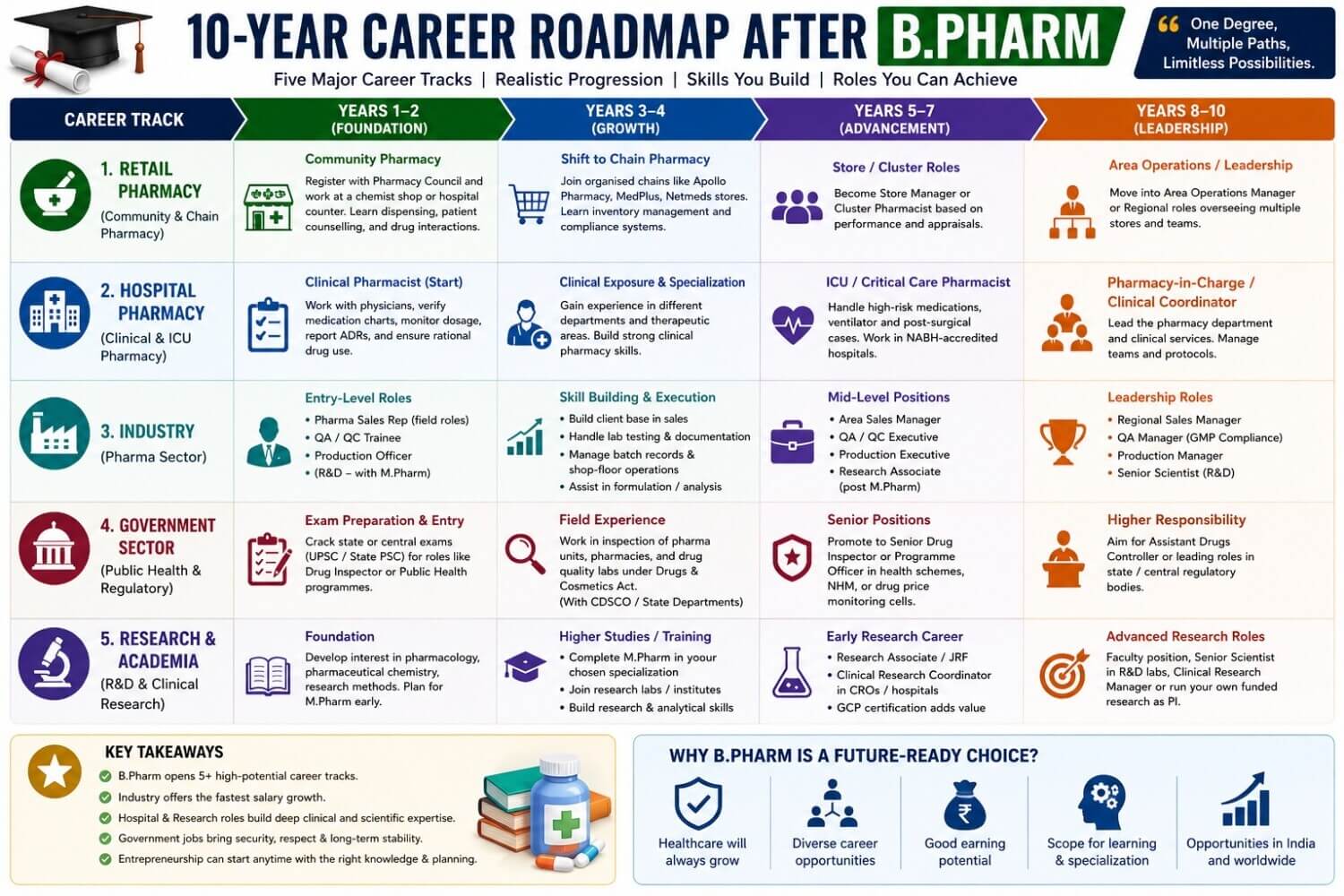
Figure 1: 10-Year Career Roadmap After B.Pharm across Retail, Hospital, Industry, Government, and Research tracks.
2. Hospital Pharmacy
The pay here is a notch below what industry offers fresh graduates, but you get clinical exposure that retail simply can't match — and that matters a lot if clinical research or a PharmD-style role is somewhere on your radar later.
- Clinical Pharmacist: The early years put you shoulder-to-shoulder with physicians — checking medication charts, flagging dosage issues, reporting adverse drug reactions. It's more collaborative than people expect.
- ICU Support Pharmacist: With a few years behind them, some clinical pharmacists move toward critical-care work, reviewing high-risk drug combinations for ventilator patients and post-surgical cases. NABH-accredited hospitals are asking for this specifically these days. Push further and a Pharmacy-in-Charge or Clinical Coordinator title is a fair expectation by year eight or nine.
3. Industry
Salary jumps happen fastest here, and our students tend to do particularly well early on — the university's industry tie-ups help more than most people realise.
- Pharma Sales: Medical or Pharma Sales Representative roles — calling on doctors and chemists — are usually the best-paying option straight out of college once incentives are factored in. Not everyone enjoys the field-heavy grind, but the ones who do tend to move up fast.
- QA/QC: Quality Assurance and Quality Control roles keep you inside a manufacturing unit, checking batches against pharmacopoeial standards. Give it five or six years and a QA Manager title overseeing GMP compliance is well within reach.
- Production: Starts on the shop floor of a formulation unit as a Production Officer, handling day-to-day batch work. Take ownership of batch records and yield targets, and Production Executive or Manager follows naturally.
- R&D: This one usually needs an M.Pharm behind it. You'd start as a Research Associate in formulation development or analytical R&D — working on new drug delivery systems, generic formulations, that sort of thing — with Senior Scientist roles realistically opening up somewhere around year eight or nine.
4. Government Sector
Competitive, no doubt, but the job security is exactly why so many families here in Uttarakhand push their kids toward it.
- Drug Inspector: Clear a state or central exam and you'll spend your early years monitoring manufacturing units and pharmacies under the Drugs and Cosmetics Act, working alongside bodies like the Central Drugs Standard Control Organisation (CDSCO). These posts get announced through UPSC and state public service commissions — and moving up to Senior Drug Inspector or Assistant Drugs Controller within a decade is a fairly realistic goal, not just wishful thinking.
- Public Health: Think state health departments, National Health Mission projects, drug-price monitoring cells. A Pharmacy Council of India registration plus some field experience is often enough to work your way toward programme-officer level positions over time.
5. Research
If pharmacology and pharmaceutical chemistry excited you more than the practical dispensing labs did, it's worth planning for this track early rather than stumbling into it later.
- M.Pharm/PhD Path: Two years of M.Pharm specialisation — Pharmaceutics, Pharmacology, Pharmaceutical Chemistry, or Quality Assurance, take your pick — usually comes first. After that, a PhD or a research-associate stint at an academic or ICMR-affiliated institute is the common next step. Stay on this path long enough and you're looking at a faculty position, a senior scientist role in an R&D lab, or even running your own funded research as principal investigator.
- Clinical Research Coordinator: Early on, this means coordinating clinical trials for a CRO or a hospital trial site — patient consent forms, data entry, making sure protocols are actually followed. Add a Good Clinical Practice certification and a bit of experience, and Clinical Research Associate or Trial Manager positions come within reach.
Entrepreneurship in Pharmacy
Not everyone wants to stay employed forever, and quite a few B.Pharm graduates eventually open their own pharmacy store, a small compounding unit, or a drug-distribution business. The degree hands you exactly the regulatory literacy — drug licensing, GST compliance, storage norms — that most first-time pharmacy owners struggle to pick up otherwise.
A handful of our graduates have also gone the nutraceutical or herbal-formulation route, which honestly makes sense given how close Uttarakhand sits to the Himalayan herbal belt, and with the state actively pushing AYUSH-linked enterprises right now. To open even a single retail pharmacy, you mostly just need a drug licence, a registered pharmacist on record (which, by the way, you already are), and some working capital — modest compared to what most professional degrees demand before you can strike out on your own.
Salary Ranges Per Role (With Citations)
A quick caveat before the numbers: pharmacy salaries swing quite a bit depending on city, employer, and specialisation, so read these as realistic bands rather than anything fixed.
Most of these figures come from published salary-trend reports and official recruitment notifications such as UPSC Drug Inspector recruitment and National Career Service Pharmacy Portal, and they line up reasonably well with what Haridwar University's own Training and Placement Cell tracks — 95% placement assistance for eligible students, an average package of ₹6.5 LPA, and a highest domestic offer of ₹60 LPA across programmes (as detailed on our Placement Overview page).
Higher-Studies Options
Want to push past what a bachelor's degree alone can get you? Three routes are generally worth weighing against each other:
- M.Pharm: Two years, choose a specialisation (Pharmaceutics, Pharmacology, Pharmaceutical Chemistry, Pharmaceutical Analysis, or Quality Assurance), and it's still the standard door into R&D and teaching.
- MBA in Pharmaceutical Management: Makes more sense if you're eyeing pharma marketing, product management, or business-development work rather than lab-bench roles.
- PharmD or PhD: For anyone chasing deep clinical or research specialisation. PhD normally follows an M.Pharm and remains the standard route into a full-time research or academic career.
At HU, most of these programmes take you in through GPAT (optional for M.Pharm), UGC-NET/CSIR-NET/GATE for PhD exemptions, or the university's own HUAET entrance test. The fee structure and scholarship options for each of these are already published on the admissions page, so it's worth checking early if budgeting matters to your family.
Real HU Alumni Example
Placement numbers mean more once you can actually see where people ended up. Haridwar University's HU alumni network today includes graduates spread across pharmaceutical manufacturing, hospital chains, and government drug-testing laboratories, alongside the university's wider placement record with recruiters such as TCS, IBM, and Kotak Mahindra Bank across its various programmes.
Among our own pharmacy students specifically, quite a few have moved directly into QA/QC roles at formulation companies, or as registered pharmacists in hospital chains, within their first year out. I'd credit that partly to the mandatory industrial training and hospital internship built into the B.Pharm curriculum — students aren't walking into their first job cold.
HUAET — Your Gateway to B.Pharm at HU
Getting into the B.Pharm programme at Haridwar University runs through the Haridwar University Admission Entrance Test (HUAET), a 50-question test you sit for an hour. You can also apply directly through the university's online application process, after which shortlisted candidates go through document verification and fee payment to lock in their seat.
Direct entry needs a minimum of 60% aggregate in Class 12 with PCB, though D.Pharm holders aren't left out — they can join through lateral entry straight into second year.
Ready to Start Your Pharmacy Career at Haridwar University?
Explore our B.Pharm programme details, submit your application, or connect with an admissions advisor today.
Frequently Asked Questions
1. What is the best career option after B.Pharm?
Honestly, there's no single “best” answer here — it comes down to what you actually enjoy doing. If you like talking to patients, retail or hospital pharmacy will suit you. If process-driven work appeals more, QA/QC or production in industry is a better fit. And if you'd rather dig deeper into a subject, research through M.Pharm or PhD is the direction to plan for.
2. Can I get a government job with just a B.Pharm degree?
You can, yes. Drug Inspector, Pharmacist in a government hospital, or roles in state drug-control departments all accept a B.Pharm as the base qualification — though be ready for a competitive written exam and interview along the way.
3. Is M.Pharm necessary for a good salary after B.Pharm?
Not really necessary, though it does open doors in R&D, teaching, and senior QA positions. Plenty of our graduates build perfectly solid salaries in sales, production, or hospital pharmacy without ever going back for an M.Pharm — experience does a lot of the heavy lifting too.
4. What is the starting salary after B.Pharm from Haridwar University?
It depends on the role you land, but somewhere around ₹2.5–4.5 LPA is typical for retail, hospital, or entry-level industry positions. Pharma sales and QA/QC can run a bit higher once incentives kick in. HU's placement cell works actively to place eligible students into these roles through its recruiter network.
5. How do I become a Drug Inspector after B.Pharm?
A B.Pharm degree gets you eligible to apply. From there it's about clearing a UPSC or state public service commission exam, followed by an interview. Once selected, you'd work under the Drugs and Cosmetics Act, alongside CDSCO or a state drug-control department.
6. What is the scope of clinical research after B.Pharm?
It's a genuinely growing space, especially given how large India's CRO industry has become. Most graduates start as Clinical Research Coordinators, and with a Good Clinical Practice certification plus a few years under their belt, moving up to Clinical Research Associate or Trial Manager isn't unusual.
7. Can B.Pharm graduates start their own pharmacy business?
Yes, and quite a few do. Being a registered pharmacist — which your B.Pharm already qualifies you for — is a core requirement for holding a retail drug licence, which makes pharmacy one of the more accessible fields to start your own business in.
8. What entrance exam is required for B.Pharm admission at Haridwar University?
That would be HUAET — the university's own 50-question entrance test, run for an hour. Equivalent national-level scores like CUET are also accepted where applicable.
9. Is B.Pharm a good career choice in 2026?
I'd say yes. India remains one of the world's biggest generic-drug manufacturers, and demand across hospitals, retail, and regulatory bodies hasn't really slowed down. B.Pharm still holds up as one of the more stable professional degrees — particularly for students who figure out their specialisation, whether that's industry, government, or research, sooner rather than later.