

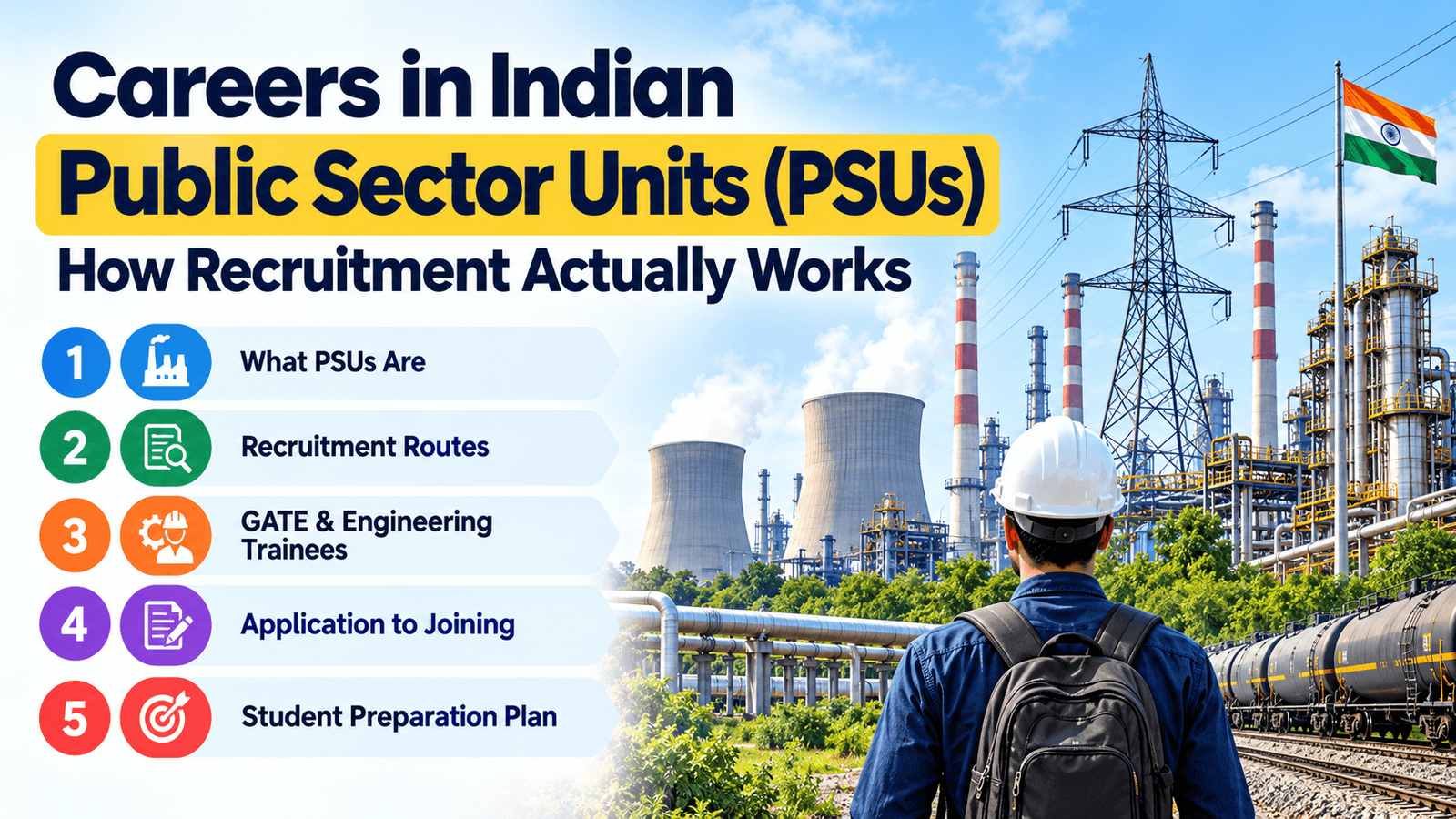
Ask any engineering student in Roorkee what a stable, prestigious first job looks like, and an Indian PSU usually comes up within a minute. Careers in Indian Public Sector Units (PSUs) attract lakhs of engineering and commerce graduates every year because of enviable job security, structured pay scales under the Industrial Dearness Allowance (IDA) pattern, and the rare opportunity to engineer critical national infrastructure—from national power grids to offshore oil refineries.
The challenge is that the hiring process is rarely explained transparently. Some PSUs recruit directly via GATE scores, some organize their own proprietary nationwide computer-based tests, and executive boardroom appointments follow a completely different statutory channel.
This comprehensive guide deconstructs each recruitment route in plain terms, clarifies reservation frameworks, and outlines how engineering students at Haridwar University can plan their preparation systematically from the very first semester.
Table of Contents
- • 1. What a PSU Really Is and Who Sets Its Hiring Rules
- • 2. Three Routes Into a PSU and Why They Are Not Interchangeable
- • 3. GATE 2027 and the Engineering Trainee Pipeline
- • 4. From Application to Joining Letter: The Stages You Will Meet
- • 5. How Haridwar University Students Can Start Early
- • 6. A Four-Year Preparation Plan That Fits Engineering Life
- • 7. Frequently Asked Questions (FAQs)
1. What a PSU Really Is and Who Sets Its Hiring Rules
A Public Sector Undertaking is an enterprise or corporation where the government holds 51% or more of paid-up share capital. At the central level, these corporations are officially known as Central Public Sector Enterprises (CPSEs), operating under the nodal jurisdiction of the Department of Public Enterprises (DPE) within the Ministry of Finance.
The DPE categorises enterprises into Schedules A, B, C, and D, conferring operational autonomy through statutory classifications:
Maharatna, Navratna, and Miniratna Status Explained
These titles reflect balance-sheet strength, three-year net profit consistency, and executive investment autonomy:
- Maharatna (13 Enterprises): Mega-corporations including Indian Oil (IOCL), NTPC, ONGC, Coal India, SAIL, BHEL, GAIL, and Power Grid Corporation of India (PGCIL). They enjoy board autonomy to invest up to ₹5,000 crore without prior cabinet sanction.
- Navratna (16 Enterprises): Heavyweights such as Bharat Electronics (BEL), Hindustan Aeronautics (HAL), NMDC, NBCC, and RITES.
- Miniratna (Category I & II): Robust regional and niche industrial enterprises with consistent profitability.
Knowing whether an enterprise is a verified CPSE helps students distinguish official advertisements from spurious private job portals mimicking government boards. Note that nationalised banks (such as SBI or PNB) and public insurers recruit via separate banking channels (IBPS).
2. Three Routes Into a PSU and Why They Are Not Interchangeable
Indian PSUs recruit through three separate pathways depending on functional tier and specialization:
Route 1: Recruitment Through GATE Scores
Major Maharatna and Navratna enterprises recruit Executive Trainees (ETs) and Graduate Engineer Trainees (GETs) directly on the basis of Graduate Aptitude Test in Engineering (GATE) scores. NTPC, IOCL, ONGC, and Power Grid routinely publish recruitment notices linked to current-year GATE performance. The primary advantage is efficiency: one standardized national exam opens recruitment doors to dozens of premier organizations.
Route 2: Company-Specific Computer-Based Tests (Non-GATE)
Non-engineering positions (Finance, Human Resources, Corporate Communications, Law, and Materials Management) and several specialized engineering roles (such as ISRO, BARC, Coal India MT non-technical, or state electricity boards) conduct their own dedicated written tests. These exams feature technical aptitude alongside quantitative ability and domain-specific questions.
Route 3: The Public Enterprises Selection Board (PESB)
Board-level executive roles—Chairman, Managing Director (CMD), and Functional Directors—follow a high-level selection process governed by the Public Enterprises Selection Board (constituted under the Government of India resolution of 3 March 1987). PESB policy gives preference to internal candidates who joined as trainees and built exemplary operational records. Joining at the entry level is your ultimate bridge to boardroom leadership.
3. GATE 2027 and the Engineering Trainee Pipeline
For students targeting the upcoming recruitment cycle, IIT Madras is the organizing institute for GATE 2027, with computer-based testing scheduled across February 2027. Under official GATE guidelines, students in their third year of undergraduate study or higher are eligible to appear, allowing engineering students to take an early, risk-free attempt.
Match Paper Code to Your Qualifying Degree: PSU recruitment rules mandate that your GATE paper code directly match your bachelor’s degree branch. An Electrical Engineering student must appear for the EE paper, while a Mechanical student must write the ME paper. Inter-disciplinary papers are generally not accepted for PSU core engineering cadres.
While a GATE scorecard remains valid for 3 years for academic postgraduate admissions (M.Tech/Ph.D.), most PSU job notifications explicitly require the score of the current recruitment year. For comprehensive preparation strategies, review our detailed GATE preparation guide.
4. From Application to Joining Letter: The Stages You Will Meet
While individual enterprises maintain customized evaluation rubrics, the recruitment pipeline follows a standard sequence:
Online PSU Application → GATE / Test Cutoff Shortlisting → Group Discussion / Personal Interview → Document Verification → Medical Examination → 1-Year Executive Trainee Period
Verification Details That Matter
Many rejections occur during document verification rather than the interview. Common pitfalls include failing to meet the strict 60% or 65% aggregate undergraduate cutoff, having name discrepancies across matriculation records and degree marksheets, or submitting expired category certificates.
Statutory Reservation Framework
CPSEs adhere strictly to Presidential Directives on direct recruitment through open national competition for Group A and B executive posts: 27% for OBC (Non-Creamy Layer), 15% for SC, 7.5% for ST, and 10% for EWS candidates. Relaxations on upper age limits (up to 5 years for SC/ST and 3 years for OBC) and application fee exemptions are detailed in each official brochure.
5. How Haridwar University Students Can Start Early
Haridwar University sits on a scenic 20-acre lush green campus on the bank of the historic Ganga Canal, just 5 km from Roorkee. Its flagship Roorkee College of Engineering conducts AICTE-approved B.Tech. Hons. programmes designed around the core engineering disciplines demanded by PSUs: Civil, Mechanical, Electrical & Electronics (EEE), and Electronics & Communication (ECE), all enhanced with specialized AI curricula.
Verified 2026-27 First-Year Fee Structure
Under Haridwar University’s official fee schedule, first-year totals (covering tuition, enrollment, admission, examination, and uniform fees) are transparently structured:
Hostel charges (including lodging, meals, and laundry) range from ₹85,000/year for standard rooms to ₹1,05,000/year for deluxe air-conditioned accommodations. Detailed breakdowns are published on our Fees & Scholarships portal.
Merit Scholarships Scheme
First-year tuition scholarships reward academic excellence based on JEE rank or Class 12 PCM performance:
In addition, a 25% first-year tuition scholarship is reserved for female students, and high achievers scoring 85%+ in any semester receive an Academic Excellence award of ₹5,000. Comprehensive institutional support, educational loan coordination with partner banks (SBI, PNB, HDFC, ICICI), and round-the-clock student assistance are detailed on our Student Welfare Service page and Admissions Overview.
6. A Four-Year Preparation Plan That Fits Engineering Life
Cracking a premier PSU does not require 14-hour daily grinds; it requires consistent academic alignment over four years:
- Years 1 & 2 (Foundational Rigour): Maintain an aggregate above 70% without backlogs to satisfy eligibility minimums. Master fundamental subjects: Engineering Mathematics, Thermodynamics, Network Theory, Fluid Mechanics, and Structural Analysis.
- Year 3 (Exam-Oriented Mastery): Download the official GATE syllabus, begin timed computer-based mock tests, and analyse previous years’ questions (PYQs). Complete a mandatory summer technical internship to build practical resume depth.
- Final Year (Targeted Execution & Backup Planning): Appear for GATE, secure your scorecard, and track Maharatna/Navratna career portals continuously between February and May. Concurrently participate in campus placements through the HU placement cell to ensure a secure professional backup.
Frequently Asked Questions (FAQs)
1. Are careers in Indian Public Sector Units (PSUs) the same as government jobs?
Not exactly. PSU employees work for government-owned commercial corporations that maintain their own IDA pay scales and corporate service rules, whereas civil servants join government ministries directly.
2. Do all PSUs recruit through GATE?
No. GATE is primarily utilised for engineering executive trainee cadres in selected Maharatna and Navratna corporations. Non-technical disciplines (Finance, HR, Law) and many state utilities run proprietary computer-based tests.
3. Who conducts GATE 2027 and when is it held?
IIT Madras is the organizing institute for GATE 2027. The exam takes place as a computer-based test in February 2027 across designated examination weekends.
4. Can commerce or management graduates work in a PSU?
Yes. B.Com, MBA, and postgraduates routinely join PSUs as Finance Executives, HR Officers, Materials Management Executives, and Marketing Officers through direct competitive exams.
5. Is reservation available in PSU recruitment?
Yes. Direct open competition for central PSU executive posts adheres strictly to government reservation directives: 27% OBC, 15% SC, 7.5% ST, and 10% EWS.
6. How are PSU chairmen and directors chosen?
Board-level executives (CMD and Functional Directors) are selected through the Public Enterprises Selection Board (PESB), which prioritizes internal executives with exemplary leadership records.
7. Which scholarships does Haridwar University offer in the first year?
Under HU’s 2026-27 structure, merit scholarships based on JEE rank or Class 12 PCM provide 10% to 80% tuition waivers. A dedicated 25% first-year tuition scholarship is awarded to female candidates.
Launch Your Engineering & PSU Career at Haridwar University
Haridwar University combines rigorous engineering education with AI-integrated curricula, modern laboratories, and expert GATE mentorship to empower your public sector and corporate aspirations.