

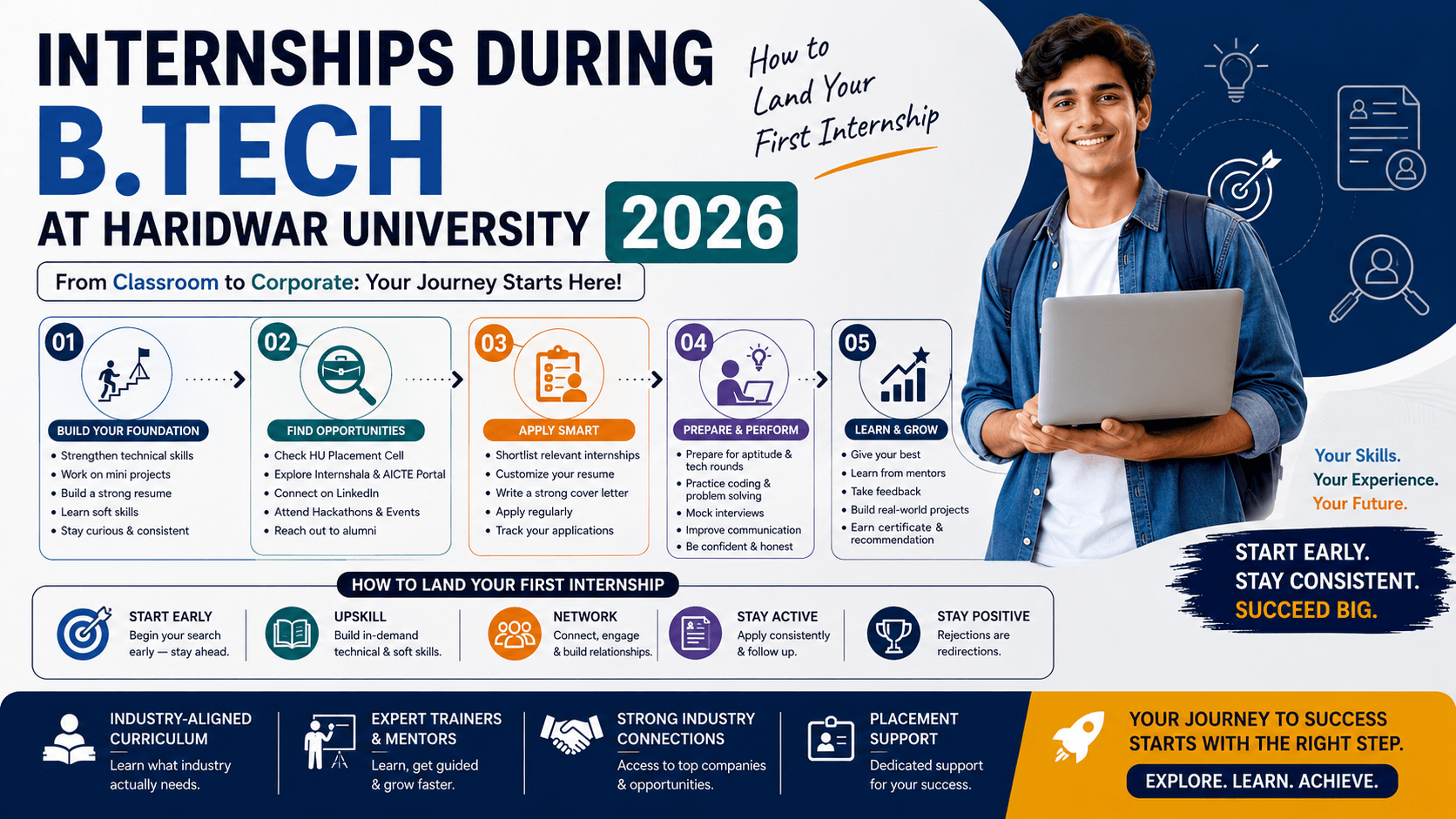
Internships During B.Tech at Haridwar University: How to Land Your First Internship (2026)
Mr. Prajwal Chaudhary
Head, Training & Placement, Haridwar University
Table of Contents
- Why Internships Matter During B.Tech
- When Should B.Tech Students Start Applying?
- Where Can B.Tech Students Find Internships?
- How HU Supports Students in Finding Industry Exposure
- Selected HU Industry and Academic Collaborations
- Build Your Profile Before You Apply
- What Can You Expect From a B.Tech Internship in 2026?
- From Internship to Placement: Make the Experience Count
- Frequently Asked Questions (FAQs)
- My Advice to B.Tech Students
An internship is not only a line on a CV. It is where classroom concepts are tested against deadlines, teams, tools and actual work. At Haridwar University, our Training & Placement Office works as a link between students and industry, supporting internships, placements and skill development.
For a B.Tech student, the more useful question is therefore not "Do I need an internship?" but "When should I start, what should I apply for, and how can I make the experience count?"
Why Internships Matter During B.Tech
I have observed that students who approach internships as an extension of their academic learning tend to get more value from them. The objective should be to gradually move from learning → applying → building → demonstrating.
HU's industrial internship guidance describes internships as a way to gain practical knowledge and experience that complements academic learning. Its pre-placement activities also include industrial internships, live industry projects, work-experience support, resume building, career advice and interview preparation.
| What an Internship Adds | What the Student Develops |
|---|---|
| Academic concepts in practice | Technical application |
| Project-based work | Problem-solving |
| Workplace exposure | Professional communication |
| Team assignments | Collaboration |
| Deliverables and deadlines | Time management |
| Industry experience | Stronger resume evidence |
The important distinction is between having an internship certificate and being able to explain what you actually worked on. The latter is what makes the experience useful during placement interviews.
When Should B.Tech Students Start Applying?
There is no single internship year that applies to every B.Tech programme or every student. The right timing depends on the student's skills, curriculum and the requirements of the opportunity.
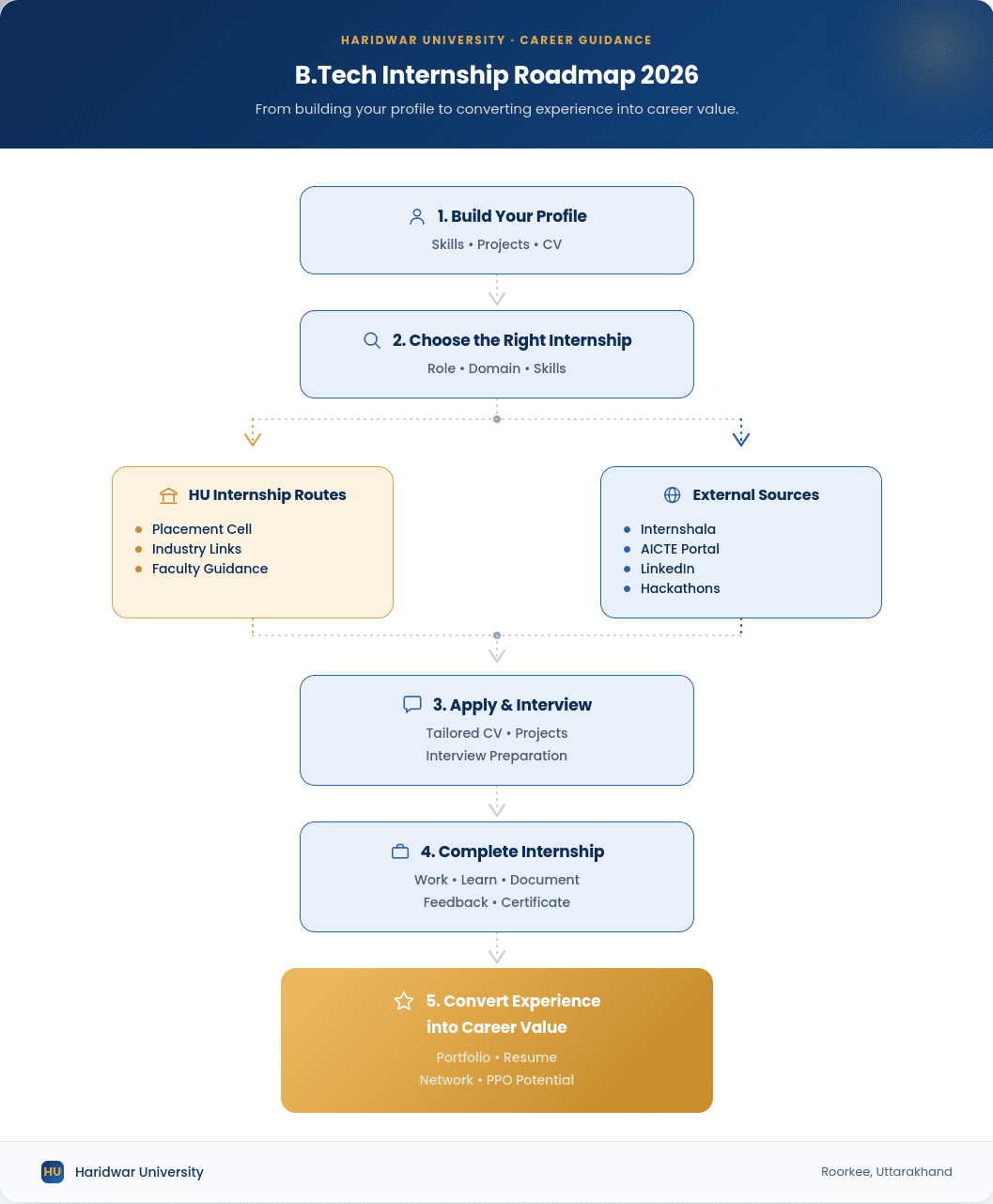
B.Tech Internship Roadmap 2026: From profile building and internship search to application, industry experience and placement preparation at Haridwar University.
My recommendation is to treat the four-year degree as a gradual preparation cycle rather than waiting for one internship season.
| B.Tech Stage | Primary Focus | Internship Approach |
|---|---|---|
| 1st year | Fundamentals | Explore domains, short projects and beginner opportunities |
| 2nd year | Skill building | Start applying for role-specific internships |
| 3rd year | Industry exposure | Prioritise substantial technical internships and projects |
| Final year | Placement readiness | Use previous experience, projects and skills for placement opportunities |
HU's industrial internship page states that students of all years and streams can apply to the Internshala opportunities listed opportunities through its internship initiative. It also states that students create an account to apply, with no fee charged by Internshala to the college or students.
This is important for first- and second-year students: you do not have to wait until the final year simply to begin exploring opportunities.
Where an internship or industrial training requirement is specified by a programme's curriculum, however, students should follow the schedule and duration prescribed for that programme rather than assuming that every B.Tech course follows the same timeline.
My advice: Start preparing before you start applying. A student who builds skills first can choose an internship; a student who waits until the last moment often ends up choosing from whatever is available.
Where Can B.Tech Students Find Internships?
I recommend using more than one channel. A student's search should combine university support with established internship and professional platforms.
| Source | How Students Can Use It |
|---|---|
| HU Training & Placement Office | Seek guidance on internships, industry opportunities and career preparation |
| HU Industry Partnerships | Explore opportunities emerging through industry collaborations |
| Internshala | Search online and offline internship opportunities across multiple roles |
| AICTE Internship Portal | Search internships posted through the national internship platform |
| Follow companies, recruiters and internship openings | |
| Hackathons & Technical Events | Build projects, demonstrate skills and connect with industry |
The AICTE Internship Portal currently provides student registration and internship listings with details such as duration, stipend, joining date and application deadlines.
HU's own internship page also identifies engineering, product management, design, sales and marketing, content writing, HR and finance among the roles available through its Internshala partnership.
HU–Internshala Facility Overview
| HU–Internshala Facility | What Students Should Know |
|---|---|
| Eligibility | Students from all years and streams can apply to the listed opportunities. |
| Internship areas | Engineering, product management, design, sales and marketing, content writing, HR and finance. |
| Application | Students create an Internshala account and apply for relevant opportunities. |
| Cost | HU states that no fee is charged to the university or students for this facility. |
For students, this creates an important advantage: do not restrict your search to one website or wait for one campus announcement. Build a profile, monitor several channels and apply selectively.
How HU Supports Students in Finding Industry Exposure
The next step is to turn access into action. At Haridwar University, industry engagement is not limited to placement drives. The university's industry collaboration framework includes opportunities for internships, training and joint projects, while the Training & Placement function supports students through industry-facing activities.
I see this support as a combination of institutional access and student preparation. An industry connection can open a door, but the student still needs the skills, profile and professional approach to walk through it.
| HU Support Area | What It Can Help Students With |
|---|---|
| Industry collaborations | Exposure to industry-linked opportunities |
| Training & Placement Office | Internship and career guidance |
| Internshala access | Searching and applying for internships |
| Live industry projects | Applying classroom learning to practical work |
| Resume preparation | Presenting skills and project experience |
| Interview preparation | Building confidence for selection processes |
Selected HU Industry and Academic Collaborations
| Collaboration | MoU Date | Relevance to Students |
|---|---|---|
| Smart Brains – IBM | 27 May 2026 | Industry-linked learning and skills |
| Smart Brains – Nasscom | 27 May 2026 | Industry exposure and skills |
| IIT Roorkee | 13 Feb 2026 | Academic and technical collaboration |
| ELSistam Technologies | 14 Mar 2026 | Technology-oriented exposure |
| Seagull Biotech | 5 Feb 2026 | Industry-linked exposure |
| NIIT Foundation | 19 Mar 2025 | Training and skill development |
These collaborations do not mean that every student is automatically placed or given an internship with every partner; opportunities depend on the programme, eligibility, selection process and availability.
The university's pre-placement activities also include resume building, career advice, aptitude and mock tests, interview preparation and live industry projects.
Build Your Profile Before You Apply
I would advise students to prepare their profile before sending applications. A recruiter should be able to understand within a few seconds what you can contribute.
For a B.Tech student, the essentials are straightforward:
| Profile Element | What to Demonstrate |
|---|---|
| Resume | Education, skills, projects and achievements |
| Technical skills | Languages, software, tools or platforms relevant to the role |
| Projects | What you built, your contribution and outcome |
| Portfolio/GitHub | Evidence of technical work where relevant |
| Professional profile and project highlights | |
| Communication | Clear explanation of your work and interests |
A common mistake is listing ten skills without demonstrating any of them. Two relevant skills supported by a real project are more useful than a long, unsubstantiated list.
Before applying, students can also use HU's pre-placement activities, which include resume building, career guidance, aptitude and mock tests, interview preparation and live industry projects.
What Can You Expect From a B.Tech Internship in 2026?
Stipends vary significantly by role, company, location, duration and skill requirements. I would therefore avoid treating one figure as a standard B.Tech internship salary.
HU's industrial internship page states that the internships offered through its listed facility provide a stipend and a certificate on successful completion. However, the actual stipend can still vary according to the role, employer and internship terms.
Current internship listings demonstrate that variation. For example, engineering opportunities listed on Internshala currently span different durations and stipend levels, with listings ranging from unpaid/low-stipend opportunities to substantially higher technical roles.
The better way to evaluate an internship is to consider the complete opportunity:
| Check Before Accepting | Why It Matters |
|---|---|
| Role and responsibilities | Does the work match your career direction? |
| Duration | Can you commit without affecting academics? |
| Stipend | Is the compensation clearly stated? |
| Learning opportunity | Will you work with relevant tools or teams? |
| Project ownership | Will you have measurable work to discuss later? |
| Certificate/experience letter | Will your contribution be formally documented? |
| Job/PPO possibility | Is there a defined opportunity after the internship? |
Do not choose an internship only because it offers the highest stipend. A technically relevant internship with meaningful project exposure can be more valuable for a B.Tech student than a better-paid role with little connection to the intended career.
From Internship to Placement: Make the Experience Count
An internship should not end when the certificate arrives. The final objective is to convert the experience into evidence of employability.
During the internship, maintain a record of:
- Projects and tasks completed
- Tools and technologies used
- Problems solved
- Measurable outcomes
- Feedback received
- Contributions made to the team
At the end, update your resume and portfolio while the experience is still fresh. If the organisation has a hiring process for interns, ask about the possibility of a full-time opportunity and understand what skills or performance standards are expected.
A PPO is never something a student should assume will happen. It depends on the organisation, role, performance and available positions. What an internship can reliably provide is experience that strengthens the next application.
Frequently Asked Questions (FAQs)
1. When should B.Tech students start looking for internships?
Students can start exploring opportunities from the first year, but applications should become more focused as they develop relevant technical skills and projects.
2. Is an internship compulsory during B.Tech at Haridwar University?
Industrial training or internships are mandatory where specified by the respective programme curriculum. Students should follow the requirements and duration prescribed for their programme.
3. Where can B.Tech students find internships?
Students can explore opportunities through the HU Training & Placement Office, HU's industry collaborations, Internshala, the AICTE Internship Portal, LinkedIn and other relevant internship platforms.
4. Can first-year B.Tech students apply for internships?
Yes. Internship opportunities can be available to students across different years. HU's internship initiative specifically states that students of all years and streams can apply for the opportunities listed through its Internshala partnership.
5. Do B.Tech internships always provide a stipend?
No. Stipends vary depending on the organisation, role, duration, location and internship opportunity. Students should check the terms of each internship before accepting it.
6. How can I improve my chances of getting a B.Tech internship?
Build relevant technical skills, complete practical projects, maintain a clear resume and apply for roles that match your skills and career interests rather than sending the same application everywhere.
7. Can an internship lead to a full-time job or PPO?
It can, depending on the organisation's hiring policy, the student's performance, available positions and other selection requirements. Students should not assume that an internship automatically guarantees a PPO.
8. How does Haridwar University help students with internships?
HU supports students through its Training & Placement Office, industry collaborations, internship initiatives, resume preparation, career guidance, interview preparation and other pre-placement activities.
My Advice to B.Tech Students
Start early, apply selectively and treat every internship as a project rather than simply a certificate.
My advice is simple: do not judge an internship only by its stipend. For a B.Tech student, the project, technical exposure and quality of mentorship can be more valuable when the goal is to build a stronger placement profile.
If you are unsure about the right opportunity, discuss your options with the HU Training & Placement Cell rather than applying randomly. Your internship should ideally move you closer to the technical role or industry you want to enter after B.Tech.