

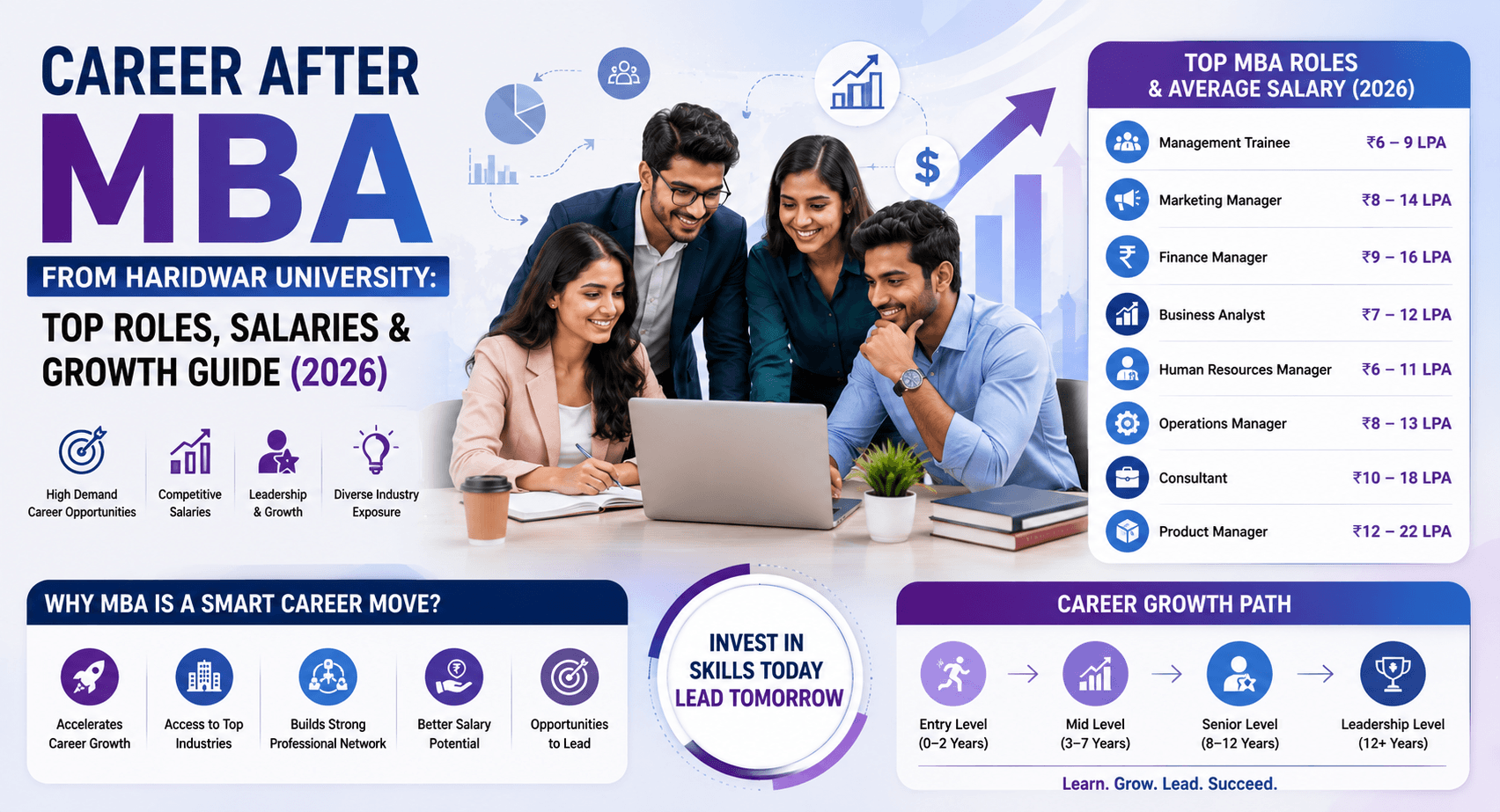
Career After MBA from Haridwar University: Top Roles, Salaries & Growth Guide (2026)
Mr. Javed Ali
Head, Roorkee College of Business Studies, Haridwar University
Table of Contents
- MBA with AI Specialisations at Haridwar University
- Career Options After MBA: Roles, Industries & Salary Expectations
- Popular MBA Career Paths, Specialisations & Salary Outlook
- How Careers Grow After an MBA
- Beyond Corporate Jobs: Entrepreneurship & Higher Studies
- Placement Support for MBA with AI at Haridwar University
- MBA with AI Fees & Scholarships
- Eligibility for MBA with AI Admission
- Admission Process
- Why Choose Haridwar University for Your MBA?
- Frequently Asked Questions
Choosing an MBA is rarely just about earning another degree. For most students, the bigger question is how much can graduates expect to earn, and how does an MBA shape long-term career growth? According to the World Economic Forum's Future of Jobs Report 2025, employers increasingly value leadership, strategic thinking, communication, analytical ability, and problem-solving alongside technical knowledge.
From our experience working with management students, one pattern appears consistently. Students who actively participate in internships, live projects, and industry interactions develop stronger managerial confidence before graduation.
At Haridwar University, the MBA with AI programme reflects this balance of academic learning and industry exposure through case studies, presentations, business simulations, seminars, industrial visits, internships, and project-based learning.
Whether your goal is consulting, analytics, entrepreneurship, or corporate leadership, understanding career paths before choosing a specialisation helps you make a more informed decision.
MBA with AI Specialisations at Haridwar University
Haridwar University offers multiple MBA specialisations, allowing students to align their studies with their career interests and industry demand.
| Specialisation | Suitable For | Typical Career Areas |
|---|---|---|
| Marketing | Students interested in branding, sales and digital marketing | FMCG, Retail, Advertising, Consulting, E-commerce |
| Finance | Students who enjoy numbers, investments and financial planning | Banking, NBFCs, Corporate Finance, FinTech |
| Human Resource Management | Students interested in people management and organisational development | HR Consulting, Recruitment, Learning & Development |
| Operations Management | Students who enjoy planning and process optimisation | Manufacturing, Logistics, Supply Chain, Operations |
| Business Analytics | Students interested in business strategy supported by data | IT, Consulting, Analytics, Digital Business |
Students should choose a specialisation based on long-term career interests rather than salary alone. Each pathway opens opportunities across different industries and business functions.
If you're still deciding between management and technology after graduation, our guide MBA vs MCA at Haridwar University: Which Post-Graduation Path Should You Choose (2026) compares both programmes based on curriculum, careers, salaries, and future opportunities.
Career Options After MBA: Roles, Industries & Salary Expectations
An MBA opens opportunities across multiple industries rather than limiting graduates to one career path. The role you eventually choose often depends on your specialisation, internship experience, communication skills, and the sector you wish to work in.
The table below highlights some of the common management careers pursued by MBA graduates in India. Salary ranges are indicative and may vary based on organisation, location, experience, business school, and individual performance.
| Career Role | Freshers (0–2 Years) | Mid-Level (3–5 Years) | Experienced (8–12+ Years) |
|---|---|---|---|
| Marketing Manager | ₹5–8 LPA | ₹10–18 LPA | ₹20–35+ LPA |
| Financial Analyst | ₹5–9 LPA | ₹10–20 LPA | ₹22–40+ LPA |
| HR Manager | ₹4–8 LPA | ₹8–16 LPA | ₹18–30+ LPA |
| Operations Manager | ₹5–8 LPA | ₹10–18 LPA | ₹20–35+ LPA |
| Business Analyst | ₹6–10 LPA | ₹12–22 LPA | ₹25–40+ LPA |
| Management Consultant | ₹8–15 LPA | ₹15–30 LPA | ₹35–60+ LPA |
| Product Manager | ₹8–14 LPA | ₹18–35 LPA | ₹40–70+ LPA |
| Project Manager | ₹7–12 LPA | ₹15–28 LPA | ₹30–55+ LPA |
| Entrepreneur | Not Fixed | Varies | Depends on business growth |
| Business Development Manager | ₹5–8 LPA | ₹10–18 LPA | ₹20–35+ LPA |
Note: Salary ranges are based on publicly available industry reports from platforms such as AmbitionBox, Coursera, Glassdoor, and Indeed. Actual compensation varies across companies, locations, work experience, and business domains.
Popular MBA Career Paths, Specialisations & Salary Outlook
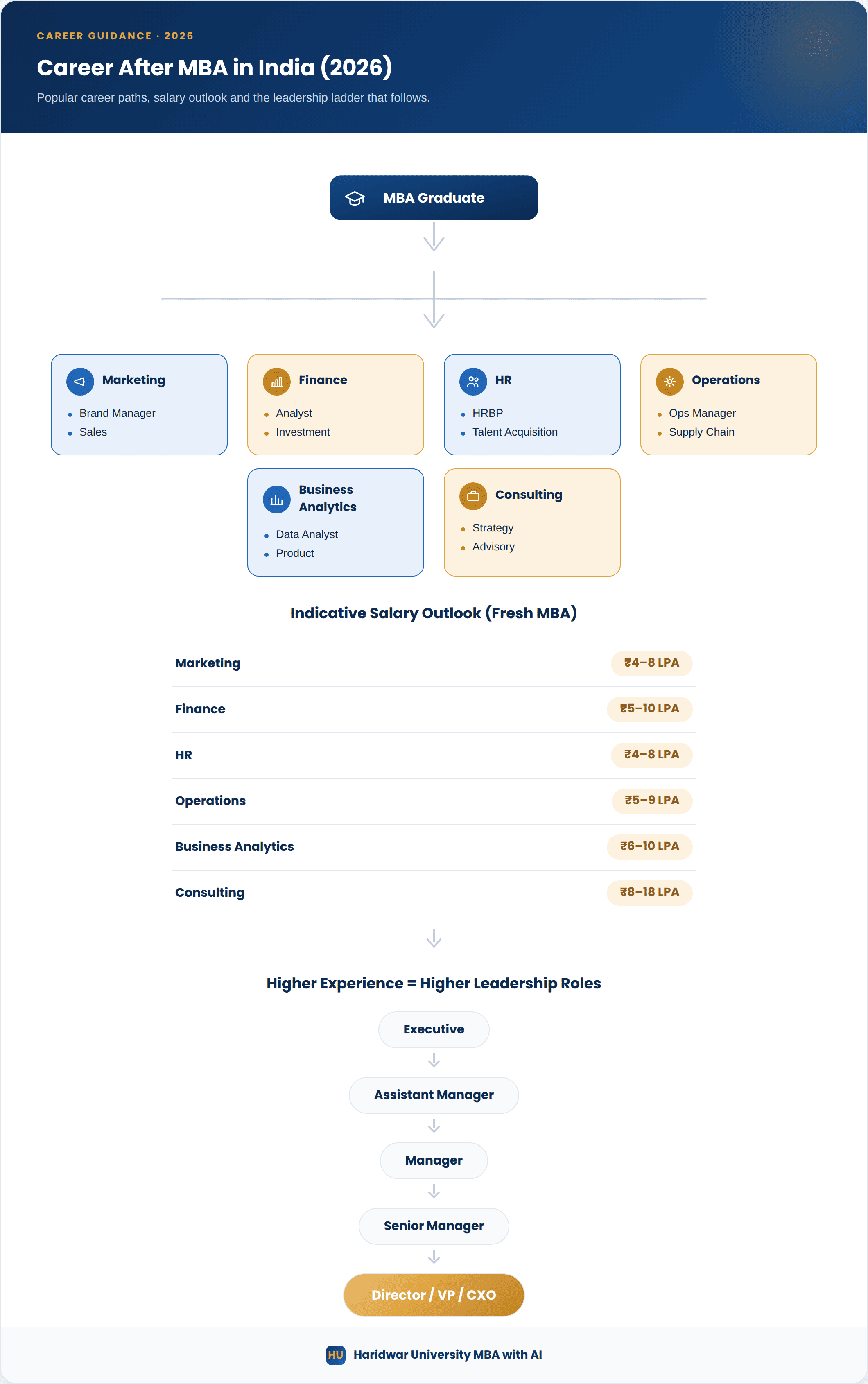
Popular MBA Career Paths, Specialisations & Salary Outlook in India (2026)
How Careers Grow After an MBA
Most management careers follow a structured progression. While the timeline differs between industries, graduates typically move into higher-responsibility roles as they gain experience and leadership exposure.
| Experience | Typical Position |
|---|---|
| 0–2 Years | Management Trainee / Executive |
| 2–5 Years | Assistant Manager / Manager |
| 5–8 Years | Senior Manager |
| 8–12 Years | General Manager / Business Unit Head |
| 12+ Years | Director / Vice President / CXO Leadership |
Career growth is influenced by far more than years of experience alone. Employers increasingly look for professionals who can solve business problems, communicate effectively, and make informed decisions. Students who actively participate in internships, live projects, case competitions, industry interactions, and management activities often develop these practical skills earlier, helping them transition more confidently into managerial roles after graduation.
Beyond Corporate Jobs: Entrepreneurship & Higher Studies
An MBA is not limited to corporate careers. Many graduates choose to build their own ventures, join family businesses, or pursue higher education to deepen their expertise.
| Career Path | What It Offers |
|---|---|
| Entrepreneurship | Build a start-up, consulting firm, retail business, or family enterprise |
| Family Business | Apply modern management practices to expand existing businesses |
| Executive Education | Executive MBA, specialised management programmes, leadership development |
| Doctoral Studies | PhD in Management for research and academic careers |
| Professional Certifications | CFA, FRM, Six Sigma, PMP, Digital Marketing, Business Analytics certifications |
For students interested in entrepreneurship, classroom learning often becomes the starting point rather than the destination. Business plan competitions, market research projects, and interactions with industry professionals help students understand how management concepts translate into real business decisions.
Placement Support for MBA with AI at Haridwar University
Along with academic learning, Haridwar University supports MBA students through its Training & Placement Cell, which focuses on career counselling, aptitude preparation, resume building, mock interviews, group discussions, industry interaction, internships, and campus recruitment activities.
According to the university's published placement statistics across academic programmes:
Students also interact with recruiters through campus recruitment drives, internships, industry visits, guest lectures, and placement activities organised by the university. The university's recruiter network includes organisations such as TCS, Infosys, Wipro, Accenture, Cognizant, IBM, HCL Technologies, Capgemini, Chetu, Programmers.io, Radiant Information Technology, among many others.
Note: These are university-wide placement figures published by Haridwar University. Programme-specific placement statistics for MBA are not published separately. Students are encouraged to visit the official Training & Placement Cell for the latest placement activities, recruiter information, and career support initiatives.
MBA with AI Fees & Scholarships
Choosing an MBA involves evaluating not only tuition fees but also the value offered through faculty, industry exposure, practical learning, and career support.
According to the latest fee structure published by Haridwar University:
| Academic Year | Tuition Fee |
|---|---|
| First Year | ₹ 1,77,000/- |
| Second Year | ₹ 1,60,000/- |
Eligible students may also apply for scholarships offered under the university's admission policy. Financial assistance is available under various categories based on merit and other applicable criteria.
Note: Tuition fees and scholarship policies may be revised by the university. Applicants should verify the latest information through the official MBA with AI admissions page before applying.
Eligibility for MBA with AI Admission
Candidates seeking admission to the MBA programme at Haridwar University should fulfil the eligibility requirements prescribed by the university.
| Requirement | Details |
|---|---|
| Academic Qualification | Bachelor's degree in any discipline from a recognised university |
| Minimum Marks | Minimum 50% marks in the bachelor's degree. |
| Admission Process | Valid CAT, XAT, or GMAT score, or admission based on the university's institutional merit assessment standards |
Eligible candidates can apply through the university's admission process after reviewing the latest admission schedule, fee structure, scholarship policy, and document requirements.
Note: Admission criteria are subject to revision by Haridwar University. Applicants should refer to the official MBA admission page for the most up-to-date eligibility requirements and admission guidelines.
Admission Process
Admission to the MBA with AI programme at Haridwar University is conducted as per the university's admission guidelines. Eligible candidates may apply through the university admission portal and participate in the admission process based on a valid CAT, XAT, or GMAT score, or through the university's institutional merit assessment. Where applicable, applicants may also be required to appear for the Haridwar University Admission Entrance Test (HUAET) as part of the admission process.
Candidates should refer to the latest admission notification for important dates, document requirements, scholarship details, and programme-specific admission guidelines before submitting their application.
Why Choose Haridwar University for Your MBA?
Selecting the right MBA programme is about more than choosing a specialisation. Students also consider faculty, industry exposure, practical learning, placement support, and the overall academic environment.
At Haridwar University, the MBA with AI programme is designed to help students develop managerial, analytical, and leadership skills through a combination of classroom learning and practical experiences, including:
- Industry-oriented curriculum with multiple specialisations
- Case studies, presentations, seminars, and live projects
- Internship and industry interaction opportunities
- Career guidance through the Training & Placement Cell
- Modern academic infrastructure and digital learning support
Students exploring postgraduate management education can also read Postgraduate Programmes at Haridwar University: The Complete 2026 Guide to compare postgraduate programmes, understand admission routes, and explore how the MBA with AI programme fits into Haridwar University's wider academic portfolio.
Frequently Asked Questions
1. What career opportunities are available after completing MBA with AI from Haridwar University?
MBA graduates can pursue careers in marketing, finance, human resources, operations, business analytics, consulting, project management, entrepreneurship, and several other management domains depending on their specialisation and interests.
2. What is the average MBA salary in India?
MBA salaries vary by industry, company, location, experience, and business school. Fresh graduates commonly begin between ₹4–10 LPA, while experienced professionals may earn significantly higher based on their role and performance.
3. Which MBA specialisation offers the highest salary?
Specialisations such as Business Analytics, Finance, Consulting, and Product Management often offer competitive salary opportunities. However, long-term career growth depends on individual skills, industry demand, and work experience.
4. Does Haridwar University provide placement support for MBA students?
Yes. The university supports students through its Training & Placement Cell with career counselling, internship opportunities, aptitude preparation, mock interviews, resume-building sessions, and campus recruitment activities.
5. Can MBA graduates become entrepreneurs?
Yes. Many graduates choose to establish start-ups, expand family businesses, or work as independent consultants after completing their MBA.
6. What is the eligibility for MBA admission at Haridwar University?
Candidates should hold a bachelor's degree from a recognised university with at least 50% marks. Admission is conducted according to university norms through CAT, XAT, GMAT or institutional merit assessment, with HUAET wherever applicable.
7. Can I pursue higher studies after completing an MBA?
Yes. MBA graduates may pursue Executive MBA programmes, PhD/FPM, or professional certifications such as CFA, FRM, PMP, Six Sigma, or Business Analytics certifications.
8. How do I apply for the MBA programme?
Interested candidates can submit their application through the official MBA admission portal after reviewing the latest eligibility criteria, fee structure, scholarship details, and admission schedule.
The Road Ahead
An MBA creates opportunities across industries, but long-term success depends on how effectively students apply what they learn. Choosing the right specialisation, gaining practical exposure through internships and projects, and continuously developing managerial skills often make a greater difference than the degree alone.
For students planning a management career in 2026, Haridwar University's MBA programme offers a structured pathway that combines academic learning with industry exposure and career development support.
Interested in pursuing MBA with AI at Haridwar University? Explore the programme, review the latest admission details, and begin your application through the official admission portal.