

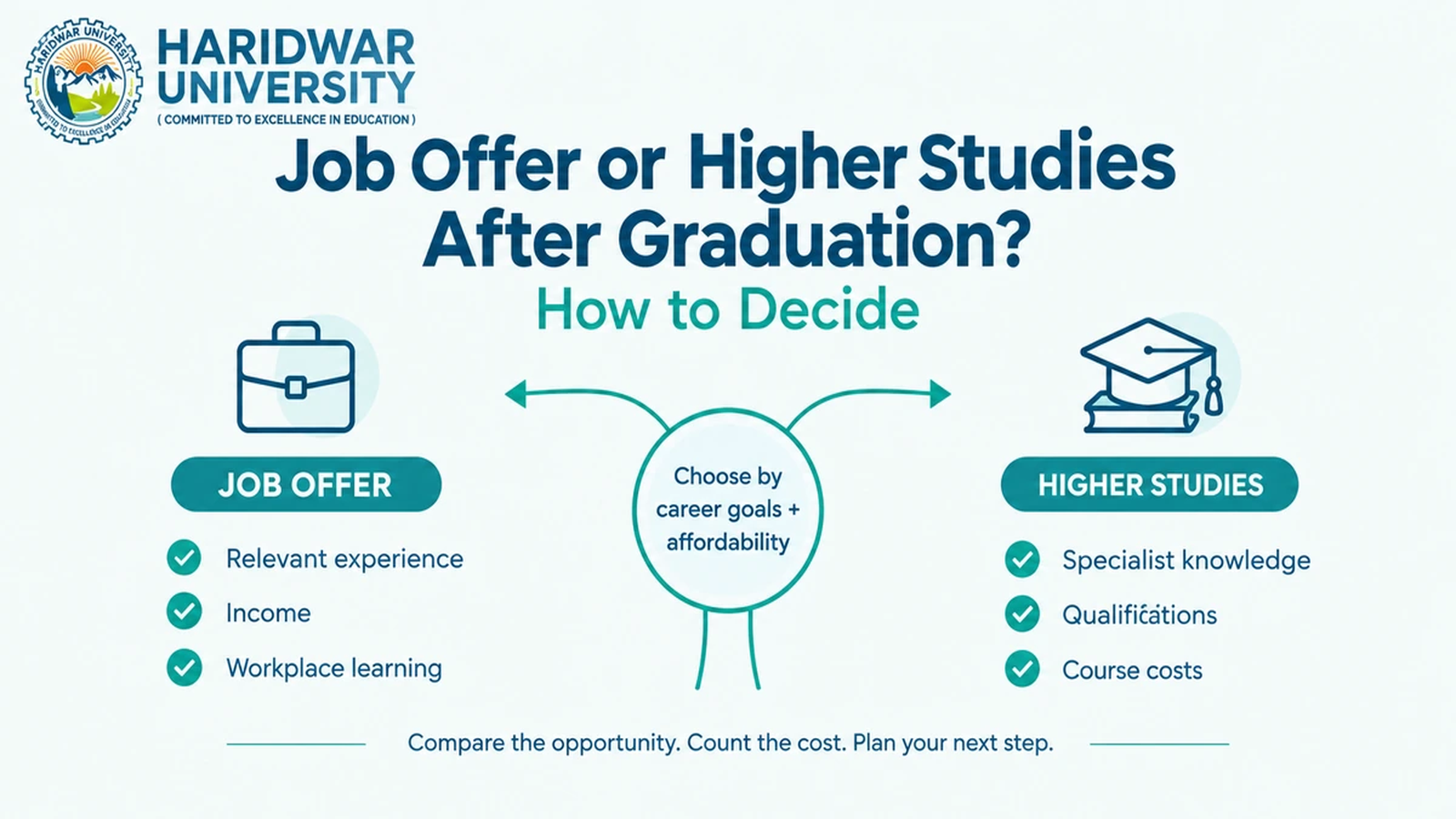
Job Offer or Higher Studies After Graduation? How to Decide
Mr. Prajwal Chaudhary
Head, Training & Placement, Haridwar University
What should you do after graduation: start working, pursue a master's degree, prepare for competitive examinations, or build specialized skills before making a bigger move? There is no single answer for every graduate. The right next step depends on your career goal, financial position, current skills and the specific opportunities available to you.
For some graduates, a job offers the practical experience and financial independence they need. For others, higher studies provide the specialist knowledge or statutory qualification required to enter their preferred field. Many can also combine both pathways by gaining industry experience first and returning to academic study later.
As Head of Training & Placement at Haridwar University, I encourage students to look beyond the peer pressure to make an impulsive decision. When comparing a job offer or higher studies after graduation, the central question is not which option sounds more impressive to others. It is which one moves you closer to a defined career goal at a cost you can reasonably afford.
Table of Contents
- 1. When Accepting a Job Offer Makes Sense
- 2. When Higher Studies May Be the Better Investment
- 3. Job Offer vs Higher Studies: A Practical Comparison
- 4. How to Calculate the Cost of Studying Further
- 5. How to Decide Between Working and Studying
- 6. A Decision Checklist for Graduates
- 7. Frequently Asked Questions (FAQs)
- 8. Make Your Next Step Count
1. When Accepting a Job Offer Makes Sense
A job can be the better choice when it offers relevant experience, structured learning and a credible path towards your intended career. Your first role does not need to be your ultimate dream job, but it should ideally teach you something useful.
Consider accepting a job when:
- The role matches your career direction: A software development role, laboratory position, sales assignment or financial analyst role can help you test your interests in an authentic commercial environment.
- You need financial independence: Earning early allows you to contribute to household expenses, build personal savings, and eliminate reliance on parental financial support.
- You learn best through workplace practice: Client communication, cross-functional teamwork, tight deadlines, production debugging, and professional judgement develop fastest through workplace accountability.
- The role offers structured progression: Transparent corporate training, technical mentorship, and real ownership of deliverables matter far more than an inflated starting title.
However, do not accept an offer simply because it happens to be the first one you receive. Carefully examine the detailed job description, fixed versus variable compensation, working hours, relocation terms, probation period, notice period, and any service bond or training repayment clauses.
A high advertised headline package can be deceptive if most of the compensation is contingent on variable incentives or the work offers minimal technical scope. Compare written contracts, not verbal interview impressions. Graduates preparing for corporate recruitment drives can refer to Haridwar University's comprehensive guide on placement drives and candidate preparation.
2. When Higher Studies May Be the Better Investment
Higher studies deserve serious consideration when a postgraduate qualification is mandatory for your target profession, or when a well-structured master's programme delivers specialist knowledge that your undergraduate degree did not cover.
A postgraduate degree makes sense if:
- Your target profession requires statutory postgraduate credentials: Academic lectureships, advanced scientific research, clinical pharmacy, and certain regulated fields mandate master's qualifications. Always verify statutory entry rules before enrolling.
- You require deep specialization: An industry-aligned master's programme allows you to pivot into high-demand areas—such as artificial intelligence, VLSI, data science, or pharmaceutics.
- You have an unambiguous objective: You can articulate exactly which technical competencies, laboratory facilities, or corporate recruitment pipelines the programme provides.
- The financial commitment is realistic: Tuition, hostel lodging, books and travel must fit your budget without gambling on an assumed starting package.
A master's degree is not automatically superior to work experience. Its return on investment depends on institutional reputation, curriculum modernity, individual performance, and campus placement support. For instance, technical graduates seeking management roles can explore MBA options, while those pursuing advanced software architecture can evaluate MCA or M.Tech routes through Haridwar University's postgraduate programmes guide.
3. Job Offer vs Higher Studies: A Practical Comparison
Instead of debating the two routes in the abstract, compare the concrete job offer against the specific postgraduate degree you are evaluating:
| Factor | Job Offer | Higher Studies |
|---|---|---|
| Immediate Income | You begin earning immediately once employment begins. | You pay tuition fees, accommodation and living expenses. |
| Skill Development | Practical, problem-driven skills based on workplace responsibilities. | Curriculum-based, theoretical, project-led and research exposure. |
| Career Direction | Tests your affinity for an industry through direct workplace immersion. | Supports entry into specialist, niche or qualification-gated professions. |
| Financial Risk | Minimal educational risk, though corporate stability varies. | Higher upfront capital outlay and foregone salary during study. |
| Future Flexibility | Savings can fund future higher study, though free time is constrained. | Full academic immersion but limited immediate financial flexibility. |
| Evidence to Check | Written offer, fixed pay, scope of duties, and promotion cycle. | Syllabus relevance, total institutional fees, and placement records. |
Neither option wins automatically. A relevant entry-level job with strong mentoring is often more valuable than a poorly chosen master's programme. When evaluating university outcomes, review institutional transparency: as documented in Haridwar University's placement report, HU achieved an 88.14% placement record with packages reaching ₹48 lakh per annum across leading corporate sectors.
4. How to Calculate the Cost of Studying Further
The most frequent mistake graduates make is comparing prospective starting salaries directly against tuition fees while ignoring opportunity cost. The true economic cost of full-time higher education includes money spent plus earnings foregone.
Estimated Study Cost = Tuition & Academic Fees + Living & Travel Expenses + Income Foregone − Scholarships / Financial Aid
Consider an illustrative model of a standard two-year master's programme:
| Cost Component | Illustrative Amount |
|---|---|
| Tuition fees over two years | ₹3,00,000 |
| Living, hostel and travel expenses (2 years) | ₹1,20,000 |
| Potential earnings foregone (₹2.4 LPA job over 2 years) | ₹4,80,000 |
| Total economic cost before financial aid | ₹9,00,000 |
Ask yourself: Does the target degree provide access to positions that reliably offset this investment? Be sure to check national assistance options, such as the University Grants Commission’s National Scholarship for Post Graduate Studies, before committing personal funds.
5. How to Decide Between Working and Studying
If you remain torn between entering employment or enrolling in a postgraduate programme, score both opportunities against five core parameters on a scale of 1 to 5 (1 = Poor, 5 = Excellent):
| Decision Factor | Job Offer Score | Higher Studies Score |
|---|---|---|
| Alignment with long-term career goal | / 5 | / 5 |
| Quality of learning & skill development | / 5 | / 5 |
| Financial feasibility & affordability | / 5 | / 5 |
| Quality of the specific institutional opportunity | / 5 | / 5 |
| Future career options kept open | / 5 | / 5 |
| Total Cumulative Score | / 25 | / 25 |
Use the total score as a structured compass, but acknowledge non-negotiable factors. If your target discipline requires a mandatory statutory degree, that criterion overrides a marginal score variance. If your family requires immediate financial support, working takes clear priority.
6. A Decision Checklist for Graduates
Before signing an employment contract or depositing admission fees, answer these eight questions with clarity:
- ✓ Can I clearly articulate the exact job profile or industry I want to reach in 3–5 years?
- ✓ Does the job offer provide relevant practical duties, mentoring and career progression?
- ✓ Does the master's programme build capabilities or award credentials that I genuinely require?
- ✓ Have I compared the written employment terms against the full economic cost of postgraduate study?
- ✓ Have I evaluated programme-specific placement records, faculty credentials and lab infrastructure?
- ✓ Have I explored scholarships, family obligations and personal risk tolerance?
- ✓ Could I gain two years of industry experience first and pursue higher studies later with greater maturity?
- ✓ Do I have a coherent plan of action for the next 12 to 24 months?
7. Frequently Asked Questions (FAQs)
1. Is it better to work or pursue higher studies after graduation?
Neither is universally better. Choose work when the role builds relevant experience and meets your immediate financial needs. Choose higher studies when the qualification or specialist skills are essential for your intended career and the cost is manageable.
2. Should I work before doing a master's degree?
Working first can help you understand an industry, clarify your specialisation and save money. However, if your target course or career has specific entry requirements or a time-sensitive admission route, check those before delaying study.
3. Does a master's degree count as work experience?
No. A master's degree is an academic qualification, not employment experience. Some employers value projects, internships and research undertaken during study, but these should not automatically be presented as full-time work experience.
4. Can I pursue higher studies after gaining work experience?
Yes. Many graduates return to education after working. Check the course's eligibility rules, entrance requirements, attendance expectations and whether your work schedule will allow you to study effectively.
5. What should I check before accepting my first job offer?
Review the role and responsibilities, fixed and variable compensation, location, working hours, probation, notice period, contractual conditions and opportunities for training. Ask questions if any term is unclear, and read the written offer before accepting.
6. How do I know whether a postgraduate course is worth the cost?
Compare the total cost, course content, practical learning, eligibility value and credible graduate outcomes. Avoid relying on the highest advertised salary alone; ask for relevant programme-level evidence and calculate the financial commitment you can realistically sustain.
7. What can I do if I cannot afford full-time higher studies immediately?
Explore scholarships, eligible financial assistance, lower-cost programmes and work opportunities that build relevant experience. Part-time or later study may also be possible, but verify the course's recognition, schedule and eligibility requirements before enrolling.
8. Make Your Next Step Count
The decision between a job offer or higher studies after graduation should come from verifiable evidence, not social comparison or pressure to follow default pathways. A job builds practical resilience and financial independence; higher education deepens technical authority and qualifies you for specialized career tracks.
Compare the concrete opportunities currently available, calculate what each path truly costs, and enter your next phase with conviction. A good next step is not the one that looks most impressive to others—it is the one you can explain, afford, and build on.
Shape Your Career & Postgraduate Trajectory at Haridwar University
Haridwar University provides comprehensive career counseling, robust corporate placement drives with 300+ recruiters, and industry-oriented postgraduate master's degrees.