


Postgraduate Programmes at Haridwar University: The Complete 2026 Guide
Dr. V.K. Saini
Director, Haridwar University
A master's programme decides a lot about where a career goes next, so it's worth checking the details before signing up anywhere. This page walks through postgraduate programmes at Haridwar University — what's on offer, who qualifies, what it costs, where graduates end up, and how the two admission routes (HUAET and graduation merit) work.
A master's degree used to be treated as a natural extension of the bachelor's that came before it. That's changing. Employers now expect a PG degree to add something specific — a skill, a tool, a way of thinking that the undergraduate degree didn't cover. HU has shaped its postgraduate courses with that in mind. Management programmes carry analytics or AI components, the computing degrees are built around projects students can show in interviews, and the science and pharmacy programmes lean on lab work rather than lecture notes alone. Skim the summaries first, then click through to whichever programme page fits — that's where the semester breakdown, faculty names, and fee tables actually live.
Table of Contents
1. Overview of HU's Postgraduate Portfolio
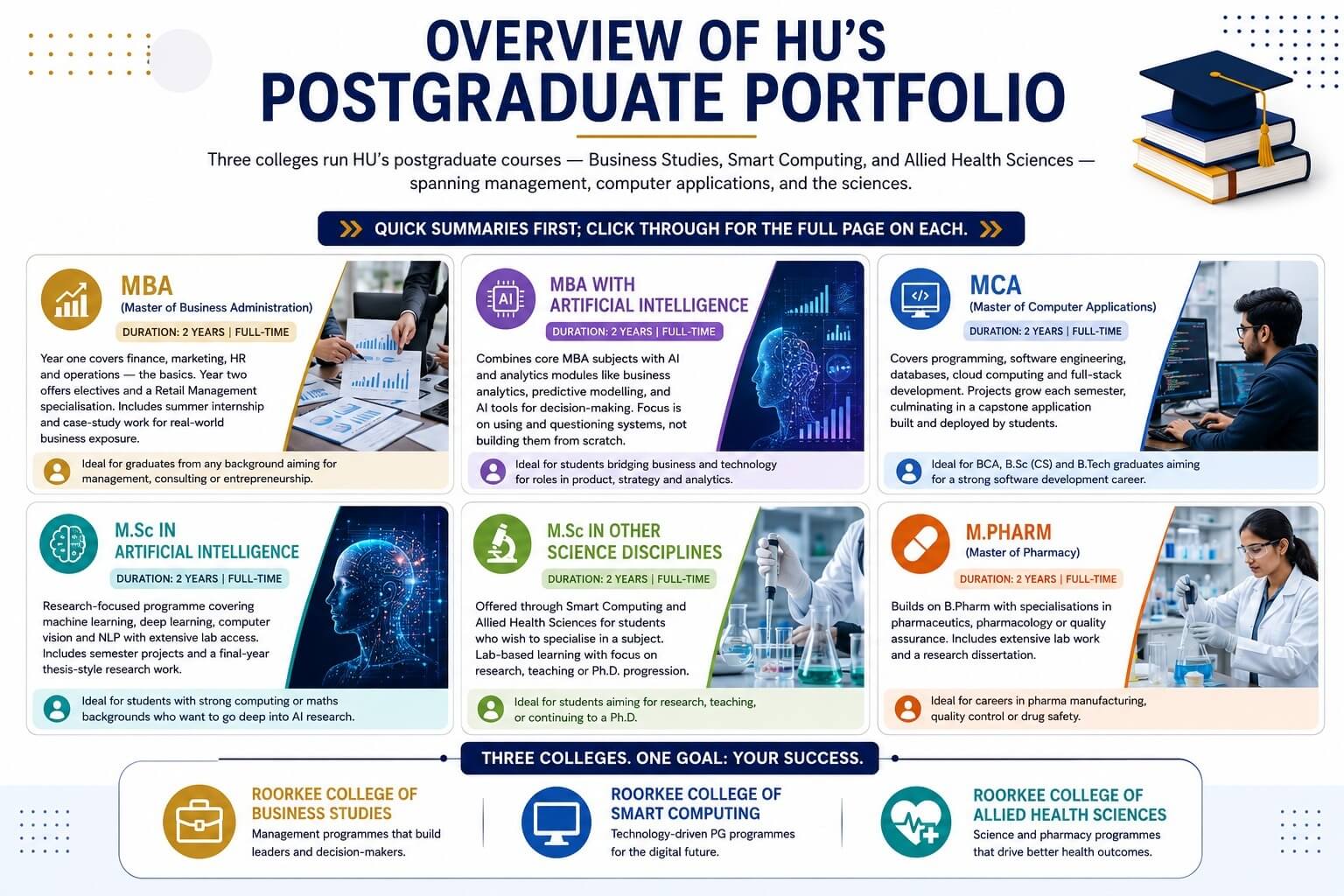
Three colleges run HU's postgraduate courses — Business Studies, Smart Computing, and Allied Health Sciences — spanning management, computer applications, and the sciences. Quick summaries first; click through for the full page on each.
MBA (Master of Business Administration)
Full-time, two years, through the Roorkee College of Business Studies. Year one is finance, marketing, HR, and operations — the basics. Year two opens electives plus a Retail Management specialisation for anyone who wants it. There's a summer internship and plenty of case-study work along the way, so students leave with more than a transcript to show for it. Works well for graduates from any background who want a general path into management, consulting, or starting something of their own.
MBA with Artificial Intelligence
Same MBA foundation, with AI and analytics built into it. Students take the standard core plus modules on business analytics, predictive modelling, and using AI tools to make decisions — the focus is on knowing how to use and question these systems, not on building them from scratch. This one suits students who want to sit between the technical and business sides of a company: product roles, digital strategy, analytics-led operations. More detail is on the MBA with AI programme page.
MCA (Master of Computer Applications)
Run out of the Roorkee College of Smart Computing, MCA covers programming, software engineering, databases, cloud computing, and full-stack development over two years. Projects get bigger each semester and end with a capstone application that students build and deploy themselves — this usually becomes the main thing they talk about in placement interviews. BCA, B.Sc (CS), and B.Tech graduates who want to go straight into software development without an M.Tech's engineering load tend to pick this route.
M.Sc in Artificial Intelligence
Also under Roorkee College of Smart Computing, this is the more research-heavy option: machine learning, deep learning, computer vision, and NLP, with lab access to back it up. Each semester has a smaller applied project, building up to a longer thesis-style piece of work in the final year. It suits students with a strong computing or maths background who'd rather go deep into one technical area than take the broader MCA route.
M.Sc in Other Science Disciplines
HU offers additional M.Sc options through the Roorkee College of Smart Computing and the Roorkee College of Allied Health Sciences for students who'd rather specialise in a subject than take a management or computing route. Lab time is a real part of the course here, not an afterthought, and most students who go this way end up as research assistants, in teaching, or continuing on to a Ph.D.
M.Pharm (Master of Pharmacy)
Where it's on offer, M.Pharm sits under the Roorkee College of Allied Health Sciences, building on a B.Pharm with specialisations in pharmaceutics, pharmacology, or quality assurance. There's a lot of instrument time in the lab and a research dissertation to finish, and most graduates head into pharma manufacturing, quality control, or drug safety work afterward. Seats per specialisation move around from year to year, so check current intake with admissions before applying rather than assuming last year's numbers hold.
2. Eligibility for Each Programme
- MBA: Graduation (any stream) with 50% aggregate; qualifying HUAET, CAT, MAT, XAT, or CUET score
- MBA with AI: Graduation (any stream) with 50% aggregate; basic aptitude for analytics preferred, not mandatory
- MCA: Graduation with Mathematics/Computer Science as a subject at 10+2 or graduation level, 50% aggregate
- M.Sc AI: B.Sc/B.Tech/BCA in a computing or mathematics-linked discipline with 50% aggregate
- M.Sc (Other): Relevant bachelor's degree in the corresponding science discipline with 50% aggregate
- M.Pharm: B.Pharm with 50% aggregate; GPAT score preferred where applicable
Treat these as floors, not guarantees — reserved-category relaxations and subject-specific tweaks get set fresh each cycle, in line with UGC reservation norms. Check this year's notice rather than going by what applied last year.
3. Career Outcomes After a PG at HU
None of these are pure lecture-hall degrees. Every one is tied to internships, an industry project, and a placement drive near the end. Roughly, here's where graduates land:
- MBA / MBA with AI: Management trainee, business analyst, marketing or HR executive, retail operations manager, and — on the AI track — product or operations roles built around data.
- MCA: Software developer, systems analyst, full-stack engineer, cloud or DevOps associate, application support at IT services and product firms.
- M.Sc AI: Machine learning engineer, data scientist, AI research associate, computer vision or NLP specialist.
- M.Sc (Other): Lab and research-assistant roles, teaching eligibility, and a route into a Ph.D. if that's the direction a student wants to go.
- M.Pharm: Quality assurance, regulatory affairs, pharma R&D, clinical research, drug safety.
Pay depends on the specialisation, whether someone's already got work experience, and how the hiring cycle is looking that year — an average package figure is a ballpark, nothing more.
HU's central placement cell runs the actual hiring process: recruiter outreach, shortlisting, interview prep. For recruiter names and past packages, check the HU Placements page.
4. Average Fees Range
Fees move depending on which specialisation someone picks, whether they're staying on campus, and any scholarship in the mix. Roughly, for both years combined:
| Programme | Average Fees (2 Years Combined) |
|---|---|
| MBA / MBA with AI | ₹2.5–4.5 Lakhs |
| MCA | ₹2–3.5 Lakhs |
| M.Sc AI / M.Sc (Other) | ₹1.5–3 Lakhs |
| M.Pharm | ₹2–3.5 Lakhs |
Tuition only — hostel, mess, and the one-time registration fee sit outside these figures. Payment usually happens semester by semester rather than all at once, which most students find easier to manage.
Merit or category scholarships can knock up to 50% off, and get applied at admission once eligibility checks out. Exact slabs for the current cycle are on the Fees & Scholarships page.
5. Admission: HUAET vs Graduation Merit
There are two ways in. One is the Haridwar University Admission Entrance Test, HUAET — 50 questions, one hour, and most PG applicants sit this as their main qualifying step. It's a general aptitude and reasoning test rather than a deep-dive subject exam, so a few focused weeks of prep is usually enough regardless of what someone studied at undergrad. The other route is direct admission based on graduation marks, or a national-level score like CAT, MAT, XAT, CUET, or GATE where the programme accepts it — no HUAET required for that route.
Which route makes sense usually comes down to where a candidate's strengths lie. Someone with strong academic marks throughout tends to go the merit route. Someone who wants a fresh shot at proving themselves, regardless of past percentages, sits HUAET instead. Neither is a fallback — both carry the same weight in the final decision.
Either way, the application process is identical: register online, pay the ₹1,000 non-refundable fee, pick a programme, get documents checked, then lock in the seat within 72 hours of an offer landing. Provisional admits still have to hand over original mark sheets and certificates when they join.
6. Why HU for a Postgraduate Degree
Two years is a real commitment — the institution matters as much as the course itself. A few things students bring up when asked why HU:
- Curriculum that actually gets updated: Management, computing, and pharmacy courses aren't left to run on autopilot — AI, analytics, and current AICTE regulatory changes get folded in as they come up.
- A placement cell that does the legwork: Recruiter outreach across IT, BFSI, retail, and pharma, plus resume and interview prep before each drive.
- Scholarships that make a real dent: Merit and category-based, up to 50% off, so the sticker price isn't the final word on affordability.
- One admission process, not five: HUAET or graduation merit — no need to sit a stack of separate entrance exams for one seat.
- A campus built with PG work in mind: Labs, library, and hostel setup that hold up under longer research and project hours.
7. Frequently Asked Questions
1. What postgraduate options are there at Haridwar University?
MBA, MBA with Artificial Intelligence, MCA, M.Sc in Artificial Intelligence, M.Sc in other science disciplines, and M.Pharm where it's on offer — spread across the Business Studies, Smart Computing, and Allied Health Sciences colleges.
2. What is the eligibility for MBA at Haridwar University?
Any bachelor's degree, any stream, 50% aggregate at minimum, plus a qualifying HUAET score or an accepted exam like CAT, MAT, XAT, or CUET.
3. Is HUAET compulsory for postgraduate admission?
No — candidates can come in through HUAET or through graduation merit, depending on the programme and their marks.
4. What is the fee range for MBA with AI at HU?
Roughly the same band as the regular MBA: ₹2.5–4.5 Lakhs for the full two years, before any scholarship is applied.
5. Does Haridwar University offer scholarships for PG students?
Yes — merit and category-based scholarships of up to 50%, with the exact slabs published on the fees and scholarships page.
6. What are the career prospects after an M.Sc in AI from HU?
Mostly machine learning, data science, AI research, computer vision, or NLP work — the placement cell helps line up recruiters for these.
7. Can a non-computer-science graduate apply for MCA?
Usually not without Mathematics or Computer Science as a subject at 10+2 or graduation level. Worth checking the current year's notice if that's not the background someone has.
8. How long does the HUAET result take?
Usually about three working days by email, and then a 72-hour window to confirm the seat.
9. Where can I see the full list of PG programmes and apply?
The HU Academics Overview page has the full, current list, and links straight through to the application.
See ALL PG Programmes at HU → https://huroorkee.ac.in/academics/overview
Apply for Postgraduate Programmes →
Advance your career with Haridwar University's industry-aligned master's degree programmes. Admissions open for 2026 session.
Apply for Postgraduate Programmes →