

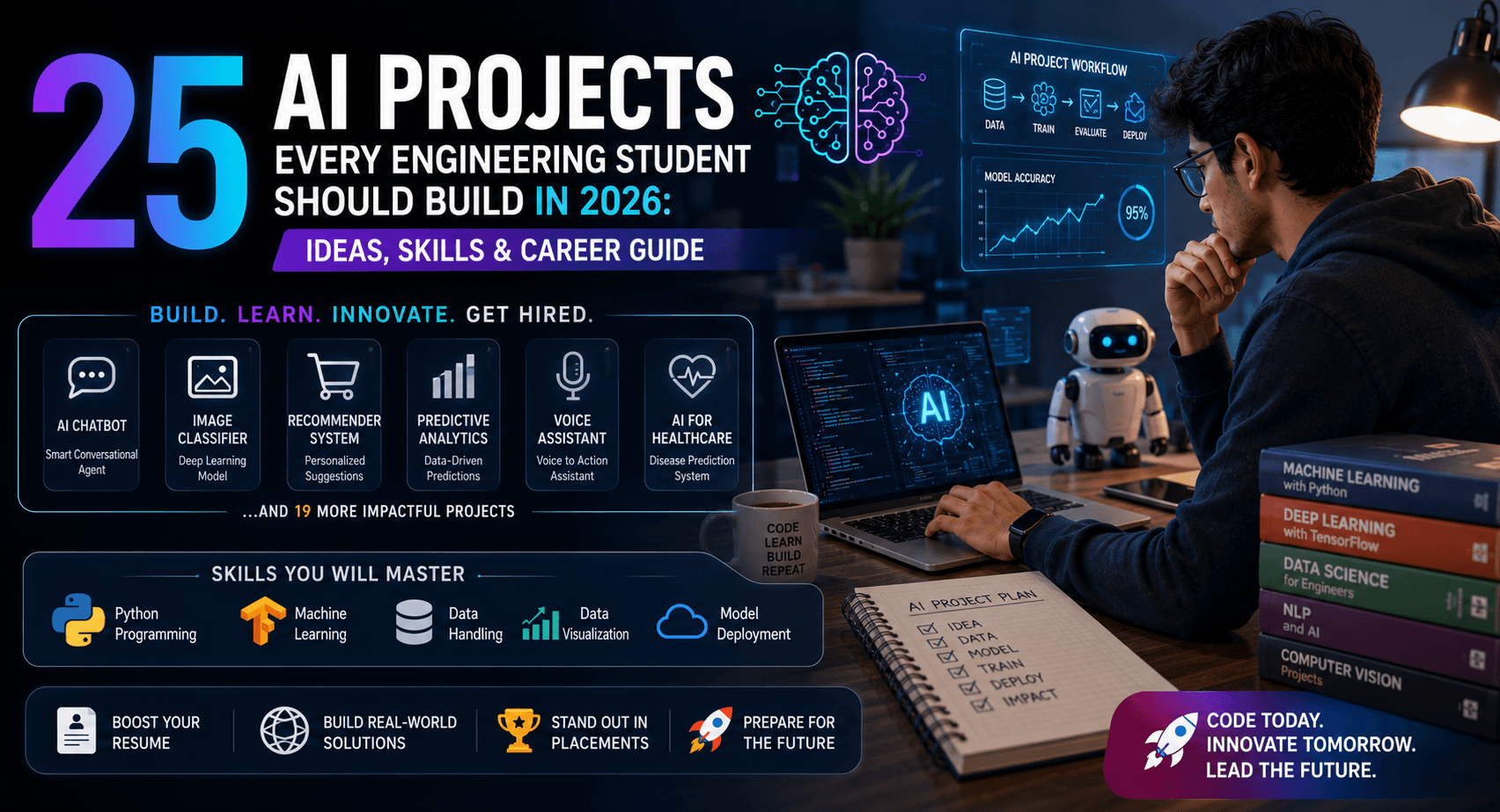
25 AI Projects Every Engineering Student Should Build in 2026: Ideas, Skills & Career Guide
Dr. Himanshu Verma
Head of CSE, Haridwar University
Artificial Intelligence is no longer limited to research labs or technology companies. It is now transforming industries like healthcare, manufacturing, finance, transportation, agriculture, and education. As a result, engineering students are increasingly expected to understand how AI can solve real-world problems rather than simply learning theoretical concepts.
Whether you are preparing for a semester assignment, a final-year project, an internship, or campus placements, choosing the right AI project can help you develop practical skills and build a stronger portfolio.
However, many students struggle with this and have one common question: Which AI project should I build?
A quick online search returns hundreds of project ideas, but most articles simply list project names without explaining which project is suitable for your skill level, engineering branch, or career goals.
This guide is different.
In this article, you'll discover 25 AI projects for engineering students, organized by difficulty level and practical relevance. You'll also learn the skills required, recommended tools, career value, and industry applications of each project, making it easier to choose the right project for your learning journey.
If you're still deciding whether Artificial Intelligence is the right engineering specialization for you, explore our guide on AI vs CSE: Which Engineering Branch Should You Choose After 12th?.
Why AI Projects Matter More Than Marks Today
Engineering education is evolving rapidly. While academic performance remains important, employers increasingly look for candidates who can apply their knowledge to solve practical problems.
A well-executed AI project demonstrates much more than programming ability. It showcases analytical thinking, creativity, teamwork, problem-solving, and technical implementation.
Many recruiters today prefer candidates who have built meaningful projects over those who have only completed coursework.
AI projects can help students:
- Apply classroom concepts to real-world problems.
- Develop practical programming skills.
- Build an impressive GitHub portfolio.
- Prepare for hackathons and innovation competitions.
- Improve internship opportunities.
- Strengthen resumes for campus placements.
- Gain confidence during technical interviews.
According to the World Economic Forum's Future of Jobs Report, AI, data analysis, software development, and technology literacy are among the fastest-growing skill areas across industries.
Similarly, NASSCOM FutureSkills Prime highlights Artificial Intelligence, Machine Learning, Data Science, Cloud Computing, and Cybersecurity as some of the most in-demand digital skills in India.
This means that building AI projects during engineering is no longer just an academic exercise. It is an investment in your future career.
To understand how AI skills influence engineering careers and future salaries, read our detailed guide on AI Engineers Salary in India.
Skills You Should Learn Before Starting AI Projects
You do not need to become an AI expert before building your first project. However, having a basic understanding of a few technical skills will make your learning journey much smoother.
Programming Fundamentals
Python is the most widely used programming language for Artificial Intelligence because of its simplicity and extensive ecosystem of AI libraries.
Students should become familiar with:
- Variables
- Functions
- Loops
- Object-oriented programming
- File handling
For beginners, free platforms such as Python.org and Microsoft Learn provide excellent learning resources.
Mathematics and Statistics
AI projects often rely on concepts such as:
- Probability
- Linear algebra
- Statistics
- Matrices
- Basic calculus
You do not need advanced mathematics for beginner projects, but understanding these fundamentals becomes increasingly important as projects become more complex.
Machine Learning Basics
Students should understand concepts like:
- Supervised learning
- Unsupervised learning
- Classification
- Regression
- Model evaluation
These concepts help explain how AI systems learn from data.
Popular AI Libraries and Tools
Some of the most commonly used technologies include:
| Tool | Primary Use |
|---|---|
| Python | Programming language |
| Pandas | Data analysis |
| NumPy | Numerical computing |
| Scikit-learn | Machine Learning |
| TensorFlow | Deep Learning |
| PyTorch | AI model development |
| OpenCV | Computer Vision |
| Streamlit | AI web applications |
| Google Colab | Cloud-based development |
You do not need to master all of these before getting started. Most beginner projects use only a few of them.
If you're looking for practical software recommendations, explore our guide on The Complete AI Toolkit for Engineering Students.
How to Choose the Right AI Project
One of the biggest mistakes students make is selecting a project simply because it sounds impressive. Instead, choose a project based on your current skills, available time, and long-term career goals. Consider these questions before starting:
Are You a Beginner?
- Python programming
- Basic Machine Learning
- Data visualization
- Simple automation
Are You Preparing for Placements?
- Recommendation systems
- Resume analyzers
- Chatbots
- Predictive analytics
- Data science
Interested in Research?
- Computer vision
- Natural language processing
- Deep learning
- Generative AI
Belong to Another Engineering Branch?
AI is no longer limited to Computer Science. Students from Mechanical, Civil, Electrical, Electronics, Agriculture, and Biomedical Engineering can also build AI-powered solutions for their respective domains. Choosing projects aligned with your branch can make your portfolio more relevant to future employers.
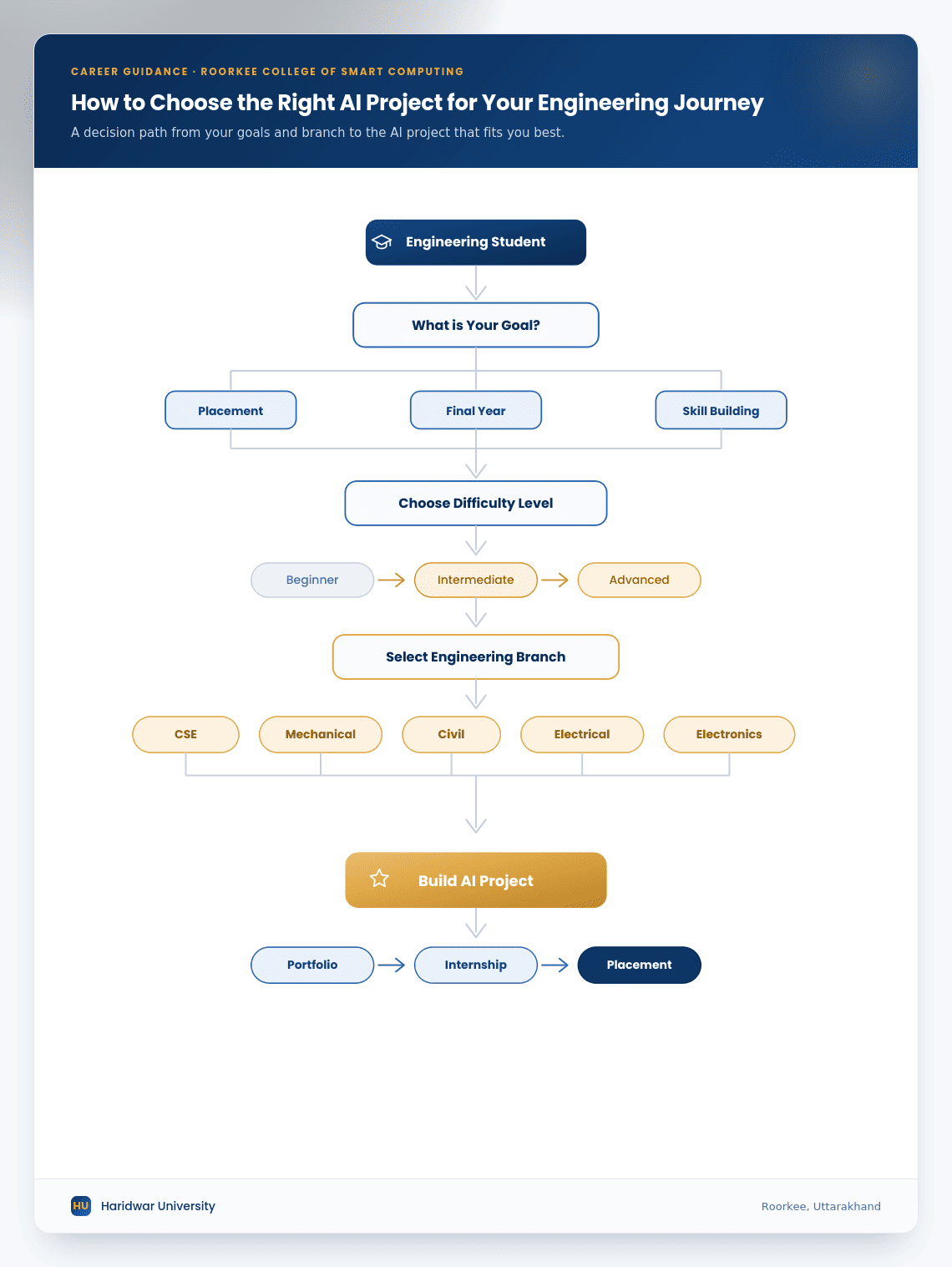
Choosing an AI project based on your skills, engineering branch, and career goals can help you build a stronger portfolio and gain practical industry experience.
Beginner AI Projects for Engineering Students
If you're new to Artificial Intelligence, start with projects that strengthen your programming fundamentals while introducing basic AI concepts. These projects require relatively little prior experience but provide valuable practical exposure.
1. Smart Student Attendance System
| Attribute | Details |
| Difficulty | Beginner |
| Best For | CSE, IT, Electronics |
| Skills You'll Learn | Python, OpenCV, Image Processing |
| Career Value | High |
| Industry Application | Education, Corporate Attendance |
A smart attendance system uses facial recognition or QR-based verification to automate attendance tracking. This project introduces students to computer vision while solving a common real-world problem faced by educational institutions and organizations.
2. Movie Recommendation System
| Attribute | Details |
| Difficulty | Beginner |
| Best For | CSE, AI & ML |
| Skills You'll Learn | Python, Pandas, Recommendation Algorithms |
| Career Value | High |
| Industry Application | OTT Platforms, E-commerce |
Recommendation systems are widely used by platforms like Netflix and Amazon to personalize user experiences. Building this project helps students understand data filtering techniques and user preference prediction.
3. Spam Email Detection
| Attribute | Details |
| Difficulty | Beginner |
| Best For | CSE, IT |
| Skills You'll Learn | Machine Learning, Text Classification |
| Career Value | Medium to High |
| Industry Application | Email Security, Cybersecurity |
Spam detection is one of the most popular beginner AI projects. Students learn how AI can classify text and identify unwanted emails using machine learning algorithms.
4. AI Resume Screening System
| Attribute | Details |
| Difficulty | Beginner |
| Best For | CSE, IT, AI & ML |
| Skills You'll Learn | Python, NLP, Data Processing |
| Career Value | Very High |
| Industry Application | HR Technology, Recruitment |
Recruiters often receive hundreds of applications for a single job opening. This project uses Natural Language Processing (NLP) to analyze resumes based on keywords, skills, and job descriptions. It introduces students to AI applications in recruitment while strengthening their understanding of text processing.
5. Student Performance Prediction
| Attribute | Details |
| Difficulty | Beginner |
| Best For | CSE, AI & ML |
| Skills You'll Learn | Machine Learning, Data Analysis |
| Career Value | Medium |
| Industry Application | Education Analytics |
Educational institutions increasingly use predictive analytics to identify students who may need additional academic support. This project teaches students how historical data can help forecast academic performance.
6. Weather Prediction System
| Attribute | Details |
| Difficulty | Beginner |
| Best For | CSE, Civil, Environmental Engineering |
| Skills You'll Learn | Regression Models, Data Visualization |
| Career Value | Medium |
| Industry Application | Agriculture, Aviation, Disaster Management |
A weather prediction model demonstrates how AI can analyze historical climate data to estimate future weather conditions. Students learn regression techniques and data visualization while working with publicly available datasets.
7. Fake News Detection
| Attribute | Details |
| Difficulty | Beginner |
| Best For | CSE, AI & ML |
| Skills You'll Learn | NLP, Text Classification |
| Career Value | High |
| Industry Application | Media, Journalism, Cybersecurity |
With misinformation becoming a growing concern, AI-powered fake news detection has become an important real-world application. Students learn how machine learning models classify news articles based on language patterns and credibility indicators.
8. AI Chatbot for College Queries
| Attribute | Details |
| Difficulty | Beginner |
| Best For | CSE, IT |
| Skills You'll Learn | Python, APIs, NLP |
| Career Value | Very High |
| Industry Application | Education, Customer Support |
Developing a chatbot for handling admission, examination, or campus-related queries helps students understand conversational AI while solving a practical institutional problem. Modern AI APIs from platforms such as OpenAI and Google Gemini allow students to build conversational applications without creating large language models from scratch.
Intermediate AI Projects for Engineering Students
Once students become comfortable with Python and basic machine learning concepts, they can move toward projects involving larger datasets, computer vision, automation, and predictive analytics. These projects demonstrate stronger technical skills and often make excellent additions to portfolios for internships and placements.
9. Plant Disease Detection System
| Attribute | Details |
| Difficulty | Intermediate |
| Best For | Agriculture, CSE, AI & ML |
| Skills You'll Learn | Computer Vision, CNNs, TensorFlow |
| Career Value | High |
| Industry Application | Agriculture Technology |
This project uses image classification to identify diseases affecting crops. Students learn how computer vision can improve agricultural productivity by detecting plant diseases early.
10. Smart Traffic Management System
| Attribute | Details |
| Difficulty | Intermediate |
| Best For | Civil, CSE, Electronics |
| Skills You'll Learn | Computer Vision, Object Detection |
| Career Value | High |
| Industry Application | Smart Cities, Transportation |
AI-powered traffic monitoring systems can detect vehicle density, optimize signal timings, and reduce congestion. This project combines image processing with real-world urban infrastructure challenges.
11. Face Recognition Access Control
| Attribute | Details |
| Difficulty | Intermediate |
| Best For | Electronics, CSE |
| Skills You'll Learn | OpenCV, Deep Learning |
| Career Value | High |
| Industry Application | Security, Corporate Offices |
Face recognition systems are widely used for secure authentication. Students learn image recognition, facial feature extraction, and AI-based identity verification.
12. Predictive Maintenance for Machines
| Attribute | Details |
| Difficulty | Intermediate |
| Best For | Mechanical, Manufacturing |
| Skills You'll Learn | Machine Learning, Sensor Data Analysis |
| Career Value | Very High |
| Industry Application | Manufacturing, Industry 4.0 |
Manufacturing companies increasingly use AI to predict equipment failures before they occur. This project introduces students to predictive analytics using sensor data, making it especially valuable for Mechanical Engineering students.
13. AI-Based Energy Consumption Forecasting
| Attribute | Details |
| Difficulty | Intermediate |
| Best For | Electrical Engineering |
| Skills You'll Learn | Time-Series Forecasting, Data Analytics |
| Career Value | High |
| Industry Application | Smart Grids, Renewable Energy |
This project predicts electricity demand using historical consumption data. It demonstrates how AI contributes to energy efficiency and sustainable infrastructure.
14. AI-Based Medical Image Classification
| Attribute | Details |
| Difficulty | Intermediate |
| Best For | Biomedical, AI & ML, CSE |
| Skills You'll Learn | Deep Learning, CNNs |
| Career Value | Very High |
| Industry Application | Healthcare, Medical Diagnostics |
Medical image classification helps detect diseases such as pneumonia or skin cancer using X-rays and medical images. This project introduces students to healthcare AI while demonstrating socially impactful applications. To explore how Artificial Intelligence is transforming pharmaceutical and healthcare careers, read our article on AI in Pharmacy: Future Scope, Career Opportunities & Salary.
AI Projects by Engineering Branch
One of the most common mistakes students make is selecting projects that do not align with their engineering discipline. Choosing branch-relevant projects makes your portfolio stronger and demonstrates domain-specific problem-solving skills.
| Engineering Branch | Recommended AI Projects |
|---|---|
| Computer Science | Chatbots, Recommendation Systems, Resume Analyzer, Code Assistant, Fake News Detection |
| Mechanical Engineering | Predictive Maintenance, Quality Inspection, Fault Detection |
| Civil Engineering | Smart Traffic Monitoring, Crack Detection, Construction Safety Monitoring |
| Electrical Engineering | Energy Consumption Forecasting, Smart Grid Analytics, Load Prediction |
| Electronics Engineering | Face Recognition, Embedded AI Systems, Smart Surveillance |
| Agricultural Engineering | Plant Disease Detection, Crop Yield Prediction, Smart Irrigation |
| Biomedical Engineering | Medical Diagnosis, Disease Prediction, Medical Image Analysis |
This approach allows students to build projects that closely match the industries they wish to enter after graduation.
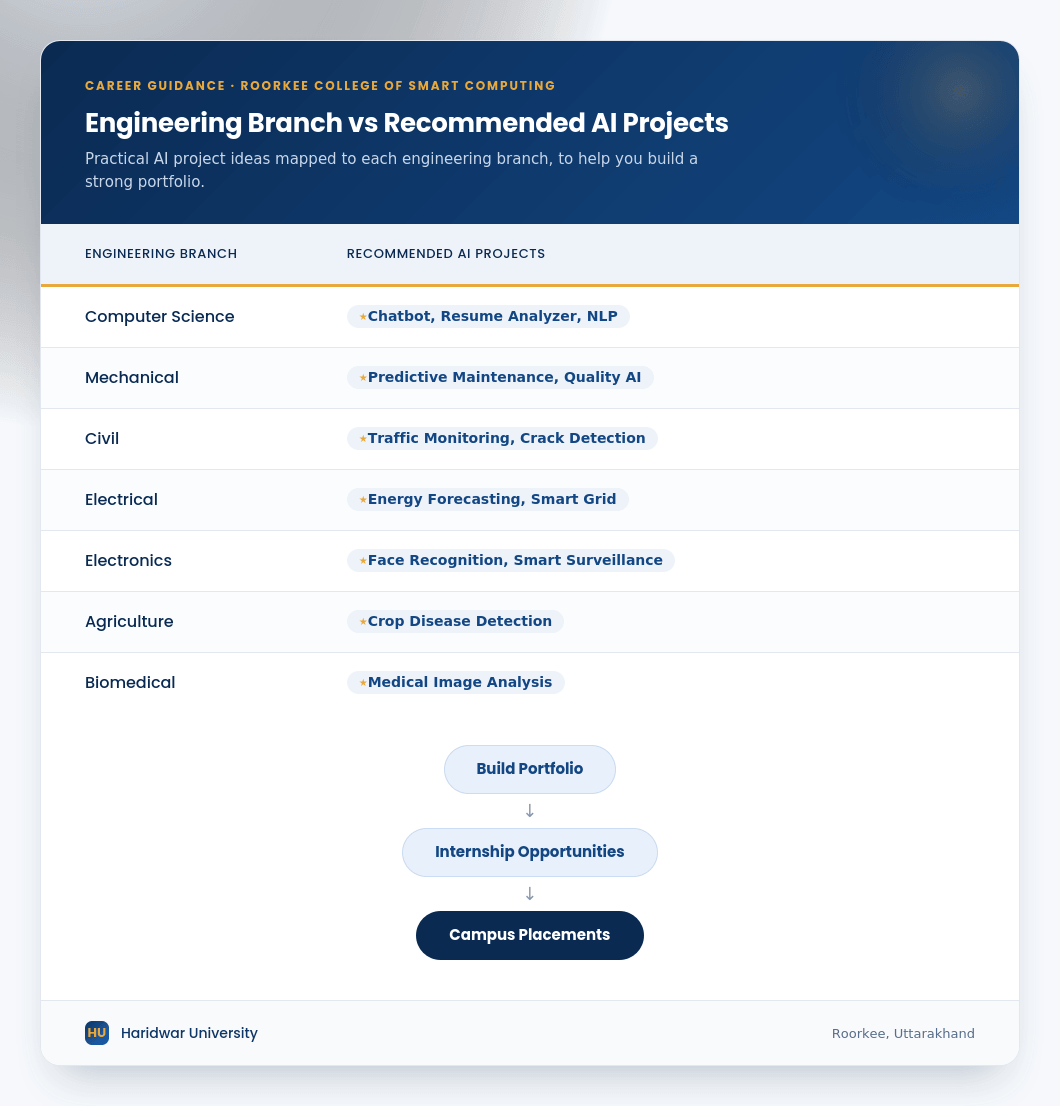
Choosing AI projects that align with your engineering discipline helps build a more relevant portfolio and prepares you for industry-specific career opportunities.
How to Select the Best AI Project for Your Career Goals
Different projects serve different purposes. Before choosing one, ask yourself what you want to achieve.
| Career Goal | Recommended Projects |
|---|---|
| Campus Placements | Resume Analyzer, Chatbot, Recommendation System |
| Internships | Predictive Maintenance, Medical AI, Smart Traffic |
| Higher Studies | Computer Vision, NLP, Deep Learning |
| Hackathons | Smart Attendance, AI Assistant, Plant Disease Detection |
| Portfolio Building | Face Recognition, Fake News Detection, AI Energy Forecasting |
Selecting projects based on career goals helps students develop relevant skills while creating a portfolio that aligns with recruiter expectations.
Advanced AI Projects for Engineering Students (15–25)
Once you have gained confidence with Python, machine learning, and intermediate AI concepts, you can move on to more challenging projects. These projects require a stronger understanding of deep learning, cloud platforms, APIs, and data engineering, but they also offer significantly higher portfolio value for internships, research opportunities, and campus placements.
15. AI Resume Analyzer
| Attribute | Details |
| Difficulty | Advanced |
| Best For | CSE, AI & ML |
| Skills You'll Learn | NLP, LLM APIs, Python |
| Career Value | Excellent |
| Industry Application | HR Tech, Recruitment |
An AI Resume Analyzer evaluates resumes against job descriptions and suggests improvements. Students gain practical experience with Natural Language Processing, text similarity models, and prompt engineering while building a project that reflects current hiring trends.
16. AI Interview Preparation Assistant
| Attribute | Details |
| Difficulty | Advanced |
| Best For | CSE, IT |
| Skills You'll Learn | LLM APIs, Prompt Engineering, Streamlit |
| Career Value | Excellent |
| Industry Application | EdTech, Recruitment |
This project creates an AI-powered interviewer that asks technical questions, evaluates responses, and provides feedback. It demonstrates how Generative AI can improve learning and interview preparation.
17. Intelligent Document Summarizer
| Attribute | Details |
| Difficulty | Advanced |
| Best For | CSE, AI & ML |
| Skills You'll Learn | NLP, Large Language Models |
| Career Value | High |
| Industry Application | Legal, Research, Corporate Documentation |
Large organizations process thousands of documents daily. This project automatically summarizes reports, research papers, or legal documents, helping students understand practical NLP applications.
18. AI Research Assistant
| Attribute | Details |
| Difficulty | Advanced |
| Best For | Research-Oriented Students |
| Skills You'll Learn | Retrieval-Augmented Generation (RAG), APIs, Vector Databases |
| Career Value | Excellent |
| Industry Application | Research, Higher Education |
Students often spend hours searching research papers. An AI Research Assistant can retrieve, summarize, and organize relevant academic content, making research more efficient.
19. Smart Retail Recommendation System
| Attribute | Details |
| Difficulty | Advanced |
| Best For | CSE, Data Science |
| Skills You'll Learn | Recommendation Algorithms, Data Analytics |
| Career Value | High |
| Industry Application | E-commerce, Retail |
Recommendation systems are used extensively by companies such as Amazon and Netflix. Building one demonstrates your understanding of user behavior, personalization, and predictive analytics.
20. AI-Powered Fraud Detection System
| Attribute | Details |
| Difficulty | Advanced |
| Best For | AI & ML, Data Science |
| Skills You'll Learn | Classification Models, Anomaly Detection |
| Career Value | Excellent |
| Industry Application | Banking, Financial Technology |
Financial institutions increasingly rely on AI to detect suspicious transactions. This project teaches students how anomaly detection models improve fraud prevention.
21. AI Code Review Assistant
| Attribute | Details |
| Difficulty | Advanced |
| Best For | CSE, IT |
| Skills You'll Learn | Python, LLM APIs, Prompt Engineering |
| Career Value | Excellent |
| Industry Application | Software Development |
An AI Code Review Assistant analyzes source code, identifies common errors, and suggests improvements. This project demonstrates practical use of Generative AI while helping students understand software quality and debugging practices.
22. AI Voice Assistant
| Attribute | Details |
| Difficulty | Advanced |
| Best For | CSE, Electronics |
| Skills You'll Learn | Speech Recognition, NLP, Python |
| Career Value | High |
| Industry Application | Smart Devices, Customer Support |
Voice assistants convert spoken commands into actions using speech recognition and Natural Language Processing. This project introduces students to conversational AI and voice-enabled applications.
23. Construction Site Safety Monitoring
| Attribute | Details |
| Difficulty | Advanced |
| Best For | Civil Engineering |
| Skills You'll Learn | Computer Vision, Object Detection |
| Career Value | High |
| Industry Application | Construction, Smart Infrastructure |
Using cameras and computer vision, this project detects whether workers are wearing helmets, safety jackets, and other protective equipment. It demonstrates how AI can improve workplace safety and reduce accidents.
24. Smart Waste Management System
| Attribute | Details |
| Difficulty | Advanced |
| Best For | Civil, Environmental Engineering |
| Skills You'll Learn | IoT, Machine Learning, Data Analytics |
| Career Value | High |
| Industry Application | Smart Cities, Urban Management |
This project uses sensors and AI models to monitor waste levels, optimize collection routes, and improve municipal waste management. It highlights AI's role in building sustainable and smarter cities.
25. AI-Based Stock Market Trend Prediction
| Attribute | Details |
| Difficulty | Advanced |
| Best For | CSE, Data Science |
| Skills You'll Learn | Time-Series Forecasting, Machine Learning |
| Career Value | High |
| Industry Application | Finance, FinTech |
This project analyzes historical market data to identify trends and forecast stock price movements. While no model can predict markets with complete accuracy, it provides valuable experience with predictive analytics and financial datasets.
AI Projects That Recruiters Love
Many students believe that simply completing an AI project is enough to impress recruiters. In reality, employers pay close attention to the project's complexity, practical relevance, documentation, and problem-solving approach.
Projects that address real-world challenges often stand out during campus placements and technical interviews.
Some of the most valuable AI projects for your resume include:
- AI Resume Analyzer
- Smart Interview Assistant
- Recommendation System
- Medical Image Classification
- Predictive Maintenance
- AI Chatbot
- Intelligent Document Summarizer
- Smart Traffic Management
- Fraud Detection System
- Plant Disease Detection
These projects demonstrate technical competence while highlighting your ability to solve practical problems across industries.
According to NASSCOM, employers increasingly seek graduates with practical AI skills, project experience, and familiarity with emerging technologies rather than theoretical knowledge alone.
How to Build an AI Portfolio That Impresses Recruiters
Building an AI project is only the first step. Presenting it professionally can significantly improve your chances during internships and campus placements.
A strong portfolio should include:
Well-Documented GitHub Repository
Upload your complete project with:
- Clean source code
- README file
- Installation guide
- Dataset information
- Screenshots
- Future improvements
A well-maintained GitHub repository demonstrates professionalism and version control skills.
Explain the Business Problem
Recruiters are interested in the problem your project solves, not just the code.
Instead of saying: "I built a chatbot."
Explain: "I developed an AI-powered chatbot to automate student admission queries, reducing response time while improving accessibility."
This approach highlights problem-solving skills.
Showcase Your Technical Stack
Mention the technologies used, such as:
- Python
- TensorFlow
- PyTorch
- OpenCV
- Streamlit
- Flask
- Scikit-learn
- Google Colab
- Hugging Face APIs
Clearly listing your technology stack helps recruiters quickly assess your technical expertise.
Add Project Demonstrations
Include:
- Screenshots
- Demo videos
- Live deployment links
- GitHub repository
- Technical documentation
Visual demonstrations make your work easier to understand and verify.
Free Resources to Build AI Projects
Fortunately, students no longer need expensive software or high-end hardware to start learning AI. Several platforms provide free tools, datasets, and learning resources.
| Platform | Purpose |
|---|---|
| GitHub | Open-source projects and version control |
| Google Colab | Cloud-based Python development with free GPU access |
| Kaggle | Datasets, competitions, notebooks |
| Hugging Face | Pre-trained AI models and NLP tools |
| TensorFlow | Deep learning framework |
| PyTorch | AI model development |
| Scikit-learn | Machine learning library |
These resources help students experiment, learn, and build projects without investing in expensive infrastructure.
If you're looking for more AI software and productivity platforms, read our detailed guide on The Complete AI Toolkit for Engineering Students: Best AI Tools for Coding, Projects, Research & Placements.
Your AI Project Roadmap: From Beginner to Placement
Learning Artificial Intelligence is not about completing dozens of projects. It is about gradually building your skills and applying them to solve increasingly complex real-world problems.
If you are unsure where to begin, follow this simple roadmap.
Step 1: Learn the Fundamentals
Before building AI projects, strengthen your understanding of:
- Python programming
- Data structures
- Basic statistics
- Machine Learning concepts
- Git and GitHub
A strong foundation will make advanced AI topics much easier to understand.
Step 2: Build Beginner Projects
Start with projects that teach core AI concepts, such as:
- Spam Email Detection
- Student Performance Prediction
- Movie Recommendation System
- Smart Attendance System
- AI Chatbot
These projects help you understand data collection, preprocessing, and basic model development.
Step 3: Move to Intermediate Projects
Once you're comfortable with the basics, challenge yourself with:
- Plant Disease Detection
- Smart Traffic Management
- Predictive Maintenance
- Face Recognition
- Energy Consumption Forecasting
These projects introduce computer vision, time-series forecasting, and deep learning.
Step 4: Build Industry-Level Projects
Finally, work on advanced projects that demonstrate your readiness for internships and placements.
Examples include:
- AI Resume Analyzer
- AI Interview Assistant
- Medical Image Classification
- Intelligent Document Summarizer
- Fraud Detection System
These projects showcase practical problem-solving and familiarity with modern AI technologies.
Step 5: Showcase Your Work
Don't let your projects remain on your laptop. Publish them by:
- Uploading code to GitHub.
- Writing proper documentation.
- Creating demo videos.
- Sharing your work on LinkedIn.
- Participating in hackathons.
- Including projects in your resume.
A well-documented project often leaves a stronger impression than simply mentioning technical skills.
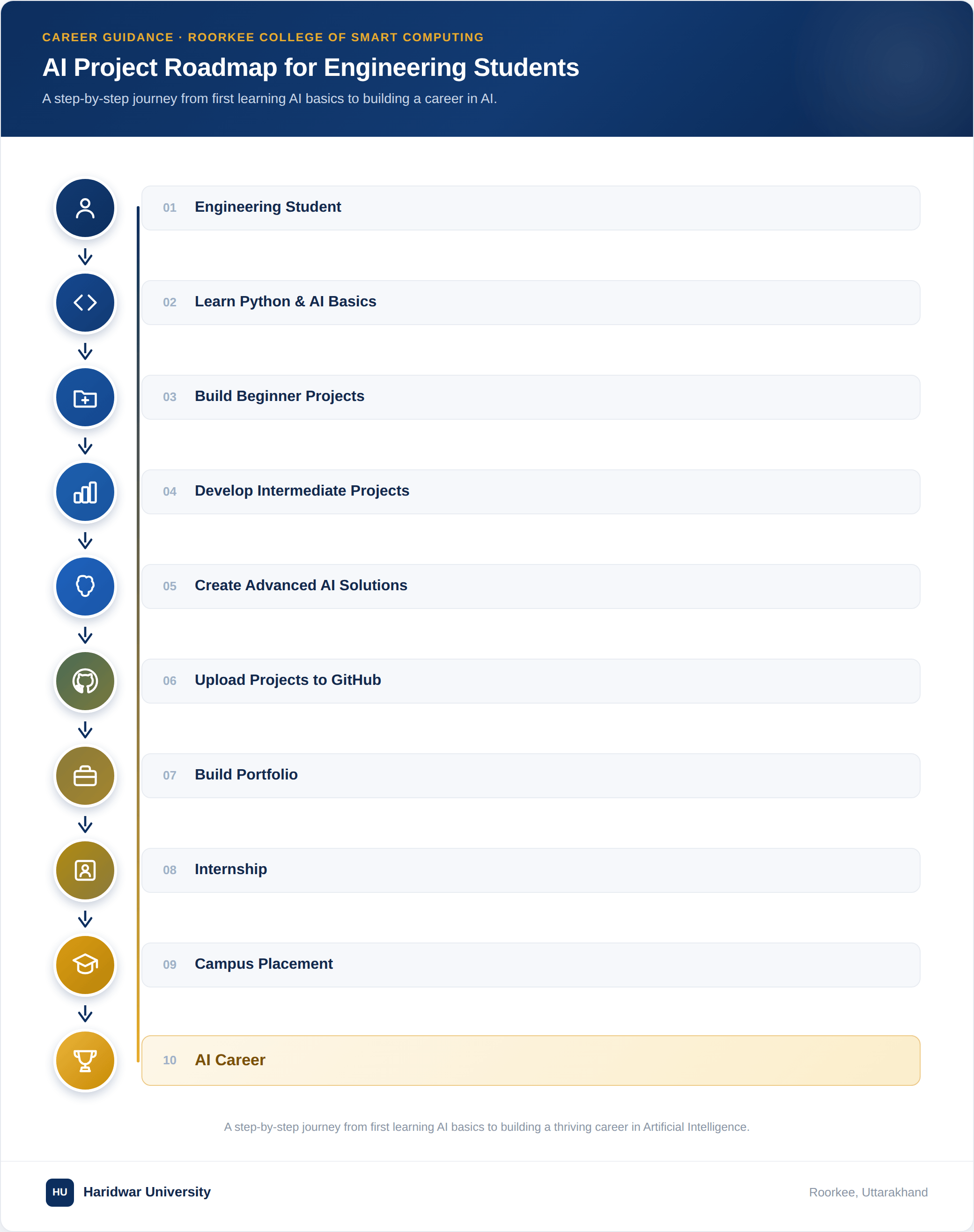
Following a structured AI learning roadmap helps engineering students build practical skills, create an impressive portfolio, and prepare for internships and campus placements.
Common Mistakes Students Should Avoid
Choosing the right project is important, but avoiding common mistakes is equally essential.
Selecting Projects Beyond Your Skill Level
Many students begin with highly advanced deep learning projects without mastering Python or machine learning fundamentals. This often leads to incomplete projects and frustration.
Copying Projects Without Understanding Them
Downloading source code from the internet may help complete an assignment, but it rarely improves your technical skills or interview performance. Instead, understand the logic behind the project and try implementing additional features.
Ignoring Documentation
Good documentation makes your project easier to understand for recruiters, faculty members, and collaborators. Always include:
- Problem statement
- Objectives
- Technologies used
- Installation guide
- Future improvements
Focusing Only on Coding
Successful AI projects require more than programming. Students should also understand:
- Data collection
- Data cleaning
- Model evaluation
- Deployment
- Ethical AI practices
Frequently Asked Questions (FAQs)
The best AI project depends on your current skill level and career goals. Beginners can start with spam detection, chatbots, or recommendation systems, while advanced students can explore medical image analysis, fraud detection, or Generative AI applications.
Python is the most widely used language for Artificial Intelligence because of its extensive ecosystem of libraries such as TensorFlow, PyTorch, Scikit-learn, Pandas, and OpenCV.
Yes. Many beginner-friendly AI projects require only basic Python knowledge and an understanding of machine learning fundamentals. Starting with smaller projects helps build confidence before moving to more advanced applications.
Absolutely. Well-documented AI projects demonstrate practical skills, problem-solving ability, and technical knowledge, making your resume more attractive to recruiters during internships and campus placements.
Students can access free datasets from trusted platforms such as Kaggle, UCI Machine Learning Repository, Google Dataset Search, and Hugging Face Datasets.
Yes. GitHub is one of the best platforms for showcasing your coding skills, maintaining project documentation, and building a professional portfolio that recruiters can review.
Conclusion
Artificial Intelligence is creating exciting opportunities across every engineering discipline. Whether your goal is to secure an internship, build a stronger portfolio, prepare for campus placements, or explore research opportunities, practical AI projects can help you develop industry-relevant skills while solving real-world problems.
Rather than trying to complete dozens of projects, focus on building a few high-quality solutions that demonstrate your technical abilities, creativity, and problem-solving approach. Choose projects aligned with your engineering branch, gradually increase their complexity, and continuously improve your portfolio.
At Haridwar University, students are encouraged to combine strong engineering fundamentals with practical learning through emerging technologies such as Artificial Intelligence, Machine Learning, Data Science, Robotics, and Industry 4.0 applications.
If you're planning to pursue an engineering programme that prepares you for the future of technology, explore our B.Tech Programmes at Haridwar University to discover engineering specializations designed to prepare students for future technologies and industry-ready careers.
Ready to begin your engineering journey? Visit our Admissions 2026 to learn about eligibility, the application process, scholarships, and important admission updates.