

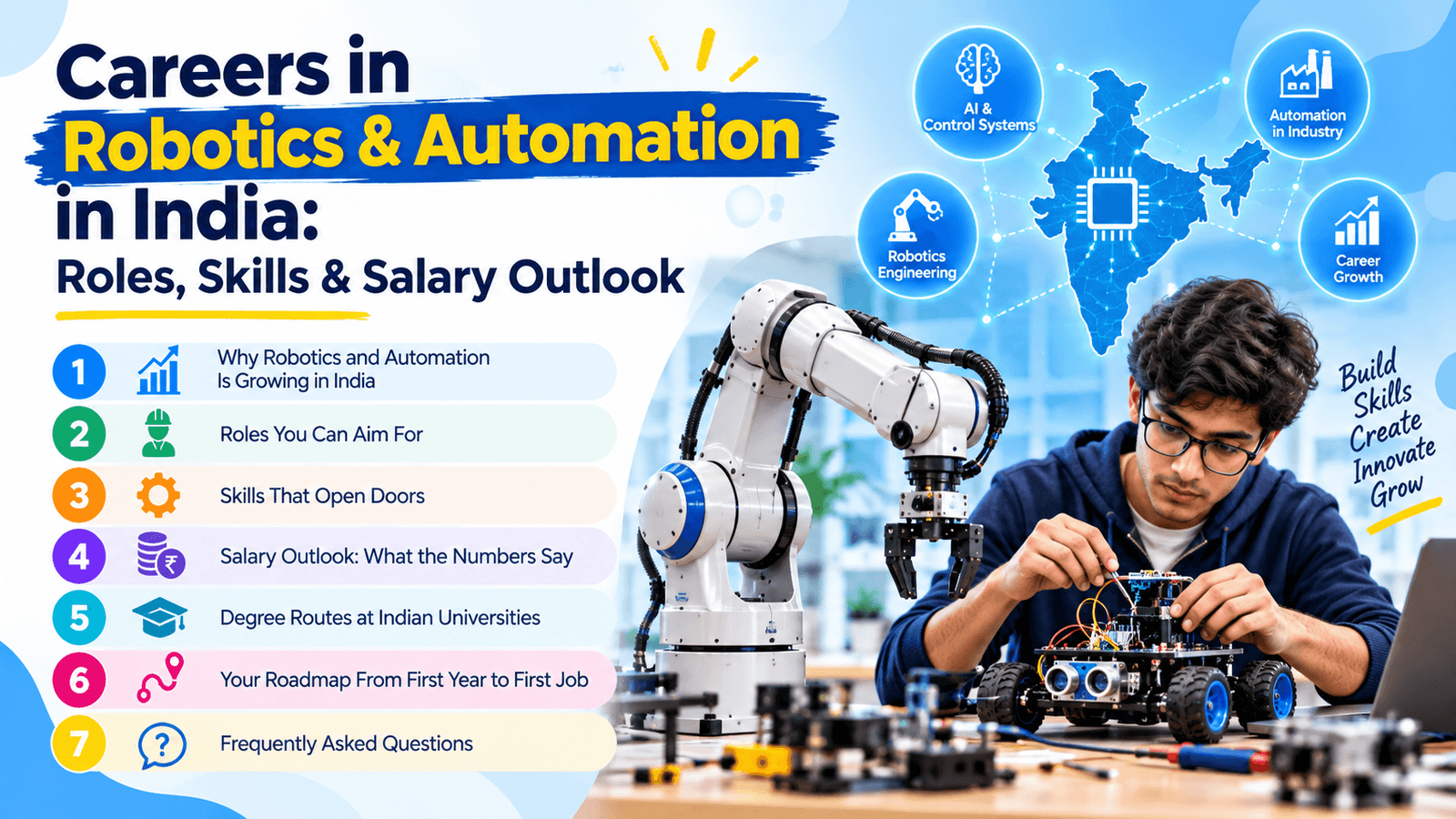
India's factories installed a record number of industrial robots in 2024, and every single one of those machines requires trained professionals to program, calibrate, maintain, and continuously optimize. If you are weighing Careers in Robotics & Automation in India, this definitive guide outlines the functional roles on offer, the technical competencies required, and the current salary landscape.
It also details where degree programmes at Haridwar University fit into this manufacturing transformation, with verified fee schedules, scholarship criteria, and four-year student roadmaps drawn from official institutional documents.
Table of Contents
1. Why Robotics and Automation Is Growing in India
According to official findings published by the International Federation of Robotics (IFR), India deployed an all-time high of 9,100 industrial robots in factories during 2024—a 7% year-on-year increase that elevated the nation to the sixth-largest robot market worldwide.
This surge spans diverse manufacturing ecosystems: automotive assembly, electronics production, pharmaceuticals, metal fabrication, logistics warehousing, and renewable energy equipment. However, factories that automate require much more than articulated mechanical arms:
- They need controls engineers who design robust programmable logic controller (PLC) architectures.
- They need robot programmers who optimize high-speed cycle times and program collaborative robots (cobots).
- They need maintenance and safety specialists who ensure seamless, zero-downtime manufacturing lines.
Consequently, automation careers in India now operate across three distinct functional tiers: system-level design engineers at the top, software/controls programmers in the middle, and skilled integration technicians on the production floor.
2. Roles You Can Aim For
India's National Qualifications Register (NQR) formalizes the career pathways and occupational standards shaping modern industrial robotics:
Robotics & Automation Engineer
Formally recognized under the Capital Goods and Manufacturing Sector (NQR Qualification File). Focuses on designing, simulating, validating, and managing end-to-end automated manufacturing cells, with clear corporate progression toward Automation Manager and Plant Head positions.
Robot Operator & Programmer
Recognized as Jr. Robot Operator and Programmer (NQR Code 14203). Involves configuring robotic grippers, optical sensors, teach pendants, and multi-axis controllers for material handling, welding, and precision assembly across automotive and aerospace assembly lines.
Industrial Automation Technician
Recognized as Senior Technician - Industrial Automation (NQR Code 9879). Handles physical installation, sensor calibration, pneumatic/hydraulic troubleshooting, and preventive maintenance. The official pathway enables transitions into R&D servicing, lateral B.Voc, and B.Tech degree qualifications.
Complementary cross-disciplinary roles include embedded firmware developers, computer-vision specialists, industrial IoT (IIoT) architects, and unmanned aerial system technologists (see our guide on drone technology careers).
3. Skills That Open Doors
To build an employable robotics skillset, combine core mechanical principles with advanced embedded electronics and computer science:
- Mechatronics & Actuators: Kinematics, CAD modelling, pneumatic/hydraulic circuits, servo and stepper motor drivers.
- Embedded Systems & Microcontrollers: Programming ARM Cortex microcontrollers, Arduino, ESP32, and Raspberry Pi in C/C++.
- Industrial Controls: PLC programming (Ladder Logic, Structured Text), SCADA systems, and industrial bus protocols (Modbus, CAN bus).
- Robotics Middleware & Vision: ROS/ROS2 (Robot Operating System), Python scripting, OpenCV, and machine learning models for object recognition.
Equally vital are documentation and safety discipline. In automated work cells, adherence to ISO 10218 safety standards, wiring schematics, and systematic build logs distinguishes top engineering candidates from amateur hobbyists. For project guidance, explore our curated roadmap of robotics projects for engineering students.
4. Salary Outlook: What the Numbers Say
Because industrial robotics is an interdisciplinary field spanning software and heavy machinery, compensation varies based on technical breadth, demonstrable project portfolio, and location:
- According to verified compensation data from Payscale India, early-career robotics engineers earn an average base pay of ₹4,79,323 per annum, with salary ranges spanning from approximately ₹1.76 lakh up to ₹20 lakh for specialized controls, embedded, and robotics AI roles.
- For campus-wide placement benchmarks, Haridwar University's public placement records highlight a 95% placement rate, an average annual compensation package of 6 LPA, and top packages reaching 60 LPA, with 200+ multinational recruiting partners visiting the campus.
Engineers who bridge hardware mechanisms with intelligent software algorithms consistently command higher packages than pure single-discipline specialists.
5. Degree Routes at Haridwar University
Established in 2010, UGC-recognised and AICTE-approved, Haridwar University provides multiple multidisciplinary engineering pathways through the Roorkee College of Engineering and the Roorkee College of Smart Computing:
Source: Verified from official Haridwar University Fee Structure 2026-27. Charges include tuition, enrollment, admission, examination, and uniform fees. Transportation and hostel fees are extra.
Scholarships & Financial Support: Merit scholarships on first-year tuition run from 10% to 80% based on JEE rank, 10+2 PCM marks, or CUET percentiles. Girl students receive 25% tuition support, and sports quota awards range from 10% to 50%. A semester cash award of ₹5,000 is given for Academic Excellence (85%+ marks on first attempt).
Innovative ideas can also access incubation and early prototyping funding through the Institution's Innovation Council (IIC) and campus incubation centre.
6. Your Roadmap From First Year to First Job
Plan your four-year engineering journey in structured milestones:
• Year 1 (Core Foundations): Master engineering mathematics, C/C++ and Python programming, basic circuit analysis, and digital logic.
• Year 2 (Sensors & Microcontrollers): Build small microcontroller systems (Arduino/ESP32), learn sensor interfacing, and participate in campus robotics clubs.
• Year 3 (Industrial Controls & Vision): Work with PLCs, simulation software (MATLAB/Simulink or Gazebo), ROS2 basics, and secure an industrial automation internship.
• Year 4 (Capstone & Placement): Complete an end-to-end automated robotic cell or vision-guided prototype and document your project portfolio on GitHub and LinkedIn.
Campus administrative needs and education loans are supported by the Student Welfare Service, which facilitates nationalized bank tie-ups (SBI, HDFC Bank) and operates Student Care Centres ensuring 24-hour turnaround for student queries.
Full admission procedures, eligibility criteria, and counseling details are available on the Haridwar University Admission Overview page.
7. Frequently Asked Questions (FAQs)
Which degree is best for a robotics career?
No single discipline monopolizes the field. Mechanical engineering provides mechanics and kinematics; electronics and electrical engineering provide sensors, power and microcontrollers; and computer science provides AI, ROS, and computer vision. The key is combining your core degree with practical programming and hardware projects.
Do I need AI knowledge to work in robotics?
Not for every position. Classical industrial automation relies heavily on PLCs, relay logic, and deterministic PID controllers. However, modern autonomous mobile robots (AMRs), collaborative cobots, and automated vision inspection increasingly require machine learning and edge AI skills.
Can I enter through a technician route?
Yes. The National Qualifications Register details technician pathways like Jr. Robot Operator and Programmer, enabling ITI and polytechnic holders to build shop-floor careers and progress into senior automation engineering through experience and lateral degree programmes.
What is the starting salary?
Payscale reports an average starting salary of approximately ₹4.79 LPA for robotics engineers in India, with compensation reaching ₹10–20 LPA for candidates skilled in ROS2, embedded AI, and industrial PLC commissioning.
How much do robotics-related courses cost at HU?
In the Fee Structure 2026-27, B.Tech. ME with AI and EEE with AI are ₹1,27,000 in Year 1 and ₹1,10,000 annually in Years 2 to 4. ECE with AI is ₹1,32,000 in Year 1 and ₹1,15,000 later. B.Tech. AI & ML is ₹1,62,000 in Year 1.
Which scholarships does HU offer?
Haridwar University provides first-year merit concessions from 10% to 80% on tuition, 25% for female students, and 10% to 50% for sports excellence. One scholarship can be claimed per student.
Is drone technology part of robotics?
Yes, unmanned aerial vehicles (UAVs) are aerial robots governed by autonomous flight controllers, GPS telemetry, and optical sensors. HU offers a 3-year B.Sc. Aviation & Drone Technology programme at ₹1,05,000 in Year 1.
What projects should I build first?
Start with a line-following robot using infrared sensors, an automated obstacle-avoiding rover, or a 3-axis servo robotic arm. Document your hardware schematics and code cleanly to showcase practical competencies.
How do I apply to Haridwar University?
Submit your online application through HU's official Apply Now portal or visit the campus admission cell in Roorkee. Seat confirmation requires a standard ₹25,000 registration advance.
8. Engineer Your Robotics Future
The future of Indian manufacturing, logistics, and high-tech industry is automated. By pairing core engineering mechanics with sensors, embedded firmware, and intelligent algorithms, you can establish an enduring, high-impact career at the intersection of hardware and artificial intelligence.
Build solid conceptual foundations, pursue real-world workshop prototypes, and step into the high-growth frontier of industrial automation.
Shape the Future of Robotics & Industrial Automation at Haridwar University
Enrol in multidisciplinary B.Tech. programmes in Mechanical, Electrical, Electronics, and Smart Computing with AI specialisations at Roorkee College of Engineering. Gain hands-on lab training with corporate placement mentorship.