

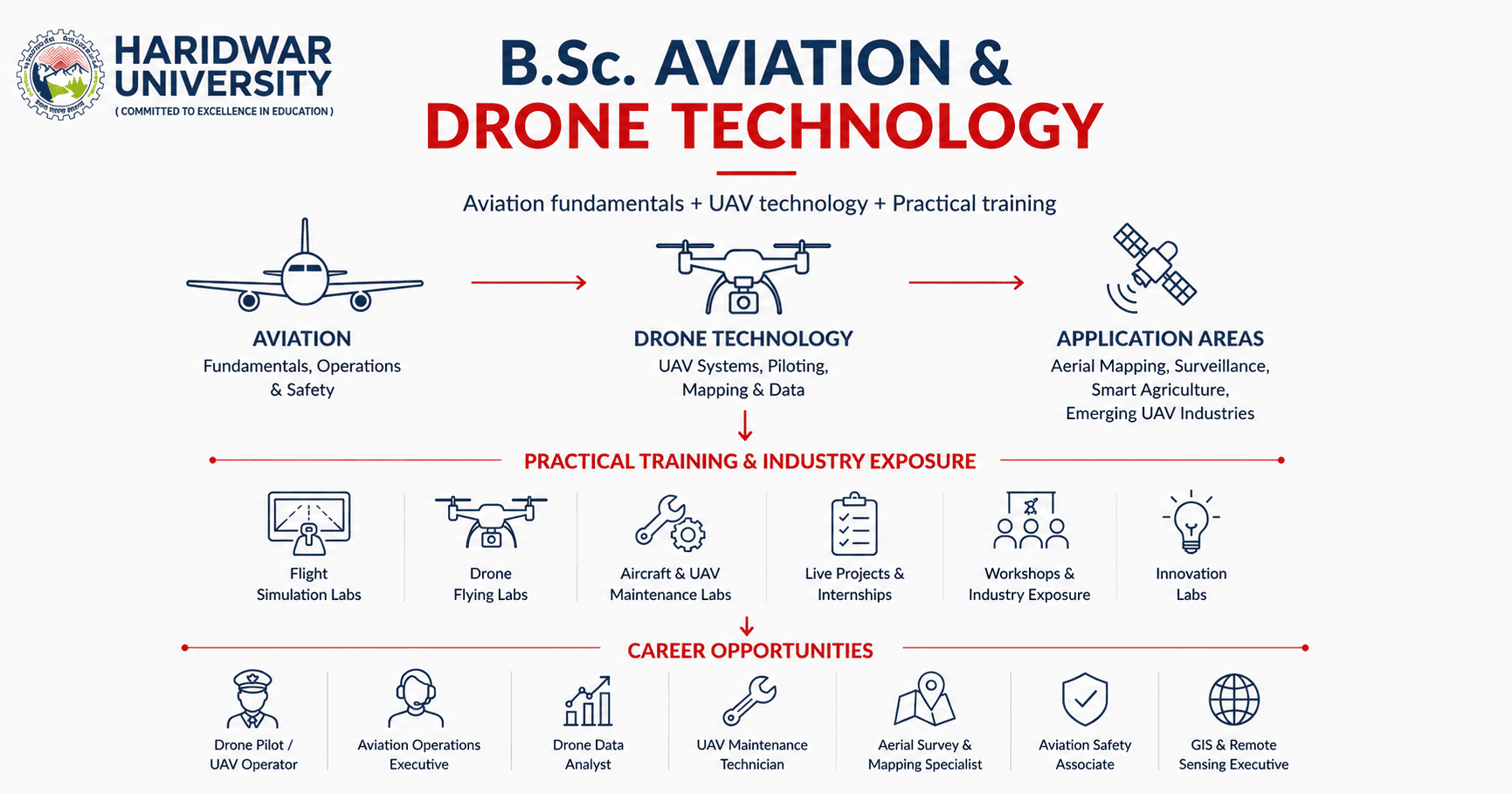
Aviation and drone technology are no longer separate conversations. Aviation depends on operational discipline, safety and technical systems, while drones add unmanned flight, aerial data and new applications around them. At Haridwar University, the B.Sc. Aviation & Drone Technology programme brings these areas together in a comprehensive three-year undergraduate programme.
I see the value of this programme in that combination. Students can study aviation while developing exposure to UAV technology, drone operations, aerial mapping and other emerging applications. HU describes the programme as a future-focused undergraduate programme designed to combine aviation science with advanced drone technology. Its stated application areas include aviation, drone operations, aerial mapping, surveillance, smart agriculture and emerging UAV industries.
Table of Contents
1. B.Sc. Aviation & Drone Technology at a Glance
2. What Does the Programme Cover?
3. Practical Training, Labs and Industry Exposure
4. DGCA and the Drone-Pilot Ecosystem
5. Career Roles After B.Sc. Aviation & Drone Technology
6. Why This Programme Fits Emerging UAV Applications
8. Who Should Consider B.Sc. Aviation & Drone Technology?
1. B.Sc. Aviation & Drone Technology at a Glance
Here is an overview of the key programme parameters published by Haridwar University for the 2026 academic cycle:
| Programme Detail | HU Information |
|---|---|
| Duration | 3 years / 6 semesters |
| Mode | Full-time |
| Intake | 60 students |
| Eligibility | 10+2 or equivalent with Physics, Chemistry and Mathematics (PCM) |
| Admission Process | Merit / entrance examination as per university guidelines |
| 1st-Year Fee | ₹1,05,000 |
| 2nd-Year Fee | ₹1,00,000 |
| 3rd-Year Fee | ₹1,00,000 |
These are the programme details currently published by HU. Students should verify the latest admission and fee information before applying.
The programme is offered through HU's Roorkee College of Smart Computing, whose academic portfolio also includes computing, AI, cybersecurity, data science and other emerging technology programmes.
2. What Does the Programme Cover?
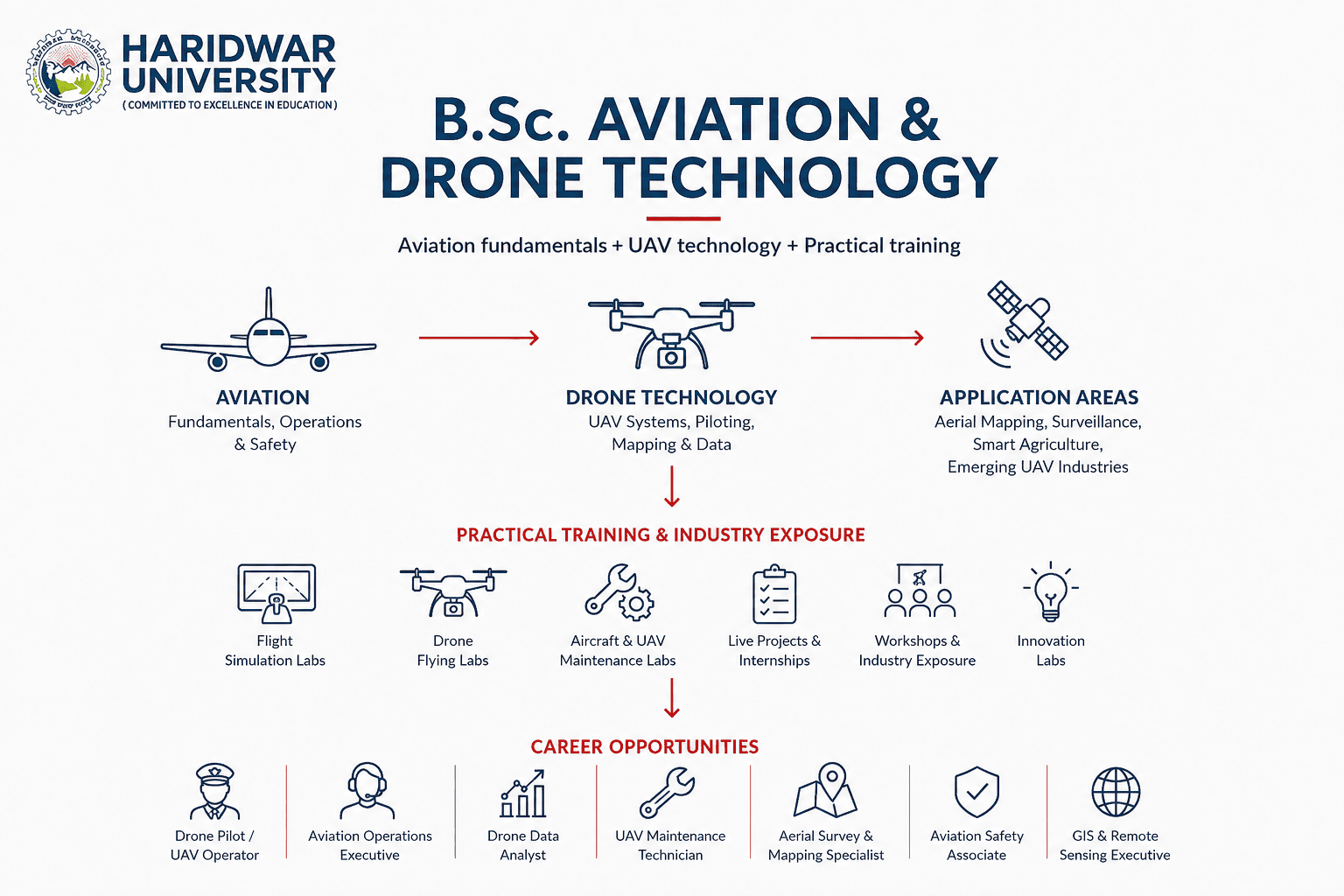
The course connects two domains: aviation and unmanned aerial systems. HU states that the programme is designed to build technical knowledge, operational skills and industry exposure around aviation and UAV technologies.
| Learning Area | Published HU Focus |
|---|---|
| Aviation | Aviation fundamentals, operations and safety |
| Drone Technology | UAV technology, drone piloting and simulation |
| Mapping and Data | Aerial surveying, mapping, GIS and remote sensing |
| Maintenance | Aircraft maintenance workshops and UAV maintenance |
| Emerging Applications | AI-enabled drone systems, agriculture, surveillance and smart-city applications |
Integrated Certifications: HU also lists career-focused certifications integrated directly into the curriculum, including UAV Operation, GIS & Remote Sensing, and Aviation Operations.
For me, this breadth is important. A student entering an emerging technology field needs more than a single technical skill. The programme's structure places aviation, UAV systems, data applications and practical exposure within one cohesive academic pathway.
3. Practical Training, Labs and Industry Exposure
For a programme built around aircraft and UAV systems, practical exposure cannot remain secondary. HU lists hands-on drone piloting and simulation training, advanced flight simulation labs, drone flying labs, aircraft maintenance workshops and innovation labs.
Drone Flying Labs
Hands-on drone piloting and field navigation practice.
Flight Simulation Labs
Advanced simulation-based flight training and cockpit dynamics.
Aircraft Maintenance Workshops
Practical maintenance, hardware troubleshooting and assembly exposure.
Live Projects & Internships
Industry-oriented experience with real-world aerial data projects.
Workshops & Seminars
Regular interactive sessions with aviation and drone industry leaders.
Innovation Labs
Applied learning, AI integration and UAV experimentation.
The programme highlights research opportunities in AI-enabled drone systems and aerial mapping. Furthermore, HU's 2026 collaboration with ISVRx identifies aviation and drone technology among key emerging areas for skill development, technical training, internships and industry exposure.
This is where classroom learning meets application. Drone technology is ultimately operational: flying, maintaining, mapping, analysing and deploying aerial systems for a defined purpose.
4. DGCA and the Drone-Pilot Ecosystem
Students should distinguish between studying drone technology academically and meeting regulatory requirements to operate drones commercially.
Regulatory Context: HU's programme includes drone piloting, simulation training and UAV-operation certification within its learning framework. However, any separate pilot certification, operating permission or regulatory requirement should be checked against the latest applicable Directorate General of Civil Aviation (DGCA) rules before commercial operations. That distinction matters because an academic degree and a regulatory licensing authorisation are not automatically the same thing.
5. Career Roles After B.Sc. Aviation & Drone Technology
HU identifies several promising career directions after successful completion of the programme:
| Career Role | Typical Direction |
|---|---|
| Drone Pilot / UAV Operator | Drone operations and commercial flight management |
| Aviation Operations Executive | Aviation operations and airport flight coordination |
| Drone Data Analyst | Drone and aerial spatial data analytics |
| Aeronautical Technician | Technical aviation systems and hardware support |
| Airfield / Ground Operations Executive | Ground support and airfield operational logistics |
| Aerial Survey & Mapping Specialist | Aerial photogrammetry, surveying and terrain mapping |
| UAV Maintenance Technician | UAV assembly, avionics repair and preventative maintenance |
| Aviation Safety Associate | Flight safety protocols and airspace regulation compliance |
| GIS & Remote Sensing Executive | GIS mapping, satellite data integration and remote sensing |
HU also identifies logistics, agriculture, defence, surveillance and smart-city development among key sector pathways for graduates.
Note: These should be read as potential career and sector pathways, not as guarantees of a particular job, salary or government appointment.
6. Why This Programme Fits Emerging UAV Applications
The strongest feature of this programme is the range of applications it addresses. A student can encounter aviation operations while developing exposure to UAVs, mapping, remote sensing and drone data.
HU specifically identifies smart agriculture, aerial mapping, surveillance and emerging UAV industries among the programme's application areas. Its broader agriculture programme also discusses drone technology for crop surveillance, field mapping and precision spraying.
Key Insight: In my view, the value of a drone is not simply the aircraft itself. It is the operational task, information or service that the system can support across modern industry.
7. Fees and Eligibility
HU currently lists the following fee structure for the 3-year B.Sc. Aviation & Drone Technology programme:
| Academic Year | Published Fee |
|---|---|
| 1st Year | ₹1,05,000 |
| 2nd Year | ₹1,00,000 |
| 3rd Year | ₹1,00,000 |
Eligibility Criteria: Candidates must have passed 10+2 or an equivalent examination from a recognised board with Physics, Chemistry and Mathematics (PCM). Minimum marks are as per university norms. Admission is based on merit / entrance examination as per university guidelines.
Students should check the current programme and admission pages at HU Admission Overview before making an application because fees, eligibility and admission provisions may be revised.
8. Who Should Consider B.Sc. Aviation & Drone Technology?
I would ask three questions before choosing this programme:
✅ Do I have the required PCM background?
✅ Do I want a career connected with aviation, UAVs, mapping or aerial data?
✅ Am I comfortable with practical training, technical systems and field-oriented applications?
If the answer is yes, the programme provides a defined undergraduate route into aviation and drone technology. Students who meet the PCM eligibility requirement and want to explore this emerging field can also compare it with other courses after 12th Science at Haridwar University before making a decision.
9. Frequently Asked Questions (FAQs)
Q1: What is the duration of B.Sc. Aviation & Drone Technology at HU?
It is a three-year, six-semester full-time undergraduate programme combining aviation fundamentals with drone and UAV technology.
Q2: What is the eligibility for B.Sc. Aviation & Drone Technology?
Candidates must have passed 10+2 or an equivalent examination with Physics, Chemistry and Mathematics (PCM) from a recognised board, subject to university norms.
Q3: What is the fee for B.Sc. Aviation & Drone Technology at HU?
The published fee is ₹1,05,000 for the first year and ₹1,00,000 each for the second and third years (total ₹3,05,000 across 3 years).
Q4: Does the programme include practical drone training?
Yes. HU lists hands-on drone piloting, simulation training, flight simulation labs and drone flying labs as part of the programme.
Q5: What career options are available after B.Sc. Aviation & Drone Technology?
Graduates can explore roles such as Drone Pilot/UAV Operator, Aviation Operations Executive, Drone Data Analyst, UAV Maintenance Technician and GIS & Remote Sensing Executive.
Q6: Does the course cover aviation as well as drone technology?
Yes. The curriculum is specifically designed to integrate aviation science, flight safety and operations alongside advanced UAV technologies and aerial mapping.
Q7: Does B.Sc. Aviation & Drone Technology include internships?
Yes. HU's programme highlights live industry projects, internships and workshops, providing opportunities for practical, industry-oriented exposure.
Q8: What industries can students explore after this programme?
HU identifies applications across logistics, agriculture, defence, surveillance, smart-city development, aerial mapping and emerging UAV industries.
Q9: Does the programme include certifications related to drone technology?
Yes. HU lists career-focused certifications integrated into the curriculum, including UAV Operation, GIS & Remote Sensing and Aviation Operations.
10. Building Skills for the UAV Era
B.Sc. Aviation & Drone Technology brings aviation fundamentals, UAV technology and practical exposure together in one undergraduate pathway. For students interested in drone operations, aerial mapping, aviation operations, GIS or emerging UAV applications, the programme can provide a structured starting point to develop relevant technical and operational skills. Students should consider the programme in the context of their own academic background and career interests, review the latest programme and admission requirements, and then make an informed decision.
Disclaimer: Programme details, fees, eligibility, admission procedures, certifications and regulatory requirements may change. Career roles are potential pathways and should not be interpreted as placement or employment guarantees. Students should verify the latest information from Haridwar University and applicable aviation and drone regulatory authorities before applying or undertaking regulated operations.
Explore B.Sc. Aviation & Drone Technology at HU
Step into India's emerging UAV and aviation sector with hands-on flight simulation, drone labs, and industry-oriented curriculum.