

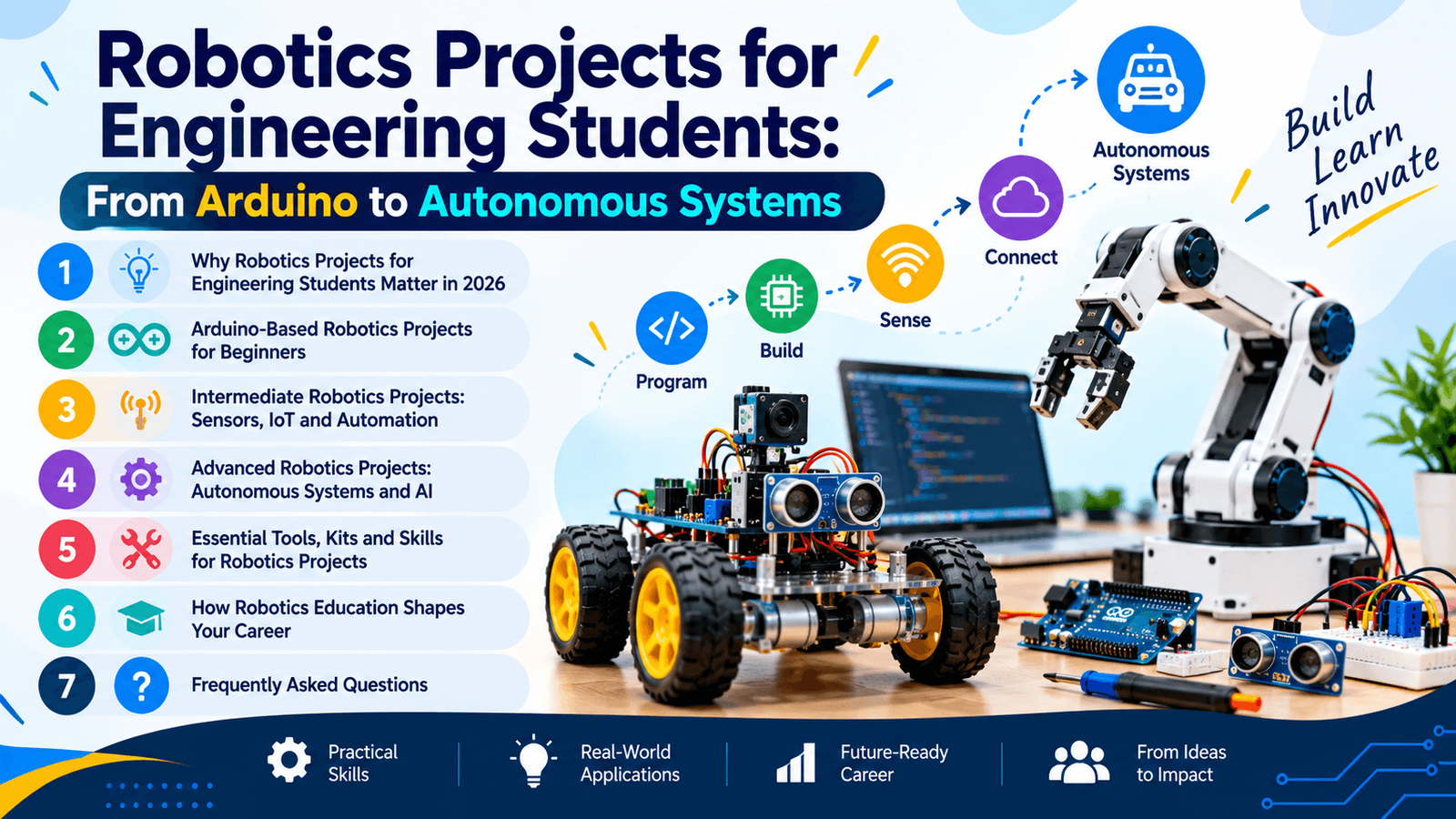
Robotics Projects for Engineering Students: From Arduino to Autonomous Systems
Dr. Himanshu Verma
Associate Professor & HOD, Computer Science & Engineering, Haridwar University
Roorkee College of Engineering & Smart Computing | Hands-On Robotics
From basic Arduino breadboard circuits to Robot Operating System (ROS) autonomous navigation.
Robotics Projects for Engineering Students have become one of the most effective ways to bridge classroom theory with real engineering practice. Whether a first-year student wires up a simple Arduino robot or a final-year student builds an autonomous navigation system, hands-on robotics work develops coding, electronics, and problem-solving abilities that recruiters actively look for.
At Haridwar University, students from Computer Science, Electronics, and Mechanical Engineering are encouraged to take up robotics work through structured coursework, academic live projects, and innovation clubs. This guide walks through robotics projects for every skill level — from simple Arduino builds to AI-driven autonomous systems — along with the tools, fee structure, and scholarships available for students who want to specialise in this fast-growing field.
Table of Contents
1. Why Robotics Projects for Engineering Students Matter in 2026
2. Arduino-Based Robotics Projects for Beginners
3. Intermediate Robotics Projects: Sensors, IoT and Automation
4. Advanced Robotics Projects: Autonomous Systems and AI
5. Essential Tools, Kits and Skills for Robotics Projects
1. Why Robotics Projects for Engineering Students Matter in 2026
India's technical education regulators have been steadily pushing colleges toward outcome-based, hands-on learning instead of pure theory. The All India Council for Technical Education (AICTE) promotes project-based curricula, internships, and innovation cells across approved institutions, while the University Grants Commission (UGC) encourages universities to build research and skill-development ecosystems for undergraduates.
Robotics sits right at the centre of this shift because a single robotics build touches electronics, embedded programming, mechanical design, and, increasingly, artificial intelligence — the same combination that recruiters in automotive, manufacturing, defence, and IT commonly value during campus placements, in our experience. For engineering students, a well-documented robotics project is often the strongest talking point in an interview, stronger than marks alone, because it proves the student can take an idea from a circuit diagram to a working prototype.
- Cross-Disciplinary Mastery: Integrates circuits, microcontroller C/C++, firmware debugging, and chassis kinematics.
- Interview Talking Point: Live demonstration of circuit schematics, obstacle handling logic, and real hardware troubleshooting.
- Industry Alignment: Maps directly to recruitment requirements across smart manufacturing, industrial automation, defence tech, and autonomous mobility.
2. Arduino-Based Robotics Projects for Beginners
Arduino remains the standard starting point because the boards are inexpensive, the community is large, and the official Arduino documentation covers every beginner concept from digital pins to serial communication. A few beginner-friendly builds that first- and second-year students commonly complete include the following:
Line-Following Robot
BeginnerUses infrared (IR) sensor arrays to detect a dark track on a light reflective surface and adjusts DC motor differential speeds to stay on track. An easy, foundational introduction to analog/digital sensor input and closed-loop motor control logic.
Obstacle-Avoidance Bot
BeginnerPairs an HC-SR04 ultrasonic distance sensor with a micro servo motor mounted on the front chassis so the robot can scan left and right, measure distance to obstacles, and reroute automatically, introducing basic conditional decision-making in code.
Bluetooth-Controlled Car
BeginnerAdds an HC-05 / HC-06 Bluetooth module so the robot can be driven wirelessly from an Android or iOS smartphone application. Teaches UART serial communication protocols alongside H-bridge motor driver circuits (typically an L298N module).
3. Intermediate Robotics Projects: Sensors, IoT and Automation
Once the basics of sensors and motors are comfortable, students usually move to projects that connect a robot or device to a network, which is where robotics work starts overlapping with the Internet of Things (IoT). Haridwar University's academic live-projects programme gives students structured guidance to take these builds from prototype to a properly documented submission.
Smart Home Automation with IoT
IntermediateUses a NodeMCU or ESP32 Wi-Fi microcontroller to control appliances, fans, lighting relays, and electronic door locks over Wi-Fi, with real-time telemetry and environmental sensor data logged to a cloud dashboard (Blynk, Adafruit IO, or AWS IoT) — a popular final-semester mini-project.
Gesture-Controlled Robotic Arm
IntermediateCombines flex sensors or an MPU6050 accelerometer/gyroscope wearable glove with high-torque servo motors so the robotic manipulator accurately mimics human hand articulation and wrist orientation in real time. A favourite for mechanical and mechatronics students because it blends firmware coding with mechanical linkage design and 3D printing.
4. Advanced Robotics Projects: Autonomous Systems and AI
Final-year and postgraduate students who want a research-grade capstone project usually transition to the Robot Operating System (ROS / ROS 2), the open-source middleware used across academia and global robotics companies to manage sensor fusion, path planning, and motor actuation on a unified autonomous platform.
Typical advanced robotics projects for engineering students include:
Self-Driving Mobile Robot with SLAM
Integrates 2D LiDAR (such as RPLiDAR A1) or depth cameras with ROS Navigation Stack (Nav2) to perform Simultaneous Localisation and Mapping (SLAM), generating obstacle occupancy grids and traversing optimal costmap trajectories.
Computer-Vision Object-Sorting Arm
Mounts an RGB camera over an industrial conveyor or workspace, runs lightweight CNN or YOLO object detection on a Raspberry Pi / Jetson Nano, and actuates a robotic gripper to classify and sort parts dynamically.
Autonomous Agricultural / Survey Drone
Employs PX4 / ArduPilot flight controllers connected to companion computers for GPS waypoint navigation, automated crop-health multispectral monitoring, and geo-fenced precision flight.
Haridwar University's Research and Innovation laboratories provide the sensor kits, compute hardware, and faculty mentorship students need to attempt this level of work, and strong projects here are routinely developed into publishable research papers or patent filings.
5. Essential Tools, Kits and Skills for Robotics Projects
Building strong robotics projects for engineering students depends less on any single expensive kit and more on a consistent toolkit developed over semesters:
| Category | Recommended Hardware / Software | Engineering Application |
|---|---|---|
| Microcontrollers | Arduino Uno, Nano, ESP32, STM32 | Real-time low-level sensor sampling, PWM motor timing, fast I/O |
| Single-Board Computers | Raspberry Pi 4/5, NVIDIA Jetson Nano | Running ROS 2, computer vision OpenCV, edge AI inference |
| Sensors & Actuators | Ultrasonic (HC-SR04), IR, MPU6050 IMU, L298N, Servos | Distance ranging, orientation tracking, kinematics actuation |
| Programming Stack | Embedded C/C++, Python 3, Linux (Ubuntu/Debian) | Firmware routines, algorithmic wrappers, middleware scripting |
| Mechanical CAD & Orgs | Autodesk Fusion 360, SolidWorks, IEEE-RAS | Chassis prototyping, 3D printing STL files, international benchmarks |
CAD tools such as Fusion 360 or SolidWorks help with the mechanical chassis design, while the IEEE Robotics and Automation Society (IEEE-RAS) publishes free tutorials, competition listings, and student-chapter resources that are useful once a student wants to benchmark a project against national or international standards.
Students at Haridwar University can build these skills further through the Aavishkar Innovation Club, which runs peer workshops on exactly this stack alongside faculty-guided project weekends throughout the academic year.
6. How Haridwar University Supports Robotics Innovation
Haridwar University's Roorkee College of Engineering and Roorkee College of Smart Computing run B.Tech and M.Tech programmes in Computer Science, AI & ML, and Electronics with dedicated robotics and embedded-systems coursework, live industry projects, and a placement cell that connects student project work directly to recruiters (see the university's placement overview).
Official 2026-27 Fee Structure & Merit Scholarships
According to the university's official 2026-27 fee structure:
- B.Tech Hons. CSE: First-year tuition and related charges total approximately ₹1,32,000.
- B.Tech Hons. AI & ML: Specialisation tuition and related charges total approximately ₹1,62,000 for the first year.
- Merit-Based Scholarships: Students with a JEE rank between 1 and 1,00,000, a 12th board percentage above 90%, or an equivalent CUET percentile can receive up to 80% tuition-fee scholarship in the first year.
- Girl Student Scholarship: Female students are separately eligible for a 25% first-year tuition scholarship.
- Sports Quota Support: Candidates with national-level certificates can receive up to 50% off first-year tuition.
Full slab-wise scholarship percentages for every rank band are listed on the university's official Fees & Scholarships page.
Beyond academics, the university's Student Welfare Service supports students with grievance redressal, medical assistance, and campus life issues while they work on demanding lab-based projects.
Ready to move beyond theory? Build Your Skills at HU → Apply For Admission at HU and start your first robotics project this semester.
7. Frequently Asked Questions (FAQs)
1. What is the best robotics project for a first-year engineering student?
A line-following or obstacle-avoidance robot built on Arduino is ideal. Both use inexpensive components and teach sensor input and motor control without requiring prior programming depth.
2. Do I need coding experience to start Arduino-based robotics projects?
Basic C-style syntax is enough to begin. The Arduino IDE uses simplified functions, and most beginner projects need under 100 lines of code, so coding experience can be built alongside the project itself.
3. Which programming languages are used in robotics projects?
C/C++ is standard for microcontroller-level control, while Python is widely used for computer vision, AI models and working with ROS on single-board computers like the Raspberry Pi.
4. What is the fee for a robotics-relevant B.Tech programme at Haridwar University?
First-year tuition and related charges are approximately ₹1,32,000 for B.Tech Hons. CSE and approximately ₹1,62,000 for B.Tech Hons. AI & ML, as listed on the university's official fees page.
5. Are scholarships available for robotics and AI students at HU?
Yes. Merit-based scholarships of up to 80% on first-year tuition are available based on JEE rank and academic percentage, along with separate scholarships for girl students and sports-quota candidates.
6. What is the difference between Arduino and Raspberry Pi for robotics?
Arduino is a microcontroller best suited to direct sensor and motor control, while Raspberry Pi is a full single-board computer better suited to camera input, AI models and running ROS.
7. Can final-year students get help with advanced robotics live projects at HU?
Yes. The university's live-projects programme and research laboratories provide sensor kits, compute hardware and faculty mentorship for autonomous-systems and AI-based final-year projects.
8. What career opportunities follow after robotics projects?
Well-documented robotics projects support roles in embedded systems, automation, mechatronics, autonomous vehicles and AI-robotics research, and are frequently discussed in campus placement interviews.
9. How can I join Haridwar University's robotics or innovation club?
Students can join the Aavishkar innovation club through the Student Corner, where peer-led workshops and faculty-guided project weekends run through the academic year.
Turn Your Robotics Ideas into Real Engineering Prototypes
Join Haridwar University's Faculty of Engineering & Technology. Learn in state-of-the-art embedded laboratories with merit scholarships of up to 80%.