

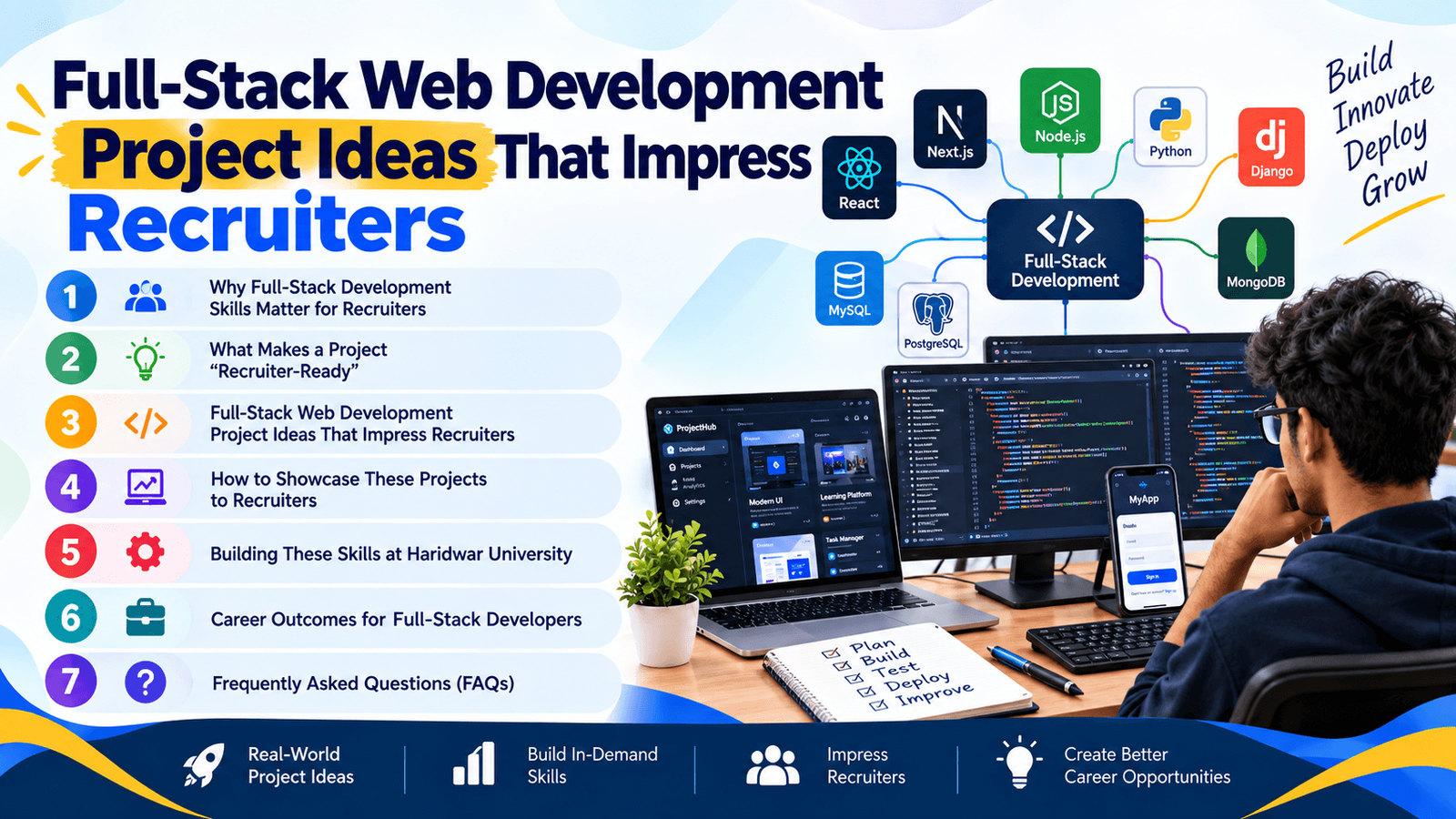
Department of Computer Science & Engineering | Placement Readiness Guide
Architecting, deploying, and presenting capstone full-stack systems that prove day-one developer capabilities to technical hiring managers.
For a final-year Computer Science, BCA, or MCA student, the line “Full Stack Developer” on a resume is only as strong as the software project backing it up. Recruiters scanning hundreds of applications every campus placement season look past generic to-do-list clones and search for genuine, architectural problem-solving.
That is exactly why choosing the right Full-Stack Web Development Project Ideas That Impress Recruiters matters long before you sit for a campus interview. A well-built project demonstrates that you can design a relational or document database schema, write clean and secure backend logic, build a responsive and accessible frontend interface, and deploy the entire production system — the exact baseline skills a hiring manager expects from a day-one developer.
This comprehensive guide walks through six recruiter-approved project architectures, details how to present them effectively on GitHub and LinkedIn, and shows how students at Haridwar University turn capstone project ideas into placement-winning professional portfolios.
Table of Contents
- Why Full-Stack Development Skills Matter for Recruiters
- What Makes a Project “Recruiter-Ready”
- 6 Full-Stack Web Development Project Ideas That Impress Recruiters
- E-Commerce Platform with Admin Analytics Dashboard
- Real-Time Chat & Video Collaboration App
- AI-Powered Learning Management System (LMS)
- Healthcare Appointment & Telemedicine Portal
- Food Delivery / Multi-Vendor Marketplace App
- Personal Finance & Expense Tracker with Data Visualization
- How to Showcase These Projects to Recruiters
- Building These Skills at Haridwar University
- Career Outcomes for Full-Stack Developers
- Frequently Asked Questions (9 Placement FAQs)
1. Why Full-Stack Development Skills Matter for Recruiters
Most campus recruiters — ranging from fast-growing product startups to established multinational IT services firms — actively hire freshers who can navigate fluidly across the entire technology stack rather than narrow, single-layer specialists. The logic is straightforward: agile engineering teams need developers who understand how a frontend user action translates into an API call, how that payload is authenticated and processed in the controller, and how queries hit the database schema without introducing latency.
Technical education regulators, including the All India Council for Technical Education (AICTE), have underscored outcome-based, project-driven engineering curricula precisely because it mirrors modern agile product delivery. In campus technical interviews, your capstone or final-year CSE and AI project is almost always the focal point of discussion. How lucidly you explain your architectural tradeoffs, data schemas, and deployment pipelines often matters far more than simply showing a polished UI.
2. What Makes a Project “Recruiter-Ready”
A project becomes truly recruiter-ready when it addresses a genuine, relatable problem rather than repackaging a standard online video tutorial. Engineering interviewers spot boilerplate code within minutes; what makes them lean forward is architectural maturity and production hygiene.
Complete Create-Read-Update-Delete (CRUD) capabilities, state management, role-based access control (RBAC), and transactional integrity across database entities.
Implementation of industry standards: JSON Web Tokens (JWT) with HTTP-only cookies, OAuth 2.0 social logins, salted password hashing (bcrypt), and CSRF/CORS protections.
A publicly accessible domain (deployed via Vercel, Render, Railway, or AWS) with zero cold-start crashes, HTTPS encryption, and seeded demo accounts for instant recruiter testing.
Consistent commit history with descriptive semantic messages, modular directory structure, environment variable isolation (.env.example), and an exhaustive README.
Selecting technologies that frequently appear in target job descriptions — such as React, Node.js, Express, TypeScript, PostgreSQL, Docker, or Django — makes your project immediately applicable. Building a solid GitHub repository alongside an industry-aligned technical portfolio gives recruiters tangible evidence of your engineering execution.
3. Full-Stack Web Development Project Ideas That Impress Recruiters
The following six project ideas stand out in placement interviews because each addresses a distinct, high-value full-stack competency required in modern software engineering teams.
1. E-Commerce Platform with an Admin Analytics Dashboard
Core Competency: Relational Modeling & Payment WorkflowsBuild a complete storefront featuring product search with debounced filtering, customer shopping cart, order checkout, and payment gateway integration (Stripe or Razorpay test environments). Pair this with an administrative analytics panel featuring live sales charts, inventory restock alerts, and order status lifecycle updates.
2. Real-Time Chat & Video Collaboration App
Core Competency: Concurrency & Event-Driven SystemsUsing WebSockets or Socket.IO, architect a multi-room messaging platform featuring live typing indicators, online/offline presence tracking, media file uploads, read receipts, and peer-to-peer 1-on-1 audio/video calls via WebRTC peer connection signaling.
3. AI-Powered Learning Management System (LMS)
Core Competency: Third-Party API Integration & AI MicroservicesCreate an educational SaaS portal where instructors upload modular course lessons and students track chapter progression, combined with an embedded AI feature — such as an automated quiz generator that synthesizes multiple-choice questions from lecture transcripts, or an in-context RAG (Retrieval-Augmented Generation) doubt-solving bot.
4. Healthcare Appointment & Telemedicine Portal
Core Competency: Multi-Role System Design & Data SecurityDesign an end-to-end clinical workflow system allowing patients to find specialists, book dynamic appointment slots, upload medical history documents, and consult physicians via integrated video calls, with strict multi-role separation for patients, doctors, and hospital administrators.
5. Food Delivery / Multi-Vendor Marketplace App
Core Competency: Complex Multi-Tenant Workflows & GeolocationReplicate a production-grade multi-vendor ecosystem with separate interfaces: vendor menu management and order acceptance, customer item customization and order placement, and delivery partner dispatch with live order status state machines.
6. Personal Finance & Expense Tracker with Data Visualization
Core Competency: Data Processing, Parsing & Interactive VisualizationBuild an analytical personal finance dashboard enabling users to log income and expenditures, set category budgets with alert thresholds, and visualize cash-flow trends through interactive visualizations. Include a CSV / Excel statement parser that categorizes bulk historical transactions.
4. How to Showcase These Projects to Recruiters
Writing high-quality code is only half of the placement equation — strategic presentation decides whether an applicant tracking system (ATS) or human recruiter takes notice. Here is the blueprint we teach students at Haridwar University:
- Deploy Live on Reliable Cloud Infrastructure: Rather than leaving code dormant on your local laptop, deploy your application to platforms such as Vercel, Render, Railway, or AWS. Include pre-populated demo login credentials directly on the login screen so interviewers can test the application in seconds without registration fatigue.
- Craft a Professional GitHub README: A recruiter-grade README must feature an executive summary, architectural flowchart, live demo URL, feature walkthrough with animated GIFs, local development installation steps, and documented API endpoints. Students can leverage the free developer tooling inside the GitHub Student Developer Pack to obtain free domains, cloud credits, and CI/CD tools.
- Produce a 90-Second Video Walkthrough: Record a concise, screen-recorded demonstration detailing the user journey and backend design, and post it to LinkedIn and your personal portfolio. As noted in the annual Stack Overflow Developer Survey, practical full-stack competence with modern JavaScript/TypeScript and database ecosystems remains the top prerequisite for entry-level engineering roles.
- Review Resume Framing: Our university’s Resume Building Cell and placement-ready LinkedIn guides help students articulate project impact using metric-driven bullet points (e.g., “Reduced API query latency by 45% through Redis caching and PostgreSQL database indexing”).
5. Building These Skills at Haridwar University
At Haridwar University, technical training extends far beyond theoretical lectures. The Roorkee College of Smart Computing embeds hands-on full-stack development directly into the curriculum across our B.Tech Computer Science & Engineering, BCA, and MCA programs.
Students hone their skills inside our specialized computing and advanced software engineering laboratories, collaborating on mandatory live academic projects and completing semester-wise industrial internships with industry partners.
Prospective students can review detailed admission criteria on the Admission Overview page, and explore merit and domicile fee concessions on the Fees & Scholarships page. Beyond academics, the university’s dedicated Student Welfare Service ensures continuous mentorship, mental well-being, and academic support throughout the degree journey.
Ready to Build Recruiter-Winning Software Projects?
Explore Haridwar University’s project-driven CSE and computing programs in Roorkee.
6. Career Outcomes for Full-Stack Developers
Placement outcomes reinforce why full-stack project excellence matters. Haridwar University’s Training & Placement Cell works with recruiters across product engineering organizations, multinational consultancies, and high-growth venture startups. Detailed placement statistics, corporate recruiters, and training modules can be explored on the Placement Overview page.
Nationally, the Indian IT and software services sector — tracked by premier industry bodies such as NASSCOM — continues to record strong recruitment for engineers with demonstrable full-stack development and cloud deployment capabilities. Coupling rigorous project work with our structured coding practice roadmaps for placements ensures students transition seamlessly from academia into high-impact engineering careers.
Take the Next Step in Your Engineering Career
Join Haridwar University’s forward-looking engineering programs with dedicated lab facilities, faculty mentorship, and 100% placement support.
Apply For Admission at HU →7. Frequently Asked Questions (9 Placement FAQs)
1. What is a full-stack web development project?
It is an application where you architect, build, and connect every layer of the system yourself — the responsive frontend interface, the backend application server and REST/GraphQL APIs, and the database persistence layer — rather than focusing exclusively on one layer. It proves to recruiters that you understand how a complete software product is engineered and deployed to production.
2. Which tech stack should I choose — MERN, MEAN, or Django with React?
Any established stack is acceptable as long as you can logically defend your choice and discuss architectural tradeoffs. The MERN stack (MongoDB, Express, React, Node.js) is widely discussed in campus interviews, but a Django-with-React or Spring Boot-with-React architecture works equally well and is particularly prized by enterprise employers and fintech organizations.
3. How many full-stack projects should I have before campus placements?
Two to three deeply engineered, live-deployed projects are ideal. Campus recruiters consistently prefer depth — clean modular code, comprehensive automated test coverage, working production URLs, and a clear architectural narrative — over a lengthy list of superficial, half-completed repositories.
4. Do I need to deploy my project online, or is a local demo enough?
Deploying online is essential. A hosted URL allows recruiters, screening panels, and hiring managers to interact with your application directly before or during an interview. Furthermore, deploying live demonstrates practical understanding of core DevOps fundamentals, including environment variable management, build optimization, reverse proxies, and CORS configuration.
5. Can I build a full-stack project alone, or should it be a team project?
Both approaches offer distinct advantages. Solo projects validate autonomous end-to-end execution across every layer of the stack. Team capstone projects demonstrate Git collaboration, pull request reviews, feature branching, and module integration — provided you explicitly detail your personal architectural contributions on your resume and during the interview.
6. How do recruiters evaluate a full-stack project during technical interviews?
Interviewers rarely test if your button colors look nice; they probe architectural decisions. They examine database schema relationships, query indexing, authentication and token refresh handling, input sanitization against injection attacks, state management patterns, and what scalability improvements you would implement given additional time.
7. Is it acceptable to use AI coding tools while building these projects?
Utilizing AI assistants to generate boilerplate code, test fixtures, or regex expressions is standard industry practice. However, you must be capable of explaining every algorithm, lifecycle hook, and database query in your repository. Recruiters immediately notice when an applicant cannot defend their own codebase during live whiteboarding sessions.
8. Does Haridwar University provide guidance for building these projects?
Yes. The Department of Computer Science & Engineering conducts mandatory live project modules, semester internships, and lab hackathons as integral components of the B.Tech CSE, BCA, and MCA degrees. Our Training & Placement Cell conducts portfolio reviews and mock technical interviews ahead of every campus placement cycle.
9. What scholarships are available for CSE students at Haridwar University?
Haridwar University provides comprehensive merit scholarships of up to 80% on first-year tuition fees for candidates demonstrating strong JEE scores or Class 12 board percentages. Dedicated concessions are also available for female engineering aspirants, sports achievers, and Uttarakhand domicile applicants. Full criteria are detailed on the Fees & Scholarships page.