

Every September, CSE and AI/ML classrooms at Haridwar University start the same conversation: what should the final-year project be? Picking from a strong list of final year project ideas CSE AI students can actually finish, defend, and put on a resume matters far more than chasing an impressive-sounding topic.
This guide groups 25 ideas across AI/ML, web and app development, data and cloud, IoT and embedded systems, and cybersecurity, with the specific problem each one solves, the recommended tech stack, difficulty rating, and placement-interview value. Fee figures below come directly from Haridwar University's verified admissions pages; project-structure and cybersecurity standards cite the AICTE Model Curriculum, the national IndiaAI Mission, and CERT-In, named and dated.
A good CSE and AI/ML final-year project does two jobs at once: it satisfies the internal evaluation rubric with full academic rigor, and it gives you something concrete and defensible to walk an engineering recruiter through months later. The list below is built around that second goal as much as the first.

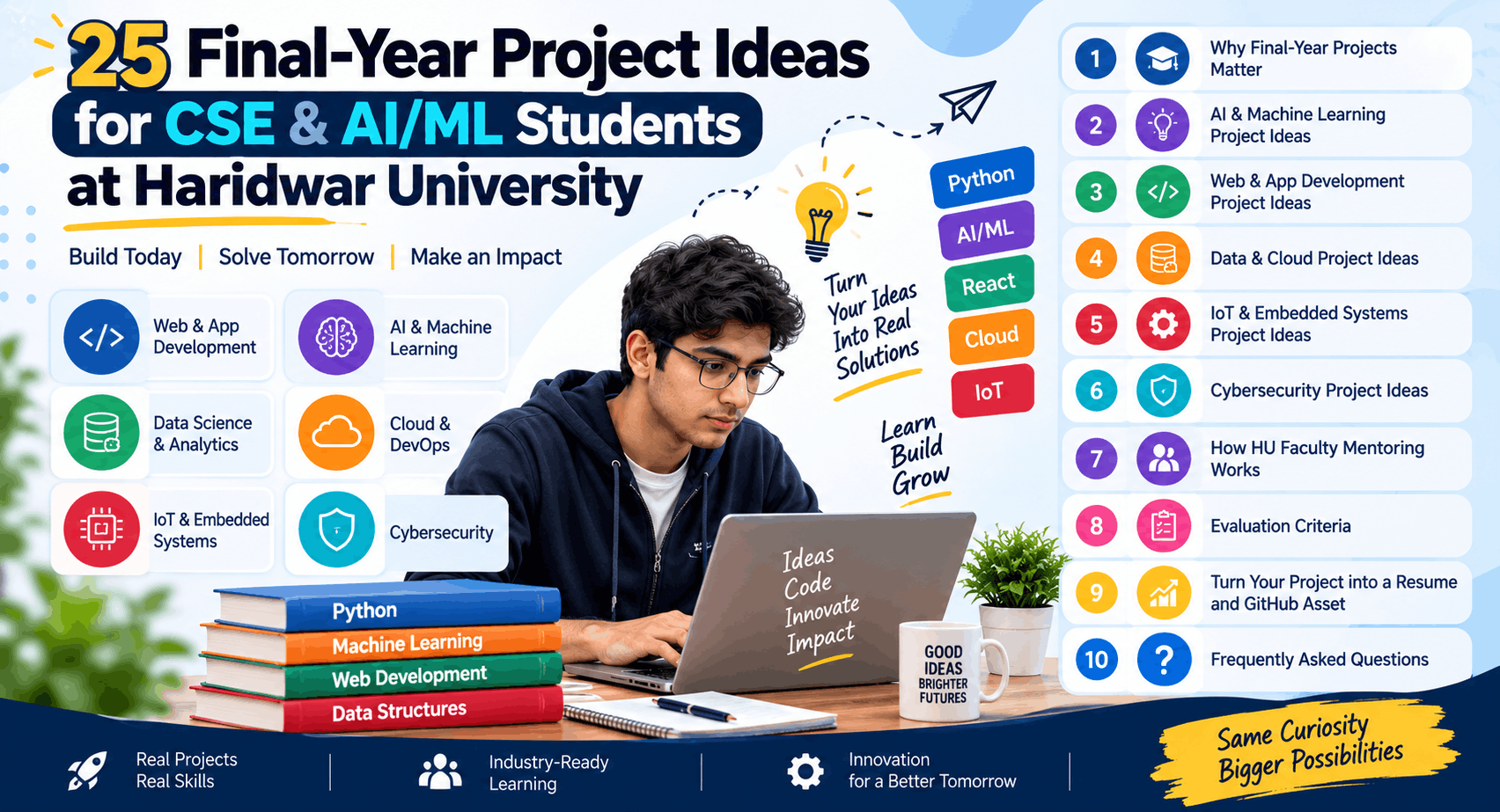
Table of Contents
- 1. Why Your Final-Year Project Matters More Than You Think
- 2. AI & Machine Learning Projects (Projects 1–8)
- 3. Web & App Development Projects (Projects 9–14)
- 4. Data & Cloud Projects (Projects 15–19)
- 5. IoT & Embedded Systems Projects (Projects 20–22)
- 6. Cybersecurity Projects (Projects 23–25)
- 7. How HU Faculty Mentoring Works
- 8. Evaluation Criteria for Final-Year Projects
- 9. Turning Your Project into a Resume and GitHub Asset
- 10. HU's CSE & AI/ML Programmes, and the Fees Behind Them
- 11. Frequently Asked Questions (FAQs)
- 12. Explore Programmes & Campus Admissions
1. Why Your Final-Year Project Matters More Than You Think
In contemporary engineering placements, recruiters from top technology firms spend less time asking textbook definitions and more time scrutinizing your capstone project repository. They want to see how you structure code, handle edge cases, manage datasets, debug deployment failures, and communicate technical trade-offs.
A capstone project is not just an academic requirement to clear your eighth semester; it is your primary proof of engineering competence. Choosing a project aligned with industry demand turns your resume into an invitation for high-impact interview discussions.
2. AI & Machine Learning Projects (Projects 1–8)
These eight ideas cover the AI/ML themes recruiters ask about most: computer vision, natural language processing (NLP), and applied predictive modeling. Where a project requires training data, IndiaAI's AIKosh platform (hosting over 7,000 public datasets and models across 20 sectors, as of September 2026, under the government's IndiaAI Mission) serves as an authorized, legitimate starting point instead of scraping unverified data.
1. Crop Disease Detection from Leaf Images
Difficulty: IntermediateProblem: Farmers often catch crop disease too late to save the yield, resulting in severe agricultural loss.
Tech Stack: Python TensorFlow CNN OpenCV Streamlit demo
2. Fake News and Misinformation Detector
Difficulty: Intermediate/AdvancedProblem: Forwarded messages and unverified stories spread across digital channels faster than fact-checking can keep up.
Tech Stack: Python spaCy scikit-learn / fine-tuned BERT Flask API
3. AI-Based Resume Screener and Job Matcher
Difficulty: IntermediateProblem: Placement cells manually shortlist hundreds of student resumes against a handful of rigid job descriptions, leading to fatigue and oversight.
Tech Stack: Python spaCy entity extraction cosine similarity / sentence-transformers React UI
4. Multilingual Hindi-English Campus Chatbot
Difficulty: IntermediateProblem: Students and parents frequently ask admissions and campus logistics questions in Hindi, English, or mixed Hinglish text.
Tech Stack: Python Rasa / transformer intent classifier WhatsApp / Telegram API
5. Predictive Maintenance for Lab Equipment
Difficulty: AdvancedProblem: Engineering laboratory machines and computational nodes fail without warning, disrupting practical exam schedules.
Tech Stack: Python scikit-learn / XGBoost sensor telemetry (simulated or IoT kit) Grafana dashboard
6. Indian Sign Language Recognition
Difficulty: AdvancedProblem: Assistive communication tools for the hearing-impaired remain extremely limited for Indian Sign Language (ISL).
Tech Stack: Python MediaPipe / OpenCV hand landmarks CNN or LSTM classifier
7. Sentiment Analysis of Product or App Reviews
Difficulty: Beginner/IntermediateProblem: Commercial enterprises need real-time sentiment telemetry across thousands of app reviews and user feedback channels.
Tech Stack: Python VADER / fine-tuned transformer Pandas Streamlit / Power BI
8. AI-Powered Attendance via Face Recognition
Difficulty: IntermediateProblem: Manual roll-calls in large lecture sections consume 10–15 minutes of valuable instructional time.
Tech Stack: Python OpenCV face_recognition / lightweight FaceNet MySQL
3. Web & App Development Projects (Projects 9–14)
Full-stack software projects demonstrate that you can architect, build, and ship a production-grade software application end to end — far beyond running isolated scripts inside a Jupyter Notebook.
9. Campus Placement Portal
Difficulty: IntermediateProblem: Institutional placement cells juggle unorganized spreadsheets across multiple cloud drives, recruiters, and batch applications.
Tech Stack: MongoDB Express React Node.js (MERN) JWT Authentication
10. E-Commerce Site with a Recommendation Engine
Difficulty: Intermediate/AdvancedProblem: Small online merchants lack enterprise personalization tooling to suggest relevant products to shoppers.
Tech Stack: React / Next.js Node.js MongoDB Python Collaborative-Filtering Microservice
11. Telemedicine Appointment Booking App
Difficulty: AdvancedProblem: Semi-urban and rural towns near Roorkee experience limited physical access to specialized medical healthcare.
Tech Stack: React Native / Flutter Firebase / Node.js WebRTC video SDK
12. Hostel Management System
Difficulty: Beginner/IntermediateProblem: Room allocation, mess billing calculations, and student out-pass leave requests are frequently mishandled on physical paper registers.
Tech Stack: Django / Spring Boot MySQL Role-based admin & student portal
13. Mini Learning Management System (LMS)
Difficulty: IntermediateProblem: Regional coaching centres require lightweight course distribution and quiz administration without deploying bulky enterprise LMS suites.
Tech Stack: MERN or Django File-upload handling Automated quiz-scoring module
14. Real-Time Chat and Collaboration App
Difficulty: Intermediate/AdvancedProblem: Student project teams require dedicated, distraction-free internal messaging and file sharing without relying on generic consumer social apps.
Tech Stack: Node.js Socket.io / WebSockets React Redis for pub/sub session state
4. Data & Cloud Projects (Projects 15–19)
Cloud and data-engineering capabilities are what separate a model that runs only on a personal laptop from an enterprise system that operates reliably at scale. A standard free-tier account on AWS, Azure, or Google Cloud Platform (GCP) is fully sufficient to complete all five projects in this section.
15. Real-Time Sales Analytics Dashboard
Difficulty: AdvancedProblem: Regional retail chains cannot spot sudden shifts in demand or inventory leakage until static month-end reports arrive.
Tech Stack: Apache Kafka Python Cloud Warehouse (Amazon Redshift / Google BigQuery) BI Dashboard
16. Serverless Pipeline for IoT Sensor Data
Difficulty: AdvancedProblem: Raw hardware sensor streams arrive erratically and require immediate serverless cleaning, schema validation, and partitioned cold storage.
Tech Stack: AWS Lambda / Azure Functions MQTT broker Managed DynamoDB / Firestore
17. Cloud-Based File Storage and Sharing Tool
Difficulty: IntermediateProblem: Students and small research labs need a private, secure, self-hosted cloud-drive alternative for sharing large files.
Tech Stack: AWS S3 / Azure Blob Storage Node.js / Django Time-limited pre-signed URL generator
18. Public Dataset Analysis and Visualization
Difficulty: Beginner/IntermediateProblem: Extensive open Indian government and demographic data is readily available but rarely explored by engineering undergraduates in a structured, actionable manner.
Tech Stack: Python Pandas IndiaAI AIKosh curated dataset Power BI dashboard
19. Retail Data Warehouse and BI Dashboard
Difficulty: AdvancedProblem: A simulated multi-branch retail chain lacks a unified analytical source of truth across transactions, inventory, and supplier returns.
Tech Stack: Star-schema warehouse (PostgreSQL / Snowflake free tier) SQL ETL pipelines Power BI reporting
5. IoT & Embedded Systems Projects (Projects 20–22)
These three hardware-software hybrid projects sit closer to physical engineering, tailored for student groups who want a tangible, interactive prototype to demonstrate live during final project defense before external examiners.
20. Smart Agriculture Monitoring System
Difficulty: IntermediateProblem: Smallholder farms lack low-cost, real-time soil-moisture and atmospheric monitoring to automate precision irrigation.
Tech Stack: ESP32 / Arduino Capacitive soil-moisture & DHT sensors ThingSpeak / Firebase telemetry dashboard
21. IoT-Based Smart Parking System
Difficulty: IntermediateProblem: Busy commercial centres and college parking facilities generate fuel wastage and congestion due to manual slot hunting.
Tech Stack: Ultrasonic distance sensors Raspberry Pi / ESP32 Mobile app showing live slot status
22. Voice-Controlled Home Automation
Difficulty: Beginner/IntermediateProblem: Standard physical wall switches pose severe inconvenience for elderly individuals or differently-abled users.
Tech Stack: ESP32 / Raspberry Pi Speech-recognition API Optocoupled relay modules Flutter companion app
6. Cybersecurity Projects (Projects 23–25)
Cybersecurity projects carry significant weight in tech screenings if you can articulate the underlying threat model, attack surfaces, and risk vectors, rather than merely showcasing syntax. CERT-In (the Indian Computer Emergency Response Team under MeitY) regularly issues technical advisories that serve as the industry benchmark for what these applications must defend against.
23. Network Intrusion Detection System (NIDS)
Difficulty: AdvancedProblem: Small and medium enterprises rarely have access to budget-friendly enterprise-grade intrusion detection mechanisms.
Tech Stack: Python scikit-learn / XGBoost NSL-KDD / CICIDS benchmark dataset Wireshark / PCAP parser
24. Secure File Encryption and Sharing Tool
Difficulty: IntermediateProblem: Sharing confidential files over unencrypted email or consumer chat exposes sensitive information in transit and at rest.
Tech Stack: Python / Node.js AES-256 (symmetric) & RSA-2048 (asymmetric) Web UI with end-to-end client decryption
25. Phishing URL Detection Using Machine Learning
Difficulty: IntermediateProblem: Phishing campaigns remain one of the most prolific and dangerous attack vectors highlighted across CERT-In's public security advisories.
Tech Stack: Python scikit-learn / Random Forest Lexical & WHOIS URL feature extraction Flask demo interface
7. How HU Faculty Mentoring Works
Final-year project work under an AICTE-aligned B.Tech curriculum sits in a dedicated project-and-seminar credit block culminating in the eighth semester, with an experienced faculty guide assigned per student or team (AICTE Model Curriculum sets aside project work, seminar, and internship as a distinct credit category).
At Haridwar University's Department of Computer Science & Engineering, this generally follows a structured four-stage evaluation pipeline:
1. Guide Allocation & Topic
Alignment of student project interests with faculty domain expertise across AI, Systems, and Cloud.
2. Synopsis Review
Submission of a one-page problem statement, proposed methodology, and initial feasibility checklist.
3. Mid-Term Review
Live demonstration of baseline code, dataset pipelines, and initial schema or model prototypes.
4. Final Defense
End-to-end prototype demo, comprehensive IEEE-format project report defense before an evaluation committee.
Mentors typically expect a one-page problem statement before signing off on a topic, so narrowing down your project choice from this curated list early guarantees you significantly more hands-on guidance time before the mid-term checkpoint.
8. Evaluation Criteria for Final-Year Projects
Across AICTE-aligned CSE programmes, internal and external evaluation panels systematically weigh four fundamental dimensions:
- Originality and Problem Clarity: Is the problem well-defined and contextualized, or is it a verbatim clone of a generic internet tutorial?
- Technical Execution: Does the application actually compile, execute, and handle edge cases reliably live, rather than merely relying on static presentation slides?
- Documentation & Code Quality: Is the repository modular, commented, and accompanied by a well-structured project report following academic standards?
- Defense & Architectural Justification: How clearly and convincingly can the student defend design trade-offs (e.g., choosing WebSockets over REST, or BERT over BiLSTM) during technical cross-examination?
⚠️ Faculty Examiner Warning: A stock dataset and tutorial code, left unmodified, consistently lose marks on originality even when the code runs cleanly. Select a project you can meaningfully adapt, benchmark against alternative models, or enrich with custom data rather than merely reproduce.
9. Turning Your Project into a Resume and GitHub Asset
A finished project is only half the battle; packaging it into an accessible, professional digital asset is what actually gets you shortlisted in corporate screening rounds. A clean GitHub repository featuring a descriptive README.md, architectural diagrams, quickstart reproduction steps, and a one-sentence resume impact bullet (highlighting the problem solved and measurable outcomes) distinguishes top candidates.
Recruiters who hire from Haridwar University's CSE and AI/ML pipeline — including top tier employers such as TCS, IBM, and Cognizant among the university's verified hiring partners (see our Training & Placement Overview) — consistently ask candidates to walk through one project end to end. Make sure you can articulate your system's architecture, challenges, and lessons learned in under three minutes.
Related reading: explore our Coding Practice Roadmap for Placements and A Day in the Life of a B.Tech Student at HU to help balance project development with semester exam routines.
10. HU's CSE & AI/ML Programmes, and the Fees Behind Them
For prospective candidates evaluating engineering admissions for the upcoming 2026 academic year, Haridwar University delivers industry-integrated B.Tech programmes with transparent tuition structures:
B.Tech (Hons.) Computer Science & Engineering
Complete 4-year curriculum covering advanced systems, full-stack development, cloud computing, and cybersecurity.
- Total 4-Year Tuition: ~₹4,77,000
- Year 1: ₹1,32,000
- Years 2–4: ₹1,15,000 per year
B.Tech (Hons.) AI & Machine Learning
Specialized 4-year degree focusing on deep learning, computer vision, natural language processing, and big data systems.
- Total 4-Year Tuition: ~₹5,97,000
- Year 1: ₹1,62,000
- Years 2–4: ₹1,45,000 per year
Fee figures verified against HU's official Fees & Scholarships portal as of 9 September 2026. Merit scholarships (awarded on JEE rank, Class 12 PCM aggregate, or CUET score) can cut up to 80% off first-year tuition. A student is eligible for only one institutional scholarship scheme.
11. Frequently Asked Questions (FAQs)
1. How do I choose a topic from this list?
Match it to your immediate skill gap and career target: choose AI/ML if you want to solidify machine learning fundamentals, Web/App if you need full-stack depth for software engineering interviews, or Data/Cloud if you are targeting data engineering roles.
2. Can I combine ideas from two categories?
Yes — hybrid projects like IoT smart agriculture monitoring integrated with predictive ML maintenance create exceptional differentiation. Always confirm the expanded scope and deliverables with your faculty guide first.
3. Do I need cloud experience before starting a Data & Cloud project?
No. Free tiers across AWS, Azure, and Google Cloud Platform provide more than enough computational credits and managed services for all five ideas above; you build your cloud competence incrementally as you develop the project.
4. How many students can work on one project as a team?
Team size guidelines are established department-wise based on total project scope rather than a rigid fixed number — confirm current batch limits with your departmental project coordinator before submitting the synopsis.
5. Is a research paper required alongside the project?
A publication is not mandatory for every capstone project, but authoring a conference paper or journal article substantially strengthens postgraduate (M.Tech/MS) and research-oriented applications. Consult your guide to see if your methodology has novel research potential.
6. Which category is best for placement interviews?
AI/ML and Cybersecurity draw the most technical screening questions from specialist hiring teams, but a clean, fully deployed Web & App project with automated testing performs just as strongly for general software engineering tracks.
7. Can I use open datasets instead of collecting my own?
Yes — the IndiaAI Mission's AIKosh repository hosts thousands of verified public datasets across healthcare, agriculture, and governance; using open public data is completely legitimate provided you cite source provenance and licensing clearly.
8. What if my own idea isn't on this list?
That is completely encouraged — prepare a concise one-page problem statement outlining the objective, proposed tech stack, and deliverable milestones, and present it to your assigned faculty guide for formal approval.
9. How do I make my project GitHub-ready?
Author a comprehensive README.md that details the project problem statement, architecture diagram, tech stack, installation instructions, environment variables, and live screenshots or a short GIF demo of the functioning system.
12. Explore Programmes & Campus Admissions
Whether you are a current student preparing your capstone synopsis or an applicant looking forward to engineering at Haridwar University, our dedicated faculty, advanced computing labs, and comprehensive placement support provide the platform to build career-defining projects.
Build Your Engineering Career at Haridwar University
Admissions are open for B.Tech in CSE, AI & Machine Learning, and allied engineering disciplines with merit scholarships of up to 80% on first-year tuition.