

For most Computer Science students, the primary challenge is not finding coding questions. There are thousands of them on LeetCode, HackerRank, and Codeforces. The real hurdle is knowing what to practise, in what sequence, and when to transition from solving random problems to targeted placement assessments.
At Haridwar University (HU), I consistently advise students to treat coding practice as a structured four-year progression rather than a panicked final-year rush. You do not need to solve hundreds of hard problems in your first year. You need to build solid habits early and increase problem complexity systematically.
Table of Contents
1. Start Coding Practice Before Placement Season
2. Semester-wise Coding Practice Roadmap (Semesters 1 to 8)
3. DSA Topics: Build the Right Coding and DSA Foundation
4. Set Realistic Coding Practice Targets
5. How to Use LeetCode and HackerRank Without Random Practice
6. Follow a Consistent Weekly Practice Routine & Contests
7. How to Track Your Coding Progress
8. Coding Practice Is Only One Part of Placement Preparation
1. Start Coding Practice Before Placement Season
Placement preparation becomes overwhelming when coding begins too late. A student who starts DSA in their final year attempts to learn fundamental data structures, solve hundreds of problems, build speed, and prepare for behavioral rounds simultaneously.
A sustainable progression breaks this down into manageable milestones:
Programming Fundamentals ➔ Core Data Structures ➔ Algorithmic Problem Solving ➔ Timed Assessments ➔ Technical Interviews
Our CSE career guide follows a similar progression, moving students from programming and problem-solving towards DSA, projects, internships and technical interviews.
The goal is not collecting a vanity streak on LeetCode; it is gaining the confidence to approach an unfamiliar problem, decompose it cleanly, and implement an optimal solution within 30 to 45 minutes.
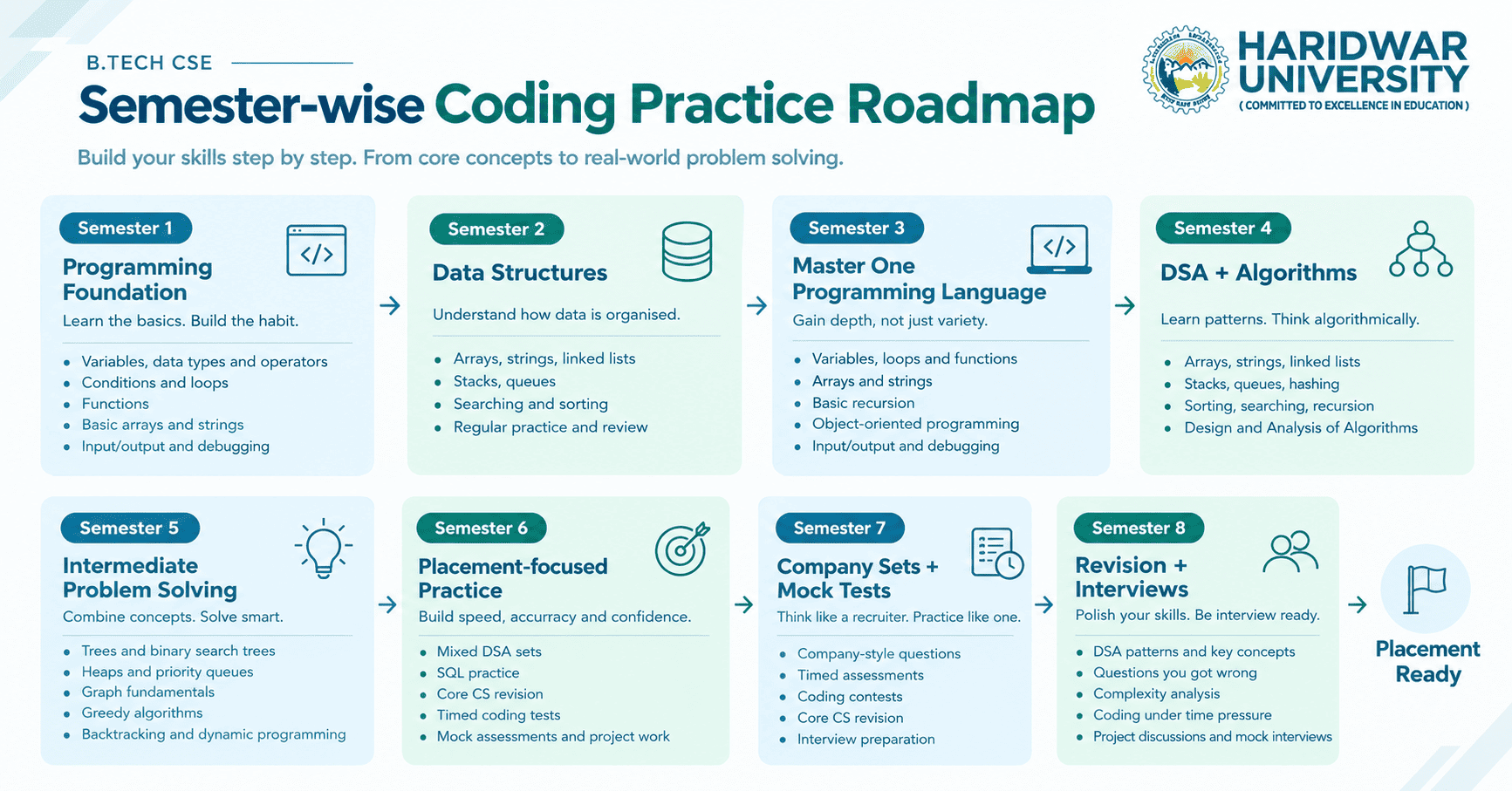
2. Semester-wise Coding Practice Roadmap (Semesters 1 to 8)
Semester 1: Build Your Programming Foundation
Focus on syntax mastery, computational thinking, and debugging. HU's curriculum introduces C programming at this stage.
- Variables, data types, operators, conditionals, and loops
- Functions, modular code, 1D/2D arrays, and basic strings
- Debugging errors independently and tracing step-by-step logic
🎯 Practice Target: 2–3 short problems per week.
Semester 2: Linear Data Structures
Aligning with HU's second-semester Data Structures curriculum, transition from simple syntax to memory representation.
- Arrays, Strings, Singly & Doubly Linked Lists
- Stacks (LIFO operations) and Queues (FIFO & Circular)
- Linear Search, Binary Search, and Elementary Sorting (Bubble, Insertion, Selection)
🎯 Practice Target: 3–5 problems per week with thorough mistake review.
Semester 3: Master One Primary Language & OOP
Pick one primary language for interview problem-solving (C++ with STL, Java with Collections, or Python).
- Object-Oriented Programming (Classes, Inheritance, Polymorphism, Encapsulation)
- Standard Template Library / Built-in Collections (Vectors, HashMaps, Sets)
- Basic Recursion and Time/Space Complexity (Big-O notation)
Do not switch languages every few weeks. Our programming languages guide explains why building depth in a smaller set of languages is more useful than chasing every new language.
🎯 Practice Target: 4–5 problems per week; avoid language-hopping.
Semester 4: Algorithmic Foundations (DAA)
Strengthen algorithmic thinking in sync with Design & Analysis of Algorithms (DAA).
- Hashing techniques (Collision handling, frequency counting)
- Divide & Conquer (Merge Sort, Quick Sort)
- Two-pointer and sliding window patterns
🎯 Practice Target: 4–6 problems per week with pattern recognition.
Semester 5: Non-Linear Structures & Intermediate Algorithms
Expand to complex hierarchical and network data structures.
- Binary Trees, BST, Tree Traversals (Inorder, Preorder, Postorder, Level-order)
- Priority Queues / Heaps and Greedy Algorithms
- Graph fundamentals (BFS, DFS, Topological Sort) and Dynamic Programming introduction
🎯 Practice Target: 6–10 problems per week.
Semester 6: Shift to Placement-Focused Practice
Simulate real online recruitment assessments (OAs) under strict timers.
- Mix of Medium and Easy DSA problem sets
- SQL query writing (Joins, Aggregations, Subqueries) and Database Normalization
- Core CS revision (Operating Systems, DBMS, Computer Networks)
- Integration with AI and development projects
Students should also start connecting coding with projects. A project is not separate from technical preparation. Our AI projects guide shows how practical projects can strengthen programming, problem-solving and portfolio development.
🎯 Practice Target: 8–10 hours per week including timed assessments.
Semester 7: Company-Wise Sets & Mock Contests
Focus on recruiter test formats and live coding tests.
- Company-specific problem patterns (Service-based & Product-based tracks)
- Weekly timed mock tests and LeetCode/HackerRank live contests
- System design basics and technical resume defense
🎯 Practice Target: 8–12 hours per week.
Semester 8: Spaced Revision & Technical Interviewing
Consolidate knowledge and refine verbal technical communication.
- Revisit frequently failed questions and high-frequency DSA patterns
- Live whiteboard problem explanation (Dry-running logic aloud)
- Final project code walkthrough and architectural justification
🎯 Practice Target: 6–10 hours per week (Interview-focused).
3. DSA Topics: Build the Right Coding and DSA Foundation
Avoid jumping directly into complex Dynamic Programming while still struggling with recursion. Follow this logical hierarchy:
HackerRank's current Interview Preparation Kit similarly organises interview practice around areas such as arrays, hashmaps, sorting, strings, greedy algorithms, search, dynamic programming, stacks, graphs and trees.
4. Set Realistic Coding Practice Targets
Consistency far outweighs occasional marathon cramming. Coding 1 hour daily for 5 days yields much better retention than an 8-hour sprint on Sunday.
5. How to Use LeetCode and HackerRank Without Random Practice
Use these platforms as practice environments, not as your curriculum.
LeetCode provides structured Study Plans that can help students organise practice rather than simply browsing individual questions.
HackerRank's preparation kits similarly provide structured sets, including one-week, one-month and three-month options.
The 5-Step Learning Loop:
Learn Concept ➔ Solve 3–4 Guided Examples ➔ Attempt Unseen Medium Problems ➔ Log Mistakes & Edge Cases ➔ Revisit 30 Days Later.
6. Follow a Consistent Weekly Practice Routine & Contests
Incorporate live coding contests starting in Semester 4 or 5 (bi-weekly) and weekly in Semesters 6 and 7. Contests train crucial real-world assessment skills:
- Rapid problem statement reading and constraint analysis
- Deciding question attempt order quickly
- Handling time pressure and debugging failing test cases
- Accepting imperfect scores and conducting detailed post-contest analysis
7. How to Track Your Coding Progress
Maintain a simple spreadsheet tracker rather than relying solely on platform profile badges:
🚀 Campus Coding Spotlight: Aavishkar Technical Club
At Haridwar University, the student-led Aavishkar Technical Club hosts the Coding & Algorithms Special Interest Group, organizing monthly competitive programming challenges, algorithmic hackathons, and the flagship 24-hour HackHU hackathon to foster collaborative problem solving.
8. Coding Practice Is Only One Part of Placement Preparation
Clearing the online coding round gets you the interview; clearing the technical interview requires complete software engineering fluency:
- Core CS Concepts: Operating Systems (Processes, Threads, Deadlocks), DBMS (SQL, Transactions, ACID properties), Computer Networks (TCP/IP, HTTP).
- Project Defensibility: Deep technical mastery of every line of code in your resume projects.
- Communication & Aptitude: Explaining your thought process clearly while live coding.
Learn more about overall training on the HU Training & Placement Overview.
9. Frequently Asked Questions (FAQs)
How early should I start coding for placements?
Ideally, begin structured coding practice by Semester 3. Early exposure in Semesters 1 and 2 builds programming fluency and removes fear of syntax.
How many coding problems should I solve for placements?
Focus on understanding core algorithmic patterns and reviewing mistakes rather than chasing an arbitrary target like 500 or 1,000 problems.
Is LeetCode better than HackerRank for placements?
Neither is universally superior. HackerRank is excellent for structured language basics and topic tracks, while LeetCode excels for company-specific interview patterns.
Which programming language should I use for DSA?
C++, Java, and Python are all widely accepted. Choose one language, master its standard libraries, and stick with it consistently.
Should I practise company-wise coding questions?
Yes, particularly in Semesters 6 and 7 to understand assessment patterns, though you should avoid memorizing specific questions.
Are coding contests necessary for placement preparation?
Contests are highly recommended for developing speed, mental resilience, and the ability to debug under real exam countdowns.
What should I track while practising coding?
Track topics covered, problems attempted, questions solved independently, logged mistakes, and spaced revisit dates.
10. Build Your Coding Routine at Haridwar University
A good coding practice plan for placements is not about solving problems all day. It is about progressing deliberately.
Start with one language. Build your DSA foundation. Increase difficulty gradually. Introduce timed practice. Review your mistakes. Build projects alongside coding. By the time placement season arrives, you should not be learning the basics for the first time. You should be applying them.
At Haridwar University, I encourage CSE students to treat coding as a skill developed through regular practice, projects and problem-solving rather than as a subject reserved for placement season. If you want to strengthen your wider CSE preparation, our career guide for B.Tech CSE students provides the broader progression from programming and DSA to projects, internships and career roles.
Join the Coding Culture at Haridwar University
Accelerate your coding journey with modern computing laboratories, student hackathons, and structured placement training.