

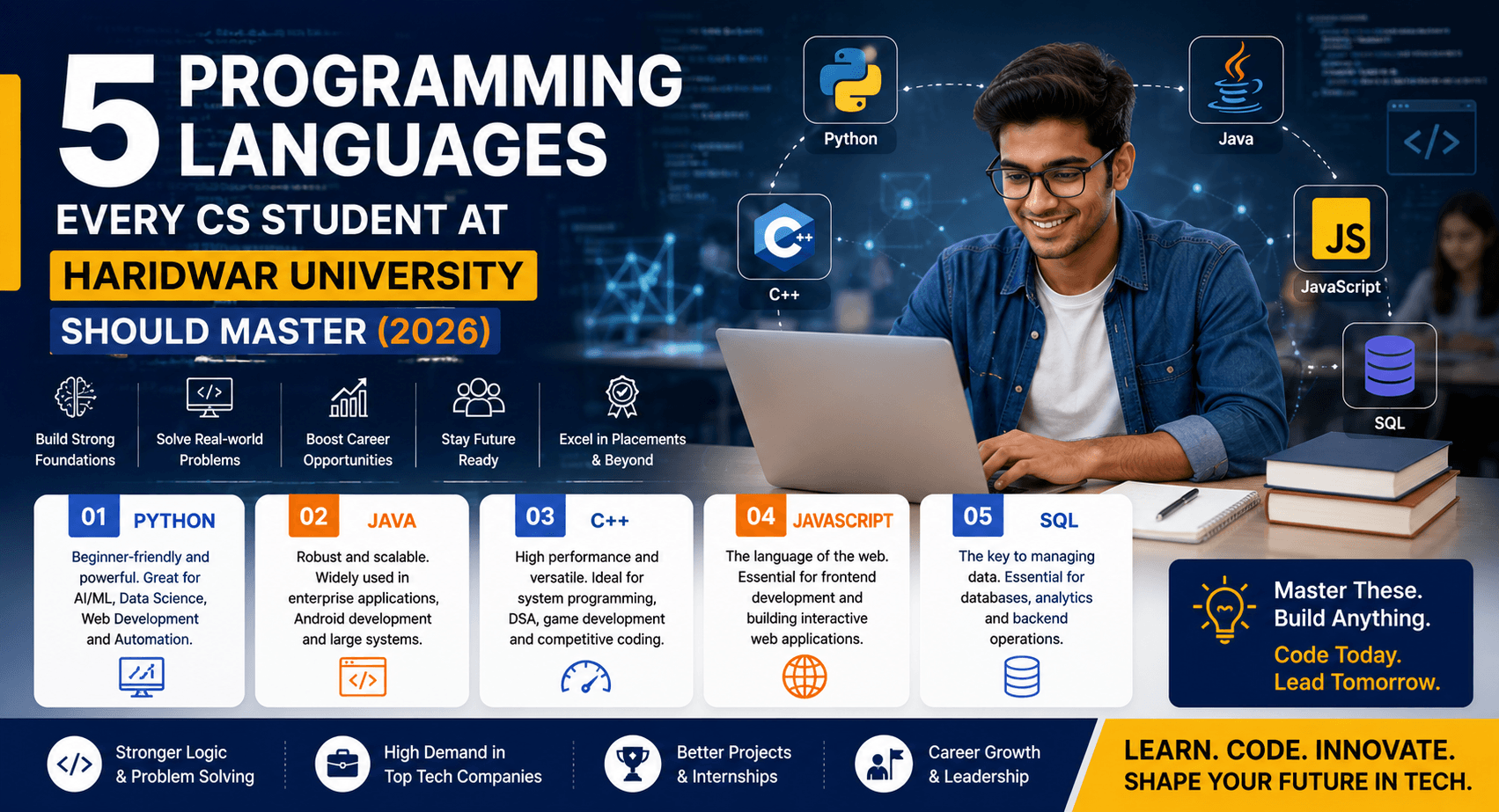
5 Programming Languages Every CS Student at Haridwar University Should Master (2026)
Dr. Himanshu Verma
Faculty, HU Department of AI/ML
Ask ten CS students what actually matters and you'll get ten different answers. Half of them will be repeating whatever's trending on Twitter that week. The real answer is smaller than people think, and it comes down to programming languages CS students learn in 2026 — five of them, specifically, and not because they're new or exciting but because they keep showing up in hiring data, in HU's own syllabus, and in the interview rooms you'll be walking into in a year or so.
So here's the plan for this post: why these five made the cut, what you can actually build with each, what the job numbers currently say, how HU's CSE program already teaches them, how to get into the programme in the first place, what order makes sense to learn them in, where to study outside class, and which projects are worth putting on a resume.
Table of Contents
- 1. Why These 5: Python, Java, JavaScript, C++, and Go/Rust
- 2. What to Build With Each Language
- 3. Industry Demand Data for 2026
- 4. How HU's B.Tech CSE Curriculum Covers These Languages
- 5. Getting In: HUAET and Admission to HU's B.Tech CSE
- 6. The Order to Learn Them
- 7. Self-Study Resources Worth Your Time
- 8. Projects to Showcase for Placements
- 9. Frequently Asked Questions (FAQs)
Why These 5: Python, Java, JavaScript, C++, and Go/Rust
Every year there's some new “must-learn” language making the rounds, and most years it never touches anyone's actual first job. The languages that matter are the boring, consistent ones — the ones companies keep hiring for, that show up in your own coursework, and that let you build something real before placement season sneaks up on you.
Python's on this list for the obvious reason — it's the default now for AI, data work, automation, and a fair bit of backend too. It's also just less painful to start with, which counts for something when you're juggling five subjects and trying to line up an internship at the same time.
Java doesn't get the hype Python does, but it's still running half the enterprise software out there. Banking systems. Insurance platforms. Large backend services at companies like TCS, Infosys, Wipro — Java's underneath a lot of it. And most core Data Structures & Algorithms (DSA) and Object-Oriented Programming (OOP) interview questions still get asked in Java, so if you're chasing IT-sector placements, you can't really skip it.
JavaScript is the only language every browser runs natively, full stop. If web development interests you even a little, there's no way around learning it. Add a framework on top and you can ship something on your own, no team required.
C++ is where things get less abstract — memory, pointers, what your code is actually doing when it runs. Competitive programmers still live in C++. So do game engines, and a lot of the harder interview questions at product companies.
Then there's Go and Rust, the “pick one, not both” pair. Go's become the default for cloud infrastructure — Docker, Kubernetes, that whole world runs on it. Rust gets around memory-safety headaches that have dogged C++ forever, and it's starting to show up on recruiters' radar because of it. As for which one — go with Go if cloud and backend feels like your thing, Rust if you're more drawn to systems-level or performance work.
What to Build With Each Language
Here's where a lot of students get stuck — they learn syntax and never build anything with it. So think of it this way instead: what's each language actually for?
- Python is good for data analysis scripts, ML models, a Django or Flask app, automation bots, or a scraper pulling data off some website.
- Java shines in Android apps, Spring Boot REST APIs, or something like an inventory system with a real database behind it — not a toy one.
- With JavaScript you can put together a portfolio site, a React dashboard, a full MERN project — or if you've got the time, even a small browser extension.
- C++ is worth spending on a basic compiler or interpreter, a serious LeetCode/Codeforces habit, or a small SFML game.
- Go and Rust work well for CLI tools, small microservices, or a concurrent scraper — Go especially, because of goroutines.
There's a pattern here worth noticing. Every language has a lane it's genuinely built for. Trying to force a machine learning project into Java, or build a REST backend in raw C++ just because you happen to know it — that's usually more effort than it's worth. Use the right tool.
Industry Demand Data: Which Programming Languages CS Students Should Learn in 2026
The numbers mostly back this list up. Python's currently leading the TIOBE Index by a wide margin — somewhere near 19% as of mid-2026, well ahead of anything else on the chart, and it's basically owned the AI-and-data space for years at this point. JavaScript wins on raw usage, though; most working developers report using it regularly, mainly because nearly every company needs some kind of web presence.
Java's slipped a bit in recent TIOBE numbers, which sounds worse than it is — hiring hasn't followed the same trend. It's still among the top five most-searched languages globally, and Indian service companies keep running core systems on it. C and C++ combined still hold spots two and three on that same index. Systems-level skills clearly haven't been pushed out by the AI hype cycle, whatever the headlines might suggest.
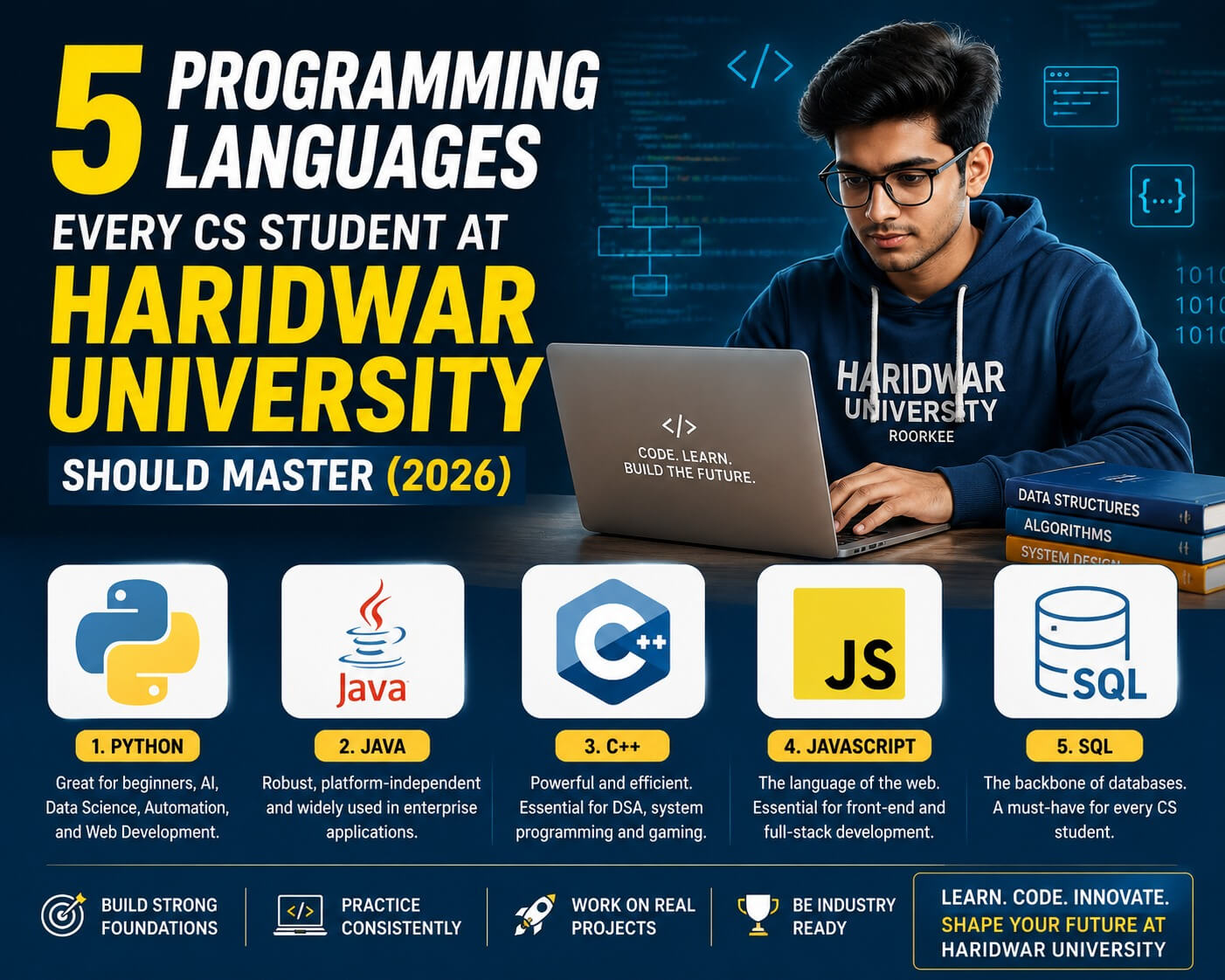 Top 5 programming languages CS students should learn in 2026: Python, Java, JavaScript, C++, Go, Rust
The more interesting shift is at the bottom half of the top 10. Rust made it into TIOBE's top 10 for the first time ever this year — a jump from well outside the top 15. It also tends to pay well; developers who know Rust generally earn above the median. Go's usage in cloud and backend infrastructure just keeps climbing too — makes sense, given how much is moving to the cloud these days.
So if you're trying to read the tea leaves — Python and JavaScript will get you hired quickest, since practically everyone's hiring for both. Java gets you through the standard technical interview rounds. C++ proves you actually understand what's underneath the syntax. Go or Rust is what makes you different from everyone else applying for the same role.
How HU's B.Tech CSE Curriculum Covers These Languages
None of this sits outside the syllabus at Haridwar University — it's built into the semester structure directly. Early semesters cover C and C++ through core programming and data structures, which happens to line up exactly with when you should start competitive programming and DSA prep anyway. OOP gets taught through Java, the same language most product companies use in technical rounds — convenient, assuming you take the coursework seriously in the first place.
Python isn't confined to one course either. It shows up in intro programming, then again in AI, ML, and data science electives — which tracks with how central it's become both in classrooms and in the industry generally. Web technology and full-stack electives bring in JavaScript alongside modern frameworks, so you're actually building front-end and back-end things, not just reading about them in a slide deck.
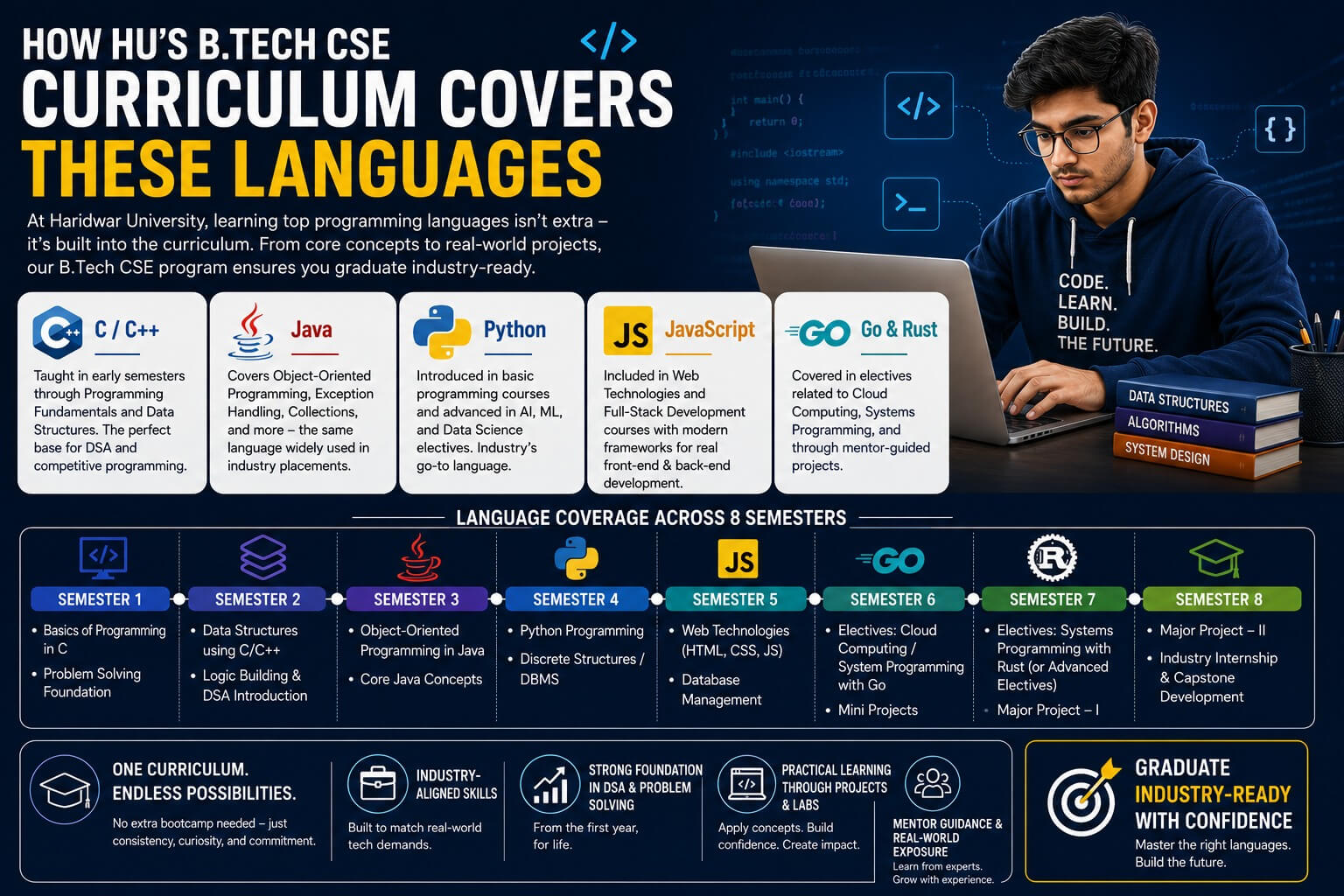 B.Tech CSE students at Haridwar University learning programming languages for placements
Go and Rust are newer additions, understandably. They tend to show up through elective coursework tied to cloud computing and systems programming, or through project work with a faculty mentor rather than a dedicated core paper. String it all together, though, and a student who stays consistent through all eight semesters comes out the other end with working knowledge of all five — no separate bootcamp required, at least in theory.
Getting In: HUAET and Admission to HU's B.Tech CSE
None of this matters if you haven't actually secured a seat yet, so a quick detour on admissions. Haridwar University runs its own entrance exam — the Haridwar University Admission Entrance Test (HUAET) — as a single-platform test that covers admission to programmes across the university, B.Tech CSE included. You'll need a minimum of 10+2 to be eligible, and you can pick a test date and slot based on availability rather than being locked into one fixed exam day, which is more flexible than most university entrance tests.
HU also accepts national-level scores in place of HUAET — JEE Main is the relevant one for B.Tech applicants, alongside options like CUET depending on the programme. Results from HUAET typically come back by email within three working days, and once you're in, there's a 72-hour window to confirm your seat. Merit-based scholarships are also available, including a 25% first-year tuition scholarship for limited seats and a separate sibling scholarship — worth checking on the admissions page if cost is a factor.
Point being: the language roadmap in this post only matters once you're actually enrolled, so if you're still at the application stage, HUAET is where that starts.
The Order to Learn Them
Sequence matters more than most students assume. Jumping around with no real plan just wastes time you don't have to spare.
Start with Python. Forgiving syntax, fast feedback, and it builds programming intuition without also making you fight semicolons and braces at the same time. Move to C++ next — once basic logic clicks, this is where memory, pointers, and data structures actually start making sense, and it's a good point to start DSA prep in earnest. Java comes third. OOP concepts land easier by this point, and Java's stricter syntax reinforces what C++ already taught. It tends to overlap nicely with second-year coursework too. JavaScript is fourth — once core logic is solid, JavaScript plus a bit of HTML/CSS lets you build things people can actually look at, which helps both your resume and your motivation, frankly. Go or Rust comes last, more of a third- or fourth-year specialization once you've figured out whether backend/cloud or systems/performance is more your thing.
Handy coincidence: this order roughly matches how HU's semesters are laid out already. Keep pace with coursework and you're mostly following this sequence by default, without even trying.
Self-Study Resources Worth Your Time
Classroom coverage gets you the fundamentals. What actually makes you placement-ready is what you do outside of class.
- Python: freeCodeCamp's curriculum, the official Python docs, and Kaggle once you want hands-on work with real data instead of toy examples.
- C++: GeeksforGeeks covers DSA practice well, and Codeforces plus LeetCode give you the reps competitive programming demands.
- Java: Oracle's official tutorials paired with a DSA course that specifically uses Java, since a lot of campus placement tests run in Java anyway.
- JavaScript: MDN Web Docs is basically the only reference you need, and from there any decent project-based course covering React and Node rounds things out.
- Go: the official Go Tour, genuinely well put together for beginners.
- Rust: “The Rust Book” — pretty much everyone points to this as the starting point.
Worth building the habit early: finish one resource per language before starting the next one. Half-finished courses scattered across six platforms don't really add up to anything usable.
Projects to Showcase for Placements
A recruiter spends seconds on a resume, not minutes, so your projects need to say something specific right away. That means one solid project per language beats five half-finished ones, every time.
- A Python project built on a real dataset — not another beginner Kaggle set that everyone's already done — something like a recommendation engine or a prediction model with a proper writeup, works well.
- A Java Spring Boot API hooked up to an actual database, ideally with basic auth built in, signals you're backend-ready.
- A full-stack JavaScript project — MERN or similar — actually deployed somewhere and documented on GitHub, not just sitting in a folder on your laptop, carries real weight.
- A strong C++ project, or honestly just a decent competitive programming profile — a respectable Codeforces rating, a solid chunk of LeetCode solved — matters a lot specifically in product-company interviews.
- And one Go or Rust project, even something small like a CLI tool or a basic microservice, tends to be enough on its own to set you apart, mostly because so few students bother with either.
Deploy what you can, document it properly, and walk into interviews ready to explain the choices behind the project — not just what it does on the surface.
Frequently Asked Questions
Which programming languages should CS students learn in 2026?
Python, Java, JavaScript, C++, and one of Go or Rust — that combination covers the highest-demand areas, the fundamentals interviewers actually test, and a skill most other applicants won't have.
Is Python enough to get placed, or do I need more than one language?
Python alone can open doors in AI/ML-focused roles, but most core technical interviews at product and service companies still lean on Java or C++ for data structures and algorithms. Add one of those and your options widen considerably.
Should I bother with C++ if I already know Python?
Worth it, yes. Python builds logic fast; C++ shows you what's happening underneath, which happens to be exactly what competitive programming and a lot of technical interviews test for.
Is Java still worth learning for placements in 2026?
Yes — it's dipped a bit in global popularity charts, but hiring hasn't followed. Enterprise systems still run on it heavily, and campus placement coding tests are frequently Java-based.
Go or Rust — which one should I actually pick?
Depends what direction interests you. Go if backend/cloud infrastructure appeals — it's the standard behind Docker and Kubernetes. Rust if systems programming or performance work is more your speed; it's currently one of the fastest-growing, best-paying skills around.
What order should these five be learned in?
Python first for intuition, C++ second for fundamentals and DSA, Java third to reinforce OOP, JavaScript fourth for visible projects, Go or Rust last as a specialization.
Does HU's B.Tech CSE program actually cover all five?
Yes — C and C++ through early core courses, Java through OOP papers, Python across programming and AI/ML electives, JavaScript through web tech and full-stack electives. Go and Rust mostly through newer electives and project work.
How do I get admission into HU's B.Tech CSE programme?
Through HUAET, Haridwar University's own entrance test, or by submitting a valid JEE Main or CUET score instead. Minimum eligibility is 10+2, and you can book your HUAET slot based on availability rather than a fixed exam date.
What kind of projects actually help at placement time?
One well-documented project per language, not five shallow ones — a Python ML project with real data, a Java Spring Boot API, a deployed full-stack JS app, a solid C++/competitive programming profile, and a small Go or Rust tool.
Realistically, how long does this take?
Students who stay consistent with coursework and add some focused self-study on the side usually hit a placement-ready level across all five by the end of third year, leaving final year free for internships and interview prep.
For a deeper breakdown of how these languages map to placement outcomes: Top Programming Languages for CS Students 2026
See B.Tech CSE at HU →
Discover how Haridwar University prepares Computer Science students for top placements with a robust, modern curriculum covering core and advanced programming languages.
See B.Tech CSE at HU →