

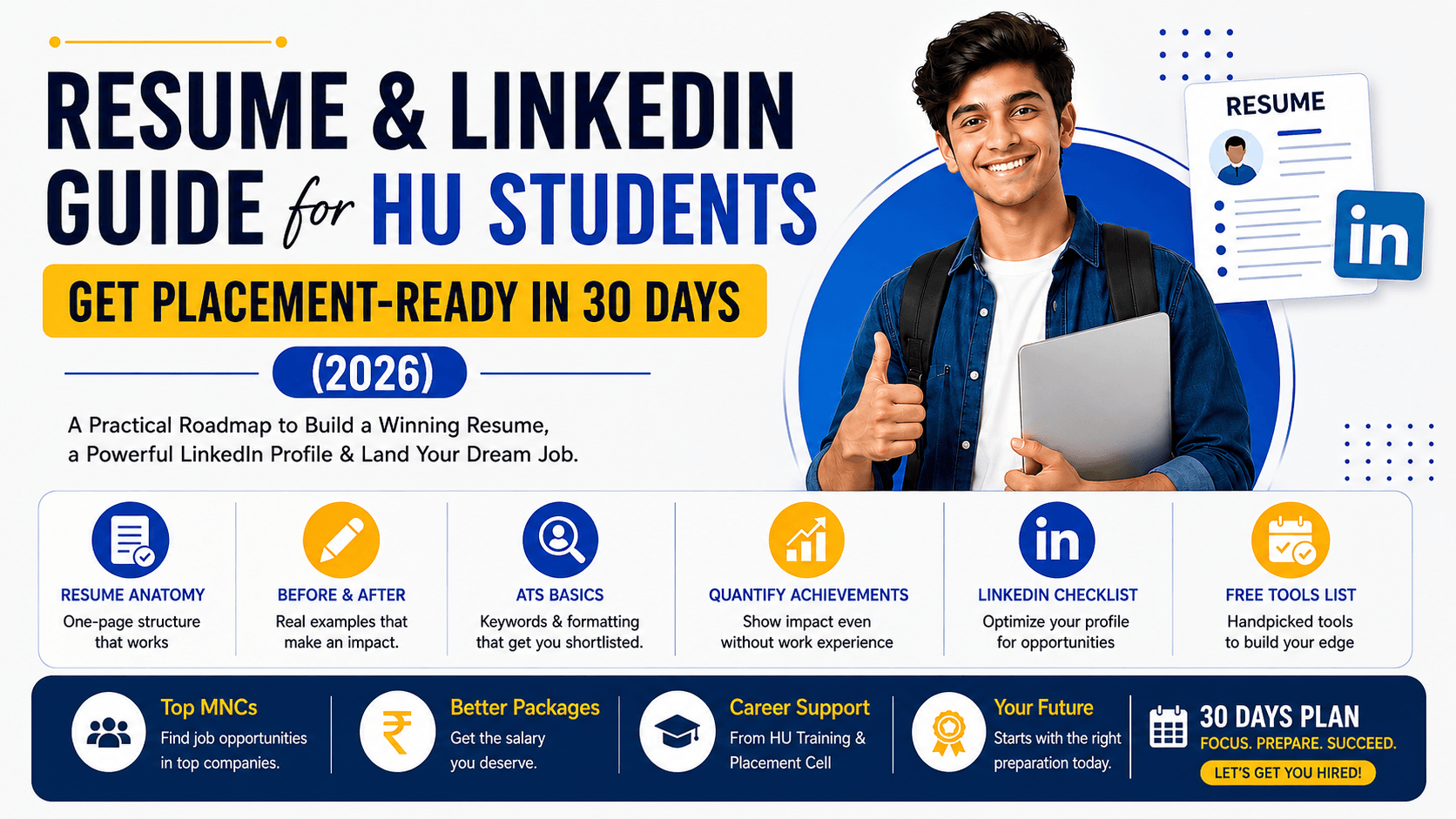
Placement season feels overwhelming the moment you open a blank resume template for the first time. This student resume guide placements 2026 is built specifically for Haridwar University students — engineers, managers, pharmacists, nurses, and agriculture graduates alike — who want a recruiter-ready resume and a placement-ready LinkedIn profile without guesswork. HU's Training & Placement Cell works with 200+ recruiting companies each season, including MNCs such as IBM and Deloitte, with an average package of 6 LPA. This guide turns that placement infrastructure into a practical, do-it-yourself roadmap you can follow in 30 days.
Haridwar University is recognised by the University Grants Commission (UGC), and several of its programmes are approved by statutory councils such as the Pharmacy Council of India and the Indian Nursing Council, so the placement guidance in this student resume guide placements 2026 article is grounded in the same standards recruiters expect from an accredited institution.
Table of Contents
- 1. One-Page Resume Anatomy for Freshers
- 2. Before & After: Resume Line Makeovers
- 3. ATS Basics: Keywords & Formatting
- 4. Project Descriptions That Impress Recruiters
- 5. Quantifying Achievements Without Work Experience
- 6. LinkedIn Profile Checklist
- 7. Common Fresher Resume Mistakes
- 8. The 30-Day Placement-Ready Action Plan
- 9. Free Tools List
- 10. Frequently Asked Questions
1. One-Page Resume Anatomy for Freshers
Recruiters visiting campus spend under 30 seconds on a first resume scan, so freshers should stick to one page, arranged in the order below. Each section should be scannable, consistent in formatting, and free of decorative graphics that confuse both human recruiters and applicant tracking systems (ATS).
Header & Contact Details
Full name, phone number, a professional email ID, city, and links to LinkedIn and GitHub/portfolio (if relevant) — all in one line under your name. Skip your photo, marital status, and full home address; Indian campus recruiters no longer expect these.
Career Objective / Professional Summary
Replace generic lines like "seeking a challenging position" with two lines stating your target role, core skill set, and one measurable strength — for example, your CGPA, a certification, or a project outcome.
Education
List your degree, specialisation, university/board, CGPA or percentage, and year, in reverse chronological order (current degree first, then Class XII, then Class X).
Technical & Soft Skills
Group skills into two short lists — technical (languages, tools, frameworks) and professional (communication, teamwork, leadership) — so recruiters can match them instantly against the job description.
Academic Projects
Two or three strong projects outperform five shallow ones. HU's Resume Building programme runs one-on-one review sessions specifically to help students pick and phrase the right projects for their target industry.
Certifications, Internships & Achievements
Include only certifications relevant to your target role — an AICTE-recognised value-added course, a paid or unpaid internship, a hackathon rank, or a paper presented at a conference all belong here.
Extracurricular & Leadership
A single line on club roles, sports achievements, or volunteering is enough — it shows initiative without crowding out your core sections.
2. Before & After: Resume Line Makeovers
Vague, duty-based lines are the single biggest reason fresher resumes get skipped. Compare these real patterns:
- Before: "Responsible for making a project on food delivery app."
After: "Built a food-delivery Android app with Firebase backend, reducing order-placement time by 40% in usability testing with 20 users." - Before: "Did an internship in marketing."
After: "Completed a 6-week digital-marketing internship; grew a client's Instagram engagement by 25% through 15 scheduled campaigns." - Before: "Participated in college fest as volunteer."
After: "Coordinated a 12-member logistics team for a 3-day, 2,000-attendee college fest, cutting vendor turnaround time by a day."
Notice the pattern: each "after" line names the tool or method, states an action verb, and closes with a number or outcome.
3. ATS Basics: Keywords & Formatting
Most campus drives and corporate portals now filter resumes through an Applicant Tracking System (ATS) before a human ever opens them. India's National Career Service portal, a Government of India employment initiative, also recommends the same plain, keyword-matched resume structure that ATS software scans best.
- Use standard section headings: Education, Skills, Projects, Certifications — avoid creative titles like "My Journey."
- Save and submit as .pdf or .docx as instructed; avoid scanned images or design-heavy templates with columns, text boxes, and icons.
- Mirror 4-6 exact keywords from the job description or the company's job posting (tools, technologies, role titles) in your skills and project sections.
- Stick to standard fonts (Calibri, Arial, Times New Roman) at 10-12pt; ATS parsers can mis-read decorative fonts.
- Avoid headers/footers for contact details — many parsers skip that content entirely.
4. Project Descriptions That Impress Recruiters
A strong project line follows a simple structure: what you built, which tools/technologies you used, and the measurable result or learning outcome. Avoid describing the assignment brief — describe your contribution.
- Weak: "Made a machine learning project for college."
- Strong: "Developed a crop-disease detection model using Python and TensorFlow, achieving 91% classification accuracy on a 2,000-image dataset."
If you're unsure how to phrase a project for your branch, HU's placement team — including feedback shared in the Training & Placement Manager's message — recommends aligning academic projects with live-industry themes such as IoT, AI/ML, cyber security, or smart agriculture, since these map directly to what recruiters are hiring for in 2026.
5. Quantifying Achievements Without Work Experience
You don't need a job title to use numbers. Quantify effort, scale, and outcome wherever possible:
- Academic performance: "Maintained 8.7 CGPA across 6 semesters" instead of "good academic record."
- Scale: "Presented to a panel of 5 faculty judges" or "Coordinated with a 4-member team."
- Time and efficiency: "Reduced manual data-entry time by 3 hours per week using an Excel macro."
- Competitions and events: "Ranked in the top 10 of 120 teams" or "Organised an event for 300+ students."
Even a single well-placed number moves a bullet from generic to credible — it signals that you can measure your own impact, a skill recruiters value in every fresher.
6. LinkedIn Profile Checklist
Recruiters increasingly cross-check a shortlisted resume against LinkedIn before scheduling an interview. Treat your profile as a living, searchable extension of your resume.
Headline
Go beyond "Student at Haridwar University." Use the format: Degree + Branch + 1-2 target skills — for example, "B.Tech CSE | Java, Cloud Computing | Aspiring SDE."
About Section
Write 3-4 short lines covering your degree, one flagship project, and what kind of role you're seeking. LinkedIn's own profile guidance recommends keeping this section conversational and keyword-rich, since recruiters search LinkedIn using the same terms they put in job postings.
Projects & Featured Section
Add your top 2-3 projects with a one-line description each, and pin certificates, GitHub links, or a portfolio in the Featured section so recruiters see proof of work immediately.
Connection Strategy
Send personalised connection requests to HU alumni, recruiters who visit campus, and faculty — a one-line note referencing your branch or a shared event gets far higher acceptance than a blank request. Aim for steady, genuine growth (10-15 relevant connections a week) rather than mass-adding strangers.
7. Common Fresher Resume Mistakes
- Using one generic resume for every company instead of tailoring skills/projects to each job description.
- Listing responsibilities instead of results — "handled social media" instead of "grew followers by 30%."
- Spelling the company name or role title incorrectly — an instant filter-out in most drives.
- Overloading the resume with more than 8-10 bullet points per section, pushing it past one page.
- Leaving contact details, LinkedIn URL, or CGPA out entirely.
- Using unprofessional email IDs or inconsistent tense (mixing "managed" and "manage").
- Submitting a resume with no PDF/Word proofreading pass — typos are read as a lack of attention to detail.
8. The 30-Day Placement-Ready Action Plan
Spread the work across four weeks so it never feels last-minute:
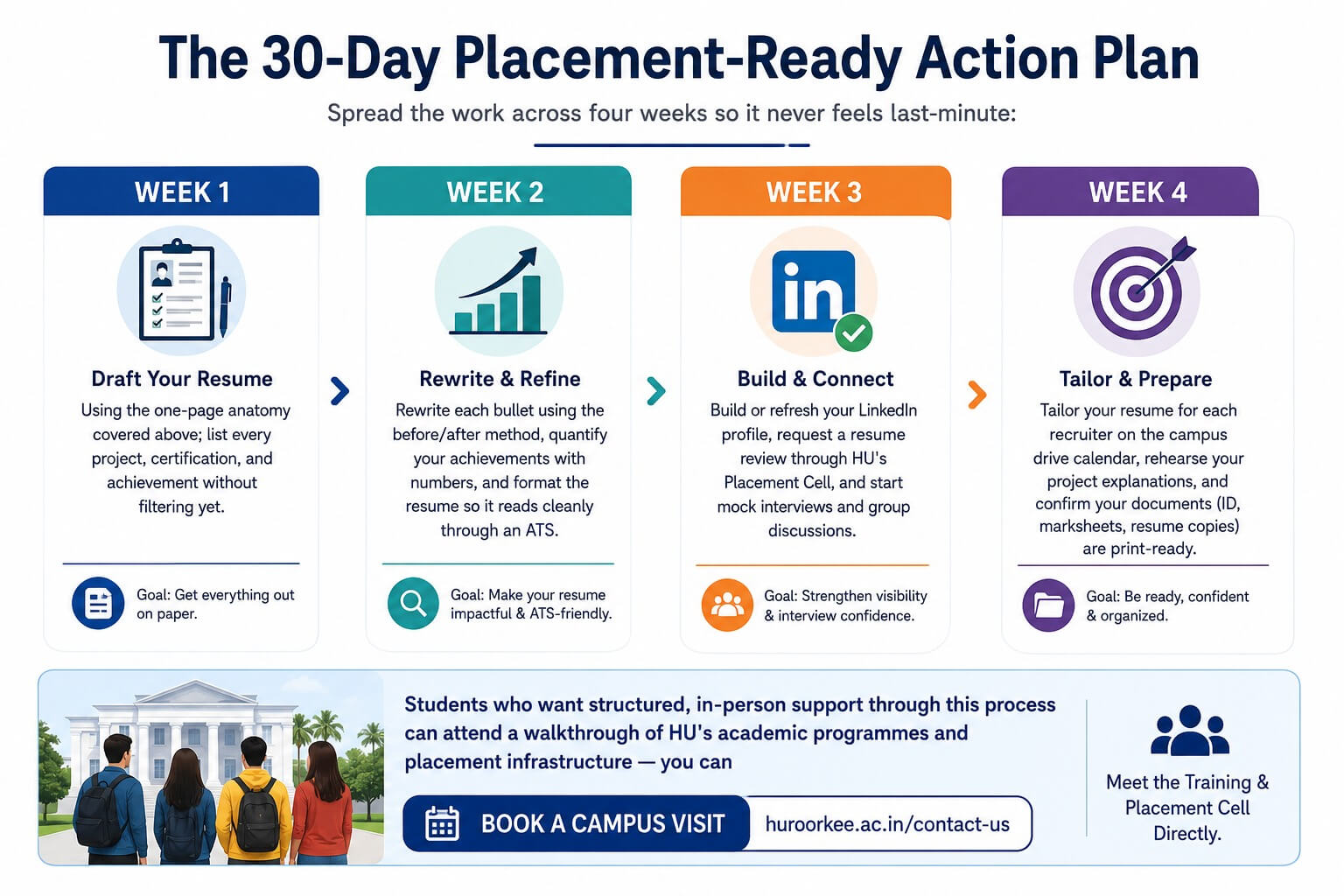
Figure: The 30-Day Placement-Ready Action Plan For Students
- Week 1: Draft your resume using the one-page anatomy covered above; list every project, certification, and achievement without filtering yet.
- Week 2: Rewrite each bullet using the before/after method, quantify your achievements with numbers, and format the resume so it reads cleanly through an ATS.
- Week 3: Build or refresh your LinkedIn profile, request a resume review through HU's Placement Cell, and start mock interviews and group discussions.
- Week 4: Tailor your resume for each recruiter on the campus drive calendar, rehearse your project explanations, and confirm your documents (ID, marksheets, resume copies) are print-ready.
Students who want structured, in-person support through this process can attend a walkthrough of HU's academic programmes and placement infrastructure — you can book a campus visit to meet the Training & Placement Cell directly.
9. Free Tools List
- Canva / Google Docs resume templates: free, ATS-friendly one-page layouts.
- Grammarly (free tier): catches spelling and grammar slips before submission.
- LinkedIn's free "Open to Work" and skill-assessment badges: signal availability and validate listed skills.
- Government of India's Skill India / NSDC portal: free short courses and certifications you can add under your Certifications section.
- Jobscan or a similar free ATS-keyword checker: compares your resume against a job description before you apply.
- GitHub Pages / Google Sites: free hosting for a simple portfolio page linking your projects.
10. Frequently Asked Questions
1. Do I need work experience to build a strong resume?
No. Academic projects, internships, coursework, and extracurricular leadership can all be quantified and framed the same way real work experience is — recruiters at campus drives expect fresher resumes to lead with projects, not jobs.
2. How long should a fresher's resume be?
One page. Recruiters scan dozens of resumes per session, and a single, well-organised page signals clarity and respects their time far more than a padded two-pager.
3. Should I submit my resume as a PDF or Word file?
Follow the format each company specifies in its job posting or portal instructions; when there's no instruction, PDF is the safer default because it preserves formatting across devices while remaining ATS-readable if you avoid images and columns.
4. How many projects should I include on my resume?
Two to three strong, well-described projects work better than five one-line entries. Pick the projects most relevant to the role you're applying for and go deeper on the tools and outcomes.
5. Is LinkedIn really necessary if I already have a resume?
Yes — many recruiters search LinkedIn first to shortlist candidates and verify a resume before an interview call. An updated, keyword-rich profile also lets alumni and recruiters find you outside of campus drives.
6. How can I make my resume ATS-friendly without design skills?
Use a simple single-column layout with standard headings and fonts, avoid text boxes or tables for content, and match 4-6 keywords from the job description in your skills and project lines — no design software required.
7. When should I start resume building — early semesters or right before placements?
Start a draft resume by your second or third year and update it every semester as you complete projects and certifications; arriving at placement season with only a rough first draft leaves too little time to quantify achievements properly.
8. Does Haridwar University offer scholarships alongside placement support?
Yes. HU offers merit, sports-quota, and category-based tuition-fee scholarships for eligible students admitted in the 2025 and 2026 batches; full eligibility criteria and percentages are listed on the Fees & Scholarships page.
9. Who do I contact for one-on-one resume review at HU?
HU's Training & Placement Cell, led by Placement Manager Mr. Prajwal Chaudhary, conducts one-on-one resume reviews, mock interviews, and LinkedIn optimisation sessions as part of the Resume Building programme; students can also reach the cell through the details on the Training & Placement Manager's message page.
Ready to Start Your 30-Day Plan?
A recruiter-ready resume and LinkedIn profile are only useful inside the right placement ecosystem. Here's where to go next: