

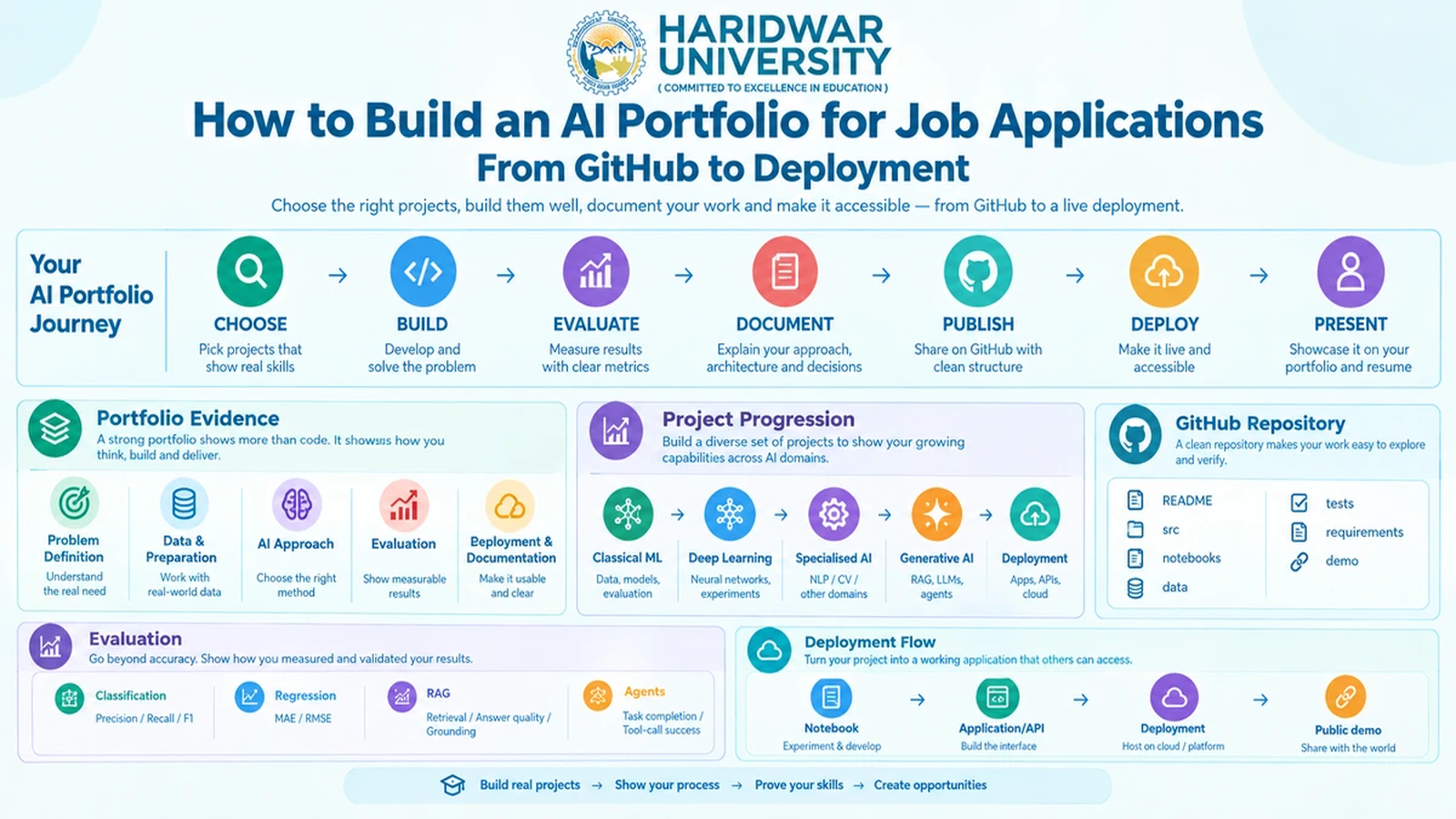
How to Build an AI Portfolio for Job Applications: From GitHub to Deployment
Dr. Rohit Kumar
Head, Computer Applications, Haridwar University
Roorkee College of Smart Computing | AI Career Portfolio Roadmap
How to turn Jupyter notebooks and GitHub repositories into measurable, defensible evidence for tech recruiters and hiring teams.
Building AI projects is essential, but I consistently advise students never to treat a GitHub profile as an unorganized storage drawer for raw .ipynb files. A truly useful AI portfolio makes it effortless for an interviewer, recruiter, or faculty evaluator to understand what problem you solved, how you approached data preparation, how you evaluated the results, and whether the system can actually be executed in the real world.
That distinction becomes critical when competing for top internships, capstone project evaluations, and engineering jobs. A portfolio can contain machine learning, deep learning, NLP, computer vision, generative AI, or agentic systems, but the technology stack alone does not make a project portfolio-ready.
Choose → Build → Evaluate → Document → Publish → Deploy → Present
Haridwar University's academic guidance similarly emphasizes documented GitHub repositories, rigorous problem formulation, complete technical stacks, interactive demonstrations, and cloud deployments rather than leaving experimental code isolated on a personal laptop.
Table of Contents
1. How to Build an AI Portfolio That Shows Real Technical Skills
2. Choose AI Projects That Demonstrate Different Capabilities
3. Build a Clear Progression From Machine Learning to Generative AI
4. Make Every GitHub Repository Portfolio-Ready
5. Document the Problem, Architecture and Technical Decisions
6. Evaluate AI Projects With Evidence, Not Just Screenshots
7. Deploy at Least One AI Project as a Working Application
8. Present AI Projects Clearly for Job Applications
9. Avoid Common AI Portfolio Mistakes
10. Build Your Portfolio Around the AI Role You Want
11. Frequently Asked Questions (FAQs)
12. Turning a Collection of Projects Into Professional Evidence & Academic Pathways at HU
1. How to Build an AI Portfolio That Shows Real Technical Skills
An AI portfolio is effective when it demonstrates how you solve real engineering problems, rather than simply proving that you know how to copy package import statements from a tutorial.
Technical recruiters and hiring managers look for concrete evidence across five core areas:
| Portfolio Element | What It Demonstrates to Hiring Managers |
|---|---|
| 1. Problem Definition | Whether you understand business context and operational objectives before selecting a model. |
| 2. Data & Preparation | Your ability to ingest, clean, impute, transform, and normalize imperfect or real-world data. |
| 3. AI Approach & Architecture | Your technical grasp of algorithms, neural layers, prompt templates, or retrieval pipelines. |
| 4. Rigorous Evaluation | Whether you can measure the true quality, variance, latency, and failure modes of your solution. |
| 5. Deployment & Documentation | Whether you can communicate technical design clearly and deliver an interactive, usable application. |
This does not mean every project requires an enterprise cloud infrastructure. A well-scoped classification system with honest evaluation and clear documentation demonstrates far more technical competence than an unfinished, buggy multi-agent chatbot.
As highlighted in HU's guide to 25 Final-Year Project Ideas for CSE & AI/ML Students, projects must be finishable, academically defensible, and structured for presentation on a professional resume.
2. Choose AI Projects That Demonstrate Different Capabilities
When students ask how many projects they should feature, my response is simple: focus on capability coverage rather than raw volume.
A compact portfolio of three to five carefully differentiated projects is far more convincing than ten variations of the same tutorial:
| Project Archetype | Core Capability Demonstrated |
|---|---|
| Predictive ML Project | Data cleaning, feature engineering, baseline comparison, and evaluation metrics. |
| Computer Vision or NLP Project | Working with unstructured perceptual data (images/video or textual sequences). |
| Generative AI / RAG Project | Vector embeddings, chunking, retrieval quality, groundedness, and prompt design. |
| AI Agent Project | Multi-step planning, tool execution (SQL/Python/Search), and loop termination guards. |
| Deployed Application | Production packaging, Streamlit/FastAPI, environment configs, and live accessibility. |
For project ideas across these archetypes, see our comprehensive guides on 20 Machine Learning Projects for Beginners and 15 Deep Learning Project Ideas for Final-Year Students.
3. Build a Clear Progression From Machine Learning to Generative AI
A convincing portfolio showcases a logical engineering evolution rather than a random assortment of trendy technologies.
A student starts with pandas and scikit-learn to solve tabular prediction, develops intuition for loss curves and neural networks with PyTorch, applies Transformers for NLP projects or OpenCV for computer vision, and then advances to Generative AI Project Ideas exploring grounded RAG and autonomous agents.
4. Make Every GitHub Repository Portfolio-Ready
GitHub describes a repository as a complete workspace for code, revision history, and documentation. Its official guides emphasize that a descriptive README.md is essential for explaining what a project does, why it matters, and how others can run it.
project-name/
├── README.md # Comprehensive architecture & evaluation documentation
├── src/ # Modular Python source code (clean functions & classes)
├── notebooks/ # Exploratory data analysis (EDA) & experiment prototypes
├── data/ # Sample records or download script (never commit huge binaries)
├── tests/ # Unit and integration tests (pytest)
├── requirements.txt # Exact pinned package dependencies
├── .gitignore # Ignore __pycache__, .env secrets, and checkpoints
└── app/ # Streamlit / FastAPI interactive user interface
When an interviewer visits your repository, they should be able to answer these 8 Essential Questions in under 60 seconds:
5. Document the Problem, Architecture and Technical Decisions
A portfolio becomes compelling when you articulate why you made key engineering choices. Compare these two project summaries:
Weak Summary (Buzzword-Heavy):
“Built an intelligent AI chatbot using an LLM, vector database, LangChain, and advanced RAG.”
Strong Summary (Engineered & Defensible):
Problem: Students needed reliable answers from 150+ university policy documents.
Data: Curated syllabus PDFs chunked into 500-token semantic passages.
Pipeline: ChromaDB hybrid search → Top-3 context retrieval → Llama-3-8B response.
Evaluation: Tested across 60 ground-truth queries; achieved 91.6% factual groundedness.
Limitation: System strictly rejects out-of-domain queries rather than hallucinating.
6. Evaluate AI Projects With Evidence, Not Just Screenshots
A UI screenshot merely confirms that an HTML layout was created; it provides zero evidence that the underlying model generalizes. Every portfolio repository should have a dedicated Evaluation & Error Analysis section:
| Project Type | Concrete Empirical Evidence to Present |
|---|---|
| Classification | Precision, Recall, F1-Score, ROC-AUC, and a normalized confusion matrix breakdown. |
| Regression | Mean Absolute Error (MAE), Root Mean Squared Error (RMSE), and residual error plots. |
| Computer Vision | [email protected], IoU scores for segmentation, and qualitative side-by-side failure detections. |
| NLP & Text | Exact Match, ROUGE-1/2/L, BLEU, and representative token misclassifications. |
| RAG Systems | Retrieval precision@k, MRR, answer correctness, and citation groundedness rates. |
| AI Agents | Task completion success rate, tool-call accuracy, step latency, and failure handling. |
| Generative AI | Held-out evaluation benchmark, rubric-scored test cases, and hallucination frequency. |
Always document failure modes. If your classifier confuses class A with class B on low-contrast images, explain why. If your RAG model struggles with ambiguous queries, document the limitation. Honest technical self-awareness is one of the highest signals of engineering maturity during viva and technical interviews.
7. Deploy at Least One AI Project as a Working Application
Deployment is the bridge where a project transforms from an academic exercise into a product that other people can interact with. You do not need to deploy five massive platforms; one or two rock-solid, live deployments carry immense weight.
The recommended deployment progression for students is:
For lightweight machine learning and GenAI applications, Streamlit Community Cloud provides a seamless path from GitHub to a public web app. Its official documentation emphasizes declaring all required libraries in a clean requirements.txt file and managing API credentials via environment secrets rather than hardcoded strings.
8. Present AI Projects Clearly for Job Applications
Your resume and portfolio website serve complementary purposes: the resume must be easy to scan in 10 seconds, while the portfolio site provides depth for the engineering lead conducting the technical interview.
The 1-Line Resume Formula:
Example: "Developed a document Q&A assistant using ChromaDB, LangChain, and Llama-3-8B; evaluated across 60 ground-truth questions achieving 91.6% groundedness with <1.2s inference latency."
On your portfolio website or project case study, expand each featured project into a full 10-point breakdown:
9. Avoid Common AI Portfolio Mistakes
When reviewing student portfolios, I frequently encounter the same avoidable pitfalls:
Copying textbook Titanic or MNIST code without unique modifications.
Showing a functioning UI with zero objective metrics or held-out test scores.
Leaving the default README without setup instructions or architecture descriptions.
Attempting an unfinished enterprise autonomous swarm rather than a solid pipeline.
Building an ungrounded API wrapper without proprietary knowledge or specialized tooling.
Failing to deploy even one project to a live public URL for interviewers to test.
10. Build Your Portfolio Around the AI Role You Want
Tailor your portfolio's emphasis toward the specific career track you are targeting:
| Target Career Direction | Key Portfolio Emphasis |
|---|---|
| Machine Learning Engineer | Data preparation, feature engineering, baselines, cross-validation, and error analysis. |
| AI Systems Engineer | APIs, containerization, microservice integration, automated testing, and cloud deployment. |
| Data Scientist | Exploratory data analysis, statistical hypotheses, business storytelling, and visual presentation. |
| Computer Vision Engineer | Image filtering, OpenCV pipelines, PyTorch vision backbones, and detection metrics. |
| NLP / LLM Engineer | Tokenization, Transformer fine-tuning, RAG retrieval pipelines, and prompt optimization. |
| Generative AI Specialist | Grounded RAG architectures, autonomous agent tool use, and parameter-efficient fine-tuning (PEFT). |
| AI / ML Researcher | Literature surveys, controlled experimentation, mathematical baselines, and reproducibility. |
Students choosing between degree specializations can also consult our B.Tech AI & ML vs CSE Guide for detailed curriculum differences.
11. Frequently Asked Questions (FAQs)
1. What are some good AI portfolio projects?
A balanced portfolio can include a machine learning project, a specialised AI project such as NLP or computer vision, and a generative AI or deployed application. Choose projects that demonstrate different skills rather than repeating the same type of application.
2. How many AI projects should I put in my portfolio?
There is no fixed number. Three to five well-developed projects can provide a useful portfolio if they demonstrate different capabilities and include documentation, evaluation and working demonstrations where appropriate.
3. Can beginners build an AI portfolio?
Yes. Beginners can start with a clearly scoped machine learning project and gradually move towards deep learning, specialised AI and generative AI. The project should match the student's current skills rather than being selected only because it sounds advanced.
4. Should every AI project be deployed?
No. Deployment is useful evidence of engineering ability, but not every experiment needs to become a public application. I would prioritise deploying the projects where a live demonstration adds genuine value.
5. What should an AI project README contain?
At minimum, explain the problem, project objective, data, approach, technology, setup instructions, evaluation, results and limitations. Add screenshots, architecture diagrams and a demo link when they genuinely help explain the work.
6. Are GitHub projects enough for an AI portfolio?
GitHub is an important part of the portfolio, but it should work alongside a clear project presentation, resume and, where appropriate, live demonstrations. A repository provides the evidence; the portfolio makes that evidence easier to navigate.
7. Can I use AI tools while building portfolio projects?
AI tools can assist with research, coding, debugging and documentation, but you should understand and verify the resulting work. A project is only useful as portfolio evidence if you can explain its architecture, decisions, limitations and results yourself.
12. Turning a Collection of Projects Into Professional Evidence & Academic Pathways at HU
An AI portfolio is fundamentally a permanent record of what you can build and defend. Over time, your repository collection should tell an unmistakable story of professional progression:
Students seeking to build this technical foundation through structured degree coursework can explore the B.Tech Hons. AI & ML and BCA AI & ML programmes at Haridwar University's Roorkee College of Smart Computing, supported by our dedicated high-performance AI & Innovation Laboratories.
Related Technical Project Guides at Haridwar University:
- HU's 25 Final-Year Project Ideas for CSE & AI/ML Students – Comprehensive guide to problem selection and rubric scoring.
- HU's 20 Machine Learning Projects for Beginners – Datasets, source code, and structured learning paths.
- HU's 15 Deep Learning Project Ideas for Final-Year Students – Neural networks, CNNs, and evaluation workflows.
- HU's Generative AI Project Ideas 2026 – RAG, AI agents, and parameter-efficient fine-tuning (PEFT).
- HU's Natural Language Processing Project Ideas – Text classification, NER, and Transformers.
- Computer Vision Projects for Students – OpenCV, YOLO, and visual perception pipelines.
- HU's 25 AI Projects for Engineering Students – Traditional AI, heuristics, and predictive models.
- HU's B.Tech AI & ML vs CSE Guide – Comprehensive curriculum comparison.
- HU's B.Tech AI & ML Programme Guide 2026 – Honors degree pathways and GPU lab infrastructure.
- Cloud Computing Projects for Students – Deploying containerized AI microservices on AWS, Azure, and GCP.
- Cybersecurity Project Ideas for Students – Threat detection, SIEM, and vulnerability analysis.
- Blockchain Project Ideas for Students – Smart contracts, dApps, and decentralized consensus.
- Robotics Projects for Engineering Students – Hardware integration and ROS robotics pipelines.
- IoT Project Ideas: Sensor-to-Cloud – MQTT telemetry and smart connected devices.
Build an Industry-Ready AI Portfolio at Haridwar University
Develop portfolio-defining artificial intelligence systems with high-performance GPU computing clusters, hands-on faculty mentorship, and career placement support at Haridwar University.