

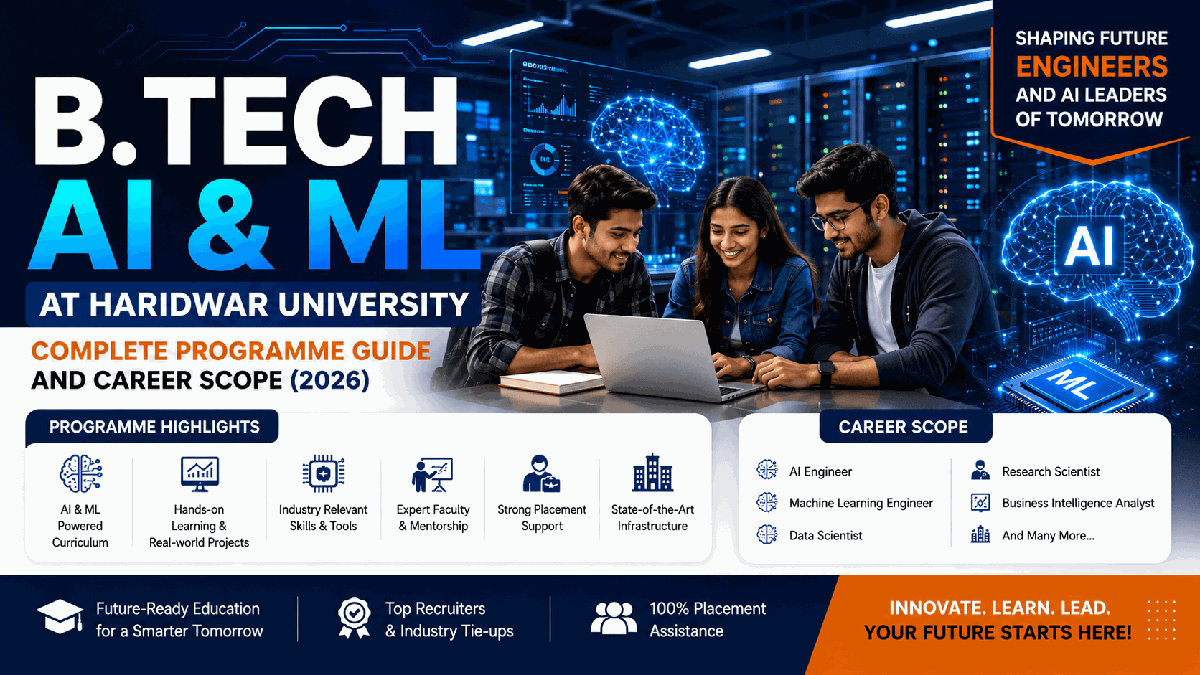
B.Tech AI & ML at Haridwar University: Complete Programme Guide and Career Scope (2026)
Dr. Himanshu Verma
Head of CSE, Haridwar University
Talk to any twelfth-grader picking a stream right now and AI & ML comes up within the first two minutes. It's not hype for the sake of hype either - this is genuinely where hiring is moving. If you're trying to figure out whether a B.Tech in Artificial Intelligence & Machine Learning is worth committing four years to, this guide walks through exactly what the program at Haridwar University looks like, semester by semester, what skills actually stick by the time you graduate, which jobs are realistically open to you, and what the pay looks like once you're out there working.
Table of Contents
- 1. What is B.Tech AI & ML?
- 2. Curriculum Overview
- 3. Key Skills Built Through the Program
- 4. Career Roles You Can Target
- 5. 2026 Salary Ranges
- 6. Top Recruiters in the AI & ML Space
- 7. Eligibility for B.Tech AI & ML
- 8. Fees at Haridwar University
- 9. Why Choose HU for AI & ML?
- 10. Frequently Asked Questions (FAQs)
What is B.Tech AI & ML?
It's a four-year undergraduate engineering degree, but the way it's structured is different from a regular Computer Science degree. In most CSE programs, AI shows up late - maybe a couple of electives in the final year if you're lucky. Here, it's baked in from much earlier. Algorithms, statistics, neural networks, applied machine learning - these aren't add-ons, they're the spine the whole course is built around.
The degree is really trying to teach you three things, and it teaches them in that order for a reason:
- Understanding how machines actually learn: Recognizing patterns from data instead of being told explicit rules.
- Building autonomous systems: Developing systems that can make a prediction or a decision on their own once they've learned those patterns.
- Deployment and Operations (MLOps): The part that trips up the most graduates - actually getting that system out of a notebook and into something that works reliably for real users.
You'd be surprised how many AI graduates can train a decent model but freeze the moment you ask them to deploy it. A properly designed program doesn't let that gap slide, and that's really the difference between a good AI & ML course and a mediocre one.
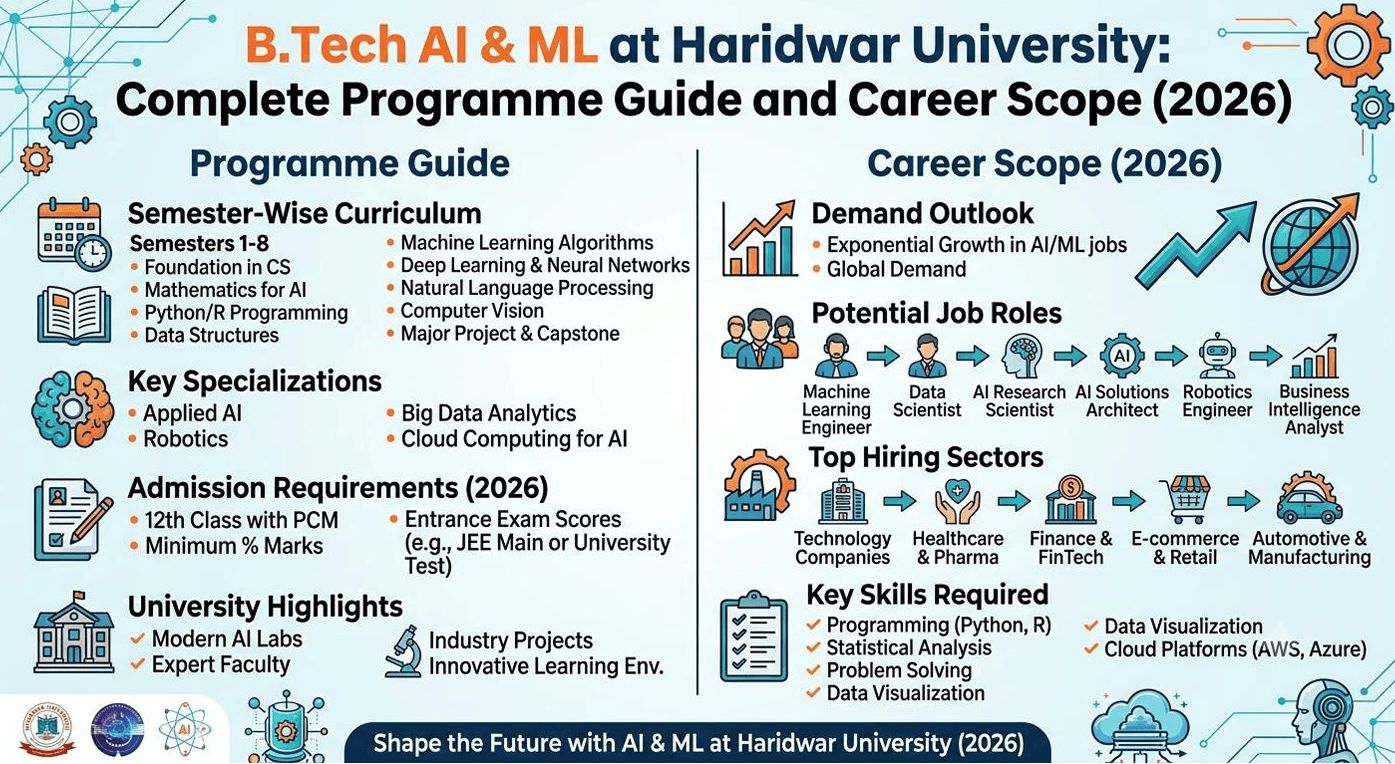
Curriculum Overview (Semester-Wise)
The exact subject names shift a little depending on the intake year, but the broad progression stays fairly consistent across most AI & ML programs in India, HU included.
- Semester 1 & 2 (Foundation Year): Engineering mathematics, physics, basic electrical and electronics, programming fundamentals in C and Python, and a first look at how computer systems actually work. Nothing AI-specific happens yet, and that's intentional - you can't jump into neural networks without first being comfortable with logic, basic data structures, and discrete math. Think of this as laying bricks before anyone talks about the roof.
- Semester 3 & 4: Data structures and algorithms, object-oriented programming, database management systems, and probability and statistics all show up here. This is also where students get their first serious exposure to Python for data work specifically - NumPy, Pandas, that whole ecosystem. Linear algebra gets a lot more serious in this phase too, and it's worth paying attention to, because nearly every ML algorithm you'll touch later leans on it more than students expect going in.
- Semester 5 & 6: This is genuinely where the course starts feeling like "AI & ML" rather than general computer science with a side of statistics. Machine learning fundamentals - regression, classification, clustering - deep learning, neural networks, an introduction to natural language processing, and computer vision all land here. Alongside that, most programs fold in some cloud computing basics and proper software engineering practices, because ML work in the real world doesn't happen in isolation from how software actually gets built and maintained.
- Semester 7 & 8: The final stretch is where things get specialized. Reinforcement learning, generative AI, advanced NLP, big data technologies, and MLOps all come into the picture. There's usually a major project built into this phase, along with an industry internship, and electives that let students push deeper into whatever interests them - robotics, computer vision, applied data science, whatever direction they want to take.
If there's one thing that seems to matter most to recruiters during placement season, it's this final-year capstone project. It's often the first real conversation starter in an interview.
Labs run in parallel through all eight semesters, which matters more than it sounds. You're not just reading about back propagation or gradient descent - you're implementing them, watching them fail on messy data, debugging why, and fixing it. That repeated cycle of building and breaking things is honestly where most of the real learning happens, far more than any textbook chapter.
Key Skills Built Through the Program
By the time a student graduates from a well-run AI & ML program, here's roughly what they should be walking away with:
- Solid Programming Foundations: Python (non-negotiable), SQL, and occasionally R.
- Mathematical Grip: Linear algebra, probability, statistics, and calculus - the literal language of ML.
- Practical Frameworks: TensorFlow, PyTorch, and Scikit-learn (having actually built and trained models).
- Data Wrangling: Cleaning up messy, inconsistent, real-world datasets (a major chunk of the actual job).
- Deployment Know-How: AWS, Azure, or GCP, and containerization tools like Docker.
- Problem-solving Instincts: Handling real datasets that rarely behave like clean textbook examples.
- Communication: Explaining complex model behavior to non-technical stakeholders.
Students looking to build these practical skills can refer to our guide on the Best AI Tools for Engineering Students or explore these 25 AI Projects Every Engineering Student Should Build to boost their portfolio.
Career Roles You Can Target
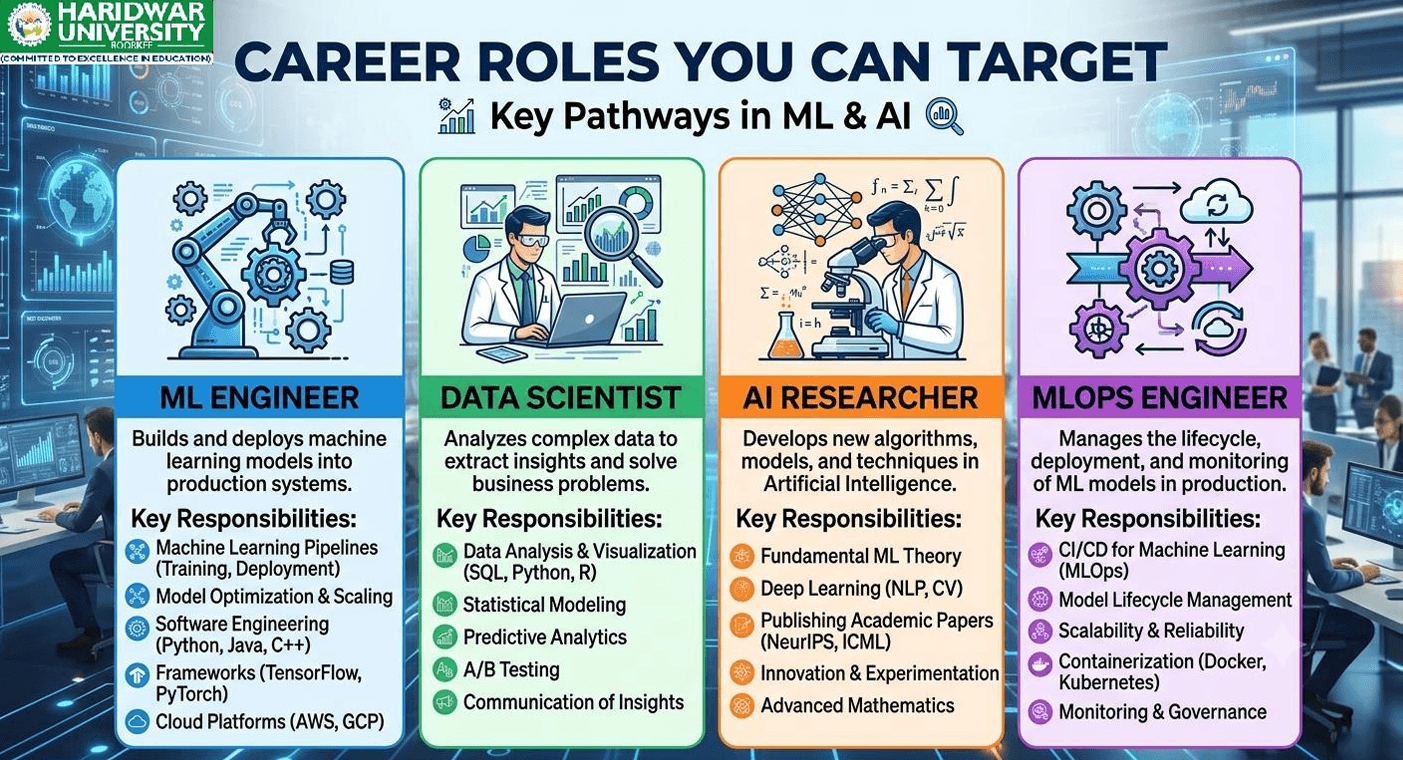
An AI & ML degree doesn't funnel you into one single job title - there are several distinct paths, and each one feels quite different day to day:
- ML Engineer: This role is about building, training, and actually deploying machine learning models into production systems that run at scale. It sits closer to software engineering than to pure research - you need to care as much about system design and production reliability as you do about model accuracy. If something breaks at 2 AM, it's usually the ML engineer's problem to fix.
- Data Scientist: More about pulling insight out of data, building predictive models, and helping guide business decisions through statistics and analysis. It's a more exploratory role, less focused on infrastructure, more centered around answering the question "what is this data actually telling us, and what should we do about it."
- AI Researcher: Focused on developing new algorithms, architectures, and techniques, usually while staying close to academic literature and running a lot of experimental work. This path tends to open up more meaningfully after further studies like an M.Tech or PhD, though a handful of research-adjacent entry roles do exist for particularly strong B.Tech graduates coming out of a solid program.
- MLOps Engineer: A relatively newer role, but one that's growing fast - bridging ML and DevOps. This involves managing pipelines, monitoring models once they're live in production, handling versioning, and generally making sure ML systems don't quietly degrade or break without anyone noticing. Right now, this is one of the fastest-growing niches in the entire field.
There's also a real blurring happening between these roles. The professionals landing the strongest offers today usually aren't purely one thing or the other - they can build a model and also get it running reliably in production. Worth keeping in mind when you're choosing electives and deciding what kind of projects to put your energy into.
2026 Salary Ranges
Salary figures in AI & ML swing quite a bit depending on which platform you're checking and how that data was collected, so it's more useful to think in ranges than chase one exact number. Based on current 2026 industry data, here are the estimated entry-level salary packages in India:
| Job Role | Estimated Salary Range (Freshers) | Key Characteristics & Details |
|---|---|---|
| ML Engineer | ₹6 – 12 LPA | Starts around ₹6–12 LPA at product companies/startups (AmbitionBox & Naukri). Glassdoor submissions show ₹6.2 to ₹14.6 LPA for fresher/early-career. |
| Data Scientist | ₹6 – 10 LPA | Leans more towards analysis and business insight. Entry-level data scientists typically start around ₹6-10 LPA at analytics-heavy firms and GCCs. |
| AI Researcher | ₹8 – 15 LPA | Pure research roles straight out of B.Tech are rare. Fresh grads at GCCs or AI labs start at ₹8–15 LPA. Often opens up further with an M.Tech or PhD. |
| MLOps Engineer | ₹8 – 14 LPA | One of the highest-paying entry niches. Freshers with DevOps/ML pipeline experience start at ₹8–14 LPA, while mid-level roles command ₹20–50 LPA. |
One thing worth flagging separately: GenAI and LLM-specific skills are pushing compensation up noticeably across all four of these roles right now. Candidates who've worked hands-on with LangChain or LlamaIndex, or who've actually deployed an LLM into production rather than just experimenting with an API, tend to land meaningfully better offers than peers without that exposure. For more detailed compensation data, you can read our deep dive on AI Engineer Salary in India.
Top Recruiters in the AI & ML Space
Hiring in this space spans a genuinely wide range - from global tech giants to fast-growing Indian product companies to smaller, scrappier AI-first startups:
- Global Tech Giants & GCCs: Companies like Google, Microsoft, Amazon, and Accenture, running large India-based engineering and research teams.
- IT Services Majors: TCS, Infosys, and Wipro, hiring in high volume for AI-adjacent project work across client engagements.
- Indian Product Companies: Flipkart, PhonePe, and Razorpay, which run dedicated ML teams handling recommendation systems, fraud detection, and personalization at scale.
- AI-First Startups: Building products around GenAI, computer vision, and applied ML, generally carrying more risk but offering faster growth and ownership early on.
- Consulting & Analytics Firms: Hiring data scientists specifically for client-facing modeling and analytics work.
Eligibility for B.Tech AI & ML
Broadly, students need the following to qualify for admission:
- A pass in 10+2 with Physics, Chemistry, and Mathematics (PCM) as core subjects.
- A minimum aggregate score set by the university, usually around 45–50% in 10+2.
- Admission is through entrance exams like JEE Main, state-level tests, or direct merit-based admission depending on the intake criteria.
For the most current eligibility criteria, cutoffs, and admissions process specific to Haridwar University, it is best to check the official Haridwar University Admission Process page or contact the admissions office directly.
Fees at Haridwar University
Haridwar University positions its AI & ML programme as an accessible, industry-aligned option for students who want a solid technical foundation without paying the kind of fees you'd see at some of the bigger private institutions.
Since fee structures get revised periodically, and can include additional components like hostel, exam, and development fees layered on top of base tuition, the most reliable way to get exact, current figures is to check the official Haridwar University website directly or speak with the admissions team. That way, you're working off this year's numbers, not something outdated that's been floating around online.
Why Choose HU for AI & ML?
A handful of reasons this programme stands out when you're weighing your options:
- Industry-Relevant Curriculum: Keeps pace with the evolving field, covering everything from classical machine learning to Generative AI (GenAI) and MLOps, rather than relying on an outdated syllabus.
- Hands-On Lab Focus: Real-world projects ensure that students graduate with a robust portfolio of work, not just a transcript of grades.
- Comprehensive Placement Support: Dedicated industry exposure connects students with recruiters actively hiring for AI-driven roles, rather than only offering access to generic technology positions.
- Experienced Faculty: Brings both theoretical expertise and practical industry experience into the classroom, instead of relying solely on presentation slides.
- Affordable Fee Structure: Quality education compared to many private technical institutions, providing high-value learning without compromise.
- Growing Campus Ecosystem: Equipped with modern laboratories, advanced computing resources, and dedicated mentorship, providing the support that a data-intensive discipline like Artificial Intelligence and Machine Learning truly requires.
If you're serious about building a career in one of the fastest-growing fields in tech right now, a B.Tech in AI & ML from Haridwar University gives you a curriculum built around where the industry is actually headed, not where it used to be a few years back. Demand for skilled ML engineers, data scientists, and MLOps professionals shows no real sign of slowing down anytime soon, and starting out with the right foundation is what ends up making the biggest difference by the time you're sitting across the table from a recruiter.
Frequently Asked Questions (FAQs)
1. Is B.Tech AI & ML worth it in 2026?
For most students eyeing a tech career, the honest answer is yes. Hiring in this space hasn't slowed down — if anything, roles like ML Engineer, Data Scientist, and MLOps Engineer keep showing up across product companies, GCCs, and startups alike. That said, the degree title alone doesn't do the heavy lifting. What actually matters is whether the program pushes you to build and deploy real projects, because that's what ends up carrying weight in interviews, not the name on your transcript.
2. What's the difference between B.Tech AI & ML and B.Tech CSE?
Think of CSE as the wide-angle lens and AI & ML as the zoomed-in version. In a typical CSE program, AI might appear as one elective tucked into the final year, almost as an afterthought. Here, machine learning, statistics, and neural networks start showing up from semester 5 and only get more central from there. CSE keeps you exposed to everything computer science has to offer; AI & ML trades some of that breadth for depth specifically in data and machine learning. You can read our detailed comparison on AI vs CSE to make an informed choice.
3. What is the eligibility for B.Tech AI & ML?
You'll need a 10+2 pass with Physics, Chemistry, and Mathematics (PCM) as your core subjects, plus a minimum aggregate score the university sets — usually hovering around 45–50%, though this number tends to move a little from year to year depending on policy changes.
4. Which entrance exams are accepted for AI & ML at HU?
Most students get in through JEE Main or one of the state-level engineering entrance exams. Some years also open up direct merit-based admission, depending on how the university decides to run that particular intake cycle.
5. What are the top job roles after B.Tech AI & ML?
There isn't just one path here. ML Engineer is the closest thing to software engineering — building and shipping models into live systems. Data Scientist leans more toward digging through data and shaping business decisions from it. AI Researcher is the academic-leaning track, one that really opens up once you've got a master's behind you. And then there's MLOps Engineer, arguably the fastest-growing of the four, focused on keeping ML systems running reliably once they're out in the wild.
6. What is the fee for B.Tech AI & ML at HU?
HU has built this program to be accessible without cutting corners on the technical side, especially compared to some of the bigger private colleges out there. Fee structures do get revised now and then, and things like hostel or exam fees can sit on top of the base tuition, so your safest bet is checking the official HU website or calling up admissions directly for numbers that reflect this year, not last year's.
7. Is HU's AI & ML programme AICTE approved?
This one's better confirmed straight from the source. Accreditation details and approval status can shift, so reach out to HU's admissions office or check their official website rather than going off something you read secondhand — it's a five-minute call that saves you from working with outdated information.