

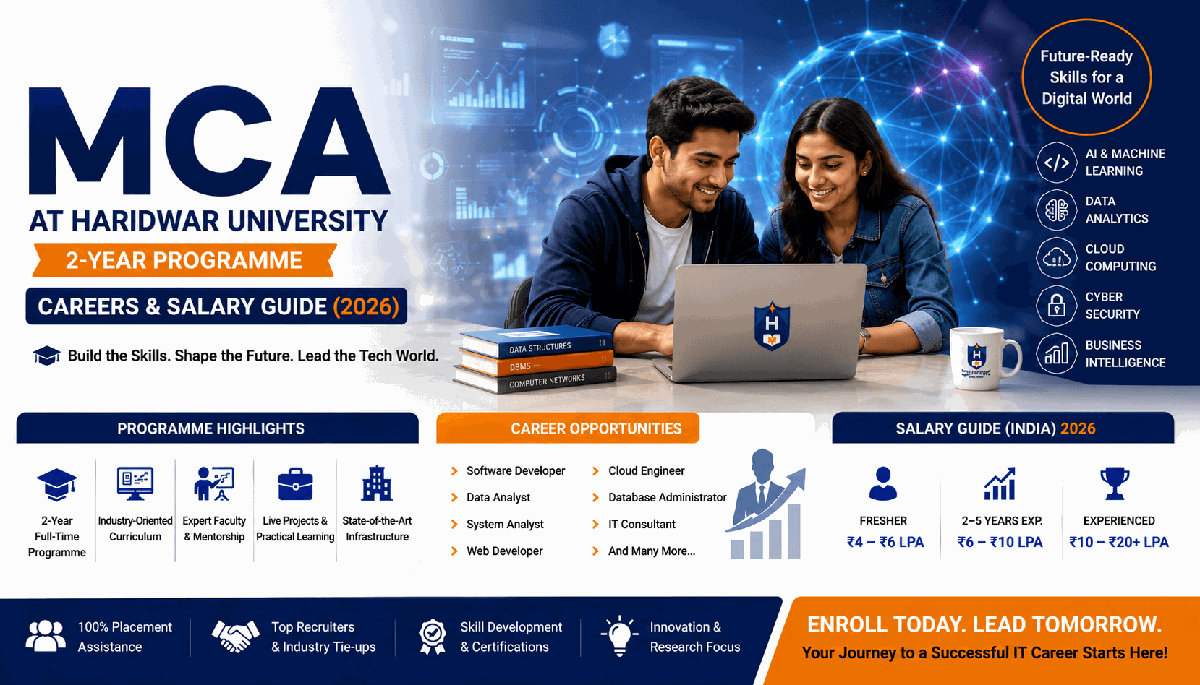
MCA at Haridwar University: 2-Year Programme, Careers & Salary Guide (2026)
Haridwar University
You've probably opened ten different college websites by now, all promising the same thing — "100% placements," "cutting-edge curriculum," and "industry partnerships." After a while, it all blurs together and stops meaning anything. So let's skip the marketing language and actually talk through what an MCA at Haridwar University looks like on the ground: what you'll study, what it costs, where it can take you, and whether it beats the alternatives.
MCA has quietly become one of the more practical postgraduate routes into tech, especially for students who didn't come from a pure engineering background but still want to build software for a living. Below is a semester-by-semester breakdown, the elective options, project work, eligibility, fees, salary expectations, and how MCA holds up against M.Tech.
Table of Contents
- 1. What is MCA, Actually?
- 2. The 2-Year Semester-wise Curriculum
- 3. Elective Tracks: Cloud, Data Science, Cybersecurity, Full-Stack
- 4. Key Practical Projects: What You'll Actually Build
- 5. Eligibility: BCA, B.Sc IT, or B.Tech
- 6. Fees at Haridwar University
- 7. Placement Roles and Salary Ranges
- 8. MCA vs M.Tech: Which One's Actually Right for You?
- 9. Career Pathway: What Your Career Could Look Like After MCA
- 10. Final Thoughts
- 11. Frequently Asked Questions (FAQs)
What is MCA, Actually?
MCA — Master of Computer Applications — is a two-year postgraduate degree built around programming, databases, systems, and software engineering. It's not an MBA with a tech label slapped on, and it's not a watered-down engineering degree either. It sits in its own lane: heavier on applied computing than a general MSc, but more flexible in entry requirements than an M.Tech.
There's a common misconception that MCA is "only for BCA students." That stopped being true a while back. B.Sc IT/CS graduates and even B.Tech graduates now enroll in MCA when they want a faster, more hands-on route into software roles rather than a research-heavy postgraduate path. The appeal is simple — you get academic depth without losing touch with what companies are actually hiring for.
The 2-Year Semester-wise Curriculum
Haridwar University spreads the MCA programme across four semesters, and the logic behind the sequencing is straightforward: build the basics first, then specialize, then prove you can build something real.
- Semester 1 is foundation territory. You'll work through Programming in C, Data Structures, Discrete Mathematics, Digital Logic and Computer Organization, Database Management Systems, and Operating Systems. Since students arrive from different undergraduate backgrounds, this semester exists mainly to level everyone up before things get harder.
- Semester 2 moves into application-building. Object-Oriented Programming with Java, Web Technologies (HTML, CSS, JavaScript plus server-side scripting), Computer Networks, Software Engineering, and more advanced Database work — think SQL optimization and normalization — make up the bulk of this term.
- Semester 3 is where the programme starts feeling personal. You pick an elective track (more on that below) and pair it with subjects like Design and Analysis of Algorithms, Cloud Computing basics, Mobile App Development, and a Mini Project — a smaller-scale build that gets you ready for the bigger one coming next.
- Semester 4 is almost entirely the Major Project and an industry internship. Most students spend this term building something substantial, often tied directly to their elective, alongside a research-oriented elective, seminars, and a final viva.
That progression — basics, application, specialization, then a real project — is really what separates this from a syllabus you just memorize and forget.
Elective Tracks: Cloud, Data Science, Cybersecurity, Full-Stack
Starting in semester 3, students choose a specialization, and this is arguably the best part of doing MCA at Haridwar University — you're not stuck with a one-size-fits-all syllabus.
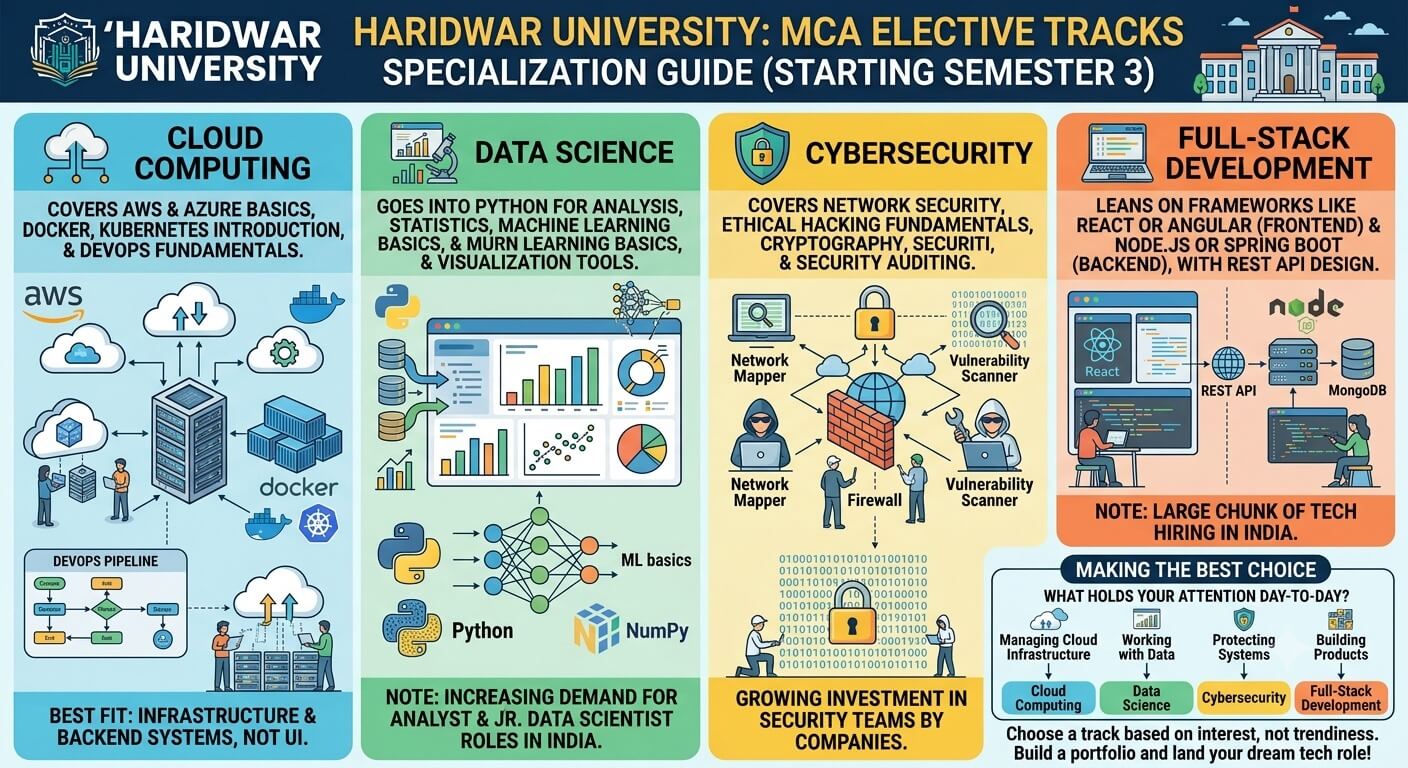
Here are the core specialization tracks you can choose from:
- Cloud Computing covers AWS and Azure basics, Docker, a working introduction to Kubernetes, and DevOps fundamentals. This is a good fit if infrastructure and backend systems interest you more than user interface (UI) work.
- Data Science goes into Python for analysis, statistics, machine learning basics, and visualization tools. This track has picked up a lot of interest lately, mostly because analyst and junior data science roles have opened up fast across Indian companies.
- Cybersecurity covers network security, the fundamentals of ethical hacking, cryptography, and security auditing. Demand here isn't slowing down anytime soon, given how many companies are investing in security teams right now.
- Full-Stack Development leans on frameworks like React or Angular for the frontend and Node.js or Spring Boot on the backend, along with REST API design. It tends to be the most popular pick simply because full-stack roles make up such a large chunk of tech hiring in India.
Pick based on what actually holds your attention day to day — building products, protecting systems, working with data, or managing cloud infrastructure. That's a better filter than just chasing whichever track sounds trendiest.
Key Practical Projects: What You'll Actually Build
Nobody gets hired off a transcript alone. Interviewers want to talk about what you built, so here's what that typically looks like across the four semesters:
- A mini project in semester 3 — usually a smaller web or mobile app, solo or in pairs, that shows you can handle core programming and database work.
- A major project in semester 4 — a full build tied to your elective. Could be a cloud-hosted inventory system, a prediction model using machine learning, a secure login/authentication system, or a full-stack e-commerce site.
- Internship-linked work — where you're solving live problems alongside industry mentors — often the strongest thing on your resume since it shows you've handled something beyond a classroom assignment.
Keeping an active GitHub through the programme is worth doing too. Recruiters ask for portfolio links more often than they used to, especially during technical rounds.
Eligibility: BCA, B.Sc IT, or B.Tech
MCA at Haridwar University keeps the door open to a few different undergraduate backgrounds:
- BCA graduates fit most naturally, since a lot of the coursework overlaps with what they've already studied. You can learn more about our undergraduate program on the BCA Course Page.
- B.Sc IT/CS graduates qualify too and usually adjust quickly thanks to prior exposure to programming and math.
- B.Tech graduates, particularly from CS or IT streams, often choose MCA over M.Tech when they want something more application-focused and less design/research-heavy. For details on related engineering options, see our B.Tech Hons. AI & ML Course Page and our M.Tech. CSE Course Page.
Generally, you'll need a minimum aggregate score at the undergraduate level (often around 50%, though this can shift) and mathematics either at 10+2 or graduation level. Students coming from non-computing backgrounds with some math exposure may still be considered, sometimes with a bridge course.
Fees at Haridwar University
Fees at Haridwar University for the MCA programme are set up to stay reasonable compared to many private universities running similar tech postgraduate degrees, while still funding lab access, project mentorship, and placement support. Since these numbers get revised from time to time and scholarships or merit concessions can apply, it's worth checking the latest fee structure directly through the official admissions page or by talking to the admissions office rather than relying on any fixed figure here.
To see active details regarding admissions, application deadlines, and fee changes, visit the official Haridwar University Admission Process page.
Placement Roles and Salary Ranges
This is usually what students actually want to know, so here's a realistic picture. MCA graduates from tech-focused programmes typically land in roles like those listed below. You can also view our detailed guide on AI Engineer Salary in India to see how specialized fields compare.
| Job Role | Typical Starting Salary (2026) | Key Responsibilities & Focus |
|---|---|---|
| Software Developer / Programmer Analyst | ₹3–6 LPA | Entry-level coding, debugging, and development roles. |
| Full-Stack Developer | ₹4–7 LPA | Handles both frontend and backend development (React/Node.js/Spring Boot). |
| Data Analyst / Junior Data Scientist | ₹3.5–6.5 LPA | Analyzing large data sets, building predictive models, and data visualization. |
| Cloud Support Engineer / DevOps Associate | ₹4–7 LPA | Managing cloud infrastructure (AWS/Azure), Docker, Kubernetes, CI/CD. |
| Cybersecurity Analyst | ₹4–6.5 LPA | Ethical hacking, network security monitoring, and auditing. |
| System Administrator / Database Administrator | ₹3–5.5 LPA | Managing servers, databases (SQL optimization), and IT infrastructure. |
These numbers shift based on company tier, city, and how you perform in interviews, but they're a fair snapshot of where MCA graduates are landing in India's job market right now, in 2026.
MCA vs M.Tech: Which One's Actually Right for You?
This question comes up in almost every conversation about postgraduate tech degrees, so let's settle it.
M.Tech leans research and design-heavy. It suits B.Tech graduates who want to dig deeper into engineering theory, often with an eye on R&D, teaching, or a future PhD. It also expects stronger core engineering math from the start.
MCA is built the other way around — application-first, industry-facing. It's meant for students who want to get into the software industry quickly, with a syllabus that stays close to current tools and frameworks instead of chasing theoretical depth.
If research or design engineering is the goal, M.Tech probably fits better. But if you want to become a developer, analyst, or IT professional as directly as possible — especially coming from a BCA or B.Sc IT background where M.Tech eligibility gets messy — MCA at Haridwar University is usually the more efficient route. For undergraduates still deciding on their initial technical degree, you can check our comparison of AI vs CSE to see how those options match your career goals.
Career Pathway: What Your Career Could Look Like After MCA
Most graduates start out as junior developers, analysts, or associate engineers for the first year or two, mostly focused on getting comfortable with real, production-level work. Somewhere between years three and five, things shift toward mid-level roles — senior developer, team lead, or specialist positions like cloud architect or data scientist, depending on the track chosen earlier.
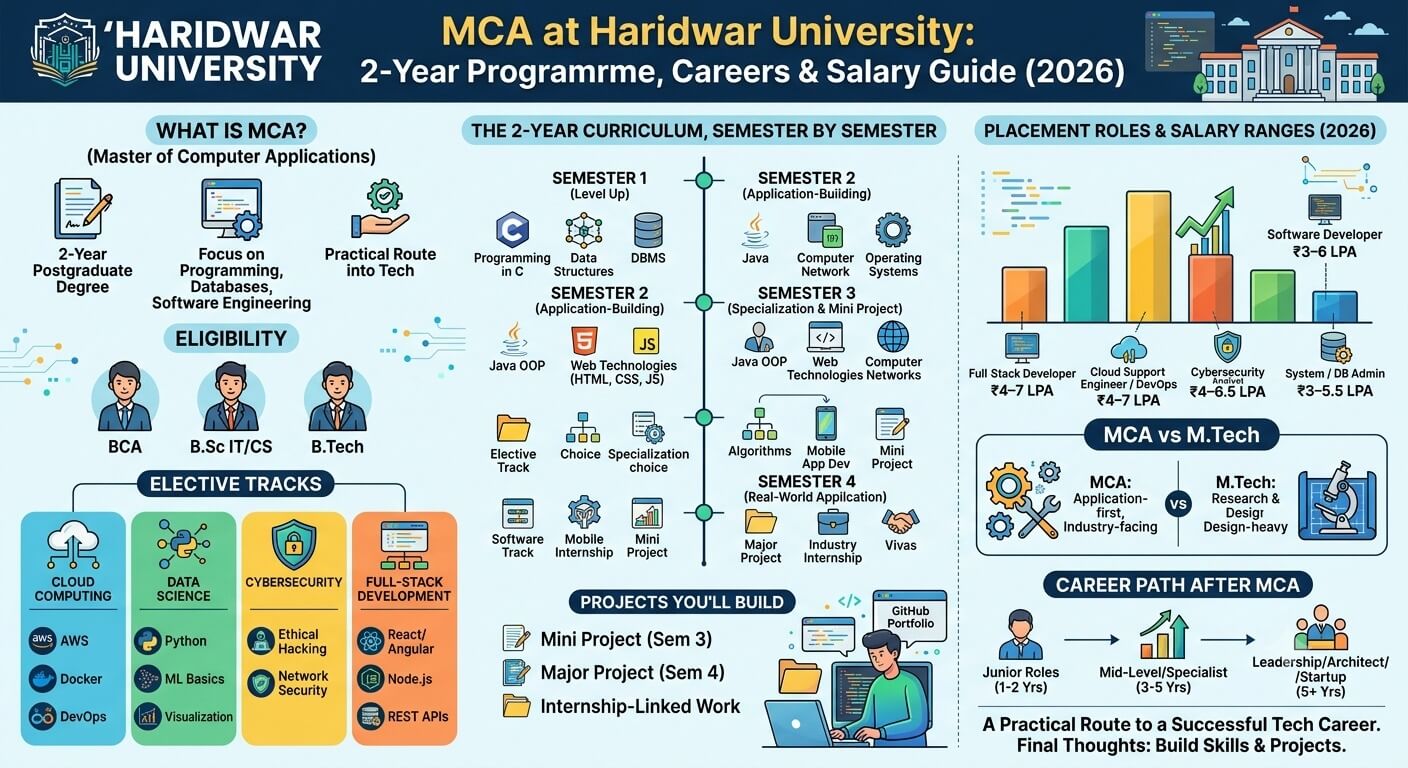
Past the five-year mark, paths start splitting. Some move into system design and technical architecture. Others shift toward product or project management. A fair number end up starting their own thing — a SaaS product, a small consultancy — built on the exact skills picked up during the MCA years. Others go back for further certifications or an MBA to move into tech leadership.
That flexibility — being able to move across development, data, cloud, or security — is probably the biggest long-term payoff of choosing MCA over a narrower, single-track degree.
Final Thoughts
A postgraduate degree isn't a decision you should make off a quick search and a gut feeling — it quietly shapes the next several years of your working life. The MCA With AI Program at Haridwar University gives you a curriculum that keeps up with what the industry is actually hiring for, elective tracks that let you specialize where demand is real, and enough project work that you walk into interviews with something to actually show, not just talk about.
If you're a BCA, B.Sc IT, or B.Tech graduate weighing your options for 2026, this is a programme worth putting on your shortlist.
Frequently Asked Questions (FAQs)
1. Is MCA at Haridwar University worth it in 2026?
For students wanting a software career without a four-year engineering route, yes — MCA at Haridwar University offers industry-aligned tracks and steady placement demand in developer, analyst, and cloud roles.
2. What is the difference between MCA at Haridwar University and M.Tech?
M.Tech is research and design-focused, suited for further studies or R&D. MCA at Haridwar University is application-first, built for students who want direct entry into development or analyst roles within two years.
3. Who is eligible for MCA at Haridwar University?
BCA, B.Sc IT/CS, and B.Tech graduates are all eligible, provided they meet the university's minimum aggregate score (commonly around 50%) and studied mathematics at 10+2 or graduation level.
4. Can a B.Tech graduate apply for MCA at Haridwar University instead of M.Tech?
Yes. Many B.Tech graduates from CS or IT backgrounds choose MCA at Haridwar University over M.Tech for a faster, more application-focused path into the software industry.
5. Which elective track is best in the MCA programme at Haridwar University?
It depends on interest: Cloud Computing for infrastructure roles, Data Science for analytics, Cybersecurity for security roles, or Full-Stack Development for product-building careers.
6. What is the average salary after MCA at Haridwar University in 2026?
Entry-level roles typically start between ₹3–7 LPA depending on the role and elective track, with Full-Stack and Cloud/DevOps positions often at the higher end.
7. What is the fee for MCA at Haridwar University?
Fees are structured to stay competitive with other tech postgraduate degrees. For exact current 2026 figures, check the official Haridwar University admissions page or talk to the admissions team.
8. Do I need a technical background to join MCA at Haridwar University?
No — semester 1 covers programming, data structures, and math fundamentals from scratch, so students from varied undergraduate backgrounds can catch up.
9. Does the internship matter for placements after MCA at Haridwar University?
Yes — the semester 4 internship is often the strongest talking point in interviews, since it demonstrates real-world project experience beyond classroom work.