

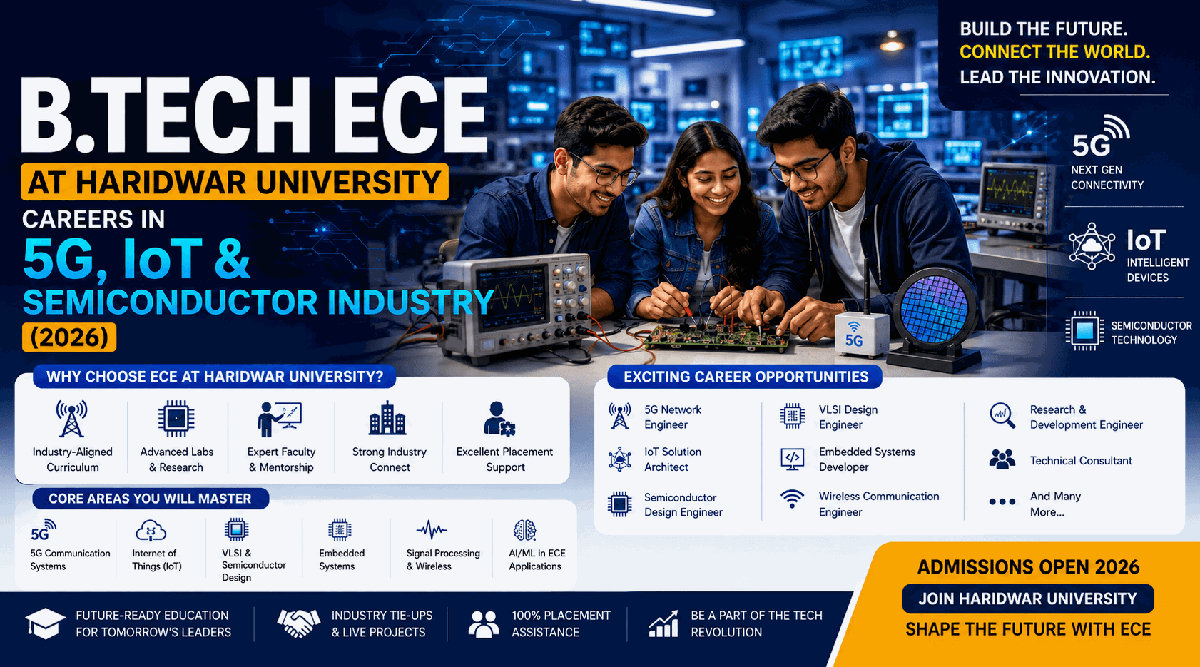
B.Tech ECE at Haridwar University: Careers in 5G, IoT & Semiconductor Industry (2026)
Dr. Ekta Jain
Head of ECE Department, Haridwar University
Ask any final-year electronics student what's changed in the last two years, and they'll tell you the same thing: ECE isn't the "safe backup" branch anymore. 5G towers are going up in places that never had proper 4G. IoT sensors are showing up in tractors, streetlights, hospital beds — you name it. And India is finally trying to build its own chips instead of just importing them. For anyone deciding on engineering after Class 12, B.Tech ECE Haridwar University is worth a serious look, not a passing glance.
Table of Contents
- 1. What is B.Tech ECE?
- 2. Why ECE Matters in 2026
- 3. HU Curriculum: Built for Where the Industry Is Heading
- 4. Lab Facilities That Make the Theory Real
- 5. Career Roles: Where ECE Graduates Actually Land
- 6. Top Recruiters
- 7. Salary Ranges: What to Realistically Expect
- 8. Fees & Eligibility
- 9. Why This Branch, Why Now
- 10. Frequently Asked Questions (FAQs)
What is B.Tech ECE?
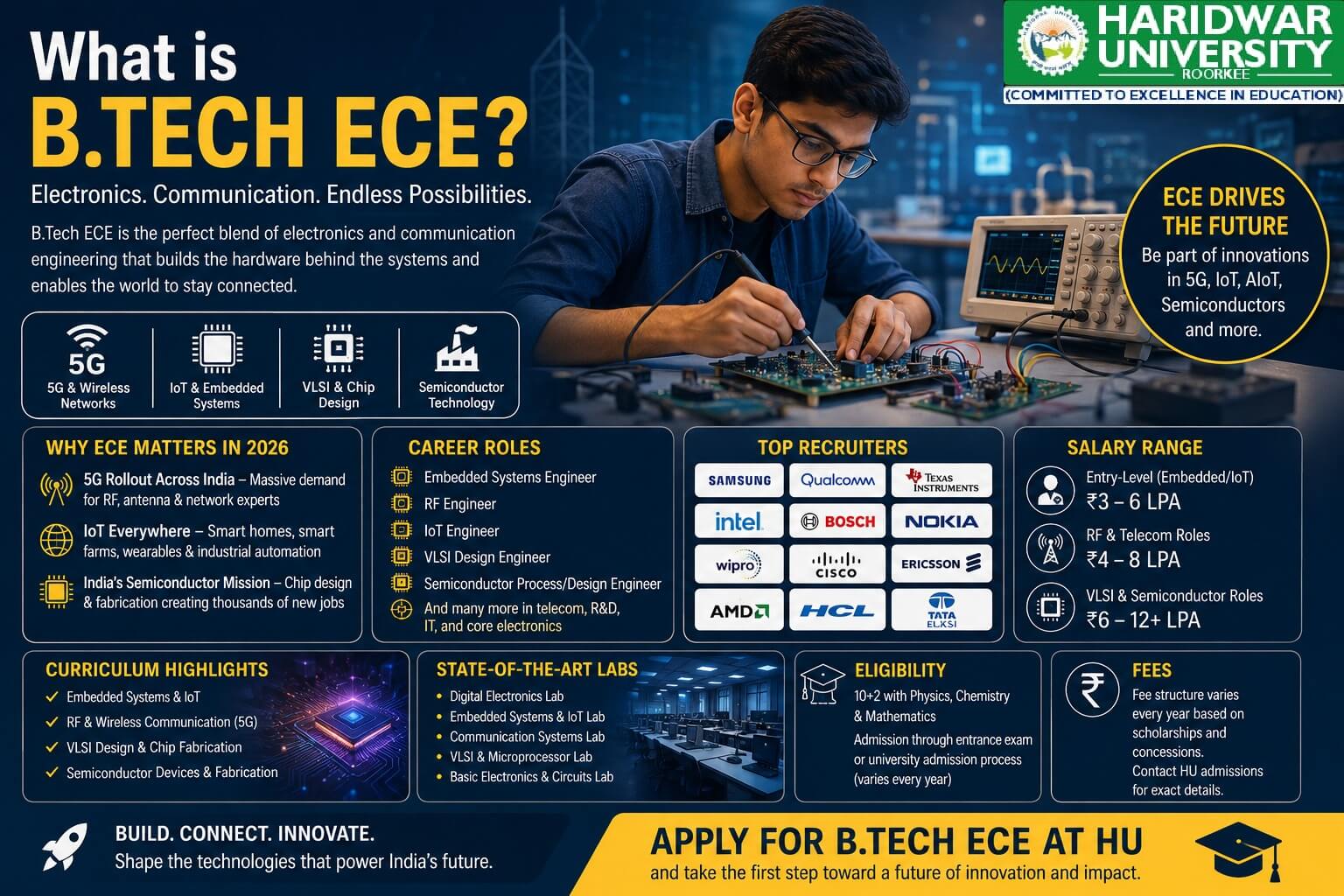
People sometimes assume Electronics and Communication Engineering is basically two separate courses stitched together — electronics on one side, communication on the other. In practice, it's one continuous thread: circuits and chips form the physical body of a system, while communication is what lets that system pass information along, whether that's a signal travelling across a network or two devices exchanging data. Across four years, coursework moves through circuit design, microcontrollers, signal processing, and eventually into building systems where hardware and connectivity work together.
The range this opens up surprises a lot of students. Someone graduating from this branch could go on to design antennas that sit on telecom towers. Someone else might write the firmware running inside a soil sensor out on a farm. Another might join a chip design team, working on transistor layouts for a semiconductor firm — while others pivot toward software-heavy tracks like Haridwar University's B.Tech AI & ML programme. The degree gives everyone the same starting toolkit — what gets built with it afterward varies a lot from person to person.
Why ECE Matters in 2026
Not long ago, ECE sat quietly in the shadow of computer science — respectable, but not exciting. That's shifted, and three things are behind it.
First, 5G rollout is past the announcement stage. Operators are actually laying down 5G infrastructure now, and not just in Delhi or Bangalore — tier-2 and tier-3 towns are getting connected too. That kind of expansion needs engineers who understand RF design, antenna systems, and network architecture, all of which live inside the ECE syllabus.
Second, IoT stopped being a buzzword a while back. Smart homes, connected farms, factory automation, wearable health trackers — every one of these runs on embedded hardware talking to sensors and, eventually, to the cloud. Someone has to design that hardware layer and write the code sitting on top of it.
Third, and maybe the biggest shift of all, India's semiconductor mission is reshaping the job market. Government incentives under the India Semiconductor Mission are pulling chip fabrication and design units into the country, and that's created sudden, real demand for engineers who know VLSI design, fabrication processes, and semiconductor testing. This is probably the single biggest change to hit ECE hiring in over a decade — India is trying to build a chip ecosystem almost from the ground up, and it needs trained people right now, not five years from now.
Put those three together, and you get a branch where demand keeps climbing exactly as the country tries to build its own capability in telecom, connected devices, and chips.
HU Curriculum: Built for Where the Industry Is Heading
At Haridwar University, the B.Tech ECE syllabus isn't treated as something to set once and forget. Alongside the core subjects everyone expects — circuit theory, digital electronics, signals and systems, microprocessors — there's a real effort to weave in what the industry actually needs right now:
- Embedded Systems and IoT — microcontroller programming, sensor integration, wireless communication protocols
- RF and Wireless Communication — antenna design plus a grounding in 5G network architecture
- VLSI Design — digital IC design flows and an introduction to chip fabrication
- Semiconductor Devices and Fabrication — a look at how chips are actually manufactured, not just how they work on paper
On top of the regular coursework, students tackle mini-projects every semester and a larger final-year project — many use this as a chance to dig into whatever specialisation they're leaning toward. Industry electives and the occasional guest lecture from working professionals keep the classroom tethered to what's actually happening in the job market, rather than drifting off into pure theory.
Lab Facilities That Make the Theory Real
Electronics doesn't really click until you've built something with your own hands — and figured out why it isn't working, at least once. HU's ECE labs are set up around exactly that idea.
Students work in a Digital Electronics Lab for logic circuit design and testing, an Embedded Systems Lab loaded with microcontroller kits and dev boards for IoT and embedded projects, a Communication Systems Lab where analog and digital communication ideas get tested in practice, and a VLSI and Microprocessor Lab for chip-design work and processor-level experiments. First and second years also get time in a Basic Electronics and Circuits Lab to build up the fundamentals.
The goal here is straightforward: by graduation, students should have actually built things, not just described them in an exam answer. Employers can tell the difference pretty quickly — between someone who's read about embedded systems and someone who's stayed up till midnight debugging a circuit before a deadline. Beyond the labs, life on campus — including hostel and campus facilities — plays its own part in shaping that hands-on learning environment.
Career Roles: Where ECE Graduates Actually Land
This is where the branch really earns its reputation — the sheer spread of roles it opens up. Here's a fairly grounded look at where graduates end up:
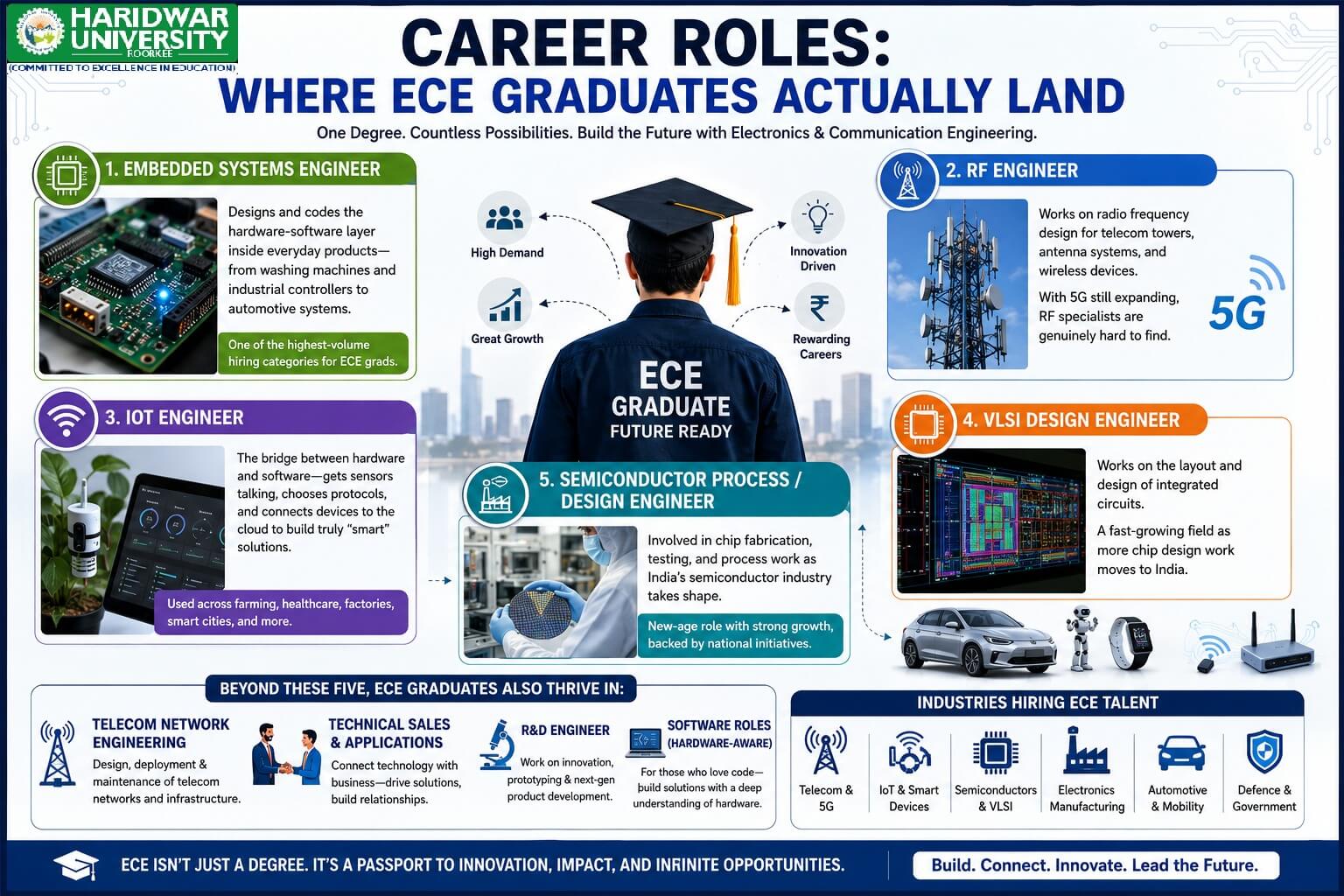
- Embedded Systems Engineer — designing and coding the hardware-software layer inside products people use every day, from washing machines to industrial controllers to car systems. This is easily one of the highest-volume hiring categories for ECE grads at the moment.
- RF Engineer — working on radio frequency design for telecom towers, antenna systems, and wireless devices. With 5G still expanding, RF specialists are genuinely hard to find.
- IoT Engineer — this role lives at the point where hardware meets software: getting sensors talking, choosing the right communication protocols, and wiring everything up to the cloud so a product can actually behave "smart" instead of just looking smart on a spec sheet. It shows up in more industries than people expect — farming, hospitals, factory floors, and city infrastructure all lean on it now.
- VLSI Design Engineer — working on the layout and design of integrated circuits, an area growing fast as more chip design work shifts into India.
- Semiconductor Process/Design Engineer — involved in chip fabrication, testing, and process work as India's semiconductor manufacturing base takes shape. Newer category, but growing quickly, and directly tied to national semiconductor initiatives.
Beyond these five, ECE graduates also drift into telecom network engineering, technical sales for electronics firms, R&D positions, and — for those who'd rather write code than solder circuits — software roles that value hardware-adjacent problem-solving.
Top Recruiters
ECE graduates aren't boxed into one type of company. Recruiters generally fall into a few buckets:
- Telecom operators and infrastructure providers rolling out 5G
- Electronics manufacturing and embedded systems firms
- IT companies hiring for hardware-software integration
- Semiconductor and chip design firms expanding their India footprint
- Public sector units or government departments working in telecom, defence electronics, and power
HU's campus placement cell brings recruiters from across these categories, alongside opportunities in core electronics manufacturing and the growing semiconductor design space. To learn more about campus placements, you can review the Placement Overview page or cross-check general guidelines on how to evaluate a college's placement record before taking admission.
Salary Ranges: What to Realistically Expect
Pay in ECE varies quite a bit depending on specialisation, employer, and city — so treat these as rough indicators, not guarantees.
Entry-level embedded systems or IoT roles generally start somewhere around ₹3–6 lakh per annum, depending on the company. RF and telecom roles often start a notch higher, given how specialised the skillset is, especially with telecom operators and infrastructure vendors.
VLSI and semiconductor design work, particularly at multinational chip firms, usually sits at the top end of ECE starting packages — often clearing what other specialisations offer straight out of college. Move three to five years into a career, and most people across these tracks see a solid jump in pay, more so if they've gone deep into something specific like RF design or chip verification work.
| ECE Specialisation / Role | Realised Starting Salary Range (p.a.) |
|---|---|
| Embedded Systems & IoT Engineer | ₹3.0 Lakh – ₹6.0 Lakh |
| RF & Telecom Engineer | ₹4.0 Lakh – ₹7.0 Lakh |
| VLSI & Semiconductor Design Engineer | ₹6.0 Lakh – ₹12.0+ Lakh (Typically sits at the top end of entry pay) |
Market conditions shift these numbers around, so read them as a rough compass rather than a fixed number. How much someone specialises, the internships they've done, and the projects they've built often end up shaping starting pay just as much as the degree on paper.
Fees & Eligibility
Understanding the entry requirements and financial commitments helps in planning your academic journey at Haridwar University.
B.Tech ECE: Fees & Eligibility Overview
Eligibility: Applicants should have cleared Class 12 (or its equivalent) with Physics, Chemistry, and Mathematics (PCM), and meet whatever minimum percentage the university has set for that particular admission cycle. Entry is generally based on the Haridwar University Admission Entrance Test (HUAET), though some years the university also considers scores from other national or state-level entrance exams. It's worth confirming the current year's B.Tech admission process directly with the admissions office before applying.
Fees Structure: For the current B.Tech ECE batch, tuition is structured as ₹1,32,000 in the first year, followed by ₹1,15,000 each in the second, third, and fourth years — bringing the total programme cost to roughly ₹4,77,000 over four years, before factoring in hostel, mess, or exam charges. Scholarships and merit-based concessions can bring this down further depending on the batch and eligibility.
HU's B.Tech ECE programme, like its other engineering courses, follows AICTE-approved guidelines for curriculum and accreditation. For a complete guide on how to apply and prepare, read our B.Tech Admission Guide 2026.
Why This Branch, Why Now
Branches go through phases of being "hot" and then fading — but what's happening with ECE isn't a passing trend. It's anchored to three real shifts happening at once: telecom networks expanding into new territory, IoT devices multiplying everywhere, and India pushing hard on semiconductor manufacturing. Anyone picking B.Tech ECE Haridwar University right now is walking into a branch where what's taught in class lines up closely with what companies are actively trying to staff for.
For someone who likes figuring out how things work — starting from the chip and working all the way up to the network — this is a solid moment to be studying electronics and communication engineering. Students exploring related postgraduate options can also look at HU's MCA programme for a software-focused path after B.Tech.
Frequently Asked Questions (FAQs)
1. What exactly does B.Tech ECE cover — is it just electronics, or communication too?
Both, and they're not really separate. Circuits and chips make up the hardware side, while communication is about how information actually moves — through a network, over the air, between two devices. Over four years you touch circuit design, microcontrollers, signal processing, and eventually systems where the two sides work together.
2. Why is ECE getting so much attention in 2026 compared to a few years back?
Three things are happening at once. 5G is finally rolling out beyond the big cities, IoT devices have gone from buzzword to everyday reality, and India's semiconductor push is creating real hiring demand for chip-related roles. None of these are hype — they're actual hiring trends showing up right now.
3. Does Haridwar University's ECE curriculum include newer areas like IoT and VLSI, or is it mostly traditional subjects?
Both. Core subjects like circuit theory, digital electronics, and microprocessors are still there, but the syllabus also weaves in embedded systems, RF and wireless communication, VLSI design, and semiconductor fabrication — so it's not stuck in an older, purely theoretical framework.
4. What kind of lab access do ECE students actually get at HU?
There's a dedicated lab for pretty much every core area — digital electronics, embedded systems, communication systems, and a VLSI and microprocessor lab. First and second years also work in a basic electronics lab to build up fundamentals before moving into the specialised ones.
5. Which job roles can I realistically expect after finishing B.Tech ECE?
Embedded systems engineering is the highest-volume option right now, but there's also RF engineering, IoT engineering, VLSI design, and semiconductor process work. Some graduates also move into telecom, technical sales, or software roles that lean on their hardware background.
6. Is a career in semiconductor design actually a good bet, or is it still too early?
It's early, but that's exactly why it's worth watching. India's semiconductor mission is pulling chip fabrication and design work into the country, and there simply aren't enough trained engineers yet to fill those roles. Getting in now, while the field is still building up, is arguably an advantage rather than a risk.
7. What kind of starting salary should I expect after B.Tech ECE?
It depends heavily on which direction you take. Embedded systems and IoT roles typically start around ₹3–6 lakh a year. RF and telecom roles often start a bit higher, and VLSI or semiconductor design roles — especially with multinational chip firms — tend to sit at the top of that range.
8. Who actually hires ECE graduates — is it just telecom companies?
Not at all. Recruiters span telecom operators, electronics manufacturers, IT firms doing hardware-software integration, semiconductor and chip design companies, and government departments working in telecom, defence electronics, and power. It's a much broader hiring pool than people assume going in.
9. What do I need to be eligible for B.Tech ECE at HU, and how do the fees work?
You'll need to have cleared Class 12 with Physics, Chemistry, and Mathematics (PCM), along with whatever minimum percentage the university sets for that admission cycle. Tuition is structured as ₹1,32,000 for the first year and ₹1,15,000 annually for subsequent years, though exact numbers can be verified with the admissions office relative to scholarship options.