


How to Evaluate a College's Placement Record Before Taking Admission (2026 Guide)
Haridwar University
Head of Training & Placements
Choosing an engineering college is one of the biggest decisions after Class 12. While many students compare rankings, fees, and campus facilities, the college placement record often becomes the deciding factor. However, a high placement percentage or a record-breaking salary package does not always tell the complete story.
This guide explains how to evaluate a college's placement record before taking admission. It covers the placement statistics that matter, common marketing claims to verify, and the questions every student should ask before making a final decision.
Table of Contents
- 1. Why Placement Records Matter Before Admission
- 2. What Is a College Placement Record?
- 3. Placement Statistics Every Student Should Compare
- 4. Placement Reality Check: Understanding the Numbers
- 5. Framework: How to Evaluate a College's Placement Record
- 6. Quick Placement Comparison Checklist
- 7. Common Placement Myths Every Student Should Avoid
- 8. Questions Every Student Should Ask Before Believing Placement Claims
- 9. Skills Recruiters Actually Look For
- 10. Why Internships and Industry Exposure Matter
- 11. Placement Evaluation Scorecard / Checklist
- 12. How Haridwar University Supports Student Placements
- 13. Related Resources
- 14. Conclusion: Choose a College Beyond Placement Numbers
- 15. Frequently Asked Questions (FAQs)
Why Placement Records Matter Before Admission
Many students select a college after looking at a single advertisement that highlights a high salary package or claims excellent placements. While these numbers may be genuine, they represent only one part of the overall picture.
A college placement record provides a broader understanding of how successfully students transition from academics to professional careers. It reflects the effectiveness of the placement cell, industry connections, internship opportunities, recruiter participation, and career support offered throughout the course.
Before taking admission, it is important to evaluate placement data carefully instead of relying on promotional claims alone. A college with consistent recruiter participation, practical learning opportunities, and transparent placement information often provides better long-term career outcomes than one promoting only exceptional salary figures.
What Is a College Placement Record?
A college placement record refers to the overall employment outcomes achieved by students through campus recruitment over a specific academic year.
Instead of focusing on a single number, students should consider multiple indicators that together reflect the strength of a college's placement ecosystem. These include:
- Placement percentage
- Average salary package
- Median salary package
- Highest salary package
- Number of recruiters visiting campus
- Internship opportunities
- Industry collaborations
- Career guidance and placement training
Looking at these factors together provides a much clearer picture than comparing only the highest package advertised by a college.
Placement Statistics Every Student Should Compare Before Admission
The following placement statistics help students compare engineering colleges more effectively. Rather than comparing colleges using only one of these metrics, evaluate them together to make a balanced decision.
| Placement Metric | Why It Matters |
|---|---|
| Placement Percentage | Shows the proportion of eligible students who secured job offers. |
| Average Package | Reflects the salary earned by most placed students. |
| Median Package | Often provides a more realistic salary expectation because it is less affected by exceptionally high offers. |
| Highest Package | Indicates the best individual offer received during campus placements. |
| Recruiting Companies | Demonstrates the diversity and quality of employers visiting the campus. |
| Internship Opportunities | Help students gain practical industry experience before graduation. |
| Industry Collaborations | Improve exposure through projects, workshops, training, and internships. |
Placement Reality Check: Understanding the Numbers
One of the most common mistakes students make is assuming every placement statistic carries the same importance. Each metric tells a different story.
Highest Package
The highest package represents the best individual offer received by a student during campus recruitment. While it reflects exceptional achievement, it does not indicate the salary earned by most students.
Average Package
The average package is calculated using the salaries of all placed students. It gives a broader picture of placement outcomes but may increase if a few students receive significantly higher offers.
Median Package
The median package represents the middle salary when all offers are arranged from lowest to highest. Many career experts consider it one of the most realistic indicators because it is less influenced by unusually high salary offers.
Placement Percentage
Placement percentage indicates the share of eligible students who secured employment through campus placements. When comparing this figure, students should also understand:
- Who is considered eligible?
- Are higher studies included?
- Are internship-to-job conversions counted?
- Is the data for the latest graduating batch?
Transparent colleges usually explain these details clearly.
While comparing engineering colleges, students can also review placement-related information published through the National Institutional Ranking Framework (NIRF), which provides standardized institutional data submitted by participating colleges. This can be useful for cross-checking placement claims and understanding broader institutional performance.
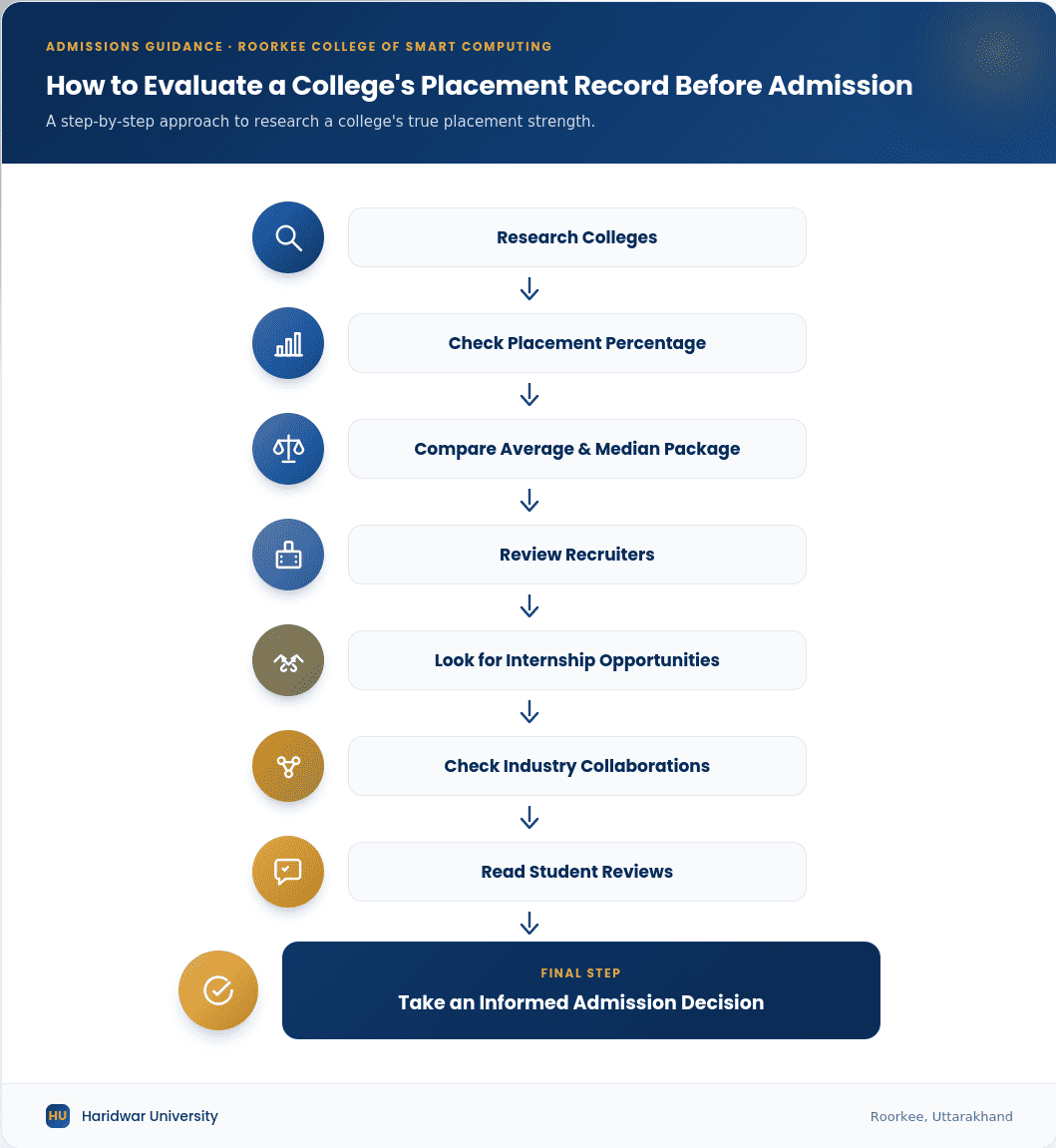
Framework: How to Evaluate a College's Placement Record
Below is a practical flowchart framework explaining the step-by-step process students should follow to evaluate and cross-verify a college's placement claims before making a final admission decision:
Quick Placement Comparison Checklist
Before finalising a college, use this checklist. Students who compare colleges using this checklist are less likely to rely on incomplete or misleading placement claims.
| Evaluation Question | Check |
|---|---|
| Is the latest placement report available? | ☐ |
| Is the placement percentage clearly mentioned? | ☐ |
| Are both average and median packages published? | ☐ |
| Is the recruiter list available? | ☐ |
| Does the college provide internship support? | ☐ |
| Are industry collaborations mentioned? | ☐ |
| Does the placement cell conduct training programmes? | ☐ |
| Is placement information updated regularly? | ☐ |
Common Placement Myths Every Student Should Avoid
Placement-related advertisements often highlight impressive numbers, but they don't always tell the complete story. Understanding a few common misconceptions can help students compare colleges more objectively.
Myth 1: A Higher Package Means Better Placements
A college advertising a ₹50 LPA or ₹1 crore package may attract attention, but that figure usually represents the highest individual offer received by one student. A balanced placement record is generally more useful than one exceptional salary offer. Before comparing colleges, also check: average package, median package, number of students placed, and variety of recruiters.
Myth 2: 100% Placement Means Every Student Gets a Dream Job
Some colleges mention 100% placement without explaining how the figure is calculated. Students should find out: Who is counted as eligible for placements? Are internship-to-job conversions included? Were students pursuing higher education excluded? Are multiple offers counted separately? Transparent placement reports usually explain these details.
Myth 3: CGPA Alone Guarantees Campus Placement
Academic performance is important, but recruiters evaluate candidates using several parameters. A strong overall profile generally creates more opportunities than marks alone. Many companies also consider: technical knowledge, practical projects, internship experience, communication skills, problem-solving ability, and aptitude and reasoning.
Myth 4: More Recruiters Always Mean Better Placements
A long recruiter list looks impressive, but quality matters as much as quantity. Consistent recruiter participation usually indicates stronger industry relationships. While comparing colleges, ask questions like: Are recruiters hiring regularly every year? Do companies recruit for core engineering roles? Are students offered internships before full-time jobs? What roles are generally offered?
Questions Every Student Should Ask Before Believing Placement Claims
Before taking admission, ask these questions during counselling sessions or while reviewing official placement reports. Students who ask these questions often gain a much clearer understanding of a college's placement ecosystem.
Placement Report
- Is the latest placement report available?
- Does it mention placement percentage?
- Are average and median salary packages published?
Recruiters
- Which companies visited the campus during the last placement season?
- How many companies recruited engineering students?
- Are core companies hiring for different branches?
Internships
- Does the college provide internship assistance?
- Are industrial internships compulsory?
- Do internships lead to Pre-Placement Offers (PPOs)?
Career Support
- Does the placement cell conduct aptitude training?
- Are mock interviews organised?
- Is resume-building support available?
- Are communication skills and personality development programmes conducted?
Skills Recruiters Actually Look For
One of the most common questions students ask is: "Is a good CGPA enough for placements?" The answer is usually no. Recruiters today evaluate candidates on a combination of academic performance and practical skills.
Technical Skills
Depending on the engineering branch, recruiters often expect:
- Programming and coding
- Core engineering fundamentals
- Problem-solving ability
- Data analysis
- Software or design tools
- AI and emerging technology awareness (for relevant roles)
Practical Experience
Students with practical exposure often have an advantage during interviews. Examples include:
- Academic projects (mini projects, final-year projects)
- Hackathons and coding competitions
- Open-source contributions
- Internships
A strong portfolio demonstrates the ability to apply classroom concepts to real-world problems.
Soft Skills
Employers also value: communication, teamwork, adaptability, leadership, presentation skills, and time management. These skills often influence interview performance as much as technical knowledge.
Continuous Learning
Technology evolves quickly. Students who regularly update their knowledge through online courses, certifications, workshops, or industry events are generally better prepared for campus recruitment.
Why Internships and Industry Exposure Matter
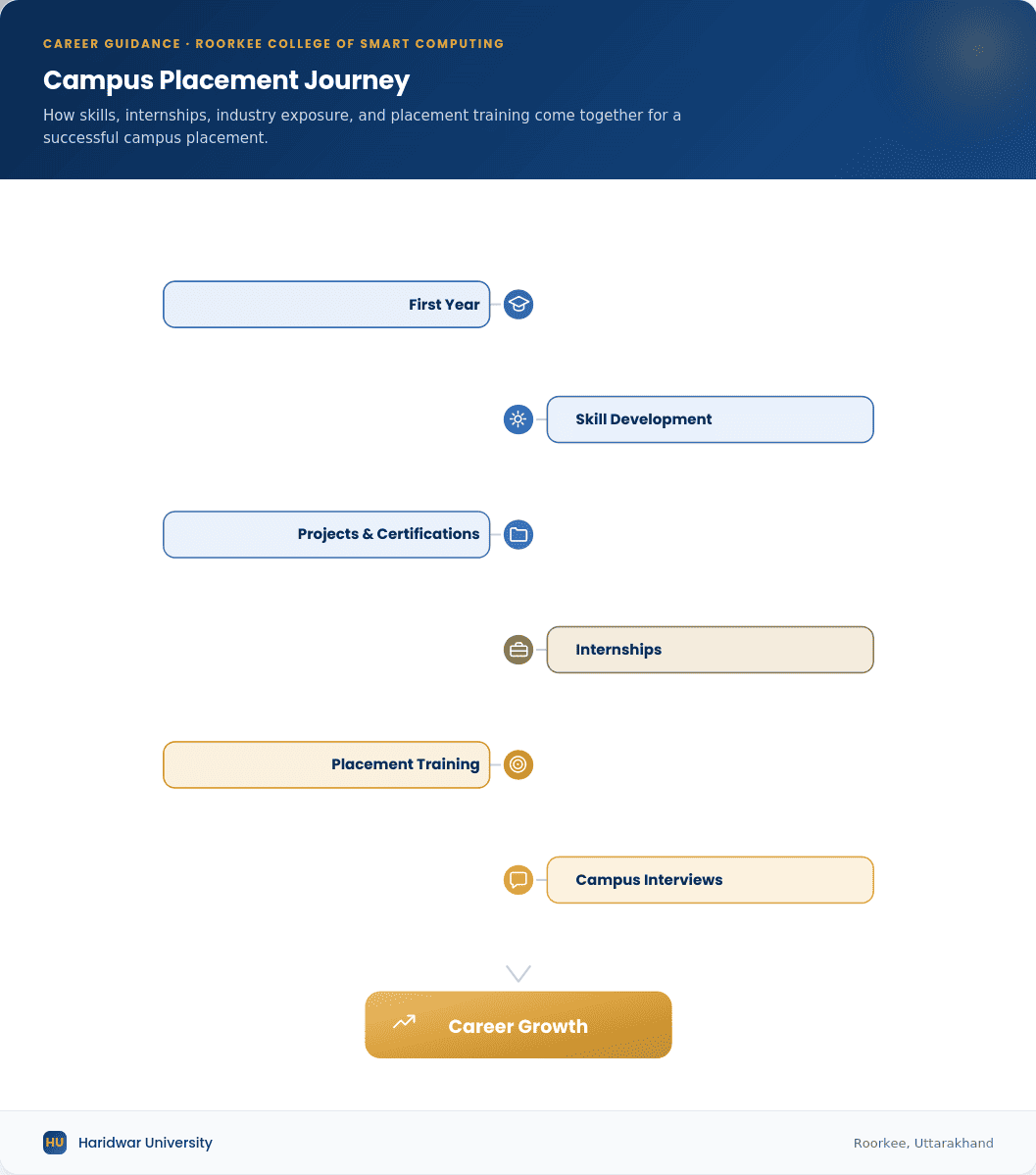
Campus placements are often the result of years of preparation rather than a single recruitment drive. Internships help students in numerous ways:
- Apply classroom concepts in real work environments.
- Understand industry expectations.
- Develop technical and professional skills.
- Build confidence before final placements.
- Improve the chances of receiving a Pre-Placement Offer (PPO).
Similarly, industry collaborations, expert sessions, industrial visits, innovation projects, and interaction with professionals provide valuable exposure that supports long-term career development. When evaluating a college's placement record, it is worth looking beyond placement numbers and considering how the institution prepares students for employment throughout the course.
Placement Evaluation Scorecard / Checklist
Before shortlisting any engineering college, use this simple scorecard. A college that performs well across these parameters is usually better positioned to support students throughout their academic journey and into their professional careers.
| Placement Factor | Score (Yes/No) |
|---|---|
| Latest placement report published | ☐ |
| Placement percentage disclosed | ☐ |
| Average package available | ☐ |
| Median package available | ☐ |
| Recruiter list published | ☐ |
| Internship opportunities | ☐ |
| Industry collaborations | ☐ |
| Placement training support | ☐ |
How Haridwar University Supports Student Placements
Choosing a college involves more than comparing placement numbers. The learning environment, industry exposure, and career support available throughout the course also play an important role. Haridwar University has developed a placement ecosystem that combines academic learning with industry engagement to help students prepare for professional careers.
Key Highlights
- 10,000+ placement offers facilitated over the years.
- 1,300+ recruiting companies have participated in campus hiring.
- 200+ academic and industry collaborations support practical learning and industry exposure.
- Highest national package of ₹60 LPA, along with multiple offers across ₹22 LPA, ₹15 LPA, ₹10 LPA, ₹7 LPA and ₹5 LPA hiring bands.
- Dedicated placement training including aptitude preparation, communication skills, resume building and interview practice.
Students interested in placement activities can explore the Placement Overview page for detailed information on training initiatives and placement support.
Industry Exposure Beyond Campus Placements
Career readiness is built through continuous interaction with industry. Haridwar University encourages students to gain practical exposure through:
- Industrial collaborations and academic partnerships
- Expert lectures and workshops
- Industry visits
- Innovation and research activities
- Internship opportunities with partner organisations
Such initiatives help bridge the gap between classroom learning and workplace expectations.
Recruiters Visiting the Campus
A strong recruiter network provides students with opportunities across different industries and job roles. Students can review the official recruiter list to understand the diversity of organisations participating in campus recruitment.
Preparing Early for Better Placement Opportunities
Placement preparation should begin from the first year instead of waiting until the final semester. Students can strengthen their profile by building technical projects, completing internships, participating in hackathons and coding competitions, improving communication skills, earning relevant certifications, and developing problem-solving abilities.
Students planning to pursue engineering can also explore the Roorkee College of Engineering and Roorkee College of Smart Computing to understand available programmes and specialisations. Students preparing for admission may also find the Haridwar University Admission Entrance Test (HUAET) useful while exploring engineering programmes.
Related Resources
Students interested in engineering admissions and career planning may also find these guides useful:
- B.Tech Admission Guide 2026
- 25 AI Projects Every Engineering Student Should Build
- AI vs CSE: Which Engineering Branch Should You Choose?
These resources cover admissions, engineering career options, and practical skill development.
Conclusion: Choose a College Beyond Placement Numbers
A college placement record should never be evaluated using a single statistic. Before taking admission, compare placement percentage, average and median salary packages, recruiter participation, internship opportunities, industry collaborations, and placement support together. These factors provide a clearer picture of how effectively a college prepares students for professional careers. Making an informed decision today can have a lasting impact on future career opportunities.
Ready to explore engineering options supported by industry collaborations, placement assistance, and practical learning opportunities?
Frequently Asked Questions (FAQs)
1. What is a college placement record?
A college placement record summarises the employment outcomes of students, including placement percentage, recruiter participation, salary packages, internship opportunities, and career support offered by the institution.
2. Which placement statistics should students compare before admission?
Students should compare the placement percentage, average package, median package, highest package, diversity of recruiting companies, internship opportunities, and industry collaborations. Looking at these factors together provides a more balanced evaluation.
3. Is the highest package the best indicator of placements?
No. The highest package represents a single exceptional offer. The average package, median package, recruiter diversity, and placement percentage provide a much more realistic understanding of overall placement outcomes.
4. Is CGPA enough to secure campus placement?
A good academic record is important, but recruiters also evaluate technical knowledge, practical projects, internships, communication skills, aptitude, and problem-solving ability.
5. Why are internships important before placements?
Internships help students gain practical experience, understand workplace expectations, build professional skills, and improve the chances of receiving full-time job offers or Pre-Placement Offers (PPOs).
6. How can students improve their placement opportunities?
Students can improve their placement prospects by developing technical skills, working on practical projects, completing internships, participating in coding competitions, strengthening communication skills, and preparing consistently throughout the degree programme.