

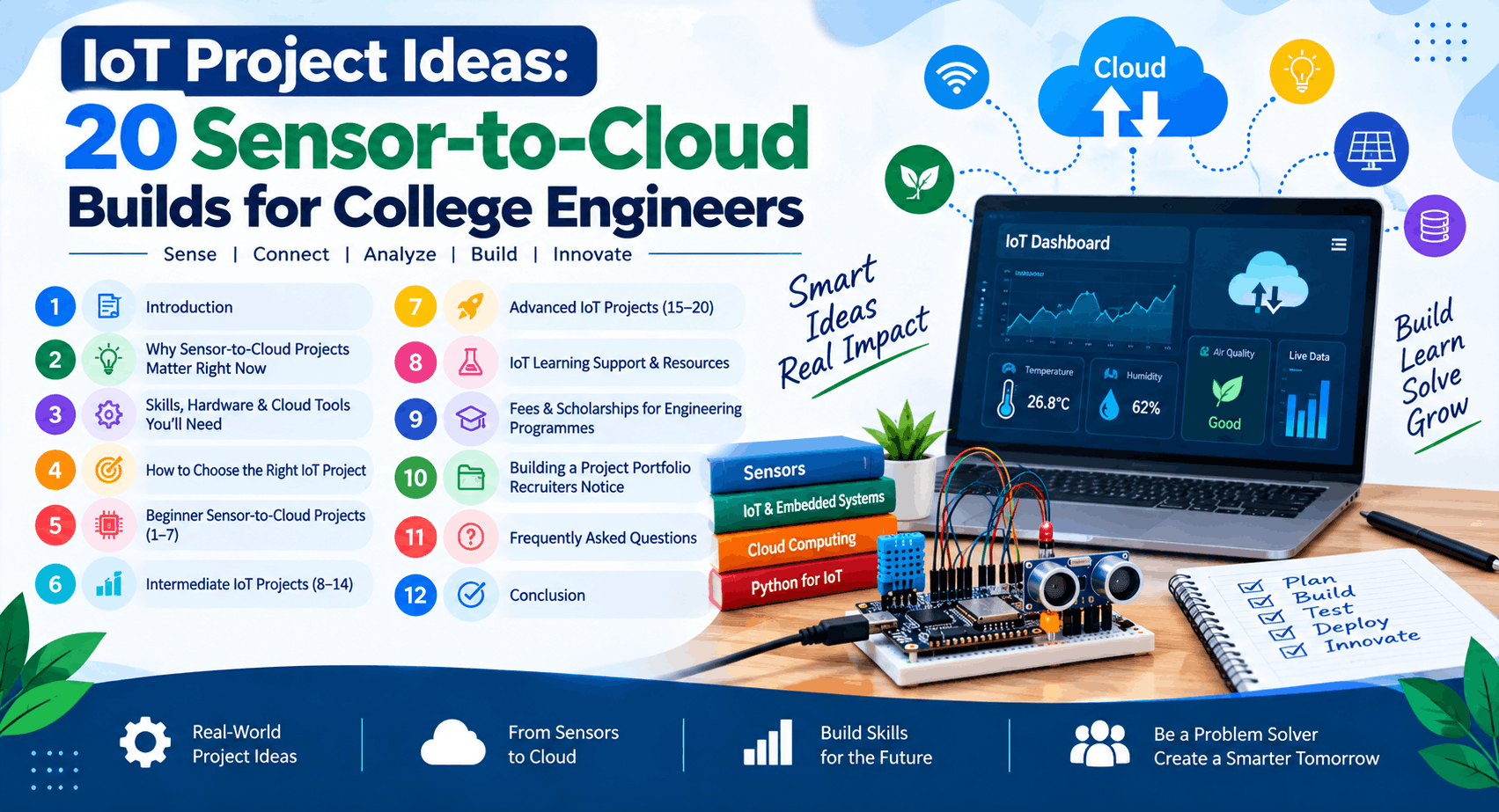
IoT Projects in Haridwar University are increasingly built around a simple idea: a physical sensor collects real-world data, and a cloud dashboard turns that data into something you can see, analyse, and act on. If you are searching for IoT project ideas that go beyond a blinking LED, this guide lists 20 sensor-to-cloud builds you can realistically finish in a semester, organised by difficulty, along with the hardware, protocols, and cloud tools each one needs.
Choosing the right project out of hundreds of generic lists online is hard because most of them don't tell you which board to buy, which protocol to use, or which branch a project actually suits. This article is written specifically for engineering students who want a working sensor-to-cloud pipeline — not just a wiring diagram — and who may later want to specialise in embedded systems, IoT, or cloud computing as part of a Computer Science or Electronics engineering degree.
1. Why Sensor-to-Cloud Projects Matter Right Now
2. Skills, Hardware & Cloud Tools You'll Need
3. How to Choose the Right IoT Project
4. Beginner Sensor-to-Cloud Projects (Projects 1–7)
5. Intermediate IoT Projects (Projects 8–14)
6. Advanced IoT Projects (Projects 15–20)
7. IoT Learning Support & Labs at Haridwar University
8. Fees & Scholarships for Engineering Programmes at HU
9. Building a Project Portfolio Recruiters Notice
1. Why Sensor-to-Cloud Projects Matter Right Now
Sensor-to-cloud systems sit at the intersection of hardware and software, which is exactly why recruiters value them. A well-documented IoT project shows that you can read data from a physical sensor, move it over a network protocol, store or visualise it on a cloud dashboard, and (in advanced builds) act on it automatically.
That combination of skills is relevant to Computer Science, Electronics & Communication, Electrical, Mechanical, and Agricultural engineering students alike, which is one reason IoT project ideas consistently rank among the most searched final-year and semester project topics.
The leap from an offline breadboard circuit to an end-to-end cloud pipeline is what converts an academic class assignment into an industry-grade portfolio asset that catches an engineering recruiter's eye.
2. Skills, Hardware & Cloud Tools You'll Need
You do not need to master every tool below before you start. Pick the smallest working combination for your first project and add complexity as you go.
Microcontrollers & SBCs
Most beginner builds use an Arduino Uno/Nano for simple sensor readouts, an ESP32 or NodeMCU (ESP8266) for built-in Wi-Fi, or a Raspberry Pi for compute-heavy workloads and camera feeds.
Common Sensor Modules
DHT11/DHT22 (temp & humidity), MQ-series (gas/air quality), PIR/ultrasonic (motion & distance), soil moisture, rain sensors, ACS712 current sensors, MPU6050 accelerometers, GPS (NEO-6M), and RC522 RFID readers.
Protocols & Cloud Platforms
MQTT is the lightweight publish-subscribe standard for IoT devices, while HTTP/REST handles one-off readings. Dashboard platforms include ThingSpeak, Blynk, Firebase, AWS IoT Core, and self-hosted Node-RED / Grafana stacks.
3. How to Choose the Right IoT Project
Match the project to your branch and the skills you already have, then let the cloud and analytics layer get more advanced as your confidence grows:
- New to electronics: start with a single-sensor logger (Projects 1–4) before adding actuators or complex relays.
- CSE / IT / AI & ML students: lean toward projects with more dashboard logic, automation rules, or predictive models (Projects 8, 9, 15, 17, 20).
- ECE / EEE students: lean toward projects with more sensor calibration, power management, and communication-module work (Projects 6, 10, 12, 14, 18).
- Mechanical, Civil, or Agricultural Engineering students: pick a domain-relevant build such as predictive machine maintenance, soil/irrigation monitoring, or cold-chain logistics (Projects 3, 11, 15, 18).
4. Beginner Sensor-to-Cloud Projects (Projects 1–7)
These introductory builds require minimal wiring, low-cost components, and can be completed within a weekend to teach the core sensor-to-cloud dataflow:
1. Temperature & Humidity Logger to the Cloud
Difficulty: BeginnerA DHT11/DHT22 sensor connected to an ESP8266 or ESP32 sends live temperature and humidity readings to a ThingSpeak channel over HTTP, giving you a graph you can check from any browser. This is usually the very first sensor-to-cloud project students complete, and it teaches the full pipeline in miniature: sensor, Wi-Fi, cloud channel, chart.
2. Smart Dustbin with Fill-Level Alerts
Difficulty: BeginnerAn ultrasonic sensor measures how full a dustbin is and pushes the reading to the Blynk app, which raises an alert once the bin crosses a set threshold. It is a favourite for smart-campus and smart-city themed exhibitions and introduces threshold-based alerting.
3. Soil Moisture Monitor with Auto-Irrigation Alert
Difficulty: BeginnerA soil moisture sensor paired with an ESP32 reports moisture levels to a cloud dashboard and sends a notification (or triggers a relay-controlled pump) when the soil dries below a set point — a practical build for Agricultural Engineering and Computer Science students working on AgriTech.
4. Gas Leak Detector with Push Notification
Difficulty: BeginnerAn MQ-2 gas sensor connected to a NodeMCU detects LPG or smoke concentration and sends an instant push notification through Firebase Cloud Messaging when levels cross a safe threshold, introducing students to real-time notification pipelines.
5. RFID Attendance Logger to Google Sheets
Difficulty: BeginnerAn RFID reader tied to an ESP32 logs each student's tag scan directly into a Google Sheet using a simple web app script, giving a timestamped, cloud-stored attendance record without any local database.
6. Smart Street-Light Prototype
Difficulty: BeginnerAn LDR (light sensor) triggers an LED street-light model to switch on at dusk, while an ESP32 logs the on/off events and ambient light readings to a cloud dashboard — a compact demonstration of smart-city energy-saving concepts.
7. Wearable Pulse Monitor with Mobile Alerts
Difficulty: BeginnerA pulse sensor on a wearable strap, read by an ESP32, streams heart-rate data to a mobile-friendly dashboard (Blynk or ThingSpeak) and can flag abnormal readings — a beginner-friendly entry point into IoT health-monitoring builds.
5. Intermediate IoT Projects (Projects 8–14)
These intermediate builds introduce multi-sensor fusion, industry-standard MQTT message brokers, and enterprise cloud stacks like AWS IoT Core:
8. Smart Parking Slot Detector
Difficulty: IntermediateAn array of ultrasonic sensors, one per parking bay, reports occupancy to an ESP32 gateway, which publishes slot status over MQTT to a Node-RED dashboard showing free and occupied spaces in real time.
9. Multi-Sensor IoT Weather Station
Difficulty: IntermediateCombining temperature, humidity, barometric pressure, and a rain-detection sensor on one ESP32 node, this build publishes readings to AWS IoT Core, letting students practise device provisioning and cloud rule-based alerts on an industry-grade platform.
10. Energy Consumption Monitor
Difficulty: IntermediateAn ACS712 current sensor tracks the power draw of a lab appliance, and the readings are logged to a cloud dashboard for daily/weekly consumption trends — useful groundwork for Electrical Engineering students exploring smart-grid concepts.
11. Automated Smart Irrigation System
Difficulty: IntermediateThis build combines a soil-moisture sensor with a public weather API so the system only irrigates when the soil is dry and rain isn't forecast, controlling a relay-driven water pump automatically and logging every irrigation cycle to the cloud.
12. GPS Vehicle Tracking with Geo-fencing
Difficulty: IntermediateA GPS module and GSM/Wi-Fi module on an ESP32 stream a vehicle's live location to a cloud map, with an alert triggered if the vehicle exits a defined geo-fence — a common logistics and fleet-safety demonstration.
13. Air Quality Index Monitor
Difficulty: IntermediateAn MQ135 gas sensor combined with a particulate-matter (PM2.5) sensor computes a simple air-quality index and publishes it to a public-facing dashboard, giving students hands-on exposure to environmental IoT.
14. Campus Water-Tank Level Monitor
Difficulty: IntermediateAn ultrasonic sensor mounted above a water tank reports fill level to a cloud dashboard and sends an SMS or app alert when the tank runs low or overflows — directly useful for hostel or campus facility management.
6. Advanced IoT Projects (Projects 15–20)
These advanced builds are tailored for final-year engineering capstones, integrating Edge-AI inference, time-series forecasting, and digital twins:
15. Predictive Maintenance for Lab Machines
Difficulty: AdvancedA vibration/accelerometer sensor (MPU6050) mounted on a motor or lab machine streams vibration signatures to the cloud, where a simple machine-learning model flags abnormal patterns before a breakdown occurs — a strong Mechanical–CSE cross-branch project.
16. Patient Vitals Monitor with Edge-AI Anomaly Detection
Difficulty: AdvancedPulse, temperature, and SpO2 sensors feed a Raspberry Pi that runs a lightweight anomaly-detection model at the edge before sending only flagged events to the cloud, reducing bandwidth while keeping response time low — relevant for Biomedical and CSE/AI&ML students.
17. Smart-Meter Load Prediction
Difficulty: AdvancedHistorical and live power-consumption data from a smart-meter simulation is used to train a cloud-hosted model that forecasts short-term load, helping students understand how utilities approach demand forecasting.
18. Industrial Cold-Chain Monitor
Difficulty: AdvancedTemperature, humidity, and GPS sensors packaged into a portable unit track conditions during transport of temperature-sensitive goods (vaccines, produce, or pharmaceuticals) and log a full route-and-condition history to the cloud — a natural fit for Pharmacy or Agriculture students collaborating with CSE.
19. Campus Security System with Motion & Camera Alerts
Difficulty: AdvancedPIR motion sensors combined with a camera module on a Raspberry Pi detect movement after hours, capture a snapshot, and push both the image and an alert to a cloud storage bucket and a mobile notification.
20. Digital Twin Dashboard for a Smart Classroom
Difficulty: Advanced (Capstone)This capstone-level build combines occupancy, temperature, air-quality, and light sensors from a single classroom into one unified cloud dashboard that mirrors real-time conditions — effectively a small digital twin — and is a strong final-year project for students combining CSE and ECE skills.
7. IoT Learning Support & Labs at Haridwar University
Building sensor-to-cloud projects needs both hardware access and software mentorship. At Haridwar University, the Electronics & Communication Lab and the university's AI and University Laboratories support the hardware, circuit, and computing-fundamentals side of these builds, while faculty in the Computer Science & Engineering department guide the cloud, dashboard, and automation-logic side.
Students interested in the software and cloud side of IoT typically pursue programmes such as B.Tech Hons. CSE, AI & ML, or Data Science under the Roorkee College of Smart Computing, while those drawn to the sensor and hardware side often choose B.Tech Hons. ECE with AI or EEE with AI under the Roorkee College of Engineering. Both paths lead naturally into IoT project work, since sensor-to-cloud builds need contributions from each side.
If coursework and project deadlines start to overlap, HU's Student Welfare Service office (Students Care Centre) offers academic and personal support, so project stress doesn't have to be managed alone.
Ready to build your first sensor-to-cloud project on campus?
Join Haridwar University's active engineering ecosystem with dedicated IoT hardware stations, edge-computing racks, and expert faculty mentors.
Build Your Skills at HU →8. Fees & Scholarships for Engineering Programmes at HU
All figures below are taken directly from HU's official Fees & Scholarships page, verified as of 20 September 2026, for the 2026–27 academic year. These are HU's official figures — the university uses its own website as the source, not a third-party aggregator.
For students interested in IoT project work, the two most relevant four-year programmes are B.Tech. Hons. CSE (Roorkee College of Smart Computing) and B.Tech. Hons. ECE with AI (VLSI Certification from IIT/NIT) (Roorkee College of Engineering). Both carry a full four-year tuition-and-allied-fee total of approximately ₹4,77,000 (Year 1: ₹1,32,000; Years 2–4: ₹1,15,000 each), covering tuition, enrollment, admission, examination, and uniform fees; transportation is charged separately based on the bus route chosen.
Three First-Year Scholarship Schemes
HU runs three separate scholarship schemes for first-year tuition fees, and a student may claim only one of them:
- Merit scale (JEE Rank / 12th percentage / CUET percentile): 80% waiver for JEE rank up to 1,00,000 or above 90% aggregate; 50% for the next band; 20% and 10% for the two lower merit bands.
- Sports quota: 50% for national-level certificate holders, 30% state-level, 20% district-level, and 10% school-level.
- Category-based 25% (first year only, for 2025 or 2026 Class 12 pass-outs): applicable separately to:
- Students scoring >60% in Class 12 whose parents serve in the Armed Forces, are Freedom Fighters/Martyrs, HU/RCE alumni, siblings of existing students, or children of university employees.
- Uttarakhand domicile certificate holders.
- All female candidates under HU's dedicated girls'-education scholarship.
No meritorious scholarships are available to private candidates, and M.Tech. applicants can additionally claim an AICTE scholarship if they have qualified GATE 2026. Full details are on the official Fees & Scholarships page.
Haridwar University's engineering programmes are AICTE approved and the university is UGC recognized, as stated on HU's own Admission Overview page (verified as of 20 September 2026).
9. Building a Project Portfolio Recruiters Notice
A working demo matters more than a long list of project names. Upload your code, a short README explaining the sensor-to-cloud flow, a clear wiring schematic, and a 30–60 second demo video to GitHub.
Explain the real-world problem the project solves rather than just naming the sensors used — recruiters read the problem statement, not just the parts list.
If you're also exploring software-only and intelligent systems alongside IoT, our companion guide on 25 AI Projects for Engineering Students covers the machine-learning and cloud-AI side in deeper depth, while our Final-Year Project Ideas Guide helps map out complete capstone requirements.
10. Frequently Asked Questions (FAQs)
1. What is the difference between an IoT project and a regular embedded systems project?
An embedded systems project usually reads a sensor and reacts locally (for example, switching on an LED). An IoT project adds a network layer that sends that sensor data to the cloud, so it can be viewed, stored, and analysed remotely — that cloud connection is the defining piece of every project in this list.
2. Which microcontroller should a beginner choose: Arduino, ESP32, or Raspberry Pi?
Start with an Arduino Uno if you're new to circuits and just want to read a sensor. Move to an ESP32 or NodeMCU as soon as you need built-in Wi-Fi to reach the cloud, since most projects in this list assume that. Use a Raspberry Pi only when a project needs more processing power, such as running a camera or a small model locally.
3. Do I need to know cloud computing to build IoT projects?
Not for beginner builds. Platforms such as ThingSpeak and Blynk let you send sensor data to a ready-made dashboard with a few lines of code. Deeper cloud-computing knowledge becomes useful once you move to AWS IoT Core or build your own dashboard logic, as described in the intermediate and advanced projects above.
4. Which branch of engineering is best suited for IoT projects — CSE, ECE, or ME?
IoT genuinely spans branches. CSE and IT students usually gravitate toward the cloud, dashboard, and automation-logic side; ECE and EEE students often focus on sensor interfacing and communication modules; and Mechanical, Civil, or Agricultural Engineering students can pick a domain-relevant build such as predictive maintenance or soil monitoring.
5. Can Agriculture or Pharmacy students also build IoT projects?
Yes. Soil-moisture and auto-irrigation systems (Project 3) suit Agricultural Engineering students, and cold-chain monitoring (Project 18) is directly relevant to Pharmacy and Agriculture students tracking temperature-sensitive goods during transport.
6. Is MQTT better than HTTP for sending sensor data to the cloud?
MQTT is lighter and better suited to devices that send frequent, small updates, which is why it's commonly used in intermediate and advanced IoT builds. HTTP/REST is simpler to set up and works fine for beginner projects that only send occasional readings, such as the temperature logger in Project 1.
7. How much does it typically cost to build a beginner IoT project?
Costs vary by sensor and board choice — but most beginner sensor-to-cloud kits (one microcontroller board plus one or two sensors) are a modest one-time hardware purchase, and the cloud dashboards used in this guide (ThingSpeak, Blynk, Firebase) all offer free tiers, so there's no recurring cloud cost for a student project.
8. Where can I get faculty guidance for choosing and building these projects at HU?
Faculty in the Computer Science & Engineering department, along with the university's Electronics & Communication and AI Lab teams, mentor student project teams through the academic year. Reach out through your department for project allocation and lab access.
9. Do IoT projects help during campus placements and interviews?
Yes. A documented sensor-to-cloud project demonstrates hardware interfacing, networking, and cloud-dashboard skills in one build, which recruiters in embedded systems, IoT, and cloud-adjacent roles specifically look for.
Start Building Your IoT Engineering Future at Haridwar University
The 20 sensor-to-cloud builds above give you a complete roadmap — from your first temperature logger to an advanced digital twin. Explore our AICTE-approved B.Tech programmes with modern lab facilities and up to 80% first-year tuition scholarships.