

Deep learning project ideas are easy to find online. Choosing one that is technically meaningful, achievable within a strict final-year semester timeline, and robust enough to defend convincingly in an external viva is considerably harder.
When I review a final-year project proposal, I never start with the model name. I look first at the problem definition, data provenance, baseline evaluation method, and realistic engineering scope. Mentioning a Transformer or deep CNN does not automatically make a project advanced. The rigour of your experimental design and the evidence used to validate improvements matter just as much.
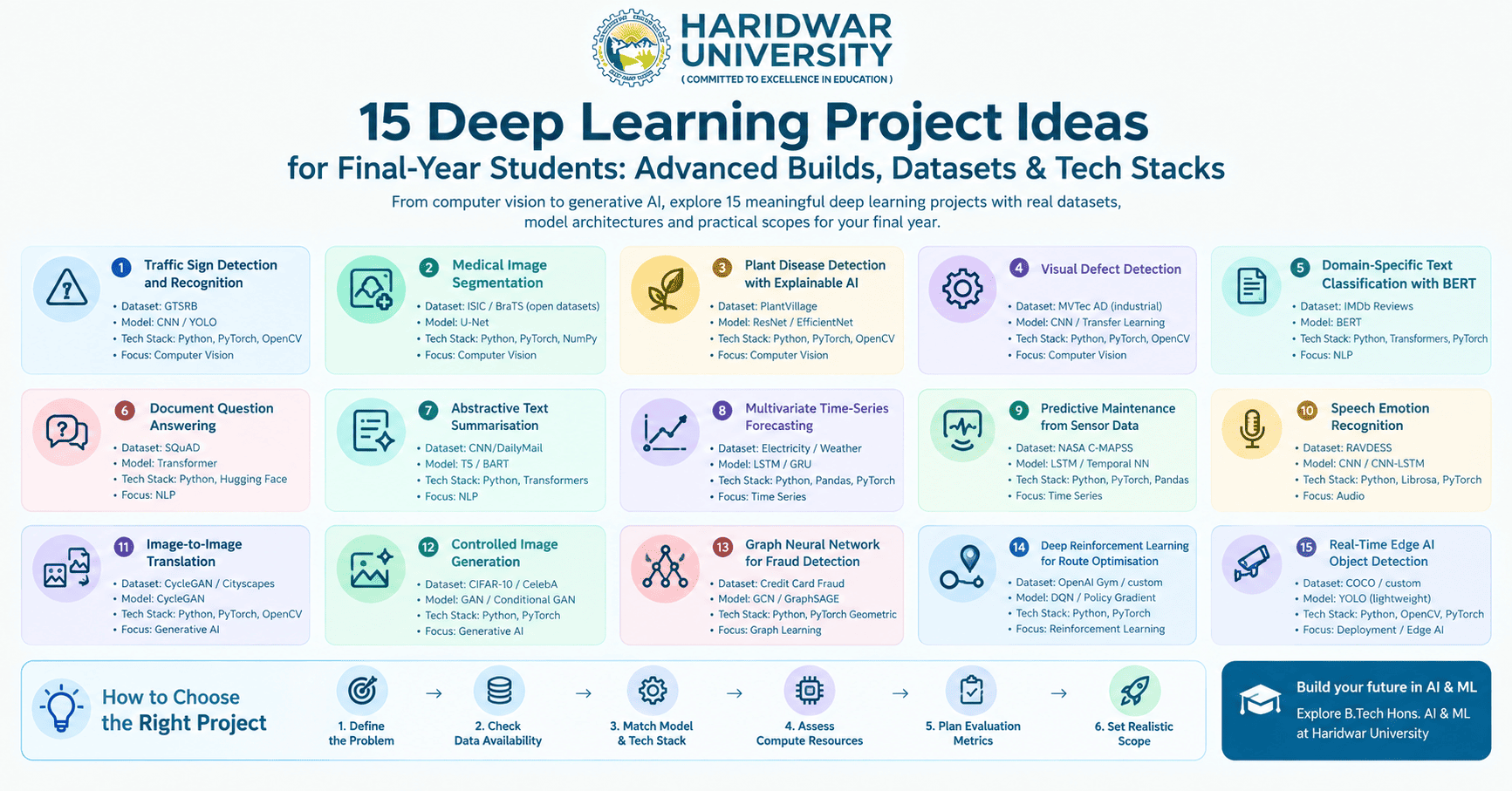
Haridwar University's guidance on computing and intelligence projects follows a simple standard: a project should be something a student can complete, explain, and defend with technical maturity. The 15 ideas below span computer vision, natural language processing, multivariate time-series forecasting, audio intelligence, generative AI, graph learning, and edge hardware deployment.
1. How to Choose a Deep Learning Project for Final Year (6-Factor Checklist)
2. 15 Deep Learning Project Ideas for Final-Year Students
3. How to Scope and Evaluate a Deep Learning Project
4. What to Demonstrate in Your Final-Year Project Defense
6. Choosing a Project That Can Stand Up to Scrutiny & HU Research Labs
1. How to Choose a Deep Learning Project for Final Year
A defensible final-year project requires far more than a downloaded dataset and a GPU notebook. Before signing a project charter, evaluate your proposal against these six feasibility factors:
| Feasibility Factor | What to Rigorously Verify Before Starting |
|---|---|
| Problem | Is there an unambiguous, well-defined problem to solve rather than a vague aspiration? |
| Dataset | Is reliable, appropriately licensed, and sufficiently labeled benchmark data available? |
| Architecture | Does the model architecture naturally fit the data modality rather than simply being a fashionable keyword? |
| Compute | Can your team realistically train and fine-tune it within local workstation or cloud GPU quotas? |
| Evaluation | Can you quantitatively prove whether the complex model genuinely outperforms a simpler baseline? |
| Scope | Can the core minimum viable pipeline be completed, debugged, and documented before attempting extensions? |
The Core vs. Extended Scope Rule: Always separate your submission into a rock-solid core scope (data pipeline, reproducible baseline, proposed architecture, and evaluation metrics) and an extended scope (model explainability, quantization, Docker deployment, or edge inference). If timeline bottlenecks occur, your core remains completely intact and defensible.
For an overview of final-year computing directions across all software domains, explore: 25 Final-Year Project Ideas for CSE & AI/ML Students at Haridwar University.
2. 15 Deep Learning Project Ideas for Final-Year Students
1. Traffic Sign Detection and Recognition
Computer Vision • AdvancedProblem: Detect and recognise road traffic signs in real time under variable lighting and adverse weather conditions.
Dataset: German Traffic Sign Recognition Benchmark (GTSRB) or German Traffic Sign Detection Benchmark (GTSDB).
Architecture & Tech Stack: Custom CNN, MobileNetV3 or lightweight YOLO-based object detector; Python, PyTorch / TensorFlow, OpenCV.
Scope: Master cropped sign classification as the core; extend towards multi-sign localisation in full video frames.
Evaluation: Accuracy, Precision, Recall, Macro F1-score, and per-class confusion matrices.
2. Plant Disease Detection with Explainable AI (XAI)
Agri-Tech • Intermediate to AdvancedProblem: Classify crop leaf pathologies accurately and produce visual heatmap explanations of why the network reached its diagnosis.
Dataset: PlantVillage Dataset (54,306 curated leaf images across 14 crop species and 26 disease conditions).
Architecture & Tech Stack: Transfer learning with ResNet-50, EfficientNet-B0 or MobileNet; Grad-CAM, PyTorch, OpenCV.
Scope: Multi-class disease classification is core; Grad-CAM visual explanation overlay represents the research-grade extension.
Evaluation: Precision, Recall, F1-score, confusion matrix, and qualitative validation of saliency maps.
3. Visual Defect Detection in Industrial Manufacturing
Industrial Vision • AdvancedProblem: Detect surface anomalies, structural scratches, and component defects from assembly-line images.
Dataset: MVTec Anomaly Detection (MVTec AD) benchmark, specifically designed for industrial visual inspection.
Architecture & Tech Stack: Autoencoder-based reconstruction, PatchCore, or transfer-learning CNN; PyTorch, OpenCV.
Scope: Start with binary defect detection (normal vs defective); extend to pixel-level defect segmentation.
Evaluation: F1-score, False Positive Rate (FPR), PR-AUC, and mAP / IoU for pixel localisation.
4. Medical Image Segmentation
Healthcare AI • AdvancedProblem: Delineate anatomical boundaries or abnormal lesion regions in clinical imaging scans.
Dataset: ISIC (Skin Lesion Analysis) or BraTS (Brain Tumor Segmentation Benchmark).
Architecture & Tech Stack: U-Net, Attention U-Net, or nnU-Net; PyTorch, NumPy, SimpleITK / MONAI.
Scope: Focus exclusively on 2D/3D segmentation; avoid overreaching into holistic prognosis or clinical prescription.
Evaluation: Dice Similarity Coefficient, Intersection over Union (IoU), Hausdorff distance, and sensitivity.
Research Disclaimer: Undergraduate prototypes must be framed as research-exploratory systems, never as clinically certified diagnostic tools.
5. Domain-Specific Text Classification with BERT
NLP • AdvancedProblem: Categorise complex text documents, customer complaints, or sentiment reviews into fine-grained labels.
Dataset: Stanford IMDb Large Movie Review Dataset (50,000 labelled reviews) or domain-specific legal/financial text.
Architecture & Tech Stack: Fine-tuned BERT / RoBERTa / DistilBERT compared against a TF-IDF + Logistic Regression baseline.
Scope: Compare traditional ML baselines against transformer representations to demonstrate fine-tuning gains.
Evaluation: Precision, Recall, Macro F1, training latency, and error breakdown.
6. Document Question Answering (Extractive QA)
NLP • AdvancedProblem: Enable users to extract precise answers from unstructured documentation and knowledge bases.
Dataset: SQuAD 2.0 or an internal university policy/handbook corpus.
Architecture & Tech Stack: Transformer-based extractive span predictor (ELECTRA / ALBERT); Hugging Face, PyTorch.
Scope: Constrain the application to a well-defined document domain (e.g. campus academic regulations).
Evaluation: Exact Match (EM) percentage and token-level F1-score.
7. Abstractive Text Summarisation
NLP • AdvancedProblem: Generate coherent, faithful natural-language synopses from lengthy articles and research publications.
Dataset: CNN / DailyMail dataset.
Architecture & Tech Stack: Sequence-to-sequence Transformer (BART or T5); PyTorch, Hugging Face.
Scope: Compare extractive baselines with abstractive generation; investigate output hallucination rates.
Evaluation: ROUGE-1, ROUGE-2, ROUGE-L, alongside manual factual consistency verification.
8. Multivariate Time-Series Forecasting
Sequential Deep Learning • Inter. to AdvancedProblem: Predict future numerical trends (energy load, weather, or financial metrics) across interdependent historical series.
Dataset: Open power grid (e.g. PJM hourly electricity) or national weather observatory time-series.
Architecture & Tech Stack: Multi-layer LSTM, Gated Recurrent Units (GRU), or Temporal Fusion Transformer (TFT).
Scope: Start with single-step-ahead forecasting; expand towards multi-step horizon predictions.
Evaluation: Mean Absolute Error (MAE), Root Mean Squared Error (RMSE), and directional accuracy.
9. Predictive Maintenance from Industrial Sensor Data
IoT & Industry 4.0 • AdvancedProblem: Predict mechanical degradation and Remaining Useful Life (RUL) of turbomachinery before catastrophic failure.
Dataset: NASA C-MAPSS Turbofan Engine Degradation Simulation Dataset.
Architecture & Tech Stack: Bidirectional LSTM / 1D-CNN temporal networks; Python, PyTorch, Pandas, Scipy.
Scope: Continuous RUL regression is core; failure alert thresholding serves as the practical application.
Evaluation: NASA scoring metric, RMSE, and early vs late prediction error profiles.
10. Speech Emotion Recognition (SER)
Audio Intelligence • AdvancedProblem: Classify human affective states (anger, joy, neutral, sad) directly from acoustic voice patterns.
Dataset: RAVDESS (7,356 recorded files from 24 actors under CC BY-NC-SA 4.0 academic licensing).
Architecture & Tech Stack: 2D-CNN on Log Mel-Spectrograms or wav2vec 2.0 fine-tuning; Librosa, PyTorch.
Scope: Audio-only classification across clean vocal recordings.
Evaluation: Macro F1-score, per-emotion recall, and confusion matrix.
11. Image-to-Image Translation with GANs
Generative AI • AdvancedProblem: Transform visual features between unpaired or paired image domains (e.g. day-to-night or sketch-to-photo).
Dataset: CMP Facades, Cityscapes subsets, or Horse2Zebra benchmark.
Architecture & Tech Stack: Pix2Pix (paired) or CycleGAN (unpaired) with PatchGAN discriminator; PyTorch, torchvision.
Scope: Restrict to a single well-defined paired or unpaired transformation task at 256x256 resolution.
Evaluation: Frechet Inception Distance (FID), Inception Score, and qualitative side-by-side matrices.
12. Controlled Image Generation
Generative AI • AdvancedProblem: Synthesise realistic images conditioned upon discrete class tags, facial attributes, or text prompts.
Dataset: CelebA (200,000 celebrity faces with 40 attribute labels) or CIFAR-10.
Architecture & Tech Stack: Conditional GAN (cGAN) or Conditional Diffusion Model; PyTorch, CUDA.
Scope: Cap output resolution to 64x64 or 128x128 to stay within compute budgets; focus on conditioning stability.
Evaluation: FID score, attribute accuracy of generated samples, and mode collapse audit.
13. Graph Neural Network (GNN) for Financial Fraud Detection
Geometric Deep Learning • AdvancedProblem: Uncover fraudulent money-laundering rings by leveraging inter-account transactional topological links.
Dataset: Elliptic Bitcoin dataset or synthetic financial transaction graphs.
Architecture & Tech Stack: Graph Convolutional Networks (GCN) or GraphSAGE; PyTorch Geometric (PyG), DGL.
Scope: Begin with node classification on static graphs; inductive prediction serves as an extension.
Evaluation: Precision, Recall, Minority Class F1, and PR-AUC.
14. Deep Reinforcement Learning for Dynamic Route Optimisation
Reinforcement Learning • AdvancedProblem: Train autonomous dispatch agents to minimise transit delay and energy usage in dynamic logistics simulations.
Simulation: Gymnasium (OpenAI Gym) custom environment or SUMO traffic simulator.
Architecture & Tech Stack: Deep Q-Networks (DQN) or Proximal Policy Optimisation (PPO); Stable-Baselines3, PyTorch.
Scope: Maintain a small, reproducible state-action space; compare policy returns against heuristic Dijkstra / A* baselines.
Evaluation: Episode reward convergence, policy stability, and comparison with classic greedy algorithms.
15. Real-Time Edge AI Object Detection
Edge Computing • AdvancedProblem: Run low-latency object detection on embedded microcomputers while respecting tight power and thermal envelopes.
Dataset: MS COCO or custom surveillance/campus dataset.
Architecture & Tech Stack: YOLOv8-Nano / YOLOv10-Nano, MobileNet-SSD; ONNX Runtime, TensorRT, Raspberry Pi 5 or Jetson Nano.
Scope: Model training/quantization (FP32 to INT8) is core; physical edge execution represents the final showcase.
Evaluation: [email protected]:0.95, per-frame inference latency (ms), FPS, and model footprint in megabytes.
3. How to Scope and Evaluate a Deep Learning Project
The single most common mistake in academic project design is treating the neural network architecture as the project itself. It is not: the architecture is merely one engineering component in a broader experimental investigation.
Follow this disciplined 8-step lifecycle throughout your final-year timeline:
Select evaluation metrics strictly based on the technical problem domain:
• Classification: Precision, Recall, Macro F1, and PR-AUC curves.
• Semantic Segmentation: Dice Coefficient and Intersection over Union (IoU).
• Time-Series Forecasting: Mean Absolute Error (MAE), RMSE, and directional error.
• Object Detection: Mean Average Precision (mAP@50 and mAP@50:95) along with latency benchmarks.
4. What to Demonstrate in Your Final-Year Project Defense
When facing university examination panels and technical recruiters, high-scoring students substantiate their code with structured scientific evidence:
| Project Deliverable | What It Proves to External Examiners |
|---|---|
| Dataset Description & Audit | Demonstrates comprehensive domain understanding and ethical awareness of data licensing. |
| Reproducible Baseline Model | Establishes a scientific point of comparison to measure whether deep learning was truly necessary. |
| Model Architecture Selection | Exhibits mature technical reasoning rather than blind adoption of trending frameworks. |
| Loss & Accuracy Curves | Proves proper hyperparameter tuning, learning rate scheduling, and absence of catastrophic overfitting. |
| Multi-Metric Evaluation | Confirms measurable, objective performance tested on strictly isolated test holdouts. |
| Confusion Matrix & Error Audit | Demonstrates profound understanding of failure modes, false alarms, and edge cases. |
| Visualisation & Explainability | De-blackboxes the model using attention weights, Grad-CAM heatmaps, or feature attributions. |
| Working Prototype or API | Validates software engineering proficiency by serving inferences via FastAPI, Docker, or Streamlit. |
| Limitations & Future Directions | Reflects academic maturity and self-awareness of real-world operational constraints. |
At Haridwar University, research priorities within the University Research & AI Laboratories focus heavily on AI, Deep Learning, Machine Learning, and Big Data Analytics, connecting student capstone projects with IEEE publications, patent applications, and startup incubation.
Advance Your Deep Learning Foundations at Haridwar University
Haridwar University's B.Tech Hons. Computer Science & Engineering with AI & Machine Learning provides high-performance GPU computing labs, certified faculty researchers, and curriculum pathways covering deep learning, computer vision, and NLP.
5. Frequently Asked Questions
1. How do I choose a deep learning project for my final year?
Start with the problem and dataset rather than the model. Check whether you can obtain appropriate data, establish a baseline, evaluate the result and complete the core version within your available time and computing resources.
2. Which topics are suitable for a final-year deep learning project?
Computer vision, NLP, speech processing, time-series forecasting, generative models, graph neural networks, reinforcement learning and edge AI can all support suitable final-year projects when the scope is clearly defined.
3. How do you do a deep learning project?
A practical workflow is problem definition, dataset preparation, baseline development, model selection, training, evaluation, error analysis and improvement, followed by deployment or a demonstrable prototype where appropriate.
4. Can I build a deep learning project using Python?
Yes. Python has mature deep-learning frameworks such as PyTorch and TensorFlow, alongside libraries for data processing, computer vision, audio and model evaluation. The choice of framework should follow the project's requirements rather than keyword popularity.
5. How much computing power does a deep learning project need?
It depends on the model and dataset. A transfer-learning classifier may be practical on modest hardware, while large generative or transformer experiments can require substantially more GPU memory and training time. Designing a smaller core experiment is often the sensible approach.
6. What should a deep learning project report include?
A strong report should document the problem, related work, dataset and provenance, methodology, architecture, experiments, evaluation metrics, results, error analysis, limitations and future scope.
7. How can I evaluate a deep learning project properly?
Use metrics appropriate to the task and compare the final model with a baseline. Report more than one metric where appropriate, investigate failure cases and avoid presenting a single accuracy figure as proof that the system is effective.
6. Choosing a Project That Can Stand Up to Scrutiny
A strong deep learning project is not necessarily the one with the most complicated architecture. It is the one where the problem is sharp, the dataset is defensible, the model selection is justified, and the results can withstand rigorous technical scrutiny. For final-year undergraduates, a tightly focused project with sound scientific experimentation is infinitely more valuable than an oversized, unfinished system that is difficult to explain.
The 15 project ideas outlined in this guide are flexible starting foundations. Your final choice should align with your team's hardware resources, personal career goals, and semester milestones. Students seeking an immersive undergraduate pathway in intelligence and computing are invited to explore the programmes offered at Haridwar University.
Build Advanced AI & Deep Learning Solutions at Haridwar University
Join Roorkee College of Smart Computing at Haridwar University. Gain hands-on exposure in our advanced AI and GPU computing laboratories under the guidance of published faculty researchers.